
OTP Morning Brief: Escalation in the Middle East, Iran threatens to establish another restricted zone
Related content
OTP Morning Brief: Major indices started the week lower in Europe, while US equities advanced
Following last week's weak performance, the US equity market started the week on a stronger footing, while in France and across the broader euro area investor sentiment was weighed down by domestic political uncertainty. At the same time, market participants were positioning ahead of this week's earnings releases from Meta, Tesla and SpaceX. Bond yields edged higher across developed market sovereign debt markets. In Hungary, Péter Magyar outlined key details of the 2027 budget proposal. Most Asian equity markets traded in negative territory during the morning session.
OTP Morning Brief: Further declines in the US technology sector on Friday
Selling pressure on the technology sector remained elevated across developed equity markets on Friday. However, favorable corporate earnings offset the weakness in the IT sector in Europe. European equity markets also posted weekly gains, marking their strongest weekly performance since June. In the US, the decline in equity indices continued, with concerns surrounding AI-related companies further amplified by the CoreWeave episode. The sell-off in equity markets prompted investors to shift toward safer assets, while long-term bond yields continued to decline. The US 10-year Treasury yield declined by 15 bps over the past week, closing Friday’s session at 5.1%, supported in part by easing expectations of further rate hikes. Based on futures pricing, the Fed is expected to leave interest rates unchanged at next week’s meeting. Eurozone bond yields also moved lower, tracking developments in overseas fixed-income markets. The euro strengthened to 1.124 against the dollar. Long-term yields also declined sharply in the Hungarian government bond market over the past week, with the 10-year yield falling by 29 bps to a three-month low of 5.31%. Oil prices continued to rise amid the unresolved situation in the Middle East. European natural gas futures soared to an early four-year high over the past week. This week, in the Hungarian market, attention will focus on the 2027 budget to be released today and the MNB’s interest rate decision meeting on Tuesday.
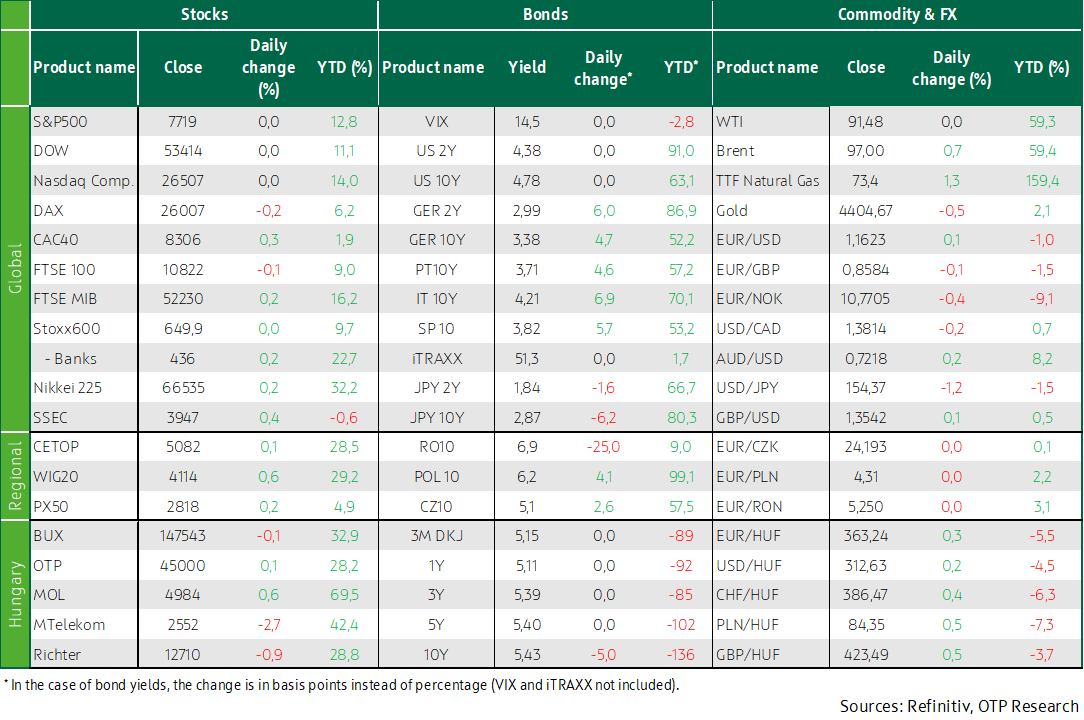
The escalating conflict in the Middle East provided further support to oil prices on Monday, intensifying inflation concerns. Iran has also threatened to establish another restricted zone. Brent crude rose to USD 97 per barrel, while the European TTF gas benchmark climbed to nearly EUR 74/MWh. US markets were closed on Monday due to a public holiday. European equity markets closed mixed on Monday, with the Stoxx 600 ending the session flat. Geopolitical risks were offset by a revised estimate showing stronger-than-expected Q2 eurozone GDP growth, as well as the Sentix investor confidence index rising to a four-year high, while investors continue to assess the outcome of the weekend's German elections and prepare for the ECB's policy meeting on Thursday. German long-term yields continued to rise, with the 10-year Bund yield closing near 3.38%. Markets expect another ECB rate hike by year-end following the anticipated September increase. EUR/USD remained above 1.16. Hungarian long-term yields showed movement only at the far end of the curve, with the 10-year yield falling to 5.43%, while EUR/HUF edged above 363. Today, attention will be focused on Hungary’s August CPI data.
European equities traded sideways, while oil prices continued to rise amid the escalating conflict in the Middle East. US markets were closed for a public holiday
European stock indices were little changed on Monday, as rising oil prices driven by renewed tensions between the US and Iran intensified CPI concerns, offsetting stronger-than-expected economic data released in the eurozone. The pan-European Stoxx 600 ended the session unchanged at 649.9 points, in line with Friday’s close. Germany’s DAX slipped 0.2%. On Sunday, the far-right AfD won the Saxony-Anhalt state election with 44% of the vote, amid a record-high turnout of 76.5%. France’s CAC 40 edged 0.3% higher after falling to a two-month low last week as fiscal concerns continued to mount ahead of next year’s elections. At the sector level, energy stocks led gains within the Stoxx 600 universe, closely followed by technology shares. Healthcare was the worst-performing sector, with Switzerland’s Novartis declining 3.2% after its cholesterol-lowering drug failed in a closely watched clinical trial. Insurers, financial services firms, real estate stocks and media companies also moved lower.
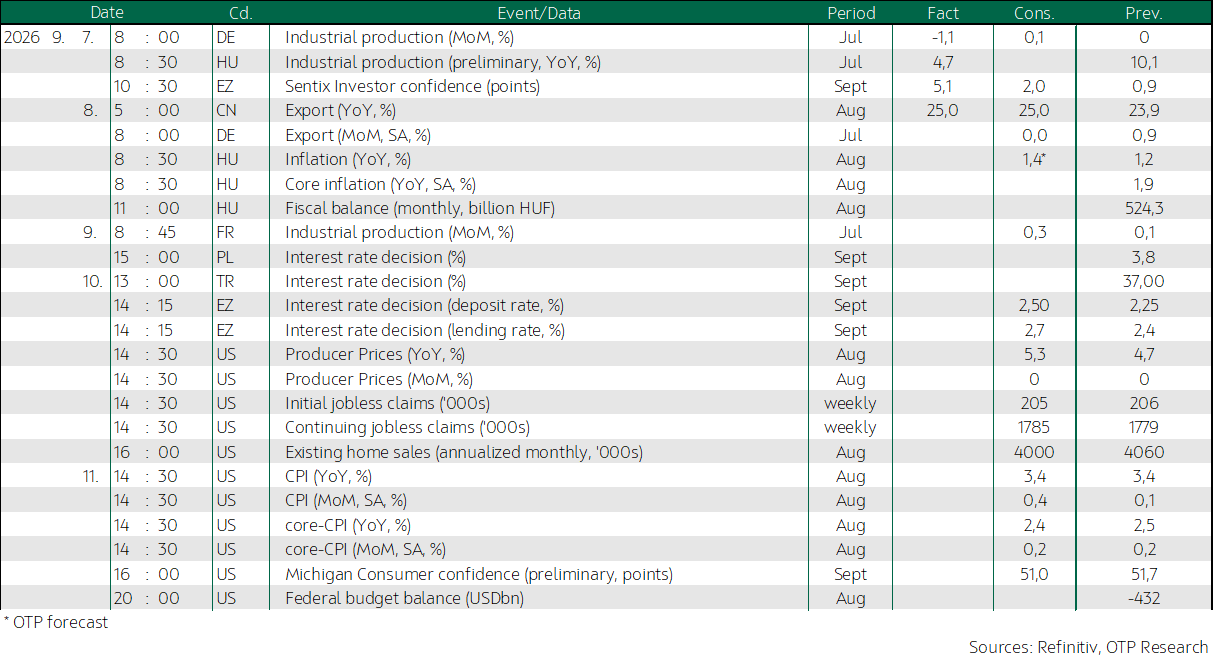
The Sentix investor confidence index improved more than expected in September, reaching its highest level in four years in the eurozone, while the third estimate of Q2 eurozone GDP pointed to stronger growth than previously reported, with the economy expanding by 0.6% quarter-on-quarter and 1.2% year-on-year. At the same time, German industry delivered a weaker-than-expected performance in July, with industrial output falling 1.1% month-on-month. In addition, the June reading was revised to show stagnation, overturning the previously reported modest growth.
Central European equities delivered a mixed performance on Monday, with Poland’s WIG20 and the Czech PX Index posting gains, while Hungary’s BUX closed lower. Hungary’s blue chips also turned in a mixed performance, with Magyar Telekom emerging as the day’s biggest loser, falling 2.7%. OTP and MOL edged higher, while Richter retreated.
Hungary’s preliminary industrial production data for July showed 4.7% year-on-year growth, exceeding the Reuters consensus forecast of 3.2%.
Brent crude surged to a six-week high on Monday after Iran threatened to launch attacks on energy infrastructure across the Middle East and establish another restricted zone beyond the Strait of Hormuz in response to renewed US strikes against Iranian facilities. The latest escalation of the conflict could significantly disrupt oil supplies from the region. Brent settled at USD 97 per barrel after reaching an intraday high of USD 98.06, its highest level since July 24. No WTI quotation was available due to the US Labor Day holiday.
The TTF benchmark on the Dutch gas exchange rose to nearly EUR 74/MWh, its highest level since late 2022 and early 2023. The rally was driven by the escalating conflict between the US and Iran.
Long-term eurozone yields rose, with markets now pricing in two additional 25bp ECB rate hikes. Meanwhile, the forint weakened beyond 363 against the euro
Long-term yields in the eurozone moved higher again after declining for two consecutive days from their highest levels in more than 15 years, as investors remained cautious following the AfD's victory in Saxony-Anhalt and ahead of the ECB's policy meeting on Thursday. Germany’s 10-year Bund yield rose by 5bp to 3.38%, moving back toward last week’s peak of 3.3951%, its highest level since April 2011.
Markets widely expect the ECB to raise interest rates on Thursday, while maintaining a cautious stance as the prolonged US-Iran conflict keeps oil prices elevated, adding to CPI pressures. Money markets are also pricing in roughly a 90% probability of a second rate hike by year-end. The euro was little changed, with EUR/USD remaining above 1.16.
Following last Friday’s sharp decline in yields across the Hungarian bond market’s longer-end segment, trading activity on Monday was limited to maturities beyond five years. Based on early afternoon quotations, the 10-year benchmark yield fell by 5bp to 5.43%, its lowest level since mid-August. The forint weakened on Monday, while regional currencies posted modest gains. EUR/HUF edged above 363.
Today's highlights
Asia-Pacific equity markets were mixed ahead of Tuesday’s close. In Japan, the final reading of Q2 GDP showed stronger growth than initially estimated, while July’s current account balance posted a larger-than-expected surplus. In China, exports rose 25% year-on-year in August, in line with market expectations. Meanwhile, crude oil prices continued to rise on Tuesday morning.
Futures markets point to a mixed opening in both Europe and overseas.
Today, Hungary’s August CPI data will be in the spotlight, while August budget figures are also scheduled for release.
Get more out of your investments!
Global Markets Services
OTP Global Markets offers a broad range of services in the field of local and international money and capital markets.
Read morePrivate Banking Services
Personal care and expertise with OTP Private Banking, along with the knowledge, security, and innovations of a multinational banking group.
Read more