
OTP Morning Brief: August data dispelled concerns about the stability of the US labor market
Related content
OTP Morning Brief: US producer price index came in above expectations, yet the US 10-year Treasury yield still declined
Western European equities continued to advance despite ongoing pressure on the technology sector. Wall Street indices also rebounded, recovering some ground after Wednesday’s sell-off. Healthcare was the standout performer on both sides of the Atlantic. Eurozone industrial production declined by 0.5% month-on-month in August. In the US, the producer price index accelerated to 6.3%, delivering another upside surprise in inflation developments. US retail sales increased by 0.8% compared to August. The US 10-year Treasury yield declined by more than 10 basis points. The long end of the Hungarian government bond yield curve also declined by 7-9 basis points. In Hungary, August wage data will be released today, while in the US, September industrial production figures are due.
OTP Morning Brief: US CPI data came in above expectations
European equity markets advanced, supported by strong results from ASML and the outstanding performance of the healthcare sector. US equity markets came under pressure following higher-than-expected September CPI data. The annual CPI rate accelerated to 3.7%, driven primarily by a surge in gasoline prices, while core CPI rose by 0.3% month-on-month, supported by higher housing costs and rising transportation service prices. Oil prices rose amid escalating tensions in the Middle East and the impact of the IEA's oil market report. US Treasury yields retreated after an initial increase, driven by Fed commentary, while European bond yields generally moved higher. The US macro calendar will be busy today, with investors focusing on September retail sales and producer price index data, as well as the New York Fed Manufacturing Index, weekly jobless claims, and business inventories. August industrial production data from the euro area will be released today.
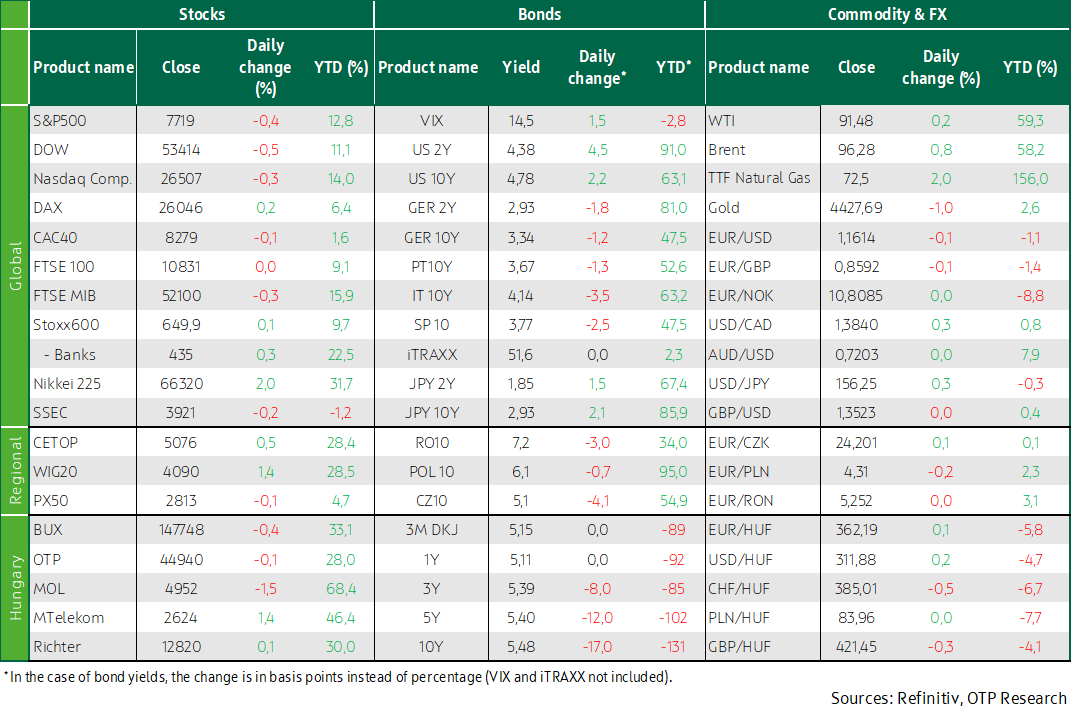
News and developments related to the Middle East conflict continued to fundamentally shape market sentiment over the past week. The major European indices declined on a weekly basis as concerns over CPI and expectations of further interest rate hikes intensified. The BUX was the region’s worst performer on a weekly basis, posting a decline of nearly 2%. Wall Street indices ended the week with modest moves. TTF gas prices rose by nearly 10% over the week, climbing above EUR 70/MWh. Oil prices also surged, with both Brent and WTI crude trading above USD 90 per barrel. Much stronger-than-expected August employment data reinforced expectations of further US interest rate hikes. Long-term yields in developed markets moved higher, while the dollar weakened against the euro. According to Bloomberg, the MNB is expected to pause its rate-cutting cycle in September and lower its inflation target to 2.5%. The forint strengthened by nearly 1.0% against the euro over the course of the week, with EUR/HUF once again trading around the 362 level. The Middle East saw another exchange of strikes over the weekend. The AfD won Sunday’s state election in Saxony-Anhalt. The most important data releases of the week will be the August Hungarian and US inflation figures, while the ECB will hold its monetary policy meeting. US markets are closed today in observance of Labor Day.
Most major European equity markets ended the week in negative territory; the BUX also closed lower; TTF gas prices climbed above EUR 70/MWh following a nearly 10% weekly rise
Major European stock indices ended Friday’s trading session mixed, with only modest moves. Market sentiment continued to be driven primarily by the escalating conflict in the Middle East, growing CPI concerns fueled by rising oil prices, and strengthening expectations of further interest rate hikes. Adding to these pressures, a stronger-than-expected US labor market report reinforced expectations that the Fed will raise rates again in September.
Among corporate developments, Volkswagen stood out on Friday with a 6.5% surge after the automaker’s supervisory board agreed on a comprehensive restructuring program, easing tensions with labor unions and the state of Lower Saxony, one of its key shareholders. The positive momentum also lifted other European carmakers, allowing the sector as a whole to close the session up 1.1%.
The pan-European Stoxx 600 edged 0.1% higher on the final trading day of the week, but still posted a 0.8% loss on a weekly basis. Most sectors in Europe ended the week in negative territory, although banks benefited from strengthening expectations of further interest rate hikes, while energy stocks advanced nearly 2% in line with rising oil prices. Meanwhile, investors increasingly turned their attention to this week’s US CPI data and the ECB’s upcoming monetary policy meeting.
Central and Eastern European markets delivered a mixed performance at Friday’s close. The BUX and PX50 ended lower, while the WIG20 climbed more than 1%. Hungary’s blue-chip stocks also turned in a mixed showing, with OTP and MOL finishing in negative territory, while Richter and Magyar Telekom closed in the green.
On a weekly basis, the Hungarian stock market underperformed its regional peers. The BUX closed lower on all but one trading day during the week, ultimately posting a 1.9% decline. Among Hungary’s blue-chip stocks, only Magyar Telekom managed to end the week in positive territory.
Over the past week, TTF gas prices on the Dutch exchange continued to rise, gaining nearly 10% and moving above EUR 70/MWh, a level not seen since early 2023. The rally has been driven by concerns that low inventory levels could leave the region vulnerable to sharp price spikes during the heating season.
In Sunday’s Saxony-Anhalt state election, held with higher-than-usual voter turnout, the far-right AfD secured a decisive victory, while support for Chancellor Merz’s conservative bloc remained below 20%. However, the AfD is unlikely to be able to form a state government on its own.
Major Wall Street indices moved lower; the August labor market report came in surprisingly strong
Major Wall Street indices ended Friday’s session with moderate losses after much stronger-than-expected August employment data reinforced expectations of further US interest rate hikes. Nonfarm payrolls increased by 162,000 in August, significantly exceeding forecasts, with broad-based job growth extending beyond healthcare into the wider private sector. In addition, employment figures for the previous two months were revised higher. The resilience of the labor market was further underscored by the unemployment rate holding steady at 4.1%, despite a notable increase in labor force participation. Wage growth also remained stable, with average hourly earnings rising 0.3% month-on-month in August. Taken together, these figures increased the likelihood of a September rate hike, although this week’s August CPI data will likely provide the decisive signal. Following the release of the report and the market’s reaction, Donald Trump suggested that the US could cease trade with countries running trade surpluses against it unless the Fed cuts interest rates.
At the sector level, semiconductor stocks were the day’s top performers, rising 3.4%. In contrast, software and IT services companies fell 2.1%, dragged lower by major names such as Google, Netflix, Microsoft, and Apple. Lululemon shares plunged 17.4% after the company lowered its full-year revenue and earnings guidance. Adobe stock declined 6.7% following the announcement of its CEO succession plan.
For the week as a whole, the major US indices posted only marginal changes. At the sector level, technology was the strongest performer, driven largely by Nvidia’s nearly 6% rise, while industrials and consumer discretionary stocks lagged behind.
WTI crude prices surged nearly 10% over the past week, while Brent gained close to 8%, driven by the continued escalation of the conflict in the Middle East. Both benchmarks are now trading above USD 90 per barrel.
Tensions in the Middle East flared up again over the weekend. According to the US military, three Iranian crude oil tankers were struck on Saturday after the Islamic Revolutionary Guard Corps launched ballistic missiles toward two US naval vessels. On Sunday, US Energy Secretary Chris Wright said there is no guarantee that an agreement can be reached with Iran to curb its nuclear weapons program. He added that Tehran’s nuclear capabilities could potentially be eliminated through military action, while any lasting agreement may ultimately have to be negotiated with a future Iranian leadership.
Long-term yields in developed markets continued to rise; the dollar weakened against the euro; the forint strengthened versus the euro
US Treasury yields moved higher over the past week as inflation risks intensified. The 10-year yield surged to nearly 4.8% in the middle of the week before easing somewhat as concerns over further escalation of the conflict in the Middle East subsided. However, Friday’s labor market report triggered another rise in yields, leaving the US 10-year Treasury yield at 4.78% at the end of the week, still near the upper end of its post-Covid trading range. While the August employment report did not definitively determine the outcome of the Fed’s September policy meeting, it clearly strengthened expectations of a rate hike. Markets are currently pricing in roughly a 60% probability of a 25-basis-point rate increase in September.
Rising energy prices and signs of accelerating CPI in the August data release pushed eurozone bond yields higher. Germany’s 10-year government bond yield climbed to 3.38% in the middle of the week before ending the week at 3.34%. Markets are unanimously expecting the ECB to raise its key deposit rate by 25 basis points to 2.5% at next week’s meeting, with another 25-basis-point increase anticipated by year-end.
The greenback weakened somewhat against the euro over the past week following its strength in the previous week, with the EUR/USD exchange rate ending the week at 1.161. Meanwhile, the Japanese yen appreciated by more than 2% against the dollar as market expectations for further rate hikes in Japan strengthened following the central bank’s more hawkish communication.
The forint strengthened by nearly 1.0% against the euro over the course of the week, with EUR/HUF once again trading around the 362 level. The currency gained momentum on Thursday after Bloomberg reported that, according to its sources, the MNB is expected to pause its rate-hike cycle in September while simultaneously lowering its CPI target to 2.5% in an effort to move closer to the ECB’s 2% target.
The Hungarian yield curve was broadly unchanged over the past week at maturities shorter than 10 years, while yields at the three longest tenors declined by 5 to 12 basis points. The drop in yields followed reports related to the MNB. As a result, Hungary’s 10-year government bond yield ended the week at 5.48%. The FRA curve currently implies a 25-basis-point rate cut by the MNB by year-end.
Today's highlights
After opening in positive territory, most Asia-Pacific equity markets moved lower this morning in response to developments in the Middle East over the weekend. Japan’s Nikkei 225, however, remained resilient and was still up around 2% in the hour before the close. Shares of LG Electronics rose more than 8% following media reports that the company is preparing a capital raise ahead of the planned IPO of its robotics subsidiary, Bear Robotics. Crude oil prices also started the week higher.
Futures markets point to a negative open in both Europe and the US.
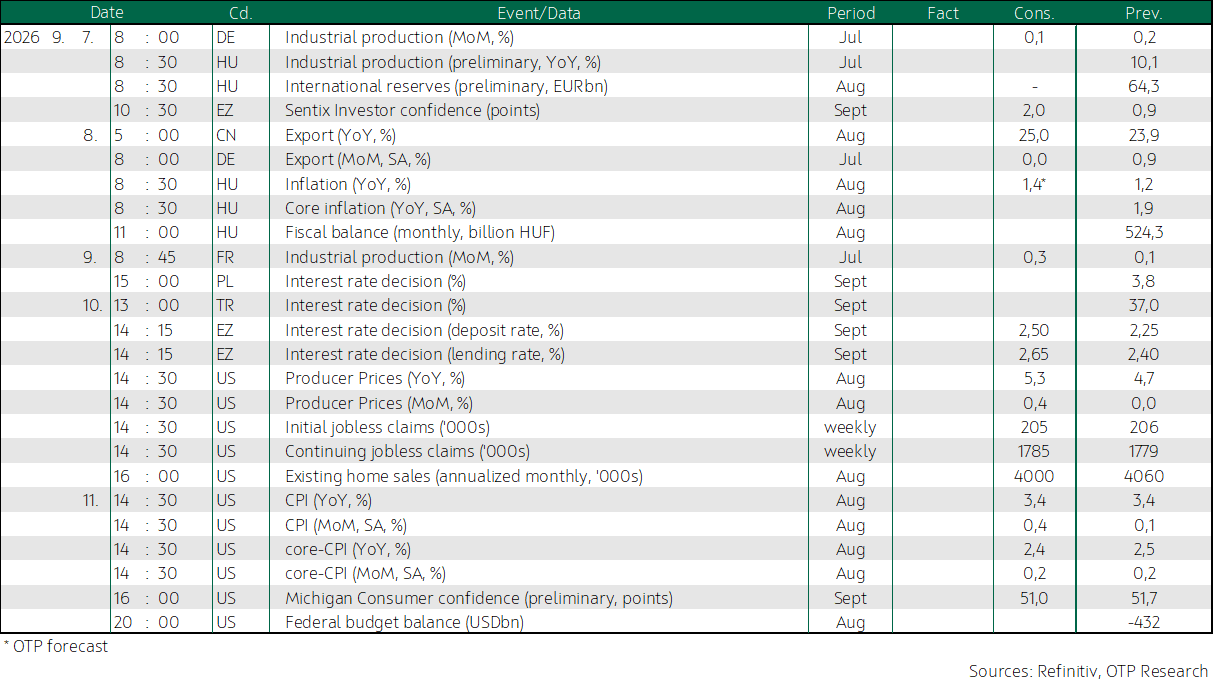
Today will bring the release of July industrial production data from Hungary and Germany, while the publication of September eurozone sentiment indicators will begin with the Sentix index.
Later this week, our focus will turn to the August Hungarian and US inflation releases, as well as the ECB’s monetary policy meeting.
US markets are closed today in observance of Labor Day.
Get more out of your investments!
Global Markets Services
OTP Global Markets offers a broad range of services in the field of local and international money and capital markets.
Read morePrivate Banking Services
Personal care and expertise with OTP Private Banking, along with the knowledge, security, and innovations of a multinational banking group.
Read more