
OTP Morning Brief: Declining expectations for US interest rate hikes improved market sentiment
Related content
OTP Morning Brief: Chipmakers' weakness kept equity markets under pressure
Global markets were characterized by a subdued, risk-off sentiment on Tuesday. In Europe, concerns over the technological advances of Chinese chipmaker CXMT weighed on technology stocks, with the STOXX 600 falling 0.1%, while the DAX, CAC 40 and FTSE 100 also closed 0.1% lower. In the US, trading was driven by weakness in the semiconductor sector and mixed corporate reactions during the early stages of the earnings season: the Dow fell 0.3%, the Nasdaq declined 0.2%, while the S&P 500 was unchanged. Ahead of Wednesday’s US inflation data, a wait-and-see approach and demand for safe-haven assets led to a decline in long-term bond yields, with the US 10-year yield easing to 5.22% and the German Bund yield falling to 3.46%. The dollar weakened against major currencies, with EUR/USD rising to 1.1199, while the Hungarian forint remained stable. Today's macro calendar will be highlighted by the September US inflation data, Chinese export figures, and the Fed's Beige Book due later in the evening.
OTP Morning Brief: Oil prices rise, the technology sector struggles, and the earnings season gains momentum
The major European stock indices closed Monday's session in positive territory, with banks and utilities leading the advance. The BUX gained 0.9%, while Hungary’s blue-chip stocks delivered a mixed performance. TTF gas prices remain above EUR 84/MWh. Wall Street indices delivered a mixed performance yesterday, with the technology sector under pressure and semiconductor manufacturers posting declines. We saw an approximately 2% rise in crude oil prices. The euro weakened against the dollar as investors grew concerned about France’s fiscal position and the outlook for next year’s presidential election. The EUR/HUF exchange rate fell below 365. The earnings season continues today with reports from major companies.
European stock indices advanced, while Trump's remarks and easing expectations for US interest rate hikes improved sentiment; the rise in European producer prices accelerated. Major US stock indices rose on the back of declining expectations for interest rate hikes; initial jobless claims came in line with expectations, while the ISM Services PMI exceeded forecasts. Developed market yields declined following gains in previous days, after dovish remarks from a Federal Reserve governor and a conciliatory statement by President Trump; the forint strengthened on reports that the MNB may pause its rate-cutting cycle and lower its CPI target. Several labor market reports are due from the US today, with the change in nonfarm payrolls standing out among them. Germany will release industrial orders data, while retail sales figures are scheduled from both the euro area and Hungary.
European stock indices advanced, while Trump's remarks and easing expectations for US interest rate hikes improved sentiment; the rise in European producer prices accelerated
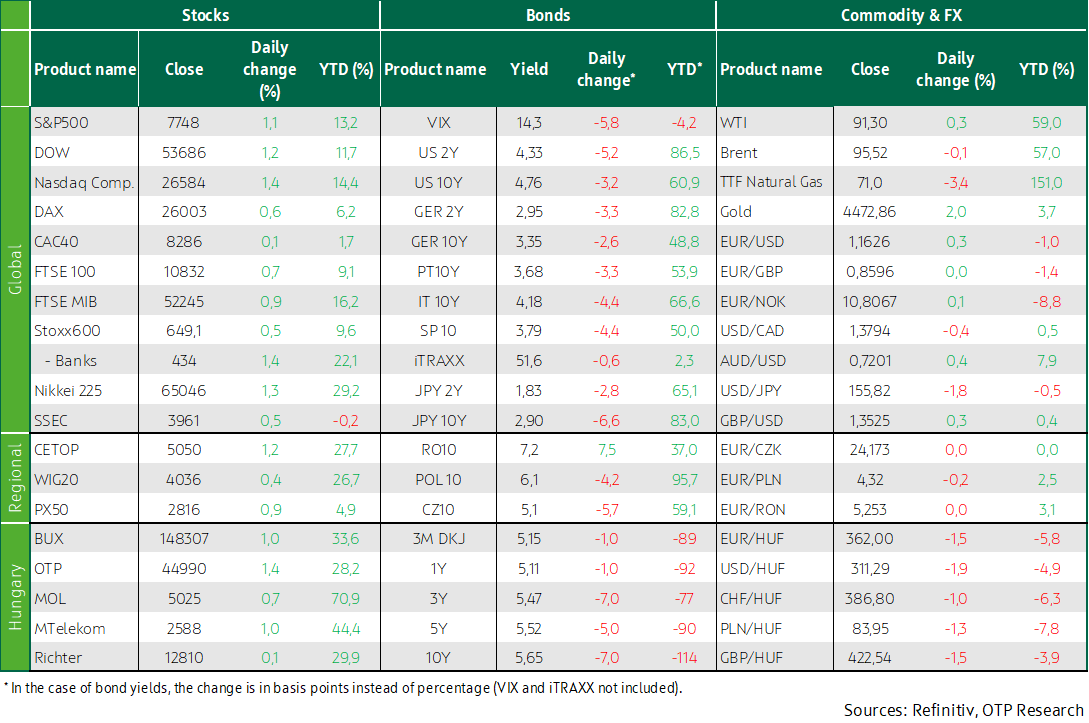
European equity markets moved higher yesterday, with the STOXX 600 index gaining 0.5%. Investor sentiment continued to be driven by developments in the Middle East conflict, although uncertainty eased somewhat after Donald Trump stated that the conflict is not expected to persist for an extended period. Following the earlier surge at the beginning of the week, oil prices and government bond yields stabilized, providing moderate support for risk appetite. Sentiment was further boosted by comments from Federal Reserve Governor Christopher Waller, who said that if incoming data over the coming weeks confirm that CPI pressures are easing, he would support keeping interest rates unchanged at the Fed’s next meeting. At the sector level, luxury goods companies underperformed, with shares of LVMH, L'Oréal, and Hermes posting notable declines. By contrast, several technology and industrial stocks advanced, including SAP, Siemens Energy, and STMicroelectronics. Deutsche Telekom also moved higher after media reports indicated that activist investor Elliott had built a stake in the company.
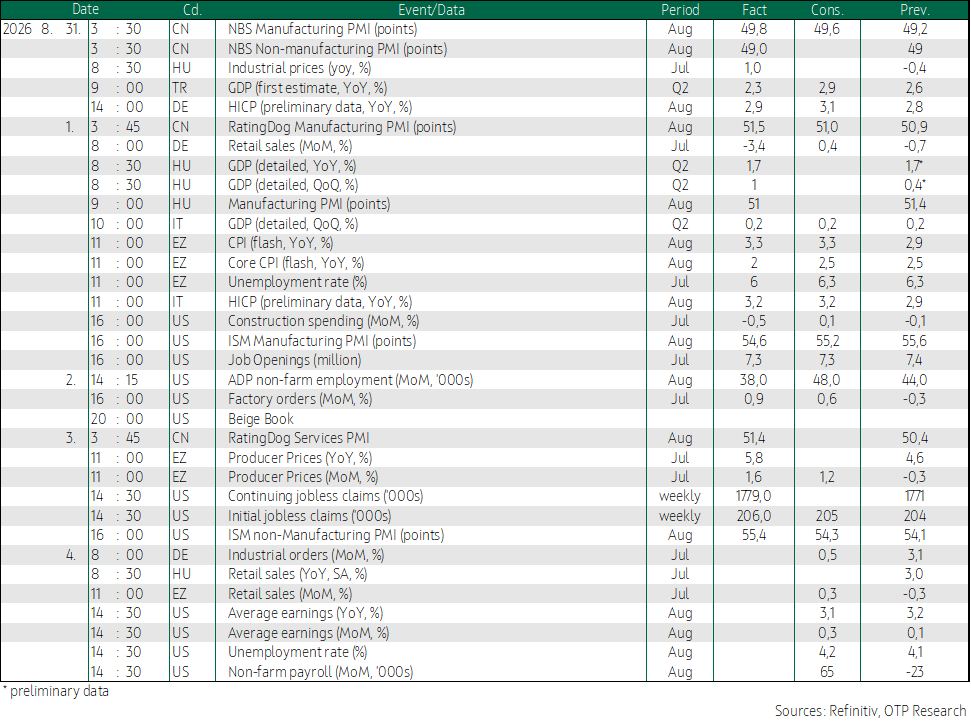
Euro area producer prices rose by 1.6% month-on-month in July, marking a sharp acceleration from the 0.3% decline recorded in June. The increase also exceeded market expectations, as analysts had forecast a monthly gain of 1.2%. The rise in producer prices was driven primarily by energy costs, with prices in the energy sector climbing 5.6%, largely due to the nearly 70% surge in European natural gas prices. Higher energy costs also lifted manufacturing production expenses more broadly through increased electricity prices. Among the main product categories, capital goods prices edged up by 0.3%, while prices for durable consumer goods and intermediate goods remained unchanged. In contrast, non-durable consumer goods recorded a decline in prices. On an annual basis, producer price inflation accelerated to 5.8% from 4.6% in June, pointing to renewed strengthening of price pressures in the euro area's producer sector.
Major indices across the CEE region advanced yesterday, with the BUX outperforming its regional peers. All Hungarian blue chips closed higher, led by gains in OTP and Magyar Telekom, which posted the strongest increases among the index's heavyweight constituents.
Major US stock indices moved higher as expectations for additional interest rate hikes continued to ease; initial jobless claims matched forecasts, while the ISM Services PMI came in above expectations
US equity markets closed sharply higher after Federal Reserve Governor Christopher Waller indicated that he would support keeping interest rates unchanged at the upcoming policy meeting in two weeks. While he emphasized that CPI remains meaningfully above the Fed’s 2% target, he noted that recent data are showing signs of disinflation. As a result, if incoming data over the next few weeks continue to confirm this trend, maintaining current interest rates could be justified. Following his remarks, expectations for further rate hikes eased, with market pricing suggesting that the probability of a September rate increase fell from above 60% to around 50% in a single day. On the corporate front, Snowflake shares soared 16.5% after the company reported better-than-expected quarterly results and issued a favorable outlook. In contrast, Broadcom's stock declined 2.7% after the company released revenue guidance for its fourth fiscal quarter that came in below market expectations.
In the US, initial jobless claims rose to 206,000 in the week ending August 29, up from 204,000 in the previous week. The figure was broadly in line with market expectations of 205,000. Continuing claims increased by 8,000 to 1.779 million. Despite the uptick, the number of benefit applications remains at historically low levels after falling to a nearly 60-year low of 189,000 in mid-July. The data suggest that the US labor market has remained resilient despite the latest BLS report showing an unexpected decline in employment. The latest reading is also consistent with the assessment of FOMC members who believe that the US economy continues to operate close to full employment.
US services sector activity improved more than expected in August, with the ISM Services PMI rising to 55.4 from 54.1 in July, exceeding the market consensus of 54.3. The reading pointed to the strongest expansion in the services sector in the past six months. Growth was primarily supported by stronger business activity, which increased to 61.7 from 59.1, as well as accelerating growth in new orders, which rose to 60.9 from 57.2, and inventories, which climbed to 56.7 from 51.4. Order backlogs also increased significantly, with the corresponding index rising from 50.9 to 55.6. Price pressures intensified further, as the prices index advanced to 72.6 from 70.3, marking a four-year high. Survey respondents mainly highlighted higher prices for petroleum products, diesel fuel, and gasoline.
Developed market yields declined after rising in previous days, following dovish remarks from a Federal Reserve governor and a conciliatory statement from President Trump; the forint strengthened on reports that the MNB may pause its rate-cutting cycle and lower its CPI target
Following the rise in previous days, US Treasury yields moved lower across the curve in response to comments from Federal Reserve Governor Christopher Waller. The yield on the 10-year US Treasury note fell by more than 3 basis points to 4.76%, while the policy-sensitive 2-year yield declined by more than 5 basis points to 4.33%. The pullback came after yields had climbed to multi-year highs in recent sessions amid concerns over the US fiscal trajectory, persistent CPI pressures, and elevated energy prices. Oil prices remained at high levels, with Brent crude trading above USD 95 per barrel, although it showed little movement yesterday following the sharp gains recorded over recent days.
In line with overseas trends, the German 10-year government bond yield also fell by nearly 3 basis points, while Hungarian yields beyond one year declined by 5-8 basis points yesterday, with the 10-year benchmark closing at 5.65%. The forint strengthened significantly against the euro, ending the session at HUF 362, following a Bloomberg report suggesting that the MNB is likely to pause its rate-cutting cycle in September and could simultaneously lower its CPI target to 2.5% in an effort to move closer to the ECB’s 2% objective. The expected pause is attributed to persistently high energy prices, uncertainty surrounding the Fed’s September policy decision, and questions related to the budget plan scheduled for release in October. The euro strengthened against the dollar, pushing the exchange rate back above the 1.16 level. Meanwhile, the Japanese yen advanced sharply after speculation about another foreign exchange market intervention intensified around the 160 level, while comments from some central bank officials increased expectations of a rate hike at the next policy meeting.
Today's highlights
Most major Asian indices were trading higher this morning, while the yen weakened slightly following its sharp appreciation over the previous two trading sessions.
Several labor market reports are due from the US today, with the change in nonfarm payrolls standing out as the key release. Germany is scheduled to publish industrial orders data, while retail sales figures will be released in both the euro area and Hungary.
Get more out of your investments!
Global Markets Services
OTP Global Markets offers a broad range of services in the field of local and international money and capital markets.
Read morePrivate Banking Services
Personal care and expertise with OTP Private Banking, along with the knowledge, security, and innovations of a multinational banking group.
Read more