
OTP Morning Brief: US treasury yields snap multi-day rise
Related content
OTP Morning Brief: Oil prices rise, the technology sector struggles, and the earnings season gains momentum
The major European stock indices closed Monday's session in positive territory, with banks and utilities leading the advance. The BUX gained 0.9%, while Hungary’s blue-chip stocks delivered a mixed performance. TTF gas prices remain above EUR 84/MWh. Wall Street indices delivered a mixed performance yesterday, with the technology sector under pressure and semiconductor manufacturers posting declines. We saw an approximately 2% rise in crude oil prices. The euro weakened against the dollar as investors grew concerned about France’s fiscal position and the outlook for next year’s presidential election. The EUR/HUF exchange rate fell below 365. The earnings season continues today with reports from major companies.
OTP Morning Brief: Modest gains in equities, stronger rise in energy prices
Both US and European equity markets posted modest gains last Friday. The BUX largely recouped the losses accumulated over the previous week. There was no positive turnaround in energy prices, however: oil prices rose both on the last trading day of the week and over the week as a whole, while European natural gas prices surged above EUR 82/MWh, reaching levels rarely seen since 2022. The US-Russia diesel agreement announced over the weekend is also unlikely to bring meaningful relief to the market, as the volumes involved are negligible relative to global demand. Following the sharp rise in yields seen in September, October has so far been characterized by ongoing uncertainty on bond markets as investors continue to search for direction.
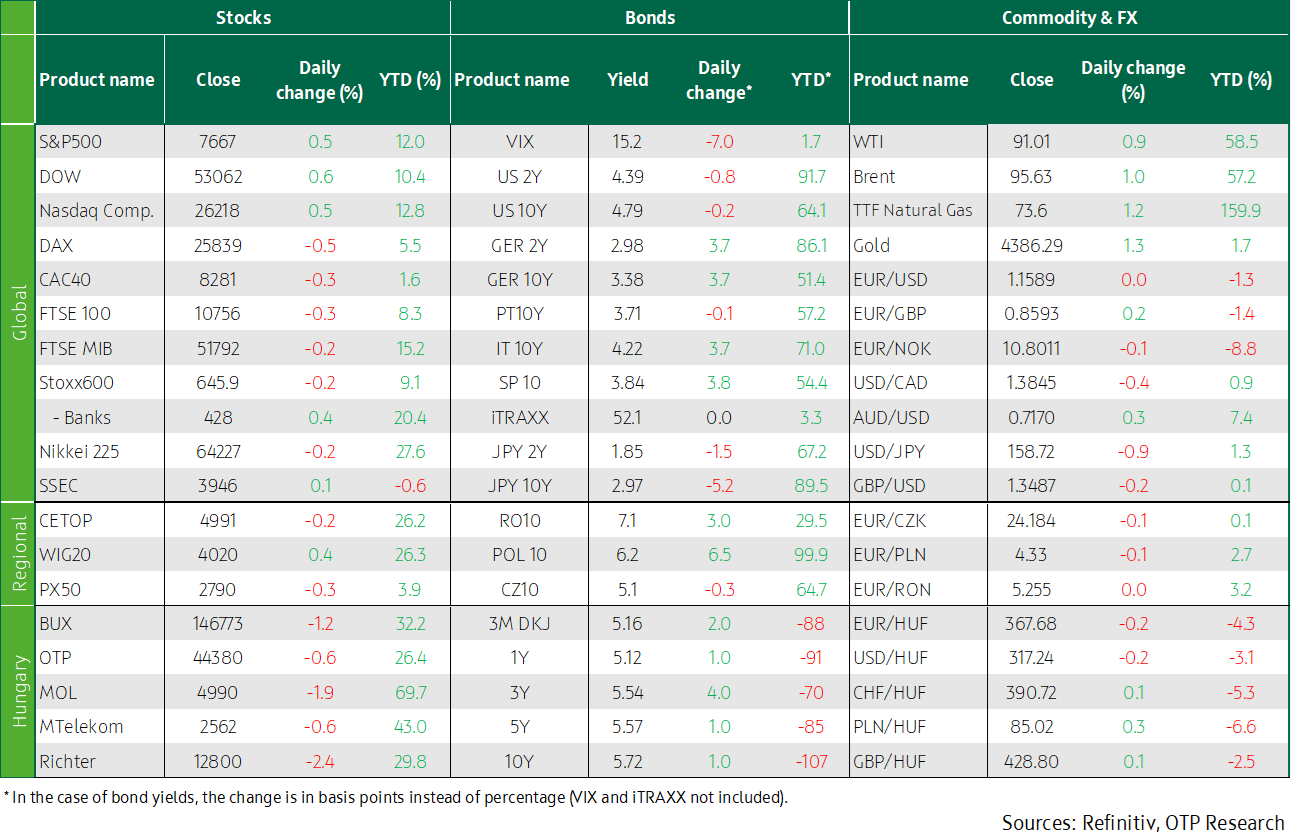
Geopolitical tensions continued to influence major market moves on Wednesday, particularly in Europe, where equities posted modest declines. In contrast, the main U.S. stock indices advanced by around half a percent, breaking the negative streak seen over recent days. Investors also welcomed the end of the recent rise in U.S. Treasury yields, which had weighed on market sentiment in recent sessions. The move was supported by a weaker-than-expected ADP employment report, although some of the positive impact was offset by higher Brent crude prices, adding to uncertainty. Domestically, bond yields continued to increase, while the forint managed to strengthen slightly against the euro. Asian markets showed a mixed performance this morning, although China's services PMI improved in August.
European markets decline amid rising geopolitical tensions
Major market moves on Wednesday were once again driven by developments in the Middle East, as the escalation seen in recent days continued. Tehran and Washington carried out their largest wave of attacks in the past month, with Iran targeting U.S. allies in the region while the United States struck Iran's southern coastline. President Trump stated that the U.S. position is in a better position than ever and that Iran's economic collapse is only a matter of time, while Tehran continues to maintain its longstanding objectives, including the lifting of sanctions and full control over the strait.
Beyond global challenges, geopolitical tensions have also intensified in Europe after Ursula von der Leyen signaled the possibility of additional sanctions and increased pressure on Russia. Her comments followed accusations that Moscow had been involved in planning a drone attack against a German airport, while she reiterated that both the EU and NATO remain committed to supporting Ukraine and will not back down.
Geopolitical tensions and high bond yields kept pressure on European equities, with the Stoxx 600 declining by 0.2%. Germany's DAX recorded the largest loss, falling 0.5%, while France's CAC 40 and the UK's FTSE 100 both slipped 0.3%. Among sectors, retail stocks performed worst, dropping 2.3%. By contrast, the banking sector helped limit losses in the broader index, gaining 0.6% as higher interest rates remained supportive for lenders. ING shares rose 2.4% after Morgan Stanley upgraded the stock from "equal-weight" to "overweight." Volkswagen shares fell 3.2% after index provider STOXX announced that Finnish telecommunications equipment manufacturer Nokia would rejoin the Euro STOXX 50 index, replacing the German automaker. Volkswagen's supervisory board is scheduled to meet on Friday to discuss a radical cost-cutting program that could include the closure of up to four factories.
Markets in the CEE region also traded mostly lower. Hungary's BUX declined 0.4%, while Poland's WIG20 fell 0.5%. The Czech PX 50, however, posted a modest gain. All Hungarian blue-chip stocks ended the session in negative territory, with Richter recording the largest decline, down 2.4%, while OTP fell 1.9%.
Overseas markets closed higher, weaker-than-expected labor market data arrived
Wall Street ended Wednesday's session in positive territory, partially recovering losses accumulated over the previous three trading days, as investors sought opportunities in stocks and sectors that may have become oversold following recent risk-off market sentiment. All three major U.S. equity indices gained around 0.5%. Among the eleven primary sectors of the S&P 500, materials posted the strongest performance, while real estate was the only sector to finish the day lower. Nvidia advanced 3.2%, while Micron and Qualcomm gained 2.4% and 2.0%, respectively. Hardware manufacturer Dell surged 15.8% after raising its full-year profit and revenue guidance. Shares of Uber Technologies rose 1.6% after the ride-hailing company announced plans to reduce its workforce by approximately 10%.
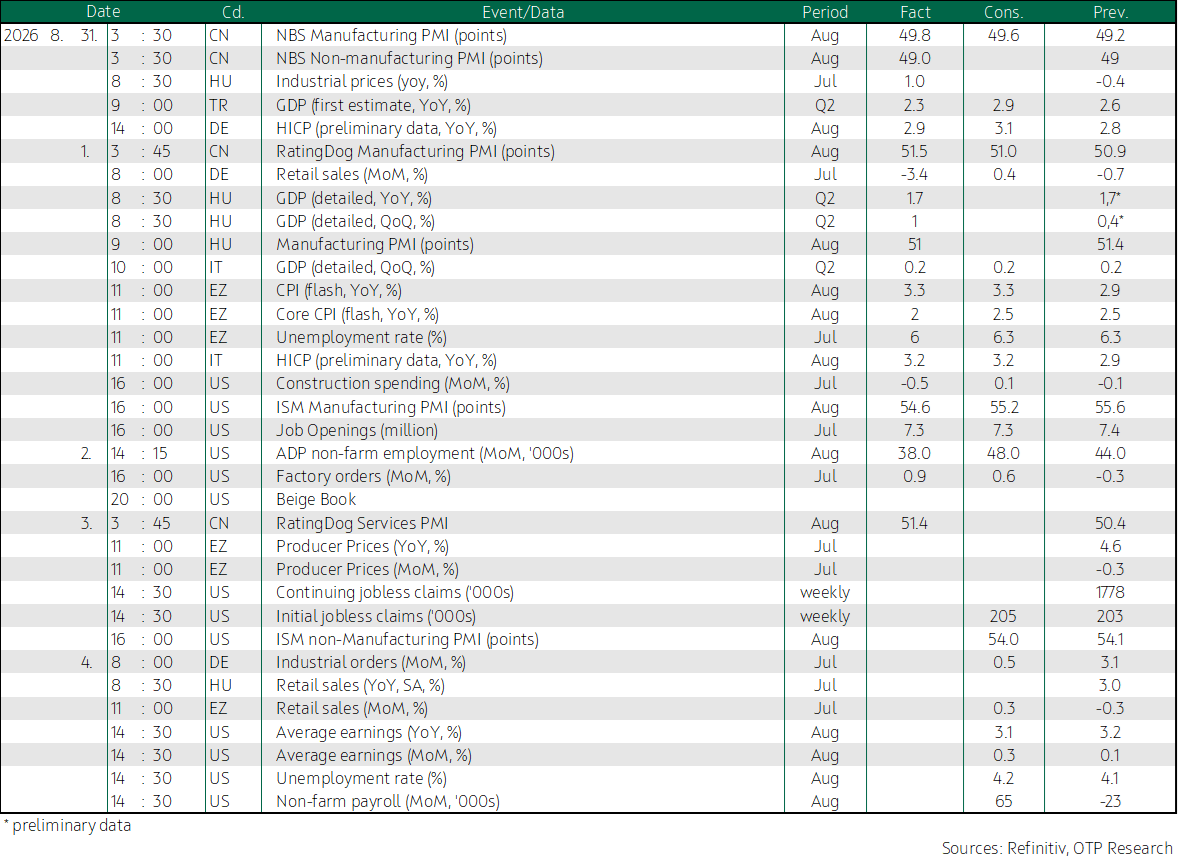
According to ADP data, U.S. private nonfarm employment increased by 38,000 jobs in August 2026, marking the weakest reading since January. The result fell short of market expectations for a gain of 47,000 and followed an upwardly revised increase of 46,000 in July, pointing to a broader slowdown in labor market momentum. Employment growth remained relatively strong in education and healthcare, construction, leisure and hospitality, and financial services, while payrolls declined in sectors including manufacturing and professional and business services.
Meanwhile, the Federal Reserve's Beige Book reported that U.S. economic activity expanded at a modest pace in recent weeks, employment continued to grow slightly, and prices increased moderately. The report is not expected to have a significant impact on policymakers' interest rate decision at the September meeting. Separately, factory orders rose by 0.9% month-on-month in July, exceeding market expectations.
U.S. Treasury yields snap their recent rise
U.S. Treasury yields ended a five-day streak of increases on Wednesday, declining by a few basis points as investors weighed slightly weaker-than-expected labor market data against steadily rising oil prices. The combination of a softening labor market and inflation remaining above target has complicated the Federal Reserve's policy outlook. Markets are currently pricing in a 62.3% probability of a rate hike at the Fed's September meeting.
In contrast, eurozone bond yields continued to move higher. The yield on Germany's 10-year government bond rose for a sixth consecutive day to 3.376%, while the two-year yield climbed above 3% for the first time since 2024. Meanwhile, the euro-dollar exchange rate was virtually unchanged by the end of the trading session.
Domestic bond yields continued to rise in line with broader European fixed-income markets. Longer-term Hungarian yields increased by one basis point, while the three-year yield closed four basis points higher. The forint, however, broke its recent weakening trend against the euro and strengthened below the 368 EUR/HUF level.
Today's highlights
Asian equity markets showed mixed performance this morning, with China's Shanghai Composite (SSEC) rising 0.1%, while South Korea's Kospi fell 1.2%, Hong Kong's Hang Seng declined 0.6%, and Japan's Nikkei slipped 0.2%. Japanese government bond yields retreated from record highs, following the recovery in U.S. Treasuries, where declining yields supported bond prices.In China, the RatingDog Services Purchasing Managers' Index (PMI) rose to 51.5 in August from 50.4 in the previous month, signaling an acceleration in activity across the services sector.
Looking ahead, the euro area's July Producer Price Index (PPI) will be released today. In the United States, investors will focus on the weekly labor market data, alongside the ISM Services PMI, which is expected to provide further insight into the strength of economic activity in the non-manufacturing sector.
Get more out of your investments!
Global Markets Services
OTP Global Markets offers a broad range of services in the field of local and international money and capital markets.
Read morePrivate Banking Services
Personal care and expertise with OTP Private Banking, along with the knowledge, security, and innovations of a multinational banking group.
Read more