
OTP Morning Brief: Bond yields rose as inflation fears intensified
Related content
OTP Morning Brief: Modest gains in equities, stronger rise in energy prices
Both US and European equity markets posted modest gains last Friday. The BUX largely recouped the losses accumulated over the previous week. There was no positive turnaround in energy prices, however: oil prices rose both on the last trading day of the week and over the week as a whole, while European natural gas prices surged above EUR 82/MWh, reaching levels rarely seen since 2022. The US-Russia diesel agreement announced over the weekend is also unlikely to bring meaningful relief to the market, as the volumes involved are negligible relative to global demand. Following the sharp rise in yields seen in September, October has so far been characterized by ongoing uncertainty on bond markets as investors continue to search for direction.
OTP Morning Brief: Developed market bond yields edged lower yesterday
European indices declined yesterday amid rising oil prices, while the German government revised its GDP growth forecast upward; German exports lost momentum toward the end of the summer; meanwhile, ECB policymakers see upside risks to European inflation. Major US indices moved mostly lower; OpenAI's revenue fell significantly short of previously projected levels; meanwhile, the number of initial jobless claims declined in the US. Long-term yields in both the US and Europe declined following the sharp increase seen in the previous period, while Christopher Waller noted that further Fed rate hikes do not necessarily need to occur at consecutive meetings. The focus today will be on the latest reading of the University of Michigan Consumer Sentiment Index.
The escalation of the Middle East conflict and rising energy prices shaped Tuesday's trading. Eurozone CPI accelerated to 3.3% in August, further reinforcing expectations of an ECB rate hike, while long-term bond yields rose on both sides of the Atlantic. Leading stock indices declined in both Europe and the US, while the dollar strengthened against the euro. On the domestic front, detailed GDP data confirmed that the Hungarian economy expanded by 0.5% quarter-on-quarter and 1.7% year-on-year in the second quarter. Today, the US ADP employment report, factory orders, and the Fed's Beige Book could be in the spotlight for investors.
European stocks declined as accelerating CPI and energy prices took center stage
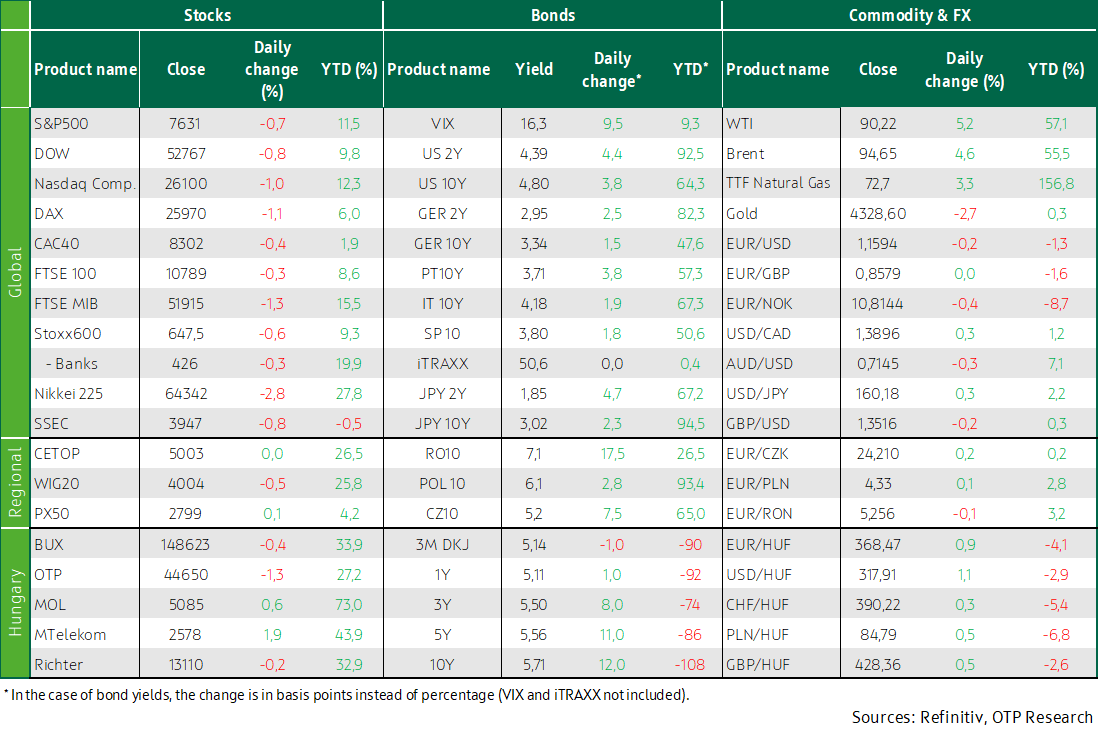
Negative sentiment prevailed across European equity markets after Eurozone CPI climbed above 3%, government bond yields advanced to multi-year highs, and expectations for an ECB rate hike next week strengthened. The STOXX 600 index fell 0.6%, slipping to its lowest level in more than a month. Among sectors, energy stocks rose 1.8%, supported by higher oil prices, while Swiss pharmaceutical company Novartis was among the day's top performers, soaring 6.3% on the back of positive clinical trial results. Meanwhile, Partners Group dropped 7.3% following weaker-than-expected performance fee revenue guidance and the announcement of its CEO's departure.
The major Western European indices all closed lower: the FTSE 100 fell 0.3%, the CAC 40 declined 0.4%, while the DAX dropped 1.1%. The German market recorded the steepest losses, as higher bond yields and the prospect of tighter monetary policy weighed on investor sentiment across the region.
The Central and Eastern European region also delivered mostly weak performance, with the BUX falling 0.4% and the WIG20 declining 0.5%, while Prague's PX index was little changed. Hungary's blue chips turned in mixed results: OTP dropped 1.3% and Richter slipped 0.2%, whereas MOL gained 0.6% and Magyar Telekom advanced 1.9%.
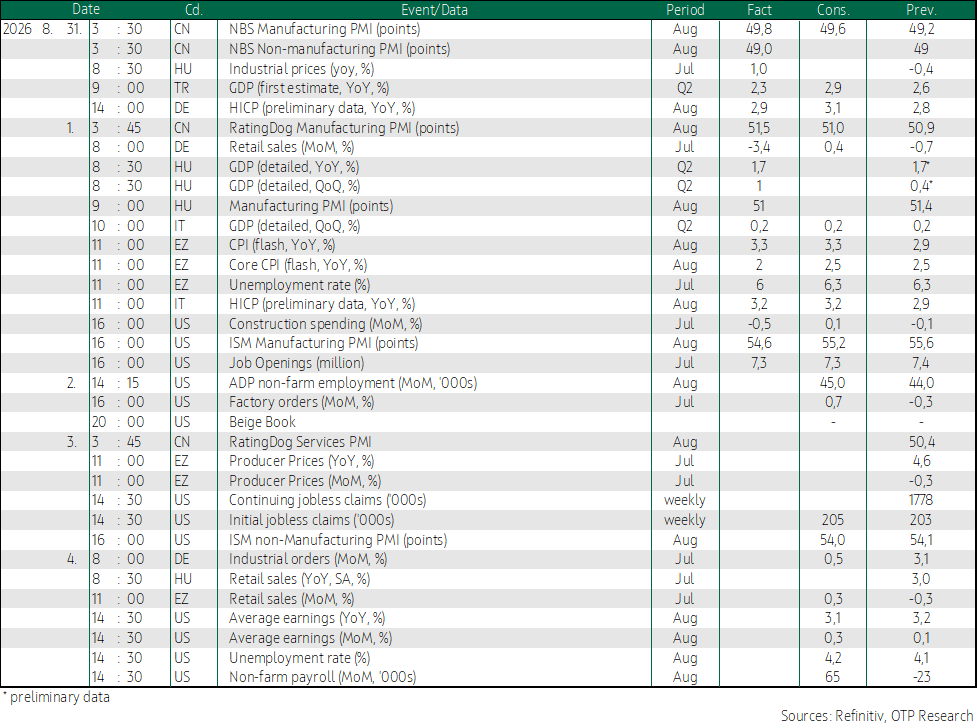
Among macroeconomic releases, Eurozone CPI remained in focus, with the headline rate accelerating to 3.3% in August from 2.9% in July, driven primarily by higher energy prices. Core CPI, however, eased to 2.4% from both the expected level and the previous month's 2.5%, while the unemployment rate held steady at 6.4% in July, pointing to a relatively resilient labor market. Following the data release, expectations of an ECB rate hike strengthened, with market pricing currently reflecting a 25-basis-point increase in September.
In Germany, retail sales fell 3.4% month-on-month in July, marking the steepest decline since the summer of 2021, mainly due to weakness in non-food products and online sales. By contrast, the Eurozone manufacturing sector continued to expand, although the higher interest-rate environment is increasingly weighing on consumer spending.
Hungary's economy expanded by 1.7% year-on-year and 0.5% quarter-on-quarter in the second quarter, with the latter exceeding the preliminary estimate of 0.4%. Growth was primarily supported by the industrial and services sectors, while agricultural output continued to be weighed down by drought conditions. Household consumption increased, although the decline in investment activity persisted. Hungary's manufacturing PMI eased to 51.3 in August from 51.4 in the previous month, but remained in expansion territory, pointing to a gradual increase in economic activity.
Italy's economy grew by 0.2% quarter-on-quarter in the second quarter, in line with expectations, marking its fourth consecutive quarter of expansion. Growth was primarily driven by household consumption and corporate investment, while net exports made a negative contribution to GDP due to higher energy imports.
US indices declined as surging oil prices and rising bond yields weighed on investor sentiment
US investor sentiment continued to be driven by developments in the Middle East. Renewed military clashes between the US and Iran intensified concerns over supply risks, triggering a sharp rise in oil prices. Brent surged more than 5% to USD 95 per barrel, while WTI climbed to nearly USD 91, as markets priced in potential disruptions to energy shipments through the Strait of Hormuz. Higher energy prices also pushed bond yields upward, which overall dampened risk appetite.
The major US equity indices started September in negative territory, with the Dow falling 0.8%, the S&P 500 declining 0.7%, and the Nasdaq dropping 1.0%. Trading was primarily influenced by higher bond yields and concerns over CPI-related risks. Cyclical consumer and technology stocks were among the weakest performers, while energy shares outperformed, supported by the surge in oil prices.
Among corporate developments, the AI sector remained in focus after Anthropic signed a USD 35 billion cloud services agreement with Nvidia-backed Lambda, further highlighting robust demand for artificial intelligence infrastructure. In addition, a new chapter began in Apple's history as Tim Cook stepped down as CEO after 15 years, handing the role over to John Ternus while continuing as Executive Chairman.
Macroeconomic data painted a mixed picture. According to the JOLTS survey, job openings rose to 7.27 million in July from 7.18 million in the previous month, although the figure came in slightly below market expectations. This suggests that the labor market remains tight, while also showing signs of gradual easing compared to earlier periods. The ISM manufacturing index fell to 54.6 in August from its nearly four-year high reached in July, mainly due to slower growth in new orders. Nevertheless, it remained above the 50-point threshold that signals expansion for the eighth consecutive month. Companies continued to report elevated cost pressures and ongoing supply chain disruptions. Meanwhile, construction spending declined 0.5% month-on-month in July, primarily as a result of weaker residential development activity.
US and European yields rose, while the dollar strengthened
In the US Treasury market, yields continued to rise. The 2-year Treasury yield increased by 5 bps to 4.40%, while the benchmark 10-year yield rose by 4 bps to 4.80%, marking its highest close since October 2023. The advance in long-term yields reflected expectations regarding the Fed's rate path, as investors positioned ahead of Friday's labor market data and next week's CPI release.
European yields also moved higher, with the German 2-year Bund yield rising 3 bps to 2.95%. Driven by higher energy prices, markets continue to price in further ECB tightening, with policy rates expected to reach 3% by the autumn of next year. This comes despite Eurozone core CPI suggesting that the spillover effects of rising energy costs remain relatively contained. In the foreign exchange market, the dollar strengthened against major currencies, with EUR/USD falling to 1.159.
The rise in global yields also spilled over to the Hungarian market. The increase was more pronounced at the longer end of the yield curve: the 3-year benchmark yield edged up 1 bp to 5.50%, the 5-year yield climbed 11 bps to 5.56%, and the 10-year yield advanced 12 bps to 5.71%, resulting in a slightly steeper yield curve. The forint remained stable, with EUR/HUF trading around 368.5 and USD/HUF near 317.95.
Today's highlights
Overnight, the US-Iran conflict escalated significantly, with the US carrying out additional airstrikes against Iranian targets, while Iran responded with missile and drone attacks. Against the backdrop of rising geopolitical tensions, trading in Asia opened sharply lower, with Japan's Nikkei falling 2.6% and South Korea's KOSPI losing more than 3%.
This afternoon, the US ADP employment report and July factory orders are due for release, while the Fed's Beige Book will be published later in the evening.
Get more out of your investments!
Global Markets Services
OTP Global Markets offers a broad range of services in the field of local and international money and capital markets.
Read morePrivate Banking Services
Personal care and expertise with OTP Private Banking, along with the knowledge, security, and innovations of a multinational banking group.
Read more