
OTP Morning Brief: Long-term bond yields rose alongside higher energy prices
Related content
OTP Morning Brief: Developed market bond yields edged lower yesterday
European indices declined yesterday amid rising oil prices, while the German government revised its GDP growth forecast upward; German exports lost momentum toward the end of the summer; meanwhile, ECB policymakers see upside risks to European inflation. Major US indices moved mostly lower; OpenAI's revenue fell significantly short of previously projected levels; meanwhile, the number of initial jobless claims declined in the US. Long-term yields in both the US and Europe declined following the sharp increase seen in the previous period, while Christopher Waller noted that further Fed rate hikes do not necessarily need to occur at consecutive meetings. The focus today will be on the latest reading of the University of Michigan Consumer Sentiment Index.
OTP Morning Brief: Long-end yields temporarily moved higher, putting equity markets under pressure
Wednesday's trading session was relatively uneventful, with a familiar pattern once again unfolding as the situation in the Persian Gulf drove oil prices higher, pushed yields up, and weighed on equity markets. The correction came within the day, as declining oil prices helped pull the US 10-year yield back from its multi-decade high of 5.36% to around 5.30%. The German 10-year yield followed a similar intraday pattern and ultimately ended the session unchanged from Tuesday's close at 3.48%. The EUR/USD closed at a 17-month low, just below 1.12. Equity markets, however, failed to regain momentum, with both the Nasdaq and the S&P pulling back from their recent highs as investors continued to digest the financing plans of AI-related companies. In Europe, banks led the declines, topping the list of worst-performing sectors. Regional stock markets, including Hungary’s, posted notable declines. The EUR/HUF rose to near 366. Hungarian long-term yields declined. Hungary’s September CPI came in slightly lower than expected. Asian equity indices declined in early trading. Today, German export data will be released, while weekly jobless claims figures are due from the US.
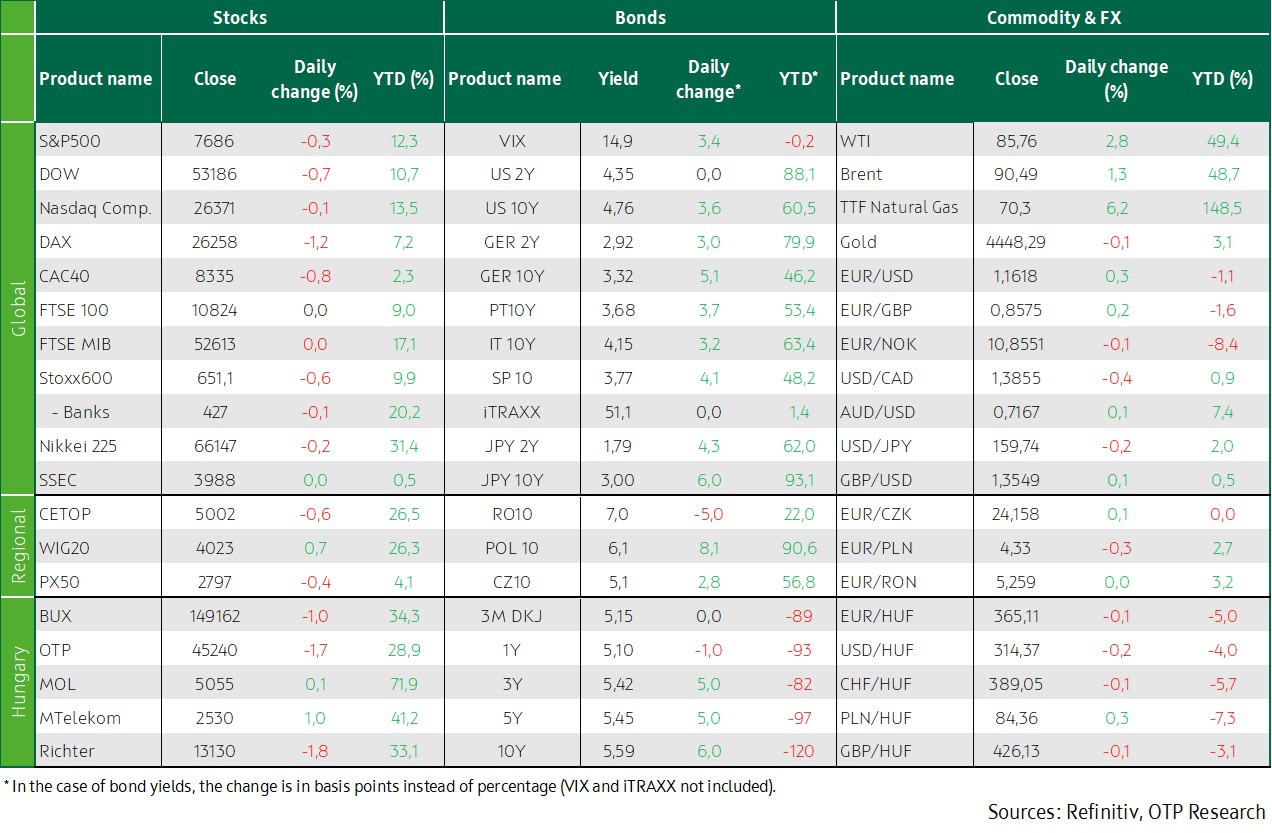
Market sentiment came under pressure on Monday as the conflict with Iran escalated again. Energy prices moved higher, with the TTF gas benchmark climbing above €70. Long-term government bond yields rose on both sides of the Atlantic, and the Hungarian government bond market was no exception. Major equity indices in both Europe and the US ended lower. Japan's 10-year government bond yield rose above 3% for the first time in 30 years. German inflation accelerated but came in below expectations. Today's focus will be on Hungary's detailed Q2 GDP release and the euro area's August inflation data.
The sell-off spread to Western Europe on Monday
Western European equity markets mostly moved lower on Monday. Investor sentiment in Europe was weighed down by the renewed escalation of the Iran conflict after the United States struck Iranian missile launch sites on Larak Island near the Strait of Hormuz, prompting retaliatory Iranian attacks against US bases in Jordan. The Stoxx 600 fell 0.6%, the DAX lost 1.2%, and the CAC 40 declined 0.8%, while the FTSE 100 managed to edge up 0.3%. Even so, the pan-European benchmark ended August up 0.3%. The energy sector outperformed yesterday, with shares of TotalEnergies, Orlen and OMV closing between 1% and 3.5% higher.
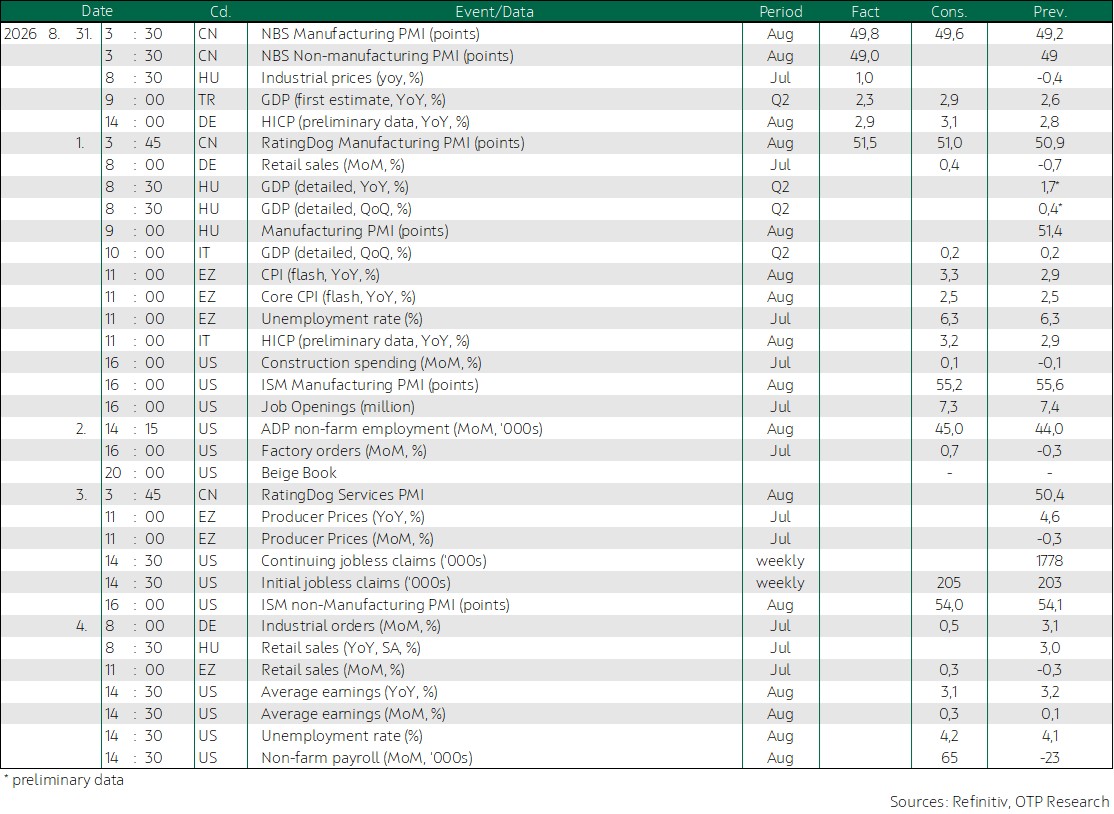
German inflation accelerated by 0.1 percentage point to 2.9% in August but came in below the market consensus of 3.1%. Attention now turns to today's euro area inflation release, which, in light of the German data, could surprise to the downside relative to the 3.3% consensus forecast.
In Hungary, industrial producer prices rose by 1.0% year-on-year in July. On the equity market, MOL and Magyar Telekom outperformed, gaining 0.1% and 1.0%, respectively, even as the BUX index fell 1.0%. Elsewhere in the region, Poland's WIG20 advanced 0.7%, while the Czech PX Index slipped 0.4%.
European TTF natural gas prices surged above EUR 70/MWh. EU gas storage facilities are currently 64.7% full, a level close to a historical low for this time of year and 13 percentage points below the level recorded a year earlier.
US equity indices extended their losses on Monday
Major US equity indices extended their declines on Monday following Friday's losses, while Brent crude oil prices rose another 1.3% amid renewed hostilities in the Middle East. The S&P 500 closed 0.3% lower, the Nasdaq Composite slipped 0.1%, and the Dow Jones Industrial Average fell 0.7%, although all three benchmarks still posted gains for August.
Among the eleven major S&P 500 sectors, energy (+2.1%) was the strongest performer, supported by higher oil prices. In contrast, utilities lagged after amendments to a California bill failed to address wildfire-related liability risks facing power grid operators. Shares of California-based utility PG&E plunged 20.1%. Meanwhile, video game retailer GameStop gained 2.9% after announcing that roughly 27% of its previously announced USD 1.4 billion debt exchange programme would be funded with cash rather than through the issuance of new shares, thereby avoiding further shareholder dilution.
The US macroeconomic calendar was quiet, with no major data releases during the session.
Rising energy prices pushed long-term bond yields higher
Brent crude oil's move back above USD 90 per barrel, together with rising inflation expectations, pushed developed market long-term bond yields higher. The US 10-year Treasury yield rose 3.6 basis points to 4.76%, while its German counterpart increased 5.1 basis points to 3.32%. While the US 10-year yield remains near the upper end of its post-pandemic trading range, the German 10-year yield climbed to a fresh 15-year high. By Monday, markets were pricing in a 65% probability of a 25-basis-point Fed rate hike in September after Kevin Warsh's Jackson Hole speech on Friday led investors to reassess the US interest-rate outlook. Following a 0.6% gain on Friday, the dollar weakened 0.3% against the euro on Monday, with EUR/USD rising to 1.162.
Hungarian long-term yields were unable to decouple from the rise in global rates. The yield on the 10-year Hungarian government bond increased by 6 basis points to 5.59%, while the forint strengthened modestly, gaining 0.1% against the euro. Today, Hungary's Government Debt Management Agency (ÁKK) will auction HUF 30 billion of discount Treasury bills maturing in December.
Today's highlights
As trading nears the close, Hong Kong's Hang Seng Index is down 1%, while other major Asian benchmarks, including the Nikkei, the KOSPI and China's Shanghai Composite (SSEC), are broadly unchanged. In China, the RatingDog Manufacturing PMI released overnight came in above expectations in August. In Japan, the 10-year government bond yield rose a significant 6 basis points and breached the 3% threshold this morning for the first time in more than 30 years.
Today's focus in Hungary will be on the release of the detailed Q2 GDP figures. In the euro area, attention will turn to August inflation and the July unemployment rate, while Germany will publish July retail sales data. In the United States, the week's key labour market releases begin with the JOLTS job openings report.
Get more out of your investments!
Global Markets Services
OTP Global Markets offers a broad range of services in the field of local and international money and capital markets.
Read morePrivate Banking Services
Personal care and expertise with OTP Private Banking, along with the knowledge, security, and innovations of a multinational banking group.
Read more