
OTP Morning Brief: Rate hike expectations rose following Kevin Warsh’s Jackson Hole speech on Friday
Related content
OTP Morning Brief: Developed market bond yields edged lower yesterday
European indices declined yesterday amid rising oil prices, while the German government revised its GDP growth forecast upward; German exports lost momentum toward the end of the summer; meanwhile, ECB policymakers see upside risks to European inflation. Major US indices moved mostly lower; OpenAI's revenue fell significantly short of previously projected levels; meanwhile, the number of initial jobless claims declined in the US. Long-term yields in both the US and Europe declined following the sharp increase seen in the previous period, while Christopher Waller noted that further Fed rate hikes do not necessarily need to occur at consecutive meetings. The focus today will be on the latest reading of the University of Michigan Consumer Sentiment Index.
OTP Morning Brief: Long-end yields temporarily moved higher, putting equity markets under pressure
Wednesday's trading session was relatively uneventful, with a familiar pattern once again unfolding as the situation in the Persian Gulf drove oil prices higher, pushed yields up, and weighed on equity markets. The correction came within the day, as declining oil prices helped pull the US 10-year yield back from its multi-decade high of 5.36% to around 5.30%. The German 10-year yield followed a similar intraday pattern and ultimately ended the session unchanged from Tuesday's close at 3.48%. The EUR/USD closed at a 17-month low, just below 1.12. Equity markets, however, failed to regain momentum, with both the Nasdaq and the S&P pulling back from their recent highs as investors continued to digest the financing plans of AI-related companies. In Europe, banks led the declines, topping the list of worst-performing sectors. Regional stock markets, including Hungary’s, posted notable declines. The EUR/HUF rose to near 366. Hungarian long-term yields declined. Hungary’s September CPI came in slightly lower than expected. Asian equity indices declined in early trading. Today, German export data will be released, while weekly jobless claims figures are due from the US.
Rate hike expectations strengthened following Federal Reserve Chair Kevin Warsh’s Jackson Hole speech on Friday, in which he struck a more hawkish tone than previously. US long-term Treasury yields rose notably, with the two-year yield surging 12 bps on Friday, while markets are now pricing in a nearly 60% probability of a 25 bps Fed rate hike in September. Eurozone long-term yields also edged higher on Friday, with the German 10-year yield reaching a new 15-year high of 3.27%. Strengthening rate hike expectations kept Wall Street indices under pressure on Friday, while European equities, which closed earlier, still managed to post gains, even as crude oil prices eased. However, conditions in the oil market are changing rapidly. Oil prices are up nearly 3% today after the US military targeted Iranian missile launchers that were preparing to lay mines in the Strait of Hormuz, marking the first such strike in more than a month. Today, attention will focus on Hungary’s producer price index and Germany’s preliminary CPI data. In the week ahead, detailed Q2 GDP data from Hungary, eurozone CPI figures, and the US August labour market report will be in the spotlight.
Major European equity indices moved higher on Friday
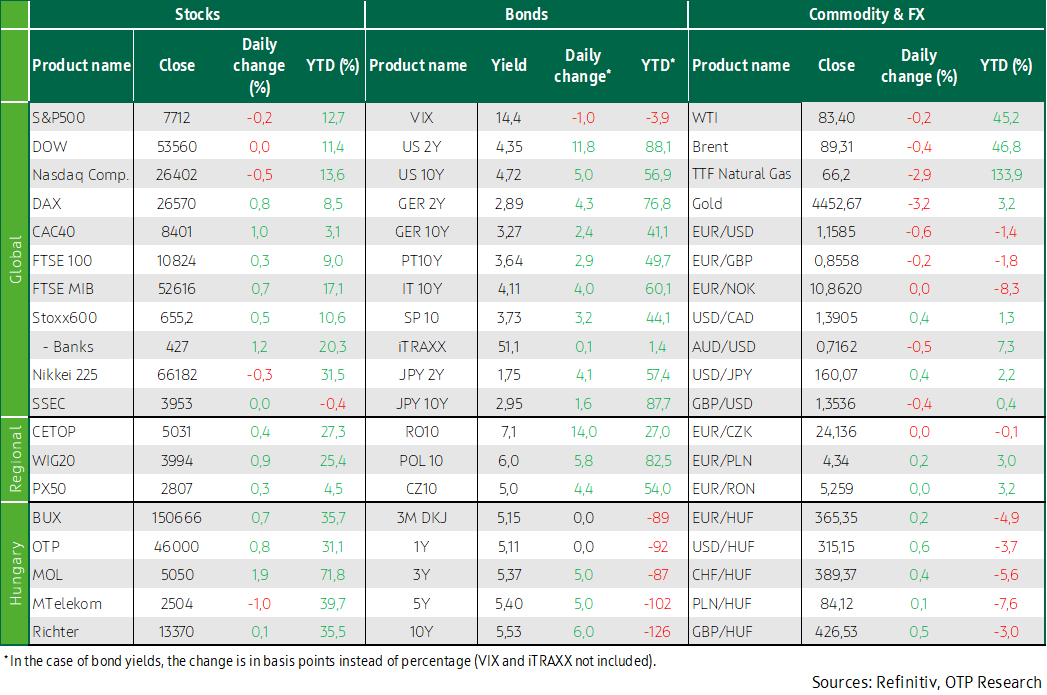
Major Western European equity indices closed higher on Friday. The Stoxx Europe 600 gained 0.5%, while the DAX rose 0.8%, the CAC 40 surged 0.9%, and the FTSE 100 added 0.3%. French equities rebounded after the CAC 40 suffered notable losses in the previous session amid investor concerns over the country's fiscal outlook, with banks bearing the brunt of the sell-off. On Friday, however, the financial sector regained momentum as rate hike expectations strengthened, with Société Générale, BNP Paribas and Crédit Agricole closing 1-2% higher, while the Stoxx Europe 600 Banks Index advanced 1.2%. Against the backdrop of growing concerns over the sustainability of France's budget deficit, Friday also brought disappointing news: according to the latest estimate, the French economy stagnated in Q2, compared with the modest quarter-on-quarter growth of 0.2% indicated by the preliminary release. CPI data were also unfavourable. Instead of the expected slight slowdown, the harmonised consumer price index accelerated to 0.8% month-on-month in August, while the preliminary year-on-year reading also came in above expectations.
Most sector indices within the Stoxx Europe 600 also finished in positive territory, with automakers among the top performers, supported by a 4.5% rally in BMW shares. Strabag surged 16% after the Austrian construction group upgraded its outlook for the current year. European equity sentiment also benefited on Friday from the European Commission’s sentiment indicators, which generally came in stronger than expected. Looking at the week as a whole, the Stoxx Europe 600 and the FTSE 100 were broadly unchanged, the DAX rose 1.7%, while the CAC 40 declined 1.0%.
Central and Eastern European equity markets also closed higher on Friday, with the BUX gaining 0.7%, the PX advancing 0.3%, and the WIG20 rising 0.9%. Among Hungarian blue chips, MOL surged 1.9%, OTP added 0.8%, while Richter ended the session marginally higher and Magyar Telekom slipped 1.0%. On a weekly basis, the BUX climbed 1.3%, outperforming both the PX and the WIG20.
On Friday, Hungary released foreign trade and labour market data. The trade balance posted a surplus of just EUR 69 million in July, falling well short of market expectations, while the July unemployment rate of 4.6% also came as a modest surprise.
US equity indices reversed course on Friday amid strengthening expectations of further Fed rate hikes
By the close, major US equity indices had slipped into negative territory, with the Dow posting only a marginal decline, while the S&P 500 fell 0.3% and the Nasdaq Composite dropped 0.5%. From an investor perspective, the key event of the day was Federal Reserve Chair Kevin Warsh’s Jackson Hole speech, in which he emphasised that the Fed remains focused on combating inflation, increasing the likelihood of further rate hikes. Market participants viewed the speech as more hawkish than previous communications, given its clear commitment to bringing CPI under control, leading to stronger expectations of additional Fed tightening. This weighed on the semiconductor sector, making technology the day’s worst-performing segment. Nvidia fell 4.6%, while Broadcom and Micron limited losses to less than 1%; AMD, Intel and Texas Instruments declined 2-3%, and Marvell Technology plunged more than 10%. Among the megacaps, Microsoft rose 1.7% and Apple gained 1.6%, helping the communication services and consumer discretionary sectors emerge as the session’s top performers.
Among individual corporate stories, PayPal was notably weak, plunging nearly 13% after Bloomberg reported that a consortium consisting of private equity firm Advent and payment processor Stripe had decided to abandon its efforts to acquire the company. Gap soared almost 13% after the retailer appointed industry veteran Michael Francis as the new CEO of Old Navy and raised its full-year profit guidance. Ulta Beauty fell 4% after the cosmetics retailer reported a slowdown in revenue growth during Q2. For the week as a whole, the S&P 500 and the Dow Jones rose 0.5%, while the Nasdaq Composite closed 0.8% higher.
According to data from the US Bureau of Labor Statistics, the annual benchmark revision to nonfarm payrolls showed a decline of 79,000 jobs over the 12 months ending in March 2026. The downward revision was concentrated in a handful of major industries, with retail trade recording the largest reduction, as employment was revised down by 154,600 positions. However, payroll figures were revised higher across several sectors. Transportation and warehousing led the gains with 135,100 additional jobs, followed by the public sector with 99,000, information services with 87,000, financial activities with 85,000, and construction with 62,000.
The final August University of Michigan Consumer Sentiment Index came in weaker than the July reading but slightly above the preliminary estimate, reaching 51.7 points. Inflation expectations also eased, with the gauge tracking five-year inflation expectations remaining unchanged at 3.3%.
Crude oil prices edged lower on Friday as the revenue-sharing agreement between Iran and Oman regarding vessel traffic through the Strait of Hormuz boosted expectations that the waterway could reopen and that supply tightness in hydrocarbon markets may ease. An Iranian official also indicated that a resumption of negotiations between the US and Iran cannot be ruled out, although no concrete details have emerged so far. European TTF natural gas prices fell nearly 3% on Friday amid expectations of improving supply conditions. For the week as a whole, WTI and Brent crude declined by 4% and 5%, respectively, while TTF gas prices edged 0.5% lower.
Rate hike expectations strengthened following Federal Reserve Chair Kevin Warsh’s Jackson Hole speech
The most closely watched event across financial markets on Friday was Federal Reserve Chair Kevin Warsh’s speech at the Jackson Hole symposium. Expectations for a September rate hike strengthened after Warsh stated that, in his view, the latest CPI data do not indicate a change in the underlying trend. In his first Jackson Hole address as Fed Chair, Warsh noted that if there is no clear evidence that CPI is moving decisively and at a sufficient pace toward the Fed’s 2% target, the central bank will have “more work to do.” Following the speech, interest rate futures began pricing in a nearly 60% probability of a 25 bps Fed rate hike in September, while the likelihood of rates remaining unchanged fell to around 40%, marking a significant shift from the roughly 40%-60% distribution seen a week earlier. Market pricing nevertheless assigns an even higher probability to a December tightening move, with another hike potentially following next year. In bond markets, the US two-year Treasury yield surged 12 bps on Friday, while the 10-year yield climbed nearly 8 bps to 4.72%, approaching the roughly 18-month high reached at the end of July. European yields were also drawn higher. Although movements were limited earlier in the session, by the close the German two-year yield had risen 4 bps and the 10-year yield added 2 bps, reaching 3.27%, its highest level since 2011. Futures markets have now almost fully priced in a 25 bps ECB rate hike at the September 10 meeting. EUR/USD closed below 1.159 on Friday after the dollar strengthened by 0.6%.
Based on the Debt Management Agency's (ÁKK) benchmark quotations published early Friday afternoon, yields beyond the one-year segment moved higher, while the short end of the curve remained unchanged. The 10-year benchmark yield rose 6 bps to 5.53%. The forint weakened against major currencies, with EUR/HUF climbing above 365.3 and USD/HUF rising above 315.0.
Today's highlights
Major Asia-Pacific equity indices were trading mixed ahead of Monday’s close. Brent crude oil prices surged 3% to USD 90.51 per barrel after US forces struck two Iranian missile launchers on Larak Island on Sunday. In response, Iran launched an attack on US forces stationed in Jordan and claimed to have hit a tanker transiting the Strait of Hormuz. President Trump later posted an AI-generated video, asserting that Iran’s main oil terminal on Kharg Island had been blown to pieces, although this claim has not been confirmed by the military.
US equity index futures point to a lower open, while European futures markets are trading mixed.
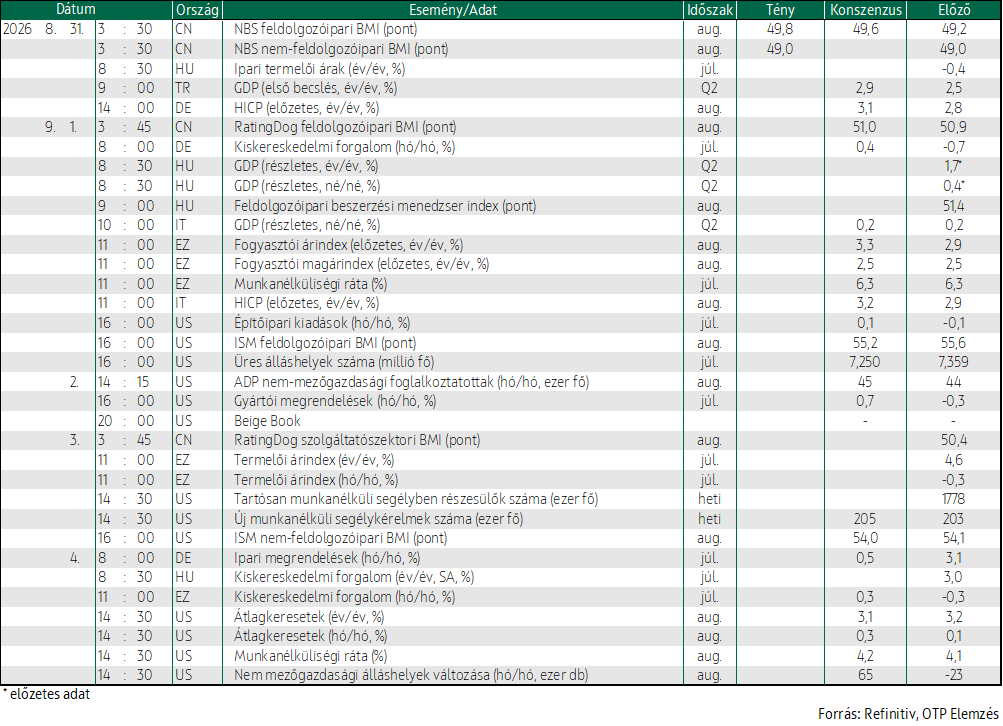
Today, attention will focus on Germany’s preliminary August CPI data, while the Hungarian Central Statistical Office (HCSO) is set to release industrial producer price figures.
Looking ahead, detailed Q2 GDP data from Hungary (Tuesday), eurozone CPI figures (also Tuesday), and the US August labour market report (Friday) will be in the spotlight this week. Following Federal Reserve Chair Kevin Warsh’s speech last Friday, August nonfarm payrolls (NFP) have become particularly important, as has the August CPI report due a week later, given that the next Fed policy meeting is scheduled for September 19.
The Debt Management Agency (ÁKK) has announced switch auctions for today, offering 12-month discount Treasury bills maturing in April 2027 and June 2027, with a planned issuance volume of HUF 10 billion each.
Get more out of your investments!
Global Markets Services
OTP Global Markets offers a broad range of services in the field of local and international money and capital markets.
Read morePrivate Banking Services
Personal care and expertise with OTP Private Banking, along with the knowledge, security, and innovations of a multinational banking group.
Read more