
OTP Morning Brief: Nvidia's strong earnings report provided some relief to uncertainty-ridden markets yesterday
Related content
OTP Morning Brief: Long-end yields temporarily moved higher, putting equity markets under pressure
Wednesday's trading session was relatively uneventful, with a familiar pattern once again unfolding as the situation in the Persian Gulf drove oil prices higher, pushed yields up, and weighed on equity markets. The correction came within the day, as declining oil prices helped pull the US 10-year yield back from its multi-decade high of 5.36% to around 5.30%. The German 10-year yield followed a similar intraday pattern and ultimately ended the session unchanged from Tuesday's close at 3.48%. The EUR/USD closed at a 17-month low, just below 1.12. Equity markets, however, failed to regain momentum, with both the Nasdaq and the S&P pulling back from their recent highs as investors continued to digest the financing plans of AI-related companies. In Europe, banks led the declines, topping the list of worst-performing sectors. Regional stock markets, including Hungary’s, posted notable declines. The EUR/HUF rose to near 366. Hungarian long-term yields declined. Hungary’s September CPI came in slightly lower than expected. Asian equity indices declined in early trading. Today, German export data will be released, while weekly jobless claims figures are due from the US.
OTP Morning Brief: Easing bond yields lifted equity markets on Tuesday
The rise in bond yields seen in recent days eased, supporting markets in both Europe and the US. In the euro area, Germany’s August industrial orders, French industrial output, and the region’s retail sales figures generally painted a negative picture. The BUX rose by 1.3%. In the US, both the S&P 500 and the Nasdaq closed at record highs. Although Brent crude started the day lower, it moved back toward the $100 per barrel mark by the close, driven by the Houthi attacks. A series of protests in France heightened uncertainty. The forint strengthened to nearly 365 against the euro. Asian equity indices declined in early trading. Today, Hungary’s CPI data will be worth watching.
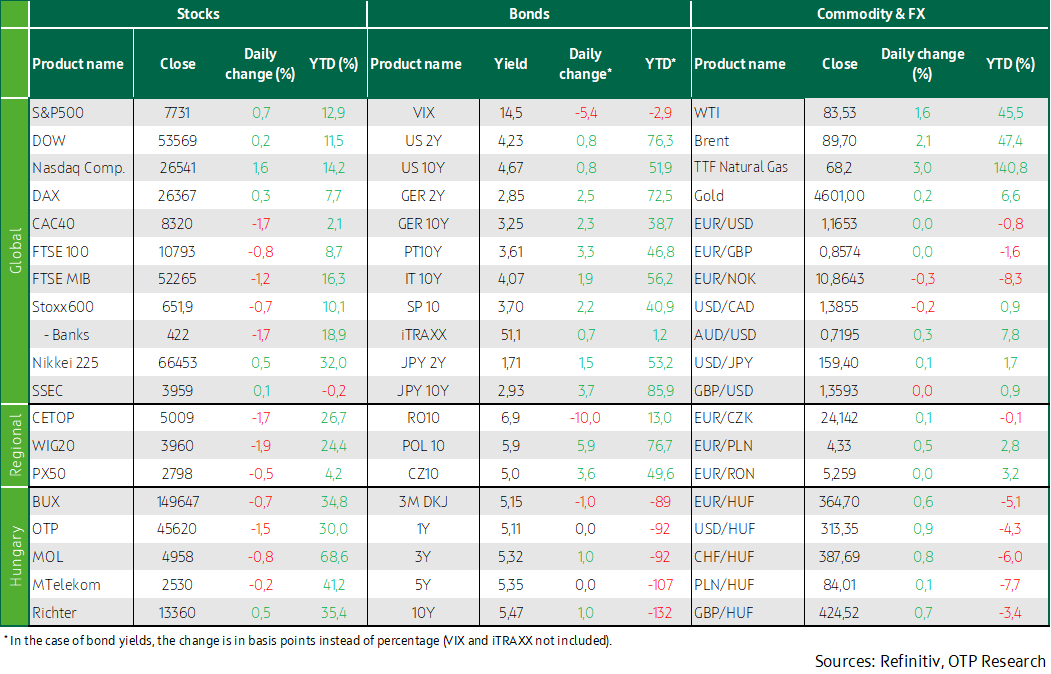
European equities declined, while major US stock indices moved higher. Better-than-expected results and guidance from Nvidia improved market sentiment and provided momentum for a broader rise across the technology sector. The BUX closed Thursday's session in negative territory, with Richter the only blue-chip stock to post gains among Hungary's largest listed companies. Crude oil prices continued to rise amid uncertainty surrounding the Strait of Hormuz. Long-term yields in developed markets increased by a few basis points, remaining close to the recent highs. The forint weakened against major currencies, with EUR/HUF trading above 364.5. Investors will focus on the Jackson Hole symposium today, particularly Kevin Warsh's speech. Preliminary August CPI data from several major euro area economies are also due for release today.
European markets were dominated by sellers, while the technology sector outperformed
Sellers dominated trading on major European exchanges on Thursday. Persistently elevated oil prices and their implications for the interest rate outlook weighed on sentiment, while country-specific developments further dampened investor confidence. The pan-European Stoxx 600 fell 0.7%, with most sector indices closing in negative territory. The day's standout performer was the technology sector, which managed to rise on the back of Nvidia's strong performance. Among the major Western European benchmarks, the DAX outperformed with a 0.3% gain, while the remaining key indices ended the session in the red. The CAC 40 was the day's biggest loser, declining 1.7%, as France's fiscal challenges moved back into focus ahead of the first presidential debate before next year's election. French bank stocks came under pressure, dragging down financial shares across Europe.
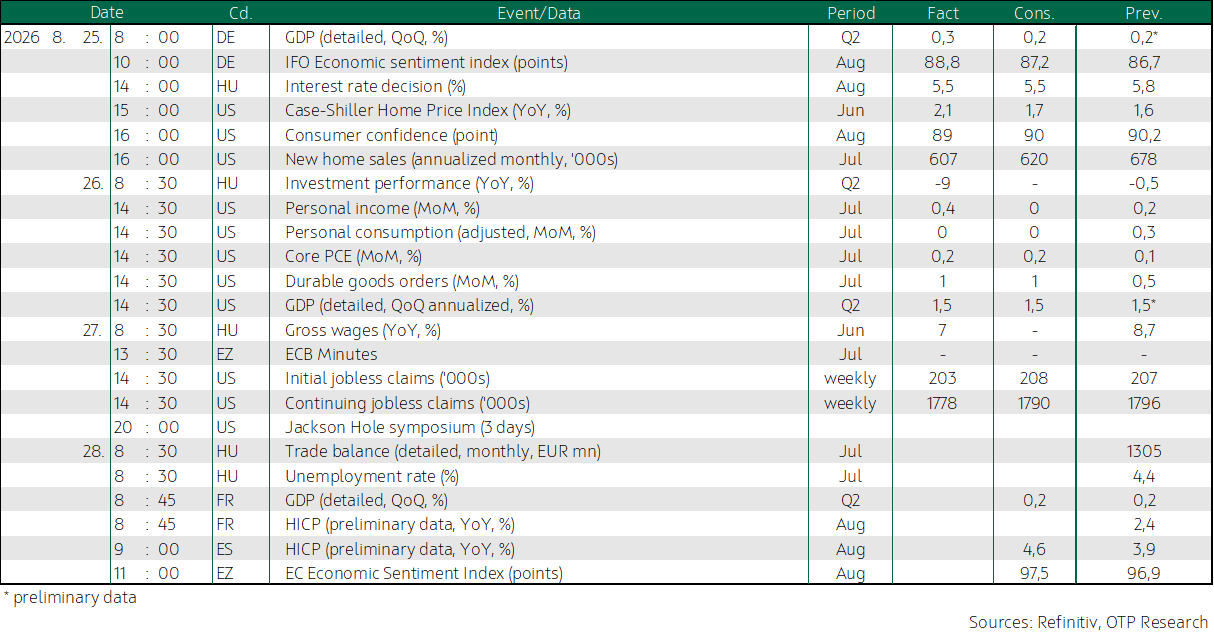
The minutes of the ECB's July meeting can be viewed as relatively hawkish, with policymakers describing the July pause in the rate-hiking cycle as temporary and indicating that further tightening may be needed to contain the impact of the Middle East conflict on energy prices. Given inflation concerns that have only intensified since then, the ECB's data-dependent approach suggests that another rate hike could follow in September.
Central European markets also closed in negative territory, with Poland's WIG20 emerging as the day's biggest loser after falling 1.9%. The BUX declined 0.7%, while among Hungary's blue-chip stocks, only Richter managed to post gains.
On the macroeconomic front, wage growth in Hungary continued to slow in June, with average gross earnings rising 7.1% year-on-year, marking the weakest growth rate since February 2023. The moderation was evident in both the private and public sectors. Nevertheless, wage dynamics remained robust overall, with the economy still posting double-digit wage growth in the first half of the year.
Major US indices advanced, with Nvidia's strong results supporting the technology sector's outperformance
Investor sentiment in the US was also shaped by the unresolved Middle East conflict and its potential impact on CPI and the interest rate outlook, while markets were already eagerly awaiting Kevin Warsh's speech at today's Jackson Hole economic symposium. Major indices managed to post gains, with the tech-heavy NASDAQ delivering the strongest performance as Nvidia's 8.7% surge lifted the broader technology sector. The company reported better-than-expected quarterly results and issued upbeat guidance, easing market concerns that AI-related investment spending could be losing momentum.
Initial jobless claims came in better than expected, with the number of new applications falling to 203,000, compared with the market consensus of 208,000. Continuing claims also declined, reinforcing the narrative that the US labor market remains resilient.
The breakdown in talks aimed at resolving the Middle East conflict supported a further rise in oil prices. Both Brent and WTI crude gained around 2%, with Brent approaching $90 per barrel, while WTI climbed above $83 per barrel.
Developed market long-term yields moved higher amid inflation concerns, while the forint weakened
Developed market long-term yields moved higher as the unresolved Middle East conflict continued to fuel concerns over accelerating CPI and a prolonged period of elevated interest rates. In Europe, yields received additional support from the minutes of the ECB's July meeting, which effectively paved the way for a September rate hike. Meanwhile, in the US, investor attention was already focused on Kevin Warsh's speech at today's Jackson Hole symposium, with markets looking for guidance on the future interest rate path from the Fed Chair, who has so far firmly rejected the concept of forward guidance. Several Fed officials also used the opening day of the conference to warn about persistent inflationary pressures and left the door open to further monetary tightening. The US 10-year Treasury yield rose to 4.67%, while the German 10-year Bund yield climbed to 3.25%, placing both at the upper end of their post-Covid trading ranges. Following a slight appreciation of the euro, the EUR/USD exchange rate traded somewhat above 1.165.
The Hungarian yield curve was largely unchanged yesterday based on the Government Debt Management Agency's (ÁKK) early afternoon benchmark quotes, with the 10-year reference yield edging up by 1 basis point to 5.47%. The forint weakened against major currencies, with EUR/HUF rising above 364.5 and USD/HUF moving past 313. Compared with its regional peers, the Hungarian currency delivered a performance broadly in line with the Polish zloty, while the Czech koruna proved more resilient than its Central European counterparts.
At yesterday's 12-month Treasury bill (DKJ) auction, Hungary's Government Debt Management Agency (ÁKK) received HUF 55.6bn in bids for the HUF 30bn of securities on offer. The debt manager accepted bids in line with the announced amount at an average yield of 5.15%, which was 4 basis points above the secondary market benchmark.
Today's highlights
Most major Asia-Pacific equity indices were trading in modest positive territory ahead of this morning's close. Technology stocks also delivered solid gains across the region, supported by the strong performance of their US peers. Crude oil prices edged lower during Asian trading.
Equity index futures are currently pointing to a mixed open in both Europe and the US.
The Jackson Hole symposium continues today, with investor focus firmly on Fed Chair Kevin Warsh's speech, which is expected to provide important signals regarding the future path of US monetary policy.
Hungary's Central Statistical Office (KSH) is scheduled to release detailed July foreign trade data and unemployment figures today.
Preliminary August CPI data and the European Commission's Economic Sentiment Indicator are due for release today from several of the euro area's major economies.
Get more out of your investments!
Global Markets Services
OTP Global Markets offers a broad range of services in the field of local and international money and capital markets.
Read morePrivate Banking Services
Personal care and expertise with OTP Private Banking, along with the knowledge, security, and innovations of a multinational banking group.
Read more