
OTP Morning Brief: Nvidia reported better-than-expected quarterly results and provided a favorable outlook
Related content
OTP Morning Brief: Oil and gas prices hit multi-year highs as equity markets slide
By the end of last week, oil prices had climbed to their highest levels since spring, while European natural gas prices approached levels last seen in late 2022, driven by escalating tensions in the Middle East. Equity markets also turned lower by the end of the week: while the energy sector benefited from higher commodity prices and soared to record highs, all other sectors came under pressure. In the bond market, the US 10-year Treasury yield dipped back below 5%, while its German counterpart closed at a one-and-a-half-month low. French, Mediterranean, and CEE bond yields showed little movement on Friday, but over the course of the week they rose noticeably overall.
OTP Morning Brief: Earnings season continues to drive equities higher, while the French 10-year yield climbs above 5%
Stock markets moved higher yesterday in both Europe and the US, with technology stocks leading the gains on both sides of the Atlantic. Individual earnings reports released so far do not indicate that the AI investment boom is set to slow in the coming months. French financial indicators, however, are coming under increasing pressure from social and political uncertainty across both the corporate and public sectors: while French retail giant Carrefour issued a profit warning due to the unrest, French long-term bond yields soared to their highest level since 2002. The rise in yields also affected other countries, with the yield on 10-year Hungarian government bonds moving higher as well.
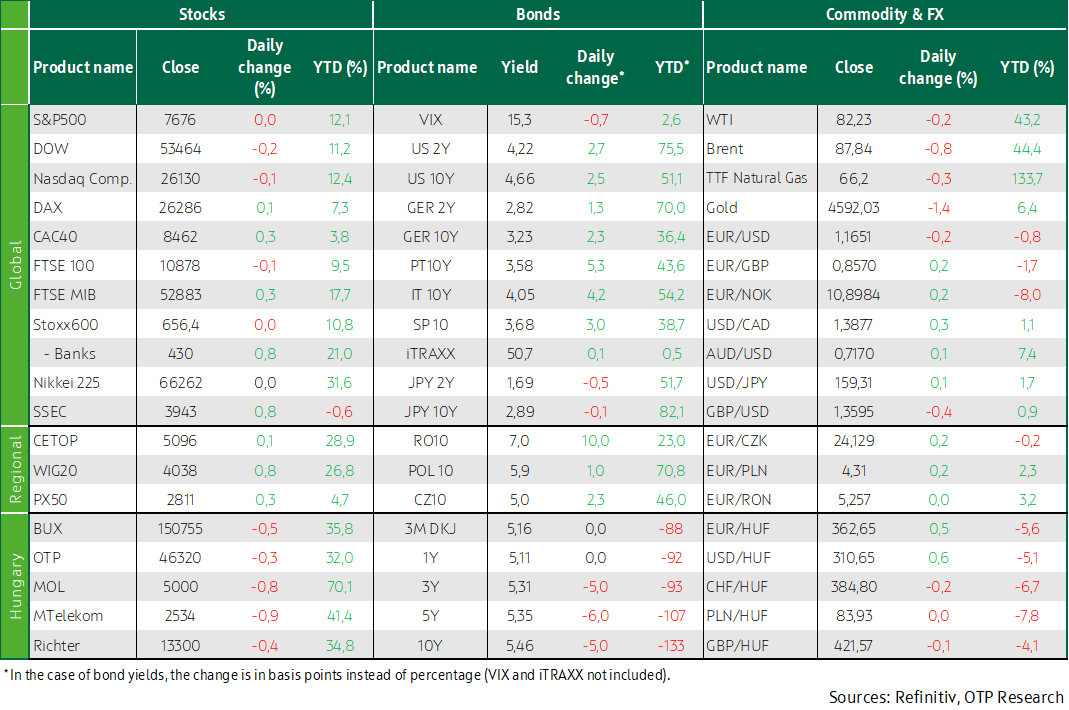
Wednesday brought no significant moves across international equity markets, as investors focused on diplomatic developments related to the Strait of Hormuz, while awaiting US PCE data and Nvidia's earnings report. Nvidia reported stronger-than-expected quarterly results and issued a more favorable outlook than the market had anticipated. Oil prices edged slightly lower; however, US consumer price indices for consumption expenditures showed a larger-than-expected year-over-year rise, alongside an increase in personal income, while the closely watched core PCE price index came in line with expectations. Expectations for Fed rate hikes this year remained unchanged, while money markets fully priced in a September tightening by the ECB in the euro area. Long-term bond yields moved higher across developed markets on Wednesday, while the US dollar strengthened slightly. In contrast, Hungarian long-term yields declined, with the benchmark 10-year government bond yield falling to 5.46%. In line with other regional currencies, the Hungarian forint weakened against the euro. The ECB’s latest policy account and weekly US jobless claims data are today's highlights. In Hungary, the Hungarian Central Statistical Office (KSH) will release June wage data. The Jackson Hole Symposium kicks off today in the US, with markets closely watching Fed Chair Kevin Warsh’s appearance on Friday.
European equity indices traded sideways, while crude oil prices edged lower on news of diplomatic talks between Iran and Oman
European benchmark indices were little changed during Wednesday’s trading session, with the Stoxx 600 ending the day close to its previous close. Meanwhile, the resumption of negotiations between Iran and Oman regarding the Strait of Hormuz eased concerns in the oil market, prompting crude prices to edge lower. The DAX posted modest gains, while the FTSE 100 finished slightly in negative territory. In the absence of major European data releases, investors focused on the US core Personal Consumption Expenditures (PCE) price index published in the afternoon. The reading came in slightly above expectations, reinforcing market expectations for future Fed rate hikes. Among the Stoxx 600 sector indices, banks outperformed, with Deutsche Bank soaring more than 4% to a five-year high. Commerzbank gained nearly 3%, while UniCredit advanced 2.2%. According to reports, German Finance Minister Lars Klingbeil is planning a meeting with UniCredit’s CEO, which would mark the first direct talks between the parties regarding a potential Commerzbank takeover. Among individual stocks, shares of UK-listed Hochschild Mining surged more than 5% after the company reported stronger-than-expected first-half revenue figures and reaffirmed its 2026 gold production guidance. As a result, the miner remains on track to meet its full-year targets despite increasing cost pressures. SAP fell nearly 3%, making it the worst-performing constituent of the Stoxx 600, after US software company Intuit issued a disappointing outlook and UBS downgraded the German software group to “neutral.” SAP’s decline also weighed on the Stoxx 600 technology sector, although healthcare was the weakest-performing sector across the index universe.
With the exception of the BUX, which pulled back from the record high reached on Tuesday, major CEE equity indices moved higher yesterday. Prague’s benchmark index edged up 0.3%, while Poland’s WIG20 rose nearly 0.8%. The BUX slipped 0.5%, with all Hungarian blue chips closing in negative territory. Magyar Telekom and MOL recorded the largest declines among the index’s heavyweight constituents.
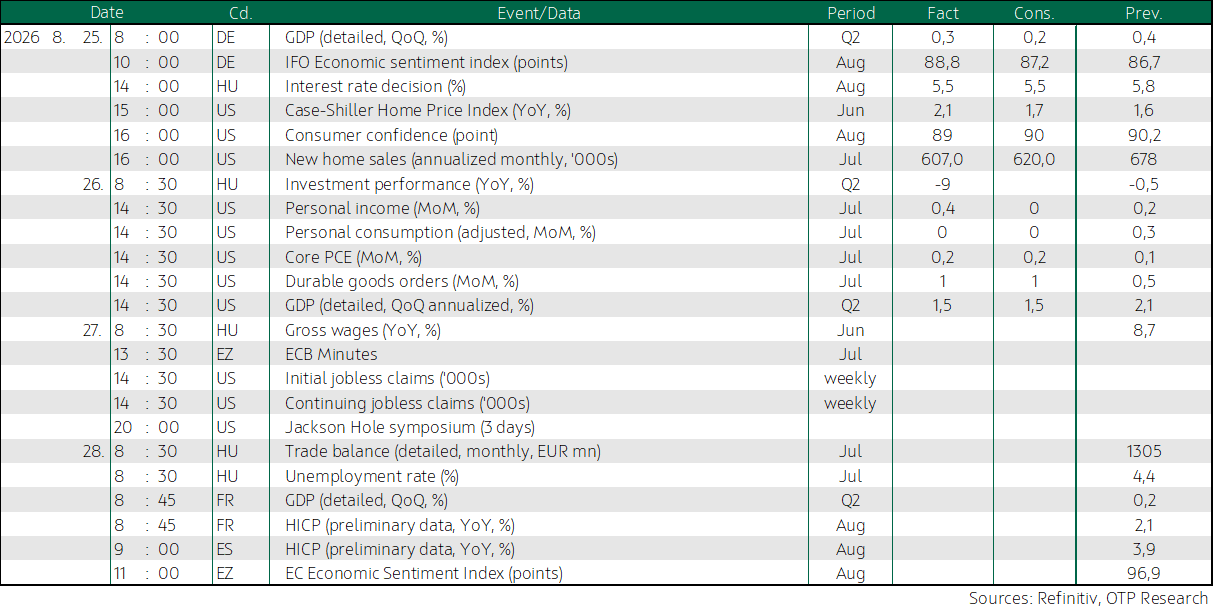
According to statistics released yesterday, Hungarian investment activity declined sharply again in Q2. Following a modest 0.5% contraction in Q1, investments fell by 9.1% year-on-year based on unadjusted data. According to the Hungarian Central Statistical Office (KSH), the decline was particularly pronounced in manufacturing investment, while the transportation and storage sectors also made a significant contribution to the downturn. The contraction was partially offset by growing investment activity in the real estate sector.
Major US equity indices closed slightly lower, as investors remained on the sidelines ahead of Nvidia’s earnings release, which ultimately came in better than expected
Major US equity indices closed modestly lower yesterday as investors awaited Nvidia’s earnings report after the closing bell, while consumer price data dominated attention at the start of the session. Adding to the constructive backdrop, reports citing a spokesperson for Iran’s Revolutionary Guard indicated that Tehran and Oman had reached an agreement on the division of the Strait of Hormuz and the allocation of related revenues. Even so, trading activity remained relatively subdued throughout Wednesday’s session. Among the S&P 500 sector indices, industrials delivered the strongest performance after durable goods orders rose more than expected in July and June’s figure was revised slightly higher. Healthcare was the worst-performing sector, with Eli Lilly falling 3.6% and Merck declining 2.1%. Following Tuesday’s strong rally, Moderna sank nearly 6%, although the stock remained well above the level at which it traded before last week’s release of late-stage clinical trial results for its cancer vaccine developed in partnership with Merck. Meta gained 1.1%, marking the strongest advance among the megacap stocks, after agreeing to pay $18 billion and implement significant changes to Facebook and Instagram to settle claims brought by several US states regarding the platforms’ alleged harmful effects on children. Apple also advanced 1.1%.
Nvidia slipped 1.6% during regular trading hours, while CrowdStrike, which also released its earnings report after yesterday’s close, gained 2%. Both companies reported better-than-expected revenue and profit figures. Nvidia also issued Q3 revenue guidance above market expectations, prompting a 5% rise in after-hours trading. Management outlined its growth strategy for the coming years, including scaling production of next-generation Vera Rubin processors and expanding sales to artificial intelligence laboratories such as OpenAI. Nvidia’s forecast of 70% growth for the fiscal year ending in January 2028 was a rare move for the chipmaker, which typically refrains from providing such long-term guidance. By projecting revenue growth well above Wall Street expectations and highlighting robust demand from leading technology companies and AI research institutions, Nvidia reinforced the view that the AI market continues to expand rather than approach a peak, even as supply constraints limit its ability to fully capitalize on available opportunities. This outlook is likely to reassure investors who have questioned how long the surge in AI-related corporate investment can be sustained following years of explosive growth.
Crude oil prices edged lower during Wednesday’s trading session following encouraging developments from the Middle East. Iran and Oman reached an agreement on sharing the waters of the Strait of Hormuz and the associated revenues, although Tehran warned that the deal alone would not be sufficient to ensure the reopening of the strategic waterway. Meanwhile, President Donald Trump announced that 10 million barrels of oil had passed through the Strait of Hormuz on Tuesday and reiterated that mines had been cleared from the shipping route. Oil prices also came under pressure this week as newly imposed US sanctions on Iran proved less aggressive than markets had anticipated, while the White House has so far refrained from taking tougher measures against Iran’s trading partners. European natural gas prices also edged lower on Wednesday, reaching EUR 66/MWh. At the same time, exceptional summer heat has boosted demand for gas-fired power generation, contributing to a decline in European gas storage levels to just 63%, the lowest level for this time of year since 2009. As a result, prices are likely to remain volatile, particularly if supply disruptions extend into the heating season.
Developed-market bond yields rose modestly following the release of US PCE data, while Hungarian long-term yields declined and the forint weakened against the euro
Following Tuesday’s notable decline, yields across developed bond markets were little changed ahead of the release of US PCE data. The German 10-year yield remained around 3.2%, while the US 10-year Treasury yield fluctuated near 4.65%. In the US, the Personal Consumption Expenditures (PCE) price index accelerated to 3.7% year-on-year and 0.2% month-on-month, with both readings exceeding expectations. The closely watched core index rose 0.2% on a monthly basis in July, in line with forecasts, following a 0.1% increase a month earlier. Personal income growth also exceeded expectations, while spending growth slowed but still came in above consensus estimates. Rate expectations changed little in response to the data. According to the CME FedWatch Tool, markets continue to assign the highest probability to the Fed keeping rates unchanged at its September meeting, while an October rate hike is priced with a probability slightly above 50%. Nevertheless, market pricing suggests that a 25bp tightening could arrive in December, followed by an additional hike early next year. The US 10-year yield closed above 4.66% yesterday, while its German counterpart climbed to 3.23%. Investors may look to Fed Chair Kevin Warsh’s speech at the annual Jackson Hole Symposium on Friday for guidance, although he is not expected to provide a clear signal regarding the Fed’s September policy decision. Meanwhile, investors continue to assess the Treasury Department’s bond buyback plans. Billionaire investor Stanley Druckenmiller argued that the initiative undermines the credibility of the Treasury market and does not create an opportunity for meaningful debt reform. In the euro area, money markets are pricing in less than 40bp of additional ECB tightening by year-end, while a September rate hike has been almost fully priced in. Reuters reported that ECB policymakers are prepared to raise rates at their September meeting to mitigate the economic consequences of the Iran conflict, but are reluctant to signal additional tightening thereafter. Nevertheless, ECB Executive Board member Isabel Schnabel stated that a prolonged conflict in the Middle East could necessitate further rate hikes due to upside risks to CPI.
The EUR/USD pair closed near 1.165, with the US dollar posting modest gains. Alongside other regional currencies, the Hungarian forint weakened yesterday, edging up to 362.6 against the euro by the close. In contrast to global market trends, Hungarian long-term yields declined on Wednesday, with the 10-year government bond yield falling to 5.46%. At the Government Debt Management Agency’s (ÁKK) six-month Treasury bill auction on Wednesday, issuance was increased to HUF 30bn from the originally announced HUF 20bn amid demand exceeding supply by more than 2.5 times.
Today's highlights
Major Asian equity indices traded mixed this morning, with both the Nikkei and Hang Seng posting modest losses, while the Shanghai Composite advanced 0.8% and the CSI 300 gained nearly 0.5% ahead of the close. Nvidia’s stronger-than-expected quarterly results and upbeat guidance provided support to Asian markets and are also expected to boost sentiment in today’s European and US trading sessions. Equity futures point to a broadly positive open across both US and Western European markets.
The Jackson Hole Symposium begins today. On the macroeconomic front, attention will turn to weekly jobless claims data in the US, while in the euro area investors will focus on the minutes of the ECB’s latest policy meeting. In Hungary, the statistical office is set to release June wage data.
The Government Debt Management Agency (ÁKK) will hold auctions today for 12-month Treasury bills as well as 10-year and 15-year government bonds. The planned issuance amounts are HUF 30bn, HUF 15bn and HUF 15bn, respectively.
Get more out of your investments!
Global Markets Services
OTP Global Markets offers a broad range of services in the field of local and international money and capital markets.
Read morePrivate Banking Services
Personal care and expertise with OTP Private Banking, along with the knowledge, security, and innovations of a multinational banking group.
Read more