
OTP Morning Brief: Oil prices declined as Middle East tensions eased
Related content
OTP Morning Brief: Earnings season continues to drive equities higher, while the French 10-year yield climbs above 5%
Stock markets moved higher yesterday in both Europe and the US, with technology stocks leading the gains on both sides of the Atlantic. Individual earnings reports released so far do not indicate that the AI investment boom is set to slow in the coming months. French financial indicators, however, are coming under increasing pressure from social and political uncertainty across both the corporate and public sectors: while French retail giant Carrefour issued a profit warning due to the unrest, French long-term bond yields soared to their highest level since 2002. The rise in yields also affected other countries, with the yield on 10-year Hungarian government bonds moving higher as well.
OTP Morning Brief: Better-than-expected earnings reports supported US equity indices
Major European indices closed slightly lower yesterday; Germany’s ZEW index declined more than expected; the UK unemployment rate developed favourably; and the MNB left its base rate unchanged, in line with expectations. Major indices closed mostly higher, supported by favourable earnings reports; several companies with significant AI exposure rebounded following the recent sell-off, while housing market data continued to point to weak activity in the US. Long-term US and European bond yields edged lower, while Hungarian long-term government bond yields rose more markedly following their decline in recent days. Today, UK CPI data will be in the spotlight.
Major European indices mostly advanced on Tuesday as geopolitical tensions eased somewhat and favorable macroeconomic data were released in Germany; meanwhile, the MNB cut its base rate by 25 basis points, in line with expectations. US major indices advanced on Monday; Canada announced retaliatory tariffs in response to US duties; meanwhile, US consumer confidence deteriorated, contrary to expectations for stagnation. Developed market yields edged lower, while the forint strengthened against the euro following the interest rate decision. Today, data from the US are due on CPI, household spending and income, as well as durable goods orders. In addition, the detailed breakdown of Q2 US GDP will be released, while in Hungary, the statistical office will publish data on the growth in investment performance.
Major European indices mostly moved higher on Tuesday as geopolitical tensions eased somewhat and favorable macroeconomic data were released in Germany; meanwhile, the MNB cut its base rate by 25 basis points, in line with expectations
With the exception of the French index, major European equity markets closed higher yesterday after investors were reassured that the new US sanctions package against Iran proved less stringent than expected. Overall, easing market concerns over Middle East tensions, lower oil prices, and favorable German growth data supported European equities.
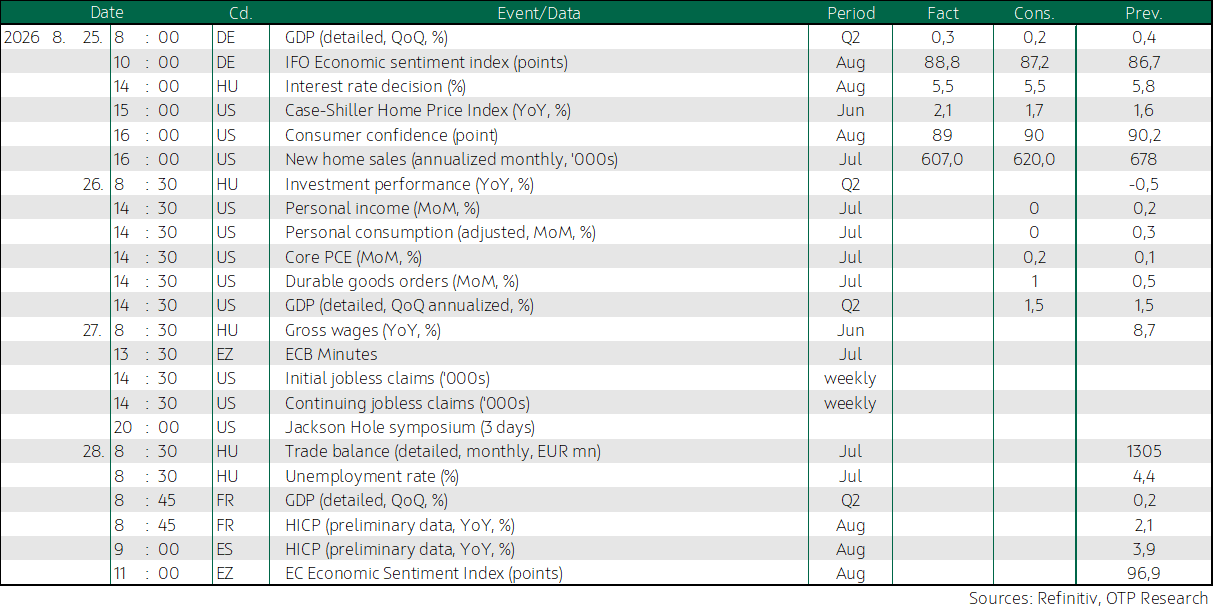
According to revised data, the German economy expanded by 0.3% quarter-on-quarter in Q2 2026, exceeding both the preliminary estimate and market expectations of 0.2%, although it slowed from the 0.4% growth recorded in the previous quarter. On an annual basis, GDP increased by 1.0%, also surpassing the earlier estimate of 0.9% and accelerating from the 0.7% rise in Q1. Exports remained the main driver of economic growth. Export volumes rose by 2.0% quarter-on-quarter, while imports increased by 1.5%, resulting in a positive contribution from net exports to overall GDP growth. Although export momentum eased from 2.4% in Q1, it remained robust. Domestic demand showed only a modest improvement, increasing by 0.1% following a 0.3% decline in the previous quarter. Household and government consumption both advanced by 0.1%, indicating subdued momentum. Investment activity remained weak, with gross fixed capital formation falling by 0.2% quarter-on-quarter, although this represented an improvement compared to the 1.3% contraction in Q1. Machinery and equipment investment declined by 1.4%, while construction investment edged up by 0.1%. Overall, the revised GDP figures paint a more favorable picture of the German economy than previously expected. Growth continues to be supported primarily by external demand, while domestic demand and investment activity remain subdued.
Germany’s Ifo Business Climate Index rose to 88.8 in August from 86.7 in July, reaching a one-year high and marking its fourth consecutive monthly improvement. The reading significantly exceeded market expectations of 87.2, suggesting a gradual strengthening in business confidence within Europe’s largest economy. The improvement was driven by a more favorable assessment of both current conditions and future prospects.
Major indices across the CEE region moved higher yesterday, with the Prague index posting the strongest gain. Among Hungarian blue chips, only MOL declined, while the other three stocks advanced. The Hungarian central bank cut its base rate by 25 basis points yesterday, in line with expectations. At the same time, CPI in July came in below the MNB’s June projection, inflation expectations have eased compared with the beginning of the year, and the risk perception of Hungarian assets has remained stable, preserving room for further monetary policy easing. However, according to the central bank, maintaining the stability of financial markets, particularly the foreign exchange market, remains of paramount importance amid an uncertain geopolitical environment.
US major indices advanced on Monday; Canada announced retaliatory tariffs in response to US duties, while US consumer confidence weakened contrary to expectations of stagnation
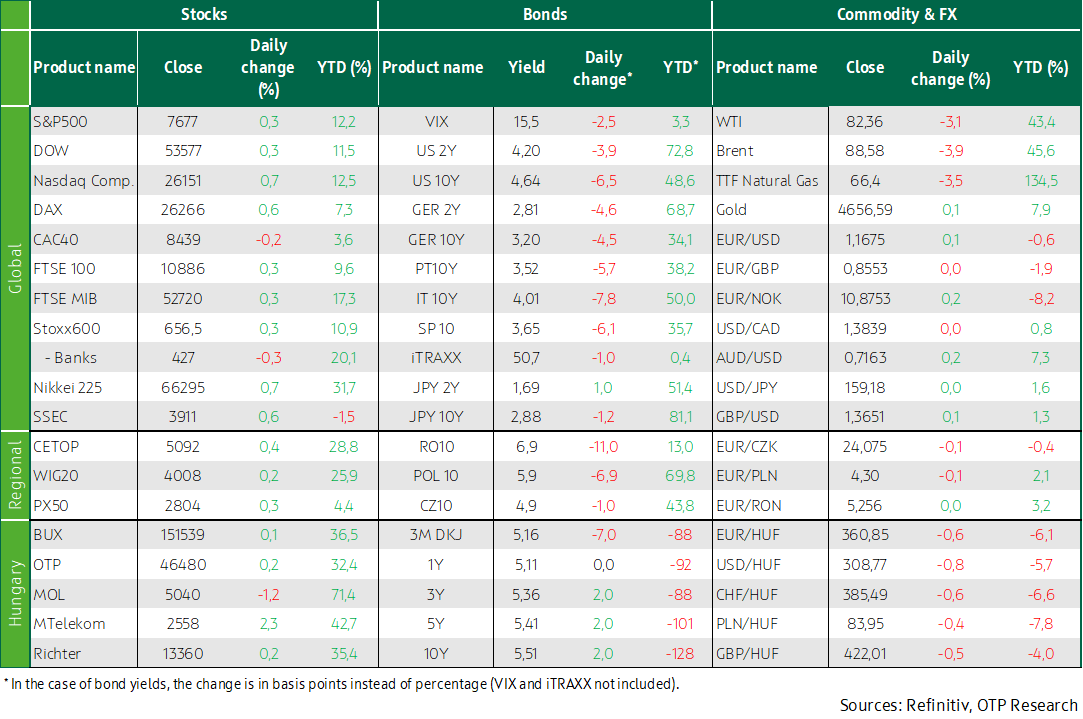
US equity markets closed higher yesterday, supported primarily by declining government bond yields and gains in semiconductor stocks. In addition, oil prices fell by more than 3%, further boosting risk assets. Technology shares, particularly chipmakers, were among the session’s top performers ahead of Nvidia’s earnings release on Wednesday. Nvidia rose 2.2%, snapping a seven-day losing streak, while AMD gained 4.9% and Micron Technology advanced 2.5%.
Uncertainty persisted, however, as Canada announced retaliatory tariffs against the US in response to the 50% duties imposed by the Trump administration over the weekend, intensifying the trade dispute between the two countries. Market sentiment was also weighed down by weaker-than-expected consumer confidence data. The Conference Board Consumer Confidence Index declined by 0.8 points to 89.4 in August from 90.2 in July, marking the second consecutive monthly deterioration in consumer sentiment and falling short of expectations for an unchanged reading. The underlying components, however, painted a mixed picture. The Present Situation Index rose by 6.8 points to 121.2, ending a three-month downward trend. In contrast, the Expectations Index fell by 5.8 points to 68.2, suggesting that households have become more pessimistic about economic and labor market prospects over the next six months.
In the US, new single-family home sales fell 10.5% month-on-month in July following the previous month's elevated level of 678,000 units, pushing the seasonally adjusted annualized sales rate down to 607,000 units, the lowest level since January. The market had anticipated a more moderate decline to 620,000 units. Supply conditions remained ample, with 488,000 new homes available for sale at the end of July, equivalent to 9.6 months of supply at the current sales pace, while the median sales price declined to $393,800, marking the lowest level in more than a year. Overall, the data point to weaker-than-expected activity in the US housing market. The sharp decline suggests that elevated financing costs and still-muted demand continue to weigh on the market for newly built homes. In contrast, June data provided a somewhat different picture on the pricing side, as the Case-Shiller Home Price Index showed 2.1% year-on-year house price growth, accelerating from 1.6% in May and exceeding the market consensus of 1.7%. As a result, annual house price growth reached its strongest pace since June 2025. Despite rising nominal home prices, the correction continued in real terms. Adjusted for CPI, house prices declined for the 13th consecutive month, as CPI of 3.5% outpaced the rate of house price appreciation.
Developed market bond yields edged lower, while the forint strengthened against the euro following the interest rate decision
US Treasury yields continued to decline yesterday. The yield on the 10-year Treasury fell by more than 6 basis points to 4.64%, while the yield on the rate-sensitive 2-year note eased to 4.2%. The decline in yields was primarily driven by a more than 3% drop in oil prices after the US shifted its focus toward economic sanctions rather than military action against Iran. Lower energy prices helped ease inflation concerns, providing support to the bond market. Investor sentiment was also supported by expectations that the US Treasury could use part of its nearly $1 trillion cash balance to finance its bond buyback program. This could reduce future issuance pressure, exerting downward pressure on yields. Investors are now focusing on the release of July's PCE inflation data later this week, a key gauge closely monitored by the Fed, as well as Fed Chair Kevin Warsh's speech at Jackson Hole on Friday, which may provide important guidance on the outlook for monetary policy and long-term bond yields.
Contrary to global trends, Hungarian yields beyond the one-year maturity edged up by 2 basis points across the curve yesterday, with the exception of the unchanged one-year benchmark. As a result, the 10-year yield closed at 5.51%. The forint strengthened against the euro following the widely expected rate cut and the central bank’s cautious communication, ending the day below 361 EUR/HUF. Meanwhile, the euro was little changed against the dollar, fluctuating near the 1.17 level.
Today's highlights
Major Asian indices were mixed this morning. Japan’s Nikkei advanced, supported by lower oil prices, which are beneficial for Japan as a net energy importer. Shares of several Asian companies linked to the AI sector also moved higher, with Samsung Electronics and SK hynix among the notable gainers.
Today, the focus will be on US data releases covering CPI, household spending and income, durable goods orders, and the detailed breakdown of Q2 US GDP. In Hungary, the statistical office will publish data on the performance of investment activity.
Get more out of your investments!
Global Markets Services
OTP Global Markets offers a broad range of services in the field of local and international money and capital markets.
Read morePrivate Banking Services
Personal care and expertise with OTP Private Banking, along with the knowledge, security, and innovations of a multinational banking group.
Read more