
OTP Morning Brief: Major stock markets ended the week in negative territory despite a strong performance on Friday
Related content
OTP Morning Brief: Earnings season continues to drive equities higher, while the French 10-year yield climbs above 5%
Stock markets moved higher yesterday in both Europe and the US, with technology stocks leading the gains on both sides of the Atlantic. Individual earnings reports released so far do not indicate that the AI investment boom is set to slow in the coming months. French financial indicators, however, are coming under increasing pressure from social and political uncertainty across both the corporate and public sectors: while French retail giant Carrefour issued a profit warning due to the unrest, French long-term bond yields soared to their highest level since 2002. The rise in yields also affected other countries, with the yield on 10-year Hungarian government bonds moving higher as well.
OTP Morning Brief: Better-than-expected earnings reports supported US equity indices
Major European indices closed slightly lower yesterday; Germany’s ZEW index declined more than expected; the UK unemployment rate developed favourably; and the MNB left its base rate unchanged, in line with expectations. Major indices closed mostly higher, supported by favourable earnings reports; several companies with significant AI exposure rebounded following the recent sell-off, while housing market data continued to point to weak activity in the US. Long-term US and European bond yields edged lower, while Hungarian long-term government bond yields rose more markedly following their decline in recent days. Today, UK CPI data will be in the spotlight.
Developed markets moved largely in tandem: both Europe and the US posted gains on Friday, although this was not enough in either region to prevent the major indices from ending the week in negative territory. August PMI data for both the US and the euro area came in stronger than expected, providing a modest boost to optimism across both regions. Bessent announced on Wednesday an expansion of US Treasury buybacks, but the move only managed to push yields lower temporarily. Asian equities opened the week lower. This week, the Hungarian central bank's rate-setting meeting will be worth watching closely.
The Stoxx 600 advanced on Friday, but still ended its second consecutive week in negative territory as robust August data were released for the euro area
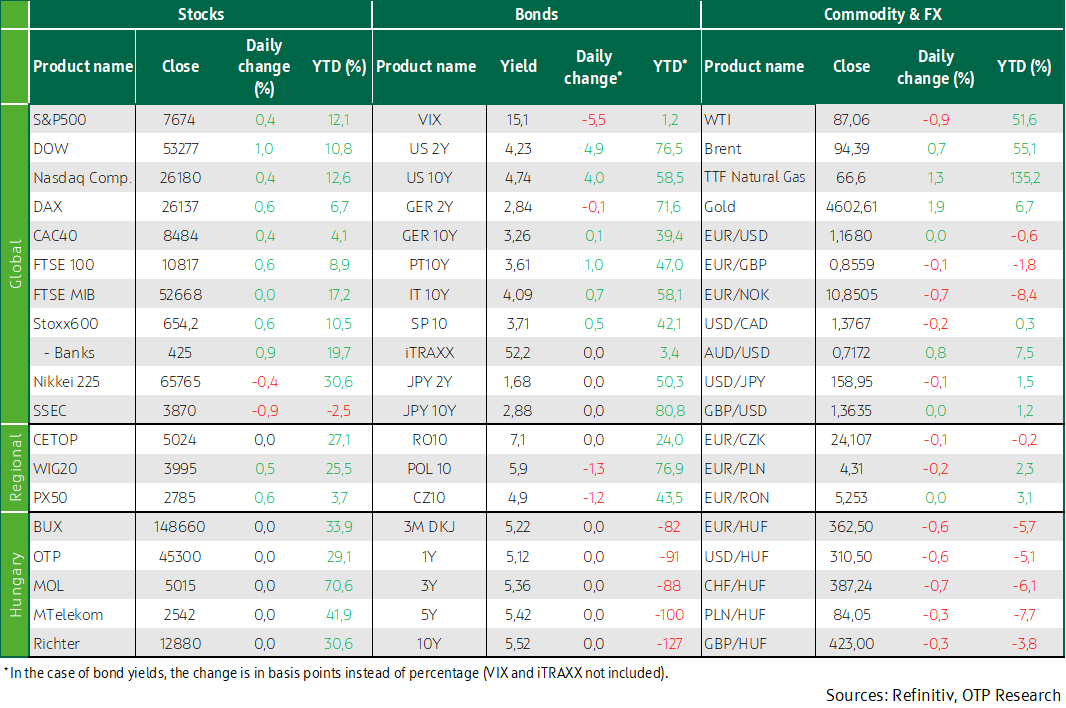
European equity markets closed higher on Friday as investors focused on signs of economic resilience, although the benchmark Stoxx 600 still ended the week down 0.6% overall. Concerns about CPI remained elevated amid persistently high oil prices and rising US Treasury yields. The pan-European STOXX 600 gained 0.6% on the final trading day of the week, but nevertheless recorded its second consecutive weekly decline. France’s CAC 40 advanced 0.4%, while Germany’s DAX and the UK’s FTSE 100 both added 0.6% on Friday. However, only the FTSE 100 finished the week in positive territory, up 0.6%, whereas the other two benchmark indices closed more than 1% lower over the course of the week.
Among sectors, luxury goods makers gained 1.4%, recovering part of the sharp losses recorded the previous day, while basic materials companies led the market higher with a 2.5% increase, supported by a weaker dollar and the resulting rise in gold prices. The retail sector advanced 1.0%, with JD Sports soaring 5.6% and partially recouping the previous session’s 14% plunge following a downgrade to its profit outlook. Among the weakest performers of the day were energy stocks, along with utilities and defence companies.
European sentiment was further supported by data showing that euro area business activity expanded at its fastest pace of the year in August, driven primarily by stronger new orders, improving manufacturing performance, and a renewed increase in export demand. The euro area's Composite Output PMI rose to 52.1 in August from 52.0 in July, marking its highest level since November 2024 and exceeding analysts’ expectations of 51.7. The manufacturing index surged by nearly one point to 52.8, while the services PMI remained unchanged at 51.7.
The CEE region was represented on Friday only by the Polish and Czech markets, as the Hungarian market was closed on August 20 and 21. The former gained 0.5% and the latter 0.6%, although both national indices still finished the week in negative territory. Meanwhile, the BUX ended its shortened trading week on Wednesday with a loss of 1.3%.
A similar pattern was observed in the US, where the services sector remained the main driver of economic growth in August
US equity markets closed higher on Friday, but still ended the week in negative territory as investor sentiment continued to be shaped by fluctuations in bond yields and uncertainty surrounding developments in the Middle East. The Dow Jones gained 1.0%, while the S&P 500 and Nasdaq each advanced 0.4% during Friday’s session. On a weekly basis, however, the S&P 500 lost 1.4%, the Nasdaq declined 2.1%, and the Dow Jones fell 0.8%. Most of the S&P 500’s 11 major sectors finished Friday in positive territory. Materials stocks led the gains with a 2.2% increase, followed by healthcare, which rose 1.3%, and financials, up 1.0%. Among the weaker performers, utilities were by far the worst-hit sector, declining 2.3%. Cryptocurrency-related stocks posted strong gains on Friday after Bitcoin surged 6.4% to its highest level since mid-May. Shares of retail trading platform Robinhood soared 13.7%, while Coinbase climbed 8.2%. Strategy, which holds substantial Bitcoin exposure, also performed strongly, rising 6.0% in line with the leading cryptocurrency’s advance.
The US services sector recorded its strongest growth since December 2024 in August, with the S&P Global Flash Services PMI rising from 54.6 to 56.8. As a result, the Composite PMI also improved significantly, increasing from 54.5 to 56.0, its highest level since April 2022. Robust expansion in services more than offset slower growth in manufacturing, where the PMI slipped from 53.9 to a five-month low of 53.2. As a result, the acceleration in overall economic activity was driven primarily by the services sector, while manufacturing growth was constrained by a slowdown in inventory accumulation and supply chain disruptions linked to the conflict involving Iran.
International and US crude oil prices moved higher on Friday after US President Donald Trump threatened economic sanctions against Iran’s trading partners, reinforcing market expectations of tighter supply. Iran’s foreign minister rejected the threat on Sunday, stating that any new US sanctions would represent another unsuccessful attempt to pressure Tehran. Brent crude rose 0.7% to USD 94.39 per barrel and ended the week with a gain of 3.9%.
US Treasury yields rose despite Bessent’s intervention, while the dollar weakened
US Treasury yields edged higher on Friday, capping an exceptionally volatile week dominated by bond market selloffs. Investor sentiment was influenced by stronger-than-expected August data from the US services sector, which pointed to continued resilience in the economy. The yield on the two-year US Treasury note rose 4.7 basis points to 4.232%, while the benchmark 10-year yield increased 3.8 basis points to 4.736%. The yield on the 30-year Treasury climbed 3.9 basis points to 5.276%. Although this remained below the more than decade-high levels reached earlier in the week, it was still above the levels seen following Treasury Secretary Scott Bessent’s announcement of an expanded bond buyback programme. Beyond the bond market, the US Treasury’s plan to broaden repurchases of longer-dated government securities also added pressure on the US dollar, which weakened by nearly 1% against the euro over the course of the week. Meanwhile, euro area sovereign bond markets presented a much calmer picture, with yields showing little change on Friday following a week marked by tensions across global fixed-income markets. The yield on Germany’s 10-year government bond, the benchmark for the euro area, was flat at 3.2572%, although it had reached a fresh 15-year high earlier in the week.
During the shortened trading week, Hungarian short-term yields declined, with the yield on the three-month Treasury bill falling by 3 basis points and the one-year government bond yield decreasing by 7 basis points. Meanwhile, longer-dated yields ended the week 8 to 10 basis points higher, reflecting the increases recorded during the first two trading days of the week. On Wednesday, the Government Debt Management Agency (ÁKK) held an auction of three-year, five-year and more than ten-year government bonds, which attracted strong investor demand. In the case of the ten-year bond, bids worth HUF 30.5 billion were accepted compared with the originally offered HUF 25 billion, while for the two shorter maturities the full HUF 20 billion offered was accepted. Over the course of the week, the forint strengthened slightly against the euro, reaching the 362.5 level.
Today's highlights
Sentiment in Asia was negative as investors awaited forthcoming US sanctions announcements, while Iran threatened to halt all oil exports through the Persian Gulf in response. The Nikkei fell 0.4%, the SSEC declined 0.9%, and the Kospi dropped nearly 3.0%. Alibaba shares plunged 8.9% in Hong Kong trading on Monday after the Chinese technology giant announced a USD 10.2 billion share offering at a substantial discount to the market price. The company intends to use the proceeds to fund its artificial intelligence initiatives; however, investors remain concerned about the dilutive impact of the issuance and the risks associated with executing its strategy.
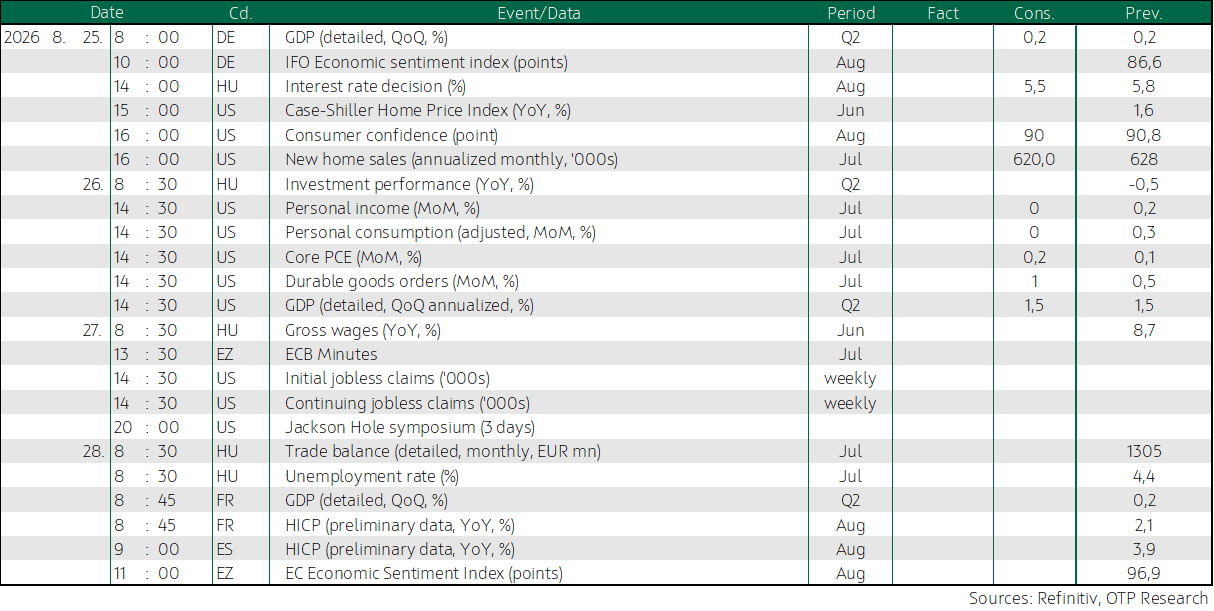
Tomorrow will bring the release of detailed German GDP data as well as the Ifo Business Climate Index, alongside US housing sales figures and consumer sentiment data. For Hungarian investors, however, the primary focus is likely to be on the MNB’s interest rate decision. Following its June meeting, the central bank effectively signalled rate cuts for both July and August.
Although the international environment has deteriorated since then and the forint is weaker than it was at the time, the latest surprisingly low CPI reading (July: 1.2% year-on-year) provides strong support for the continuation of rate cuts in August. As a result, the Hungarian policy rate is expected to be reduced by 25 basis points tomorrow, bringing it down to 5.50%.
Later this week, on Wednesday, the core PCE, the Fed’s most closely watched CPI gauge, will be released. Following June’s 0.13% month-on-month reading, July CPI data that came in broadly in line with expectations, together with a more favourable-than-expected producer price index, suggest that monthly core PCE likely came in around 0.16% to 0.20% in the previous month. In addition, detailed Q2 GDP data for the US will also be published on Wednesday.
In addition, Nvidia is scheduled to release its quarterly earnings report on Wednesday, which could prove to be a significant market-moving event.
Get more out of your investments!
Global Markets Services
OTP Global Markets offers a broad range of services in the field of local and international money and capital markets.
Read morePrivate Banking Services
Personal care and expertise with OTP Private Banking, along with the knowledge, security, and innovations of a multinational banking group.
Read more