
OTP Morning Brief: Geopolitical risks have once again moved to the forefront
Related content
OTP Morning Brief: Further declines in the US technology sector on Friday
Selling pressure on the technology sector remained elevated across developed equity markets on Friday. However, favorable corporate earnings offset the weakness in the IT sector in Europe. European equity markets also posted weekly gains, marking their strongest weekly performance since June. In the US, the decline in equity indices continued, with concerns surrounding AI-related companies further amplified by the CoreWeave episode. The sell-off in equity markets prompted investors to shift toward safer assets, while long-term bond yields continued to decline. The US 10-year Treasury yield declined by 15 bps over the past week, closing Friday’s session at 5.1%, supported in part by easing expectations of further rate hikes. Based on futures pricing, the Fed is expected to leave interest rates unchanged at next week’s meeting. Eurozone bond yields also moved lower, tracking developments in overseas fixed-income markets. The euro strengthened to 1.124 against the dollar. Long-term yields also declined sharply in the Hungarian government bond market over the past week, with the 10-year yield falling by 29 bps to a three-month low of 5.31%. Oil prices continued to rise amid the unresolved situation in the Middle East. European natural gas futures soared to an early four-year high over the past week. This week, in the Hungarian market, attention will focus on the 2027 budget to be released today and the MNB’s interest rate decision meeting on Tuesday.
OTP Morning Brief: US producer price index came in above expectations, yet the US 10-year Treasury yield still declined
Western European equities continued to advance despite ongoing pressure on the technology sector. Wall Street indices also rebounded, recovering some ground after Wednesday’s sell-off. Healthcare was the standout performer on both sides of the Atlantic. Eurozone industrial production declined by 0.5% month-on-month in August. In the US, the producer price index accelerated to 6.3%, delivering another upside surprise in inflation developments. US retail sales increased by 0.8% compared to August. The US 10-year Treasury yield declined by more than 10 basis points. The long end of the Hungarian government bond yield curve also declined by 7-9 basis points. In Hungary, August wage data will be released today, while in the US, September industrial production figures are due.
Major European and US equity indices closed lower on tuesday, with the technology sector underperforming particularly sharply. Oil prices were supported by escalating US-Iran tensions and uncertainty surrounding the Strait of Hormuz, resulting in a rise in crude prices. US Treasury yields declined, while the yield on Germany’s 10-year Bund rose to its highest level since 2011. The forint weakened against major currencies. Investors will focus on the release of the Fed minutes and the UK CPI data later today.
STOXX 600 falls to a multi-week low as elevated yields and Middle East tensions keep markets under pressure
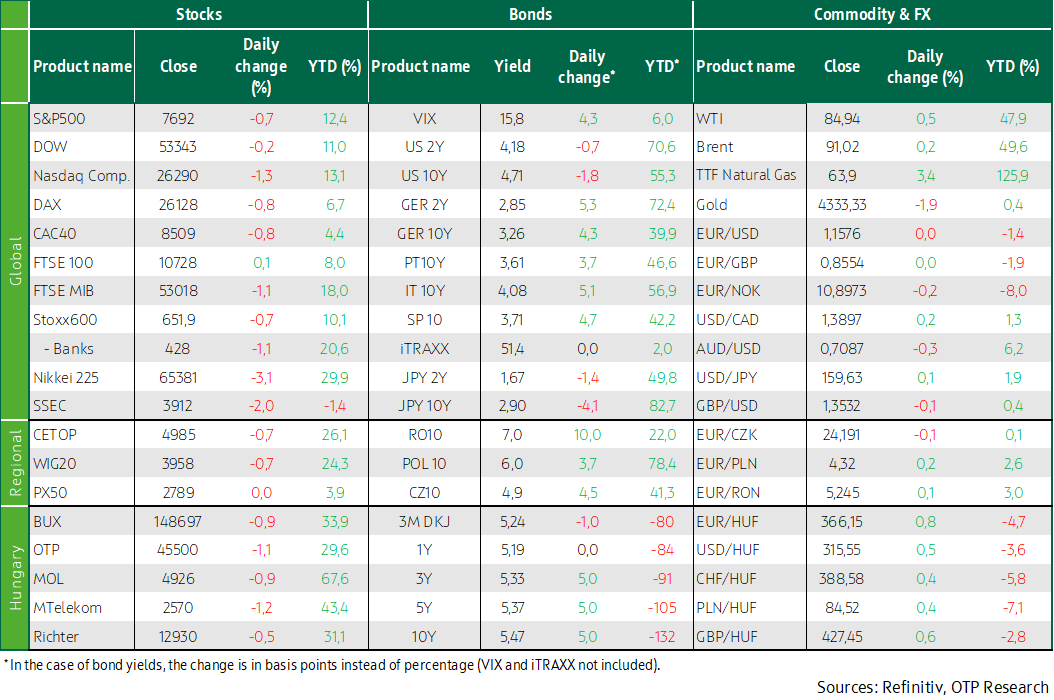
European equity markets were dominated by a risk-off sentiment on Tuesday, as investors primarily priced in the implications of developments in the Middle East and the elevated yield environment. The STOXX 600 index fell by 0.7%, slipping to its lowest level in more than two weeks. Rising bond yields weighed particularly heavily on technology stocks, making the sector the weakest performer of the day. Germany’s Infineon dropped 7.6%, while Aixtron declined 8.8%. In contrast, energy stocks were supported by rising oil prices, while the healthcare sector ranked among the session’s best performers. Among individual stocks, Sweden’s H&M gained 4.1%, Switzerland’s Huber+Suhner tumbled 11.4%, and Denmark’s Coloplast advanced 3.0%. Among the major Western European indices, the DAX fell 0.8% and the CAC 40 lost 0.8%, while the FTSE 100 closed virtually unchanged. Overall, cautious investor sentiment continued to dominate trading across European markets.
Central and Eastern European markets also moved lower, with Hungary’s BUX declining 0.9% and Poland’s WIG20 slipping 0.7%, while the PX index was broadly flat. On the Budapest Stock Exchange, all blue-chip stocks closed in negative territory: OTP fell 1.1%, Richter lost 0.5%, Magyar Telekom declined 1.2%, and MOL shed 0.9%.
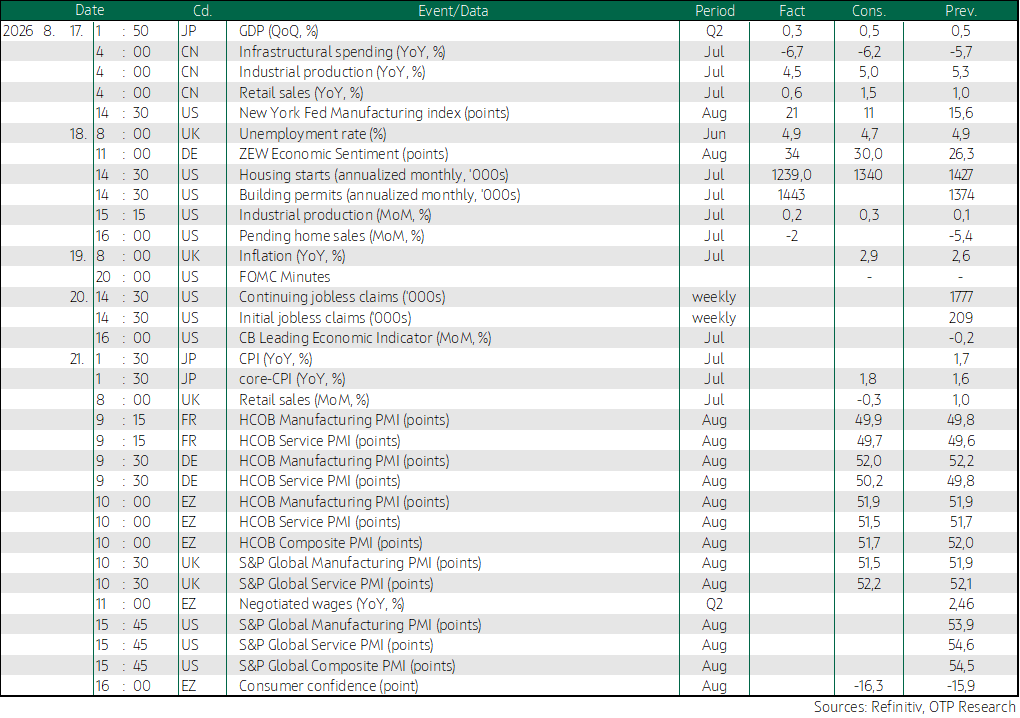
Despite ongoing market uncertainty, investors also received encouraging macroeconomic signals. In Germany, the ZEW investor sentiment index rose to 34.2, surpassing expectations and pointing to an improving economic outlook. In the United Kingdom, the unemployment rate remained unchanged at 4.9%, while employment continued to increase, highlighting the resilience of the labour market, although annual figures suggest some moderation in momentum.
Technology stocks lead Wall Street lower as Middle East tensions and rising oil prices weigh on sentiment
Investor sentiment on Tuesday was primarily driven by developments surrounding the conflict in the Middle East. Diminishing prospects for a US-Iran diplomatic resolution and uncertainty surrounding the Strait of Hormuz pushed oil prices higher, with Brent remaining above $90 per barrel and WTI trading around $85. The increase in energy prices brought CPI-related risks back into investors’ focus. Major US equity indices closed in negative territory, with the Dow declining 0.2%, the S&P 500 falling 0.7%, and the Nasdaq shedding 1.3%, leaving the latter at a two-week low. Trading was characterized by a risk-off tone, while energy companies benefited from the rise in crude oil prices.
The heaviest pressure was concentrated in the technology and semiconductor sectors. The Philadelphia Semiconductor Index fell nearly 5%, while Nvidia declined 2.3% and Meta Platforms dropped 4.5%. Micron, Western Digital, and SanDisk also posted substantial losses. In contrast, Microsoft, Salesforce, and Intel ranked among the better-performing technology stocks.
On the macroeconomic front, the latest data from the US economy painted a mixed picture. Building permits rose by 5.0% in July, exceeding expectations and suggesting that an expansion in housing supply remains on the agenda. In contrast, housing starts fell 12.4%, while pending home sales declined 2.3%, indicating that elevated mortgage rates and high property prices continue to weigh on demand. Meanwhile, industrial production increased by 0.2% in July, missing market expectations but still pointing to moderate and continued economic growth. Investor attention is also focused on the minutes from the Fed’s July meeting and next week’s Jackson Hole symposium, both of which could provide further clues regarding the future path of monetary policy.
Developed market yields were mixed, while Germany’s 10-year Bund yield climbed to its highest level since 2011
In the US Treasury market, yields declined across both longer and shorter maturities, although investors remained focused on widening fiscal deficits, increasing government debt issuance, and CPI-related risks. After reaching a 19-year high of 5.31% on Monday, the yield on the 30-year US Treasury eased to around 5.29% on Tuesday. Shorter-dated yields also moved lower, with the 10-year Treasury yield declining 2.4 basis points to 4.70%, while the 2-year yield fell 1 basis point to 4.17%. In addition, substantial capital raising by technology companies to finance AI-related investments is intensifying competition for funding, placing upward pressure primarily on longer-term yields.
In Europe, however, yields moved higher. The yield on Germany’s 10-year Bund rose by 4 basis points to 3.26%, reaching its highest level since 2011. Hungarian government bond yields also increased, with benchmark yields beyond one year advancing by 1 to 5 basis points. The 10-year benchmark yield climbed nearly 4 basis points to 5.51%.
In the foreign exchange market, the US dollar strengthened modestly, with the EUR/USD exchange rate edging down to 1.1575. The forint weakened against major currencies, with EUR/HUF rising to 366.2 and USD/HUF climbing to 315.5.
Today's highlights
Trading in Asia also reflected a negative mood on Wednesday, with Japan’s Nikkei falling nearly 3% and South Korea’s KOSPI dropping more than 4.5%. Losses were concentrated in the technology sector, as shares of Samsung and SK Hynix fell more than 6% each, while Japan’s SoftBank declined nearly 6.5%.
Today's macroeconomic calendar will be highlighted by the release of the UK’s July CPI data and the minutes from the Fed’s July policy meeting.
Later this week, US labour market data and the Conference Board’s Leading Economic Index may provide further insight into the current state of the economy. On Friday, preliminary August PMI surveys from the euro area, Germany, France, the United Kingdom, and the US will take centre stage. Investors will also be monitoring Japan’s latest CPI data, UK retail sales figures, and euro area wage growth and consumer confidence indicators.
The next publication will be released on August 24.
Get more out of your investments!
Global Markets Services
OTP Global Markets offers a broad range of services in the field of local and international money and capital markets.
Read morePrivate Banking Services
Personal care and expertise with OTP Private Banking, along with the knowledge, security, and innovations of a multinational banking group.
Read more