
OTP Morning Brief: The S&P pulled back from its record high on Friday, but ended the week in positive territory
Related content
OTP Morning Brief: US producer price index came in above expectations, yet the US 10-year Treasury yield still declined
Western European equities continued to advance despite ongoing pressure on the technology sector. Wall Street indices also rebounded, recovering some ground after Wednesday’s sell-off. Healthcare was the standout performer on both sides of the Atlantic. Eurozone industrial production declined by 0.5% month-on-month in August. In the US, the producer price index accelerated to 6.3%, delivering another upside surprise in inflation developments. US retail sales increased by 0.8% compared to August. The US 10-year Treasury yield declined by more than 10 basis points. The long end of the Hungarian government bond yield curve also declined by 7-9 basis points. In Hungary, August wage data will be released today, while in the US, September industrial production figures are due.
OTP Morning Brief: US CPI data came in above expectations
European equity markets advanced, supported by strong results from ASML and the outstanding performance of the healthcare sector. US equity markets came under pressure following higher-than-expected September CPI data. The annual CPI rate accelerated to 3.7%, driven primarily by a surge in gasoline prices, while core CPI rose by 0.3% month-on-month, supported by higher housing costs and rising transportation service prices. Oil prices rose amid escalating tensions in the Middle East and the impact of the IEA's oil market report. US Treasury yields retreated after an initial increase, driven by Fed commentary, while European bond yields generally moved higher. The US macro calendar will be busy today, with investors focusing on September retail sales and producer price index data, as well as the New York Fed Manufacturing Index, weekly jobless claims, and business inventories. August industrial production data from the euro area will be released today.
European stocks closed slightly lower on Friday, snapping a four-week winning streak. The BUX presented a much more positive picture in terms of its weekly performance. The eurozone economy expanded by 0.4% quarter-on-quarter in Q2, supported by Spain’s outstanding performance. Major US indices also closed lower on Friday, but the week was largely positive overall. Investor sentiment continued to be weighed down by uncertainty in the Middle East and elevated oil prices. US Treasury yields rose and the dollar weakened following weaker-than-expected retail sales data. Japan's Q2 GDP growth fell short of expectations, while Asian equity markets moved higher. August purchasing managers' indices are due for release this week.
European stocks snap a four-week winning streak after a modest pullback
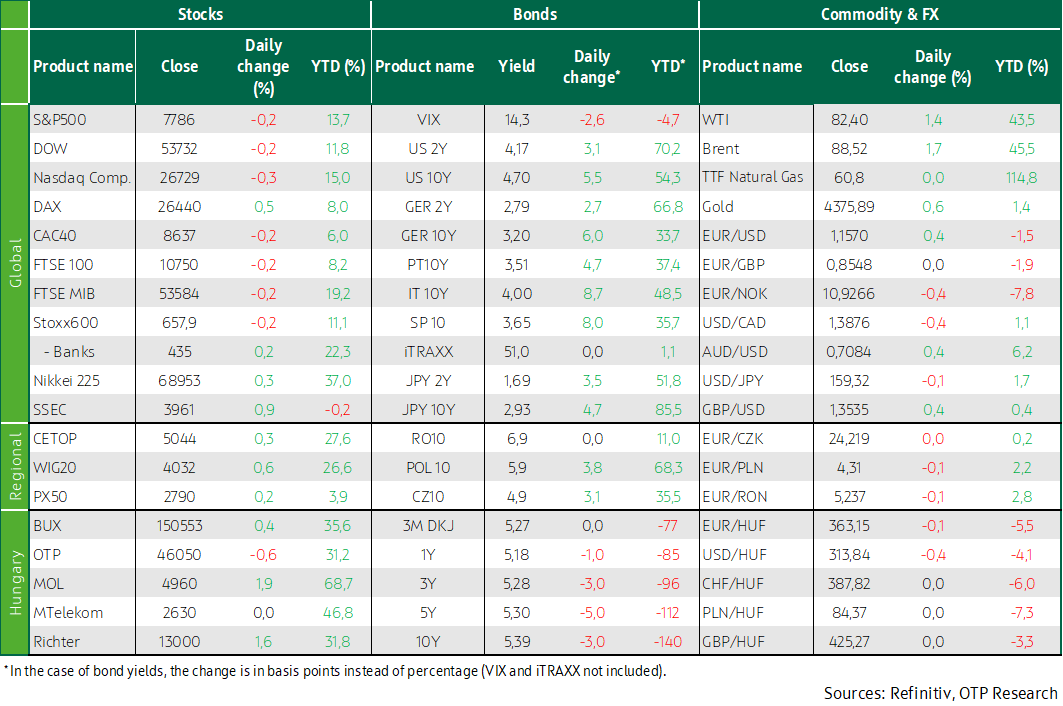
The Stoxx 600 edged 0.2% lower by the close on Friday, leaving the index down 0.4% for the week and marking its first weekly decline after four consecutive weeks of gains. A strong earnings season was offset by rising oil prices and geopolitical risks, as there was still no visible resolution to the situation surrounding the Strait of Hormuz. National benchmarks delivered mixed performances: the DAX advanced 0.5%, while the CAC 40 and FTSE 100 both slipped 0.2%. Weekly performance mirrored these trends, with the DAX also gaining 0.5% over the week, whereas the CAC 40 lost nearly 1% and the FTSE 100 fell 1.4%. Healthcare stocks were the weakest performers on Friday, with the sector declining 1.5%, partly driven by a 5.8% drop in Zealand Pharma shares. In contrast, defence stocks climbed 1.2%, led by Rheinmetall, whose share price rose 3.2%. Among European software companies, SAP gained 2.7%, Nemetschek surged 8.4%, and Temenos added 1.8%. Maersk shares soared 8.7% to their highest level in four years, extending gains that began on Thursday following stronger-than-expected quarterly results and an upgraded company outlook.
Data releases confirmed the eurozone's 0.4% quarter-on-quarter growth rate in the second estimate, as strong momentum in artificial intelligence-related investment, substantial government spending, and several one-off factors offset the negative effects of the conflict involving Iran and higher energy prices. Among the euro area's largest economies, Spain once again delivered the strongest growth, expanding by 0.7%. Meanwhile, Q2 employment increased by 0.1% quarter-on-quarter, in line with analysts' expectations.
The CEE region painted a much more positive picture than its Western European peers, with the PX 50 gaining 0.2%, the BUX rising 0.4%, and the WIG20 advancing 0.6%. As a result, all three indices finished the week in positive territory, led by the BUX, which climbed 1.3%. Hungary's blue-chip stocks delivered mixed performance, with OTP slipping 0.6%, while MOL rose nearly 2% on Friday, helping the stock end the week up 6.7%.
The S&P pulled back from its record high on Friday, but ended the week in positive territory
Following European markets, the major US indices also posted modest losses on Friday. The S&P 500 slipped 0.2% from Thursday's record high, while the Dow declined by a similar margin and the Nasdaq fell 0.3%. Nevertheless, both the S&P 500 and the Nasdaq finished the week in positive territory, gaining 0.4% and 0.1%, respectively, while the Dow lost 0.6% over the course of the week. Investor sentiment was dampened by the near-total halt of shipping traffic through the Strait of Hormuz after two additional vessels came under attack in the region. At the same time, the US stated that it could maintain Iran's maritime blockade indefinitely if necessary, while a senior Iranian source reported on Wednesday that no progress had been made in negotiations based on the June agreement aimed at ending the conflict.
The S&P 500 energy sector index rose 1.4%, tracking higher oil prices. Applied Materials shares fell 5.1%, as the company's upbeat quarterly guidance failed to impress investors. With investors becoming increasingly concerned about elevated valuations across AI-related stocks, semiconductor names also came under pressure on Friday, with Broadcom shares dropping 5.9% and Intel declining 2.0%. Reddit shares soared nearly 13% after the social media company announced that it would join the S&P 500 index effective August 18.
US retail sales fell 0.6% month-on-month in July 2026, significantly missing the analyst consensus that had anticipated a 0.1% increase. The weaker-than-expected reading was primarily driven by a 2.2% decline in sales by non-store retailers, likely reflecting Amazon's decision to move its traditionally July-held Prime Day event to June this year. Meanwhile, the University of Michigan's consumer sentiment index dropped to 51.0 in the first half of August 2026 from 55.2 in July, falling short of market expectations of 54.5.
Brent crude rose above $88 per barrel on Friday, bringing its weekly gain to more than 5%, after the US intensified economic pressure on Iran in an effort to secure the reopening of the Strait of Hormuz. US Treasury Secretary Scott Bessent stated that Washington would impose unprecedented economic measures on Iran while maintaining its maritime blockade targeting Iranian ports. He also indicated that further announcements on the matter are expected next week.
US yields rise and the dollar weakens following weaker-than-expected retail sales data
US Treasury prices declined on Friday, weighed down in part by weaker-than-expected retail sales data, while persistent tensions in the Middle East continued to keep investors on edge. In afternoon trading, the yield on the policy-sensitive two-year US Treasury note rose 3.1 basis points to 4.171%. On a weekly basis, however, it remained 3.1 basis points lower, marking its third consecutive weekly decline. The benchmark 10-year US Treasury yield increased 4.9 basis points to 4.690%, while the 30-year Treasury yield climbed 4.7 basis points to 5.258%. Similar moves were seen in Europe, where the yield on the 10-year German Bund rose 5 basis points to 3.19% on Friday, bringing its total weekly increase to 6 basis points. The dollar weakened 0.4% against the euro on Friday.
In Hungary, longer-dated government bond yields moved lower, with the three-year and 10-year yields declining by 3 basis points and the five-year yield falling by 5 basis points. Despite Friday's decline, both the three-year and 10-year yields ended the week higher, while the five-year yield finished 1 basis point lower on a weekly basis. The forint strengthened slightly against the euro on Friday, closing just above the 363.1 level. As a result, it posted a marginal gain over the course of the week.
Today's highlights
Japan's economy grew at a slower-than-expected pace in Q2, weighed down by subdued household consumption and weak corporate investment. According to analysts, the shortfall was primarily the result of one-off factors, although the war involving Iran continued to fuel uncertainty and dampen business sentiment. Gross domestic product expanded at an annualised rate of 1.1%, missing both the market consensus of 2.0% and the previous quarter's upwardly revised growth rate of 1.9%. Chinese data releases scheduled for today had not yet been published at the time of writing.
Asian markets started the week higher, driven mainly by gains in the technology sector, with the Nikkei up 0.3%, the SSE Composite rising 0.9%, and the Kospi soaring 2.4%.
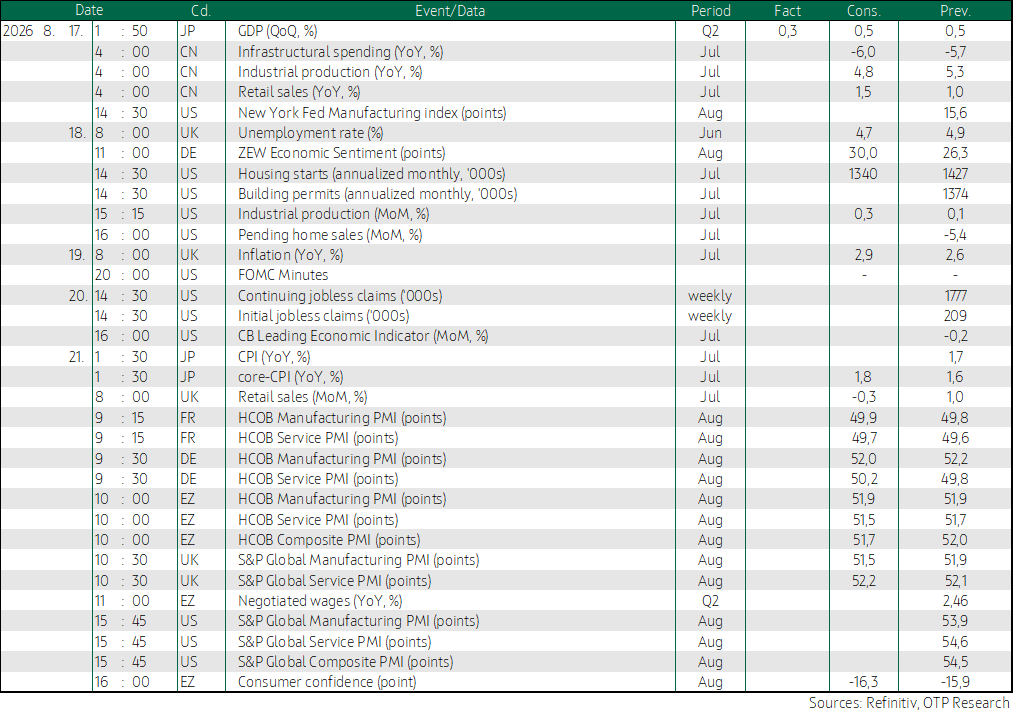
Today, the New York Fed's manufacturing index is due for release, while the remainder of the week will bring the August purchasing managers' indices for both Europe and the US. In Europe, negotiated wage growth data will also be published alongside the PMI releases, while in the US, investors will be watching July industrial production figures.
Get more out of your investments!
Global Markets Services
OTP Global Markets offers a broad range of services in the field of local and international money and capital markets.
Read morePrivate Banking Services
Personal care and expertise with OTP Private Banking, along with the knowledge, security, and innovations of a multinational banking group.
Read more