
OTP Morning Brief: Geopolitical risks remained in focus despite favorable CPI data
Related content
OTP Morning Brief: Oil prices rise, the technology sector struggles, and the earnings season gains momentum
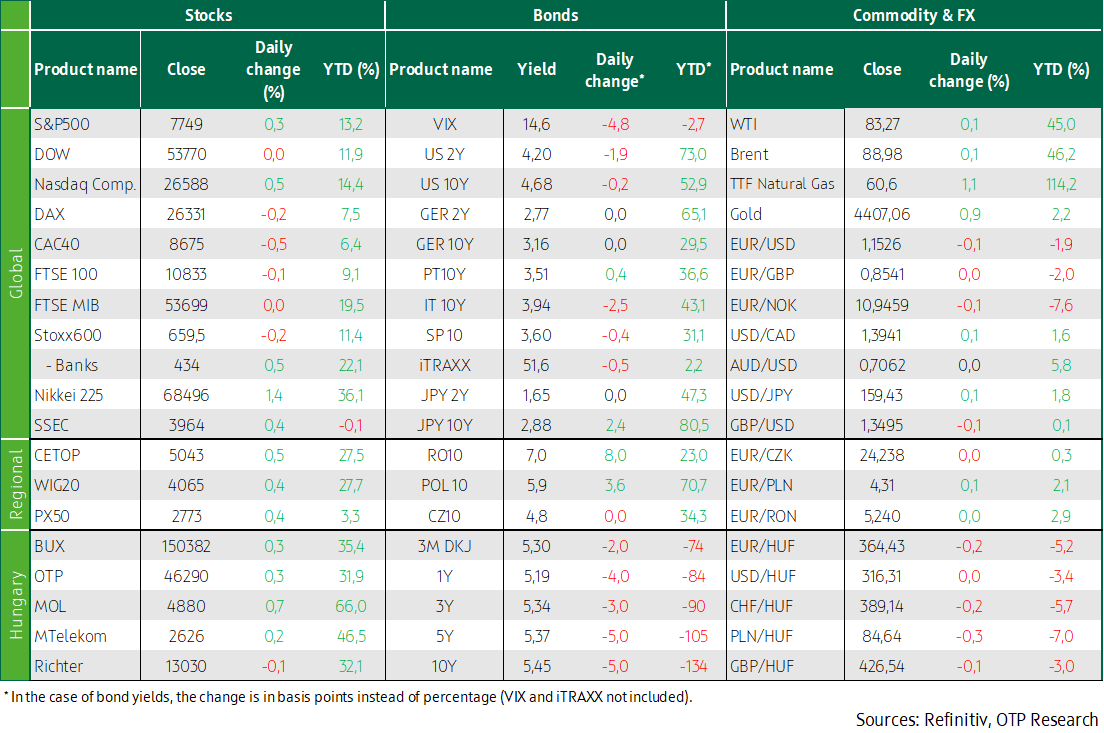
The major European stock indices closed Monday's session in positive territory, with banks and utilities leading the advance. The BUX gained 0.9%, while Hungary’s blue-chip stocks delivered a mixed performance. TTF gas prices remain above EUR 84/MWh. Wall Street indices delivered a mixed performance yesterday, with the technology sector under pressure and semiconductor manufacturers posting declines. We saw an approximately 2% rise in crude oil prices. The euro weakened against the dollar as investors grew concerned about France’s fiscal position and the outlook for next year’s presidential election. The EUR/HUF exchange rate fell below 365. The earnings season continues today with reports from major companies.
OTP Morning Brief: Modest gains in equities, stronger rise in energy prices
Both US and European equity markets posted modest gains last Friday. The BUX largely recouped the losses accumulated over the previous week. There was no positive turnaround in energy prices, however: oil prices rose both on the last trading day of the week and over the week as a whole, while European natural gas prices surged above EUR 82/MWh, reaching levels rarely seen since 2022. The US-Russia diesel agreement announced over the weekend is also unlikely to bring meaningful relief to the market, as the volumes involved are negligible relative to global demand. Following the sharp rise in yields seen in September, October has so far been characterized by ongoing uncertainty on bond markets as investors continue to search for direction.
Uncertainty surrounding the Middle East conflict and elevated oil prices kept European equity markets under pressure, while regional stock exchanges managed to post gains. US markets were supported by CPI data that came in line with expectations and the strong performance of the technology sector, with both the S&P 500 and the Nasdaq closing higher. US Treasury yields were mixed, the dollar strengthened against the euro, while the forint appreciated versus the euro. During the day, UK and Polish GDP figures, eurozone industrial production data, and the US Producer Price Index are likely to remain the primary focus for markets.
Leading European indices declined as the Middle East conflict and persistently high oil prices weighed on sentiment
Geopolitical risks moved to the forefront of investors’ attention in European markets, as there has still been no meaningful progress toward resolving the Middle East conflict. The STOXX 600 index declined by 0.2%. Investor sentiment was primarily shaped by uncertainty surrounding the Iranian conflict: despite six months of hostilities, no significant breakthrough toward a resolution has emerged, while renewed attacks on Middle Eastern shipping routes once again highlighted risks to energy supplies and global trade. Against this backdrop, defense and energy stocks outperformed, with the latter also benefiting from elevated oil prices, while the luxury goods and healthcare sectors lagged behind. At the company level, shares of Danish wind turbine manufacturer Vestas advanced on stronger-than-expected quarterly results and an upgraded full-year outlook, while German defense company TKMS gained on the back of improved sales guidance. Kingspan and Balfour Beatty also ranked among the session’s top performers following favorable corporate developments.
Sentiment was positive across the Central and Eastern European region, with the BUX rising 0.3%, while the WIG20 and PX indices both gained 0.4%. Most Hungarian blue chips closed higher: OTP advanced 0.3%, MOL added 0.7%, and Magyar Telekom rose 0.2%, while Richter slipped 0.1%.
Leading US indices advanced as AI sector strength and in-line CPI data supported investor sentiment
The situation in the Middle East remained a source of uncertainty for markets, as no progress was made in negotiations aimed at resolving the Iranian conflict, while incidents affecting commercial shipping continued in the Strait of Hormuz and the Red Sea region. Oil prices showed volatile trading throughout the session: geopolitical risks initially pushed prices higher, but downward revisions to demand forecasts by OPEC and the International Energy Agency, together with rising US crude inventories, ultimately weighed on the market. Brent crude closed near $89 per barrel, while WTI settled above $83 per barrel.
US equity markets closed higher. The Dow was essentially unchanged, while the S&P 500 gained 0.3% and the Nasdaq advanced 0.5%, bringing the latter closer to its all-time high. Investor sentiment was primarily supported by the strong performance of the technology sector, with the S&P 500 information technology index rising 1%, while the semiconductor sector posted a gain of nearly 3%. Companies linked to AI infrastructure remained in focus: CoreWeave surged nearly 20% after raising its annual capital expenditure guidance and reporting better-than-expected quarterly results, while AI server manufacturer Super Micro Computer soared 19% on the back of a 2027 revenue forecast that exceeded expectations. Positive sector sentiment also supported shares of Nvidia, which rose 3%, and Micron, which gained 4.9%.
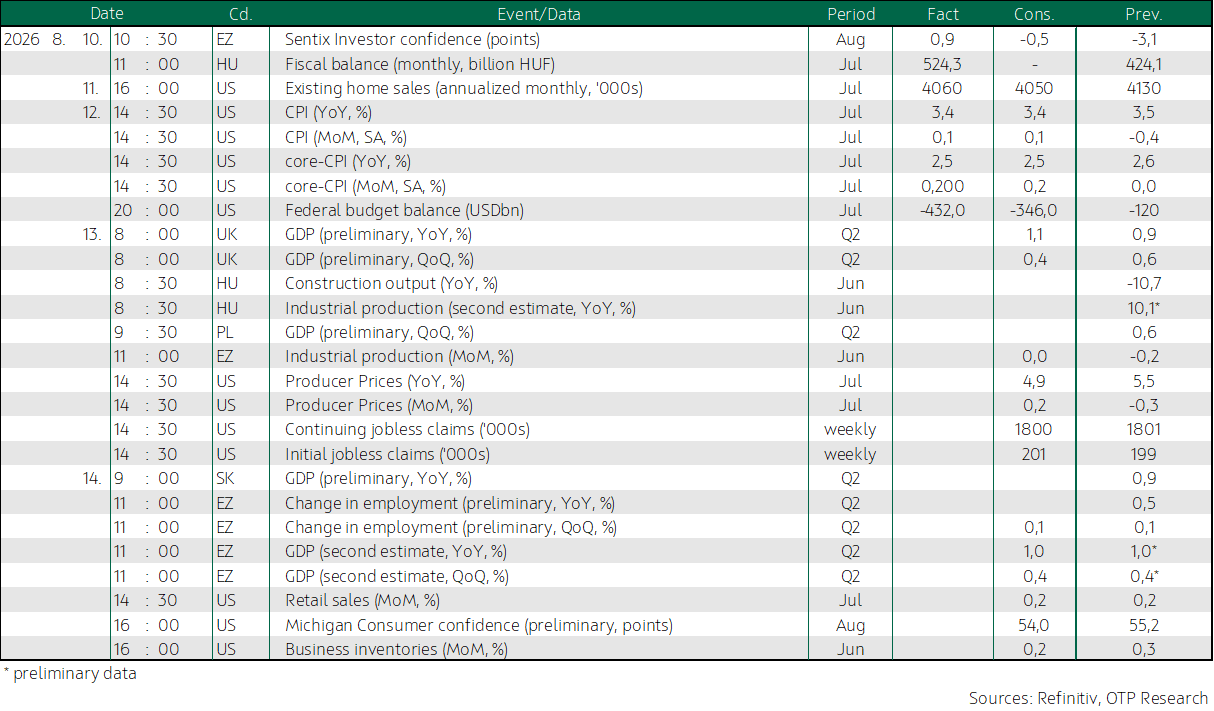
Sentiment received a further boost as US CPI remained muted and broadly in line with expectations in July. Headline CPI eased for a second consecutive month on an annual basis, while core CPI fell to 2.5% from 2.6% in the previous month, reaching a five-month low. On a monthly basis, both headline and core CPI increased in line with expectations following June’s decline and flat reading, respectively, although underlying price pressures remained subdued overall. Rising housing costs continued to contribute positively to monthly consumer price developments, while fuel prices declined compared to the previous month. The monthly increase in core CPI was driven primarily by higher prices for medical equipment, transportation services, and used cars and trucks.
At the same time, the US federal budget deficit widened to $432 billion in July 2026, compared with $291 billion a year earlier and market expectations of $346 billion. The increase was primarily driven by a significant rise in government spending, particularly on Medicare, Social Security benefits, interest payments, and defense expenditures. Meanwhile, budget revenues declined slightly from the previous year, further contributing to the deterioration in the fiscal balance.
The forint strengthened against the euro, while the dollar outperformed the euro
Following the release of July CPI data, movements in the US Treasury market were mixed. The 2-year benchmark yield declined by 2 basis points, while the 10-year yield was broadly unchanged, closing at 4.68%. The moderation in annual CPI eased expectations surrounding the September policy meeting. Markets are increasingly pricing in the possibility that the Federal Reserve will leave its benchmark interest rate unchanged at its next meeting. In Europe, the yield on the 10-year German Bund also remained largely stable. In the foreign exchange market, the euro weakened 0.14% against the dollar, with the EUR/USD exchange rate falling to 1.1526. Market sentiment continues to be influenced by developments related to the Middle East conflict and risks affecting energy markets.
International market developments were also reflected in Hungarian assets. The forint strengthened against the euro, with the EUR/HUF exchange rate falling to 364.43, while it remained broadly unchanged versus the dollar, with USD/HUF closing at 316.31. Slightly lower short-term US yields and a more favorable global risk environment provided support for regional currencies.
Today's highlights
Asian equity markets traded in positive territory, with the MSCI Asia-Pacific ex-Japan index rising 1.0%. Japan’s Nikkei gained 1.4%, while South Korea’s Kospi advanced 4.4%. In the foreign exchange market, the yen strengthened modestly against the dollar as investors increasingly expect the Bank of Japan to raise interest rates as early as September.
Today's macroeconomic calendar will be highlighted by UK and Polish GDP figures, Hungarian construction and industrial production data, as well as eurozone industrial output. Later in the day, market attention is likely to turn to the US Producer Price Index and weekly initial jobless claims data.
Get more out of your investments!
Global Markets Services
OTP Global Markets offers a broad range of services in the field of local and international money and capital markets.
Read morePrivate Banking Services
Personal care and expertise with OTP Private Banking, along with the knowledge, security, and innovations of a multinational banking group.
Read more