
OTP Morning Brief: Eurozone CPI rose in line with expectations
Related content
OTP Morning Brief: Developed market bond yields edged lower yesterday
European indices declined yesterday amid rising oil prices, while the German government revised its GDP growth forecast upward; German exports lost momentum toward the end of the summer; meanwhile, ECB policymakers see upside risks to European inflation. Major US indices moved mostly lower; OpenAI's revenue fell significantly short of previously projected levels; meanwhile, the number of initial jobless claims declined in the US. Long-term yields in both the US and Europe declined following the sharp increase seen in the previous period, while Christopher Waller noted that further Fed rate hikes do not necessarily need to occur at consecutive meetings. The focus today will be on the latest reading of the University of Michigan Consumer Sentiment Index.
OTP Morning Brief: Long-end yields temporarily moved higher, putting equity markets under pressure
Wednesday's trading session was relatively uneventful, with a familiar pattern once again unfolding as the situation in the Persian Gulf drove oil prices higher, pushed yields up, and weighed on equity markets. The correction came within the day, as declining oil prices helped pull the US 10-year yield back from its multi-decade high of 5.36% to around 5.30%. The German 10-year yield followed a similar intraday pattern and ultimately ended the session unchanged from Tuesday's close at 3.48%. The EUR/USD closed at a 17-month low, just below 1.12. Equity markets, however, failed to regain momentum, with both the Nasdaq and the S&P pulling back from their recent highs as investors continued to digest the financing plans of AI-related companies. In Europe, banks led the declines, topping the list of worst-performing sectors. Regional stock markets, including Hungary’s, posted notable declines. The EUR/HUF rose to near 366. Hungarian long-term yields declined. Hungary’s September CPI came in slightly lower than expected. Asian equity indices declined in early trading. Today, German export data will be released, while weekly jobless claims figures are due from the US.
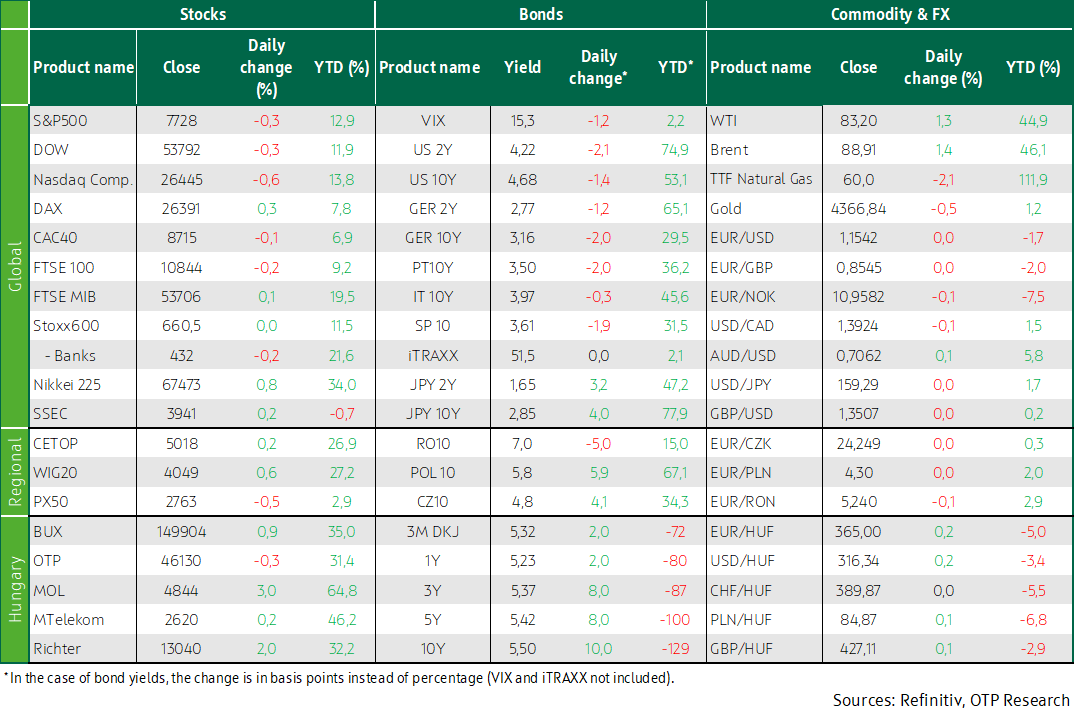
European indices closed mixed on Tuesday, while persistently elevated oil prices weighed on market sentiment. Major US indices declined on Tuesday, with the exception of the small-cap Russell 2000; uncertainty surrounding the Middle East persisted, while US existing home sales fell in July at a pace broadly in line with expectations. Developed market yields edged lower, while Hungarian yields beyond the one-year maturity increased by 8-10 basis points; the yen remained largely unchanged. Today's focus will be on US CPI and budget data.
European indices closed mixed on Tuesday, while persistently elevated oil prices weighed on market sentiment
European equity markets closed mixed yesterday as investors awaited key macroeconomic data due later this week. The pan-European STOXX 600 index was little changed, hovering near its record high. Market sentiment was also weighed down by rising oil prices after efforts to resolve tensions between the US and Iran lost momentum. Oil prices continued to rise despite reports from Pakistani sources during the day suggesting a possible US-Iran initiative, following Monday’s announcements from both sides that they intended to seek war reparations. Investors were concerned that any prolonged disruptions around the Strait of Hormuz could further intensify CPI pressures, potentially delaying monetary easing. Higher energy prices, however, provided support to the energy sector, which ranked among the strongest-performing industries. In contrast, travel and leisure stocks weakened amid concerns over rising fuel costs.
On the corporate front, Alcon shares rose 5% after the ophthalmic products maker raised its full-year earnings guidance. In contrast, Spirax Group stock fell 5.6%, as investors were disappointed that the British engineering company merely reaffirmed its previous full-year outlook. InterContinental Hotels Group shares came under pressure after the company reported slower second-quarter room revenue growth due to weaker demand in the Middle East.
Major indices in the CEE region closed mixed yesterday, with the Prague Stock Exchange posting losses, while markets in Budapest and Warsaw moved higher. Among Hungarian blue chips, OTP declined, whereas the other three heavyweight stocks ended the session in positive territory.
Major US indices declined on Tuesday, with the exception of the small-cap Russell 2000; uncertainty in the Middle East persisted, while US existing home sales fell in July at a pace broadly in line with expectations
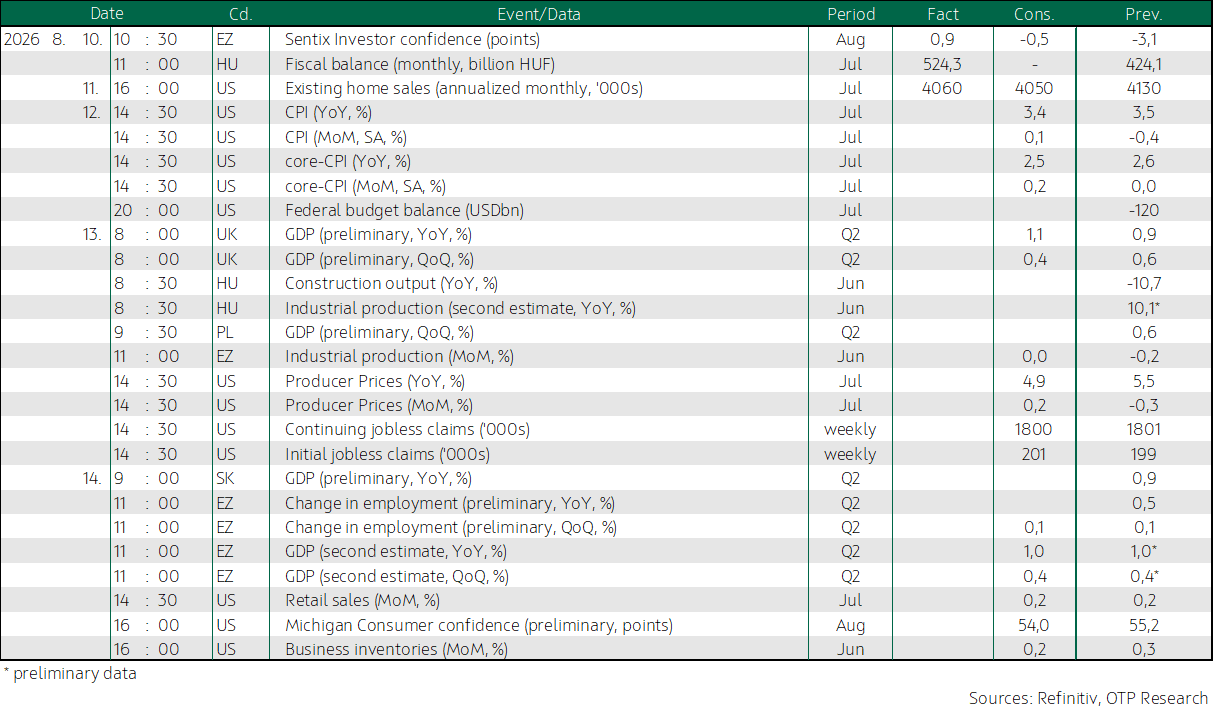
With the exception of the small-cap Russell 2000, major US indices closed lower on Tuesday as investor sentiment weakened amid fading hopes for a swift reopening of the Strait of Hormuz. Among the S&P 500 sectors, communication services posted the weakest performance, with Alphabet shares falling 3.8%. The stock remained under pressure as investors continued to assess the company’s artificial intelligence-related organizational restructuring. The technology sector also had a weak session: Nvidia erased its intraday gains to finish flat, while Apple lost more than 1%. Rising oil prices further weighed on market sentiment. Iran’s Secretary of the Supreme National Security Council reiterated that the Strait of Hormuz would not be reopened until the country’s conditions were met. As a result, WTI crude rose 1.3% to above USD 83 per barrel, while Brent gained 1.4% to nearly USD 89 per barrel. Market attention also remained focused on upcoming US CPI data. Investors are awaiting the release of July consumer and producer price figures, which could prove particularly important for the Fed’s interest rate outlook following recent signs of weakness in the labor market. Market expectations suggest that the ongoing moderation in price pressures could support a steady-rate environment, although higher energy prices continue to pose upside risks to CPI.
In the US, existing home sales declined 1.7% month-on-month in July to a seasonally adjusted annualized rate of 4.05 million units. The reading was broadly in line with market expectations of 4.06 million units. Housing supply also tightened, with the inventory of homes available for sale falling 1.9% to 1.54 million units. Meanwhile, the median home price across all housing types rose 2% year-on-year to USD 434,100. The housing market appears to be showing notable resilience despite elevated mortgage rates, with existing home sales increasing 2.4% since the beginning of the year.
Developed market yields edged lower, while Hungarian yields beyond the one-year maturity rose by 8-10 basis points; the yen remained largely unchanged
US Treasury yields saw only limited moves yesterday as investors continued to assess geopolitical tensions in the Middle East and the upcoming CPI data due later this week. The yield on the 10-year US Treasury note declined by just over 1 basis point to 4.68%, while the more monetary policy-sensitive 2-year yield eased to 4.22%. The modest decline in yields came despite deteriorating expectations regarding a resolution to the Middle East conflict. However, investors remained primarily focused on the forthcoming US CPI readings. Market participants believe the inflation data could determine whether longer-dated bond yields stabilize or resume their upward trajectory in the period ahead. German and UK long-term yields also edged lower yesterday.
Contrary to international trends, Hungarian yields beyond the one-year maturity rose by 8-10 basis points yesterday, with the 10-year yield closing at 5.5%. The forint weakened 0.2% against the euro and remained above the 365 level. Meanwhile, the Japanese yen was little changed against the dollar following Monday’s partial pullback, which came after the yen-supporting intervention carried out by Japan’s Ministry of Finance in cooperation with US authorities at the end of July.
Today's highlights
Major Asian indices were mixed this morning, while North Korea conducted another ballistic missile test, just days before the start of joint military exercises between Seoul and Washington, which Pyongyang has long criticized and condemned. Meanwhile, Taiwan condemned a planned naval exercise involving China and an Indonesian warship near the island’s eastern coast.
Today's focus will be on US CPI and budget data.
Get more out of your investments!
Global Markets Services
OTP Global Markets offers a broad range of services in the field of local and international money and capital markets.
Read morePrivate Banking Services
Personal care and expertise with OTP Private Banking, along with the knowledge, security, and innovations of a multinational banking group.
Read more