
OTP Morning Brief: Uncertainty stemming from the still-unresolved Middle East conflict weighed on Monday's trading
Related content
OTP Morning Brief: Developed market bond yields edged lower yesterday
European indices declined yesterday amid rising oil prices, while the German government revised its GDP growth forecast upward; German exports lost momentum toward the end of the summer; meanwhile, ECB policymakers see upside risks to European inflation. Major US indices moved mostly lower; OpenAI's revenue fell significantly short of previously projected levels; meanwhile, the number of initial jobless claims declined in the US. Long-term yields in both the US and Europe declined following the sharp increase seen in the previous period, while Christopher Waller noted that further Fed rate hikes do not necessarily need to occur at consecutive meetings. The focus today will be on the latest reading of the University of Michigan Consumer Sentiment Index.
OTP Morning Brief: Long-end yields temporarily moved higher, putting equity markets under pressure
Wednesday's trading session was relatively uneventful, with a familiar pattern once again unfolding as the situation in the Persian Gulf drove oil prices higher, pushed yields up, and weighed on equity markets. The correction came within the day, as declining oil prices helped pull the US 10-year yield back from its multi-decade high of 5.36% to around 5.30%. The German 10-year yield followed a similar intraday pattern and ultimately ended the session unchanged from Tuesday's close at 3.48%. The EUR/USD closed at a 17-month low, just below 1.12. Equity markets, however, failed to regain momentum, with both the Nasdaq and the S&P pulling back from their recent highs as investors continued to digest the financing plans of AI-related companies. In Europe, banks led the declines, topping the list of worst-performing sectors. Regional stock markets, including Hungary’s, posted notable declines. The EUR/HUF rose to near 366. Hungarian long-term yields declined. Hungary’s September CPI came in slightly lower than expected. Asian equity indices declined in early trading. Today, German export data will be released, while weekly jobless claims figures are due from the US.
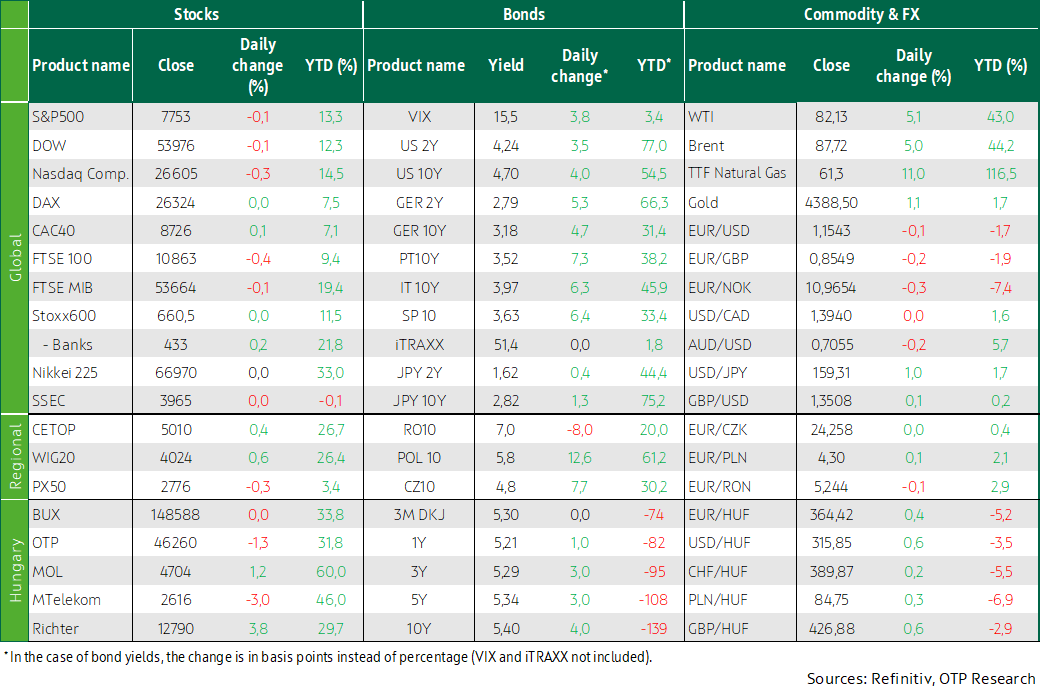
Crude oil prices rose due to the ongoing uncertainty surrounding the still-unresolved Middle East conflict and the closure of the Strait of Hormuz, reinforcing concerns over higher CPI and potential interest rate hikes. Major European indices ended Monday's trading session with modest moves. The BUX ended in the middle of the pack among CEE stock exchanges, posting a marginal decline. Major US indices moved into negative territory. Developed market bond yields moved higher, while the dollar strengthened against the euro. The long end of the Hungarian yield curve also shifted upward, and the forint weakened against major currencies.
Major European equity indices closed mixed with modest moves, while the BUX edged slightly lower
Major European equity indices closed mixed with modest moves on Monday, remaining close to their record highs. The pan-European STOXX Europe 600 was virtually unchanged. At the sector level, energy stocks led the gains alongside rising oil prices, while the basic resources sector also advanced, supported by higher gold, silver and copper prices. On the downside, telecommunications and media stocks posted the weakest performance. The biggest loser within the latter group was the UK's WPP, which fell 5.0%, likely due to profit-taking following last week's strong rally. Shares of UK housing developer Vistry declined 12.2% after the Financial Times reported that Allianz could cut insurance coverage for suppliers to the affordable housing builder by as much as 70%. Coca-Cola HBC shed 4.8% after BNP Paribas downgraded the stock from outperform to neutral.
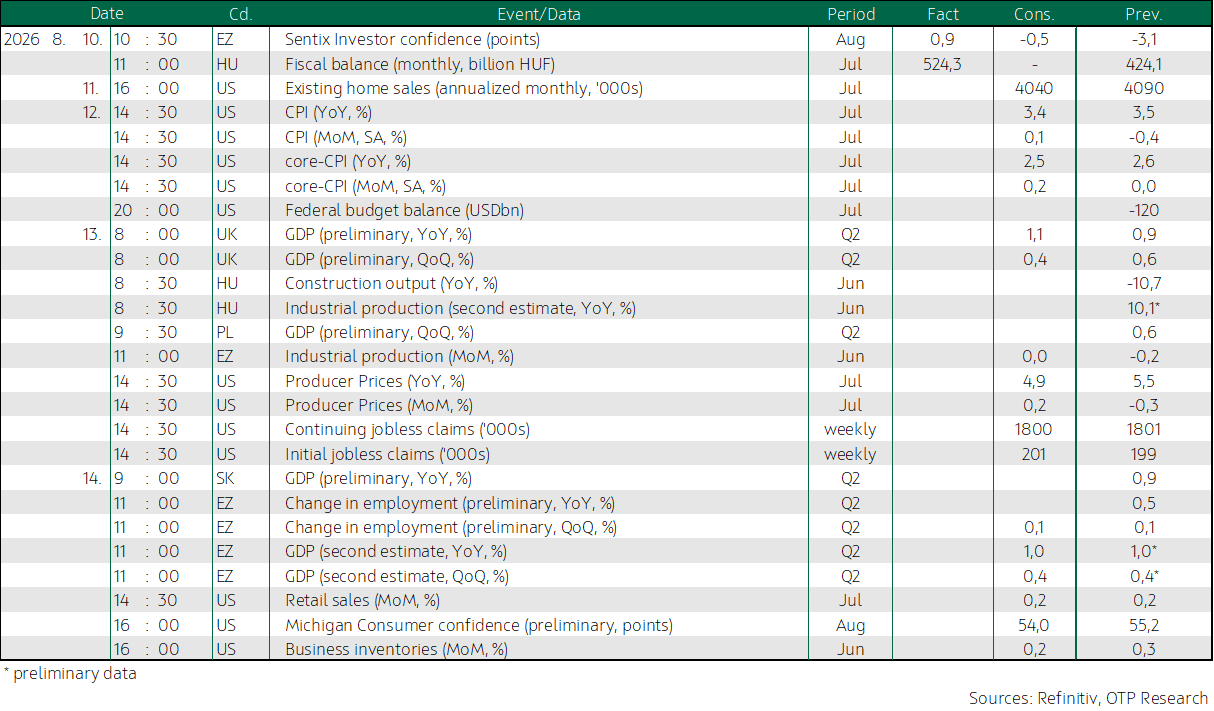
The Sentix index, the first of the monthly economic sentiment indicators to assess the outlook for the next six months, showed a stronger-than-expected improvement in its August reading published yesterday. The index rose to 0.9 points, returning to positive territory and signaling optimism for the first time since February. The data reinforces expectations that the eurozone economy may maintain its cautious growth trajectory through the second half of the year.
CEE equity markets closed mixed, with the BUX's marginal decline placing it in the middle of the regional performance ranking. There was no clear direction among Hungary's blue-chip stocks either, with only MOL and Richter managing to post gains.
According to the Ministry of Finance, the central government sub-sector posted a deficit of HUF 2,857.9 billion in the first seven months of the year, equivalent to 67.7% of the annual deficit target set out in the budget law. July recorded a surplus of HUF 524.3 billion, marking the third consecutive month in which the budget remained in positive territory.
The European TTF natural gas price soared 11% yesterday, climbing above EUR 61/MWh.
Major Wall Street indices turned negative, while crude oil prices surged 5%
The first trading day of the week brought modest losses to Wall Street, as investor sentiment was weighed down by the lack of progress in negotiations aimed at resolving the Middle East conflict and reopening the Strait of Hormuz. Donald Trump threatened economic pressure on Iran and demanded compensation for victims killed in wars, attacks and protests. Meanwhile, Iran's Supreme Leader appointed a veteran commander of the Islamic Revolutionary Guard Corps as national security chief, a figure who has previously expressed skepticism about negotiations. In addition, Iran stated that the pending agreement with Oman regarding oversight of the Strait of Hormuz would not be sufficient to secure its reopening. Against this backdrop, both Brent and WTI crude prices surged 5%, with Brent approaching USD 88 per barrel and WTI moving above USD 82. The developments reinforced concerns over higher CPI and the prospect of further interest rate hikes.
Technology stocks had a difficult session yesterday. Intel shares fell 4.1% after the company announced plans to raise USD 15 billion through a share offering. Nvidia declined 2.9% amid media reports regarding a USD 500 billion AI infrastructure investment project involving the company.
Developed market bond yields moved higher as expectations of further interest rate hikes strengthened; the dollar gained against the euro, while the forint weakened versus both the euro and the dollar
Driven by rising oil prices, developed market bond yields moved higher, with the US 10-year Treasury yield rising 4 basis points to 4.7% and the German 10-year Bund yield climbing 5 basis points to 3.18%, bringing it back close to the upper end of the trading range established in the post-Covid period. Following weaker-than-expected July labor market data, expectations for a September Fed rate hike had eased, but reversed course yesterday, with market pricing once again implying a probability of slightly above 50% for a September increase. Investors are also anticipating the ECB’s next rate hike in September. Rising energy prices supported the dollar, which strengthened against the euro.
In line with global trends, the long end of the Hungarian yield curve shifted 1-4 basis points higher, based on the Government Debt Management Agency's (ÁKK) early afternoon benchmark quotations, with the domestic 10-year yield rising to 5.4%. Although the forint started the day stronger in the FX market, it reversed course by the close, with EUR/HUF rising 0.4% to 364.42. Against the greenback, the Hungarian currency weakened by nearly 0.6%, pushing USD/HUF up to 315.85. Demand was subdued at ÁKK's bond switch auction yesterday, where the debt manager accepted HUF 20 billion in bids out of the HUF 25 billion submitted, despite initially offering HUF 10 billion.
Today's highlights
Concerns over persistently elevated energy prices continued to weigh on sentiment in this morning's trading, with major Asia-Pacific equity indices delivering a mixed performance. Australia's S&P/ASX 200 and South Korea's Kospi outperformed the region, while Japan's Nikkei 225 remained closed due to a national holiday. The recent strengthening of the Japanese yen following official intervention appears to have steadily faded in recent days. Crude oil prices edged higher during the Asian session, extending their recent rise.
Equity index futures point to a mixed open in Europe, while US markets are set to start the day higher
Today, the Government Debt Management Agency (ÁKK) will offer HUF 30 billion worth of three-month discount Treasury bills for sale.
In the US, July existing home sales data will be released today and are expected to come in broadly in line with the previous month's level.
Get more out of your investments!
Global Markets Services
OTP Global Markets offers a broad range of services in the field of local and international money and capital markets.
Read morePrivate Banking Services
Personal care and expertise with OTP Private Banking, along with the knowledge, security, and innovations of a multinational banking group.
Read more