
OTP Morning Brief: Rate hike expectations eased on signs of weakness in the US labor market, lifting markets
Related content
OTP Morning Brief: Developed market bond yields edged lower yesterday
European indices declined yesterday amid rising oil prices, while the German government revised its GDP growth forecast upward; German exports lost momentum toward the end of the summer; meanwhile, ECB policymakers see upside risks to European inflation. Major US indices moved mostly lower; OpenAI's revenue fell significantly short of previously projected levels; meanwhile, the number of initial jobless claims declined in the US. Long-term yields in both the US and Europe declined following the sharp increase seen in the previous period, while Christopher Waller noted that further Fed rate hikes do not necessarily need to occur at consecutive meetings. The focus today will be on the latest reading of the University of Michigan Consumer Sentiment Index.
OTP Morning Brief: Long-end yields temporarily moved higher, putting equity markets under pressure
Wednesday's trading session was relatively uneventful, with a familiar pattern once again unfolding as the situation in the Persian Gulf drove oil prices higher, pushed yields up, and weighed on equity markets. The correction came within the day, as declining oil prices helped pull the US 10-year yield back from its multi-decade high of 5.36% to around 5.30%. The German 10-year yield followed a similar intraday pattern and ultimately ended the session unchanged from Tuesday's close at 3.48%. The EUR/USD closed at a 17-month low, just below 1.12. Equity markets, however, failed to regain momentum, with both the Nasdaq and the S&P pulling back from their recent highs as investors continued to digest the financing plans of AI-related companies. In Europe, banks led the declines, topping the list of worst-performing sectors. Regional stock markets, including Hungary’s, posted notable declines. The EUR/HUF rose to near 366. Hungarian long-term yields declined. Hungary’s September CPI came in slightly lower than expected. Asian equity indices declined in early trading. Today, German export data will be released, while weekly jobless claims figures are due from the US.
Friday’s biggest surprise came from labor market data that were significantly weaker than expected, prompting a reassessment of rate hike expectations and boosting equity market performance on the final trading day of the week. Several European indices, including the Stoxx Europe 600, closed at record highs. In addition, favorable economic activity data were released for Germany. The BUX also posted gains. US indices also recorded substantial gains on Friday. Weaker labor market data pushed developed market yields lower, while the US dollar weakened. The other major surprise on Friday was Hungary’s CPI reading of 1.2%, which also came in below expectations. Asian markets also followed the rally. Several key data releases will be in focus this week, including European confidence indicators, detailed Q2 GDP figures and employment data, while in the US, investors will be closely watching the latest CPI release.
European markets closed at record highs on Friday, while Hungary’s CPI fell to its lowest level in nearly a decade
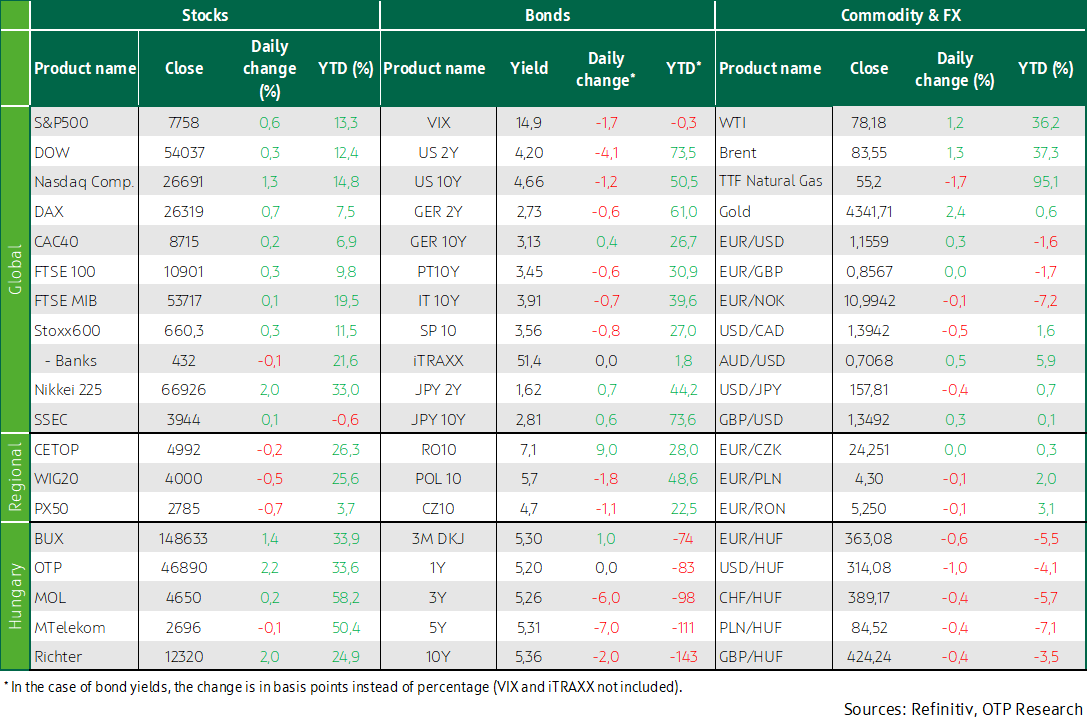
European equity markets extended their gains on Friday, with the STOXX Europe 600 rising 0.3% to close at a record high, marking its fourth consecutive week of gains. Investor sentiment was supported primarily by strong technology stocks, broadly positive corporate earnings results, and weaker-than-expected US employment data, which reinforced expectations of Federal Reserve rate cuts. Hopes of a potential US-Iran agreement also provided support throughout the week, while the earnings season helped push the benchmark index to multiple record highs. Major European indices generally advanced by around 0.3%, although Germany’s DAX outperformed with a 0.7% increase, reaching a new all-time high alongside France’s CAC 40 and Italy’s FTSE MIB. At the sector level, technology stocks led the advance, climbing 1.9% on Friday and emerging as the best-performing segment of the week. Healthcare shares gained 1.2%, driven largely by a 6.5% surge in Genmab following a favorable earnings release from the oncology-focused drug developer. Meanwhile, Novo Nordisk and Abivax rose 3.9% and 3.5%, respectively. Mining stocks added 0.3%, supported by rising prices of both precious and industrial metals. Among individual companies, Stellantis underperformed, with its share price falling 1.7% after Bernstein downgraded the automaker from „market perform” to „underperform”. As a result, the Stoxx Europe 600 ended the week 1.7% higher, while the DAX soared 2.7%. In contrast, the UK's FTSE 100 lagged behind with a more modest 0.3% gain.
Germany’s economic performance exceeded expectations in June, with industrial production rising 0.2% month-on-month, while exports increased by 0.9%, marking a fifth consecutive month of growth. Industrial output was supported primarily by a 3.6% rise in automobile manufacturing and an 8.4% increase in the production of other transport equipment, including aircraft, ships, and rail vehicles.
The CEE region delivered a more mixed performance, with the PX50 declining 0.7% and the WIG 20 falling 0.5%, while the BUX jumped 1.4%, driven primarily by gains of 2.2% in OTP and 2.0% in Richter. Despite Friday’s strong performance, the BUX lagged its regional peers over the week, advancing 1.3%, while the other two major CEE indices closed with gains exceeding 2%. Among Hungarian blue chips, Richter was the best performer of the week, appreciating 4.4%. In July, Hungary’s CPI slowed to 1.2%, coming in below our expectation of 1.6%. The easing in price pressures was broad-based, supported by a larger-than-expected decline in seasonal food prices and subdued price growth for industrial goods, the latter likely benefiting from the strengthening of the forint in recent months. At the same time, services inflation remained elevated. The favorable CPI data effectively cement an August rate cut and could give the MNB room to lower the base rate to as much as 5% by year-end.
The US labor market delivered a significant negative surprise, driving down rate hike expectations
US equity markets closed higher on Friday, with the S&P 500 reaching a fresh record high. Trading was heavily influenced by unexpectedly weak July labor market data, as nonfarm payrolls declined by 23,000, far below economists’ expectations for an increase of 80,000, while employment figures for the previous two months were revised sharply lower. Although the unemployment rate edged down from 4.2% to 4.1%, the improvement was largely driven by 264,000 people leaving the labor force, pushing the participation rate down to 61.4%, its lowest level in nearly five and a half years. In response to the weak data, expectations for a Fed rate hike in September declined, with the market-implied probability falling from 57% to 44%.
Investor sentiment was also supported by optimism surrounding a resolution to the Iranian conflict, which helped ease inflation concerns through lower oil prices and a decline in US Treasury yields. According to a US official, progress has been made in talks involving Iran and Oman regarding the Strait of Hormuz, with an agreement on restoring normal oil shipments potentially forthcoming. Such a deal could also lead to the lifting of the US blockade on Iranian ports. The reopening of this strategic waterway could alleviate disruptions in energy markets and reduce inflationary pressures, although it remains uncertain whether the negotiations will result in a lasting settlement.
The Dow Jones rose 0.3%, the S&P 500 gained 0.6%, and the Nasdaq climbed 1.3%, bringing their weekly advances to 3.0%, 3.56%, and 5.2%, respectively. Among individual stocks, SpaceX soared 15.8% on Friday following the expiration of certain share sale restrictions, while Airbnb surged 17.4% after reporting second-quarter revenue that exceeded analysts’ expectations.
Developed market yields declined, while the forint strengthened to 363 against the euro
Weak labor market data also triggered a decline in government bond yields on Friday. However, yields partially retraced from their intraday lows as investors shifted their focus to next week’s long-term Treasury auctions and the upcoming July CPI release. The yield on the two-year US Treasury note, which is particularly sensitive to Fed rate expectations, fell by 4.35 basis points to 4.202%, having dropped as low as 4.1536% during the session, its lowest level since July 17. Meanwhile, the benchmark 10-year US Treasury yield declined by 1.44 basis points to 4.656%. Changes in expectations regarding the Fed’s policy path also affected European bond markets, albeit to a lesser extent. The yield on the two-year German government bond, which is highly sensitive to ECB rate expectations, fell by 1 basis point to 2.724%, compared with 2.754% before the labor market data release. In contrast, the yield on the 10-year German Bund edged higher. The labor market figures also contributed to a weaker US dollar against major currencies, with the euro gaining 0.3% and the yen advancing 0.1% on Friday.
In addition to international market developments, Hungarian bond yields were also influenced by favorable domestic CPI data. Yields on bonds with maturities beyond one year declined, with the three-year yield falling by 6 basis points to 5.26%, the five-year yield dropping by 7 basis points to 5.31%, and the 10-year benchmark yield easing by 2 basis points to 5.36%. Over the course of the week, longer-dated yields fell by between 10 and 16 basis points, extending their downward trend, which has also been supported by optimism surrounding Hungary’s potential euro adoption. In contrast, the three-month discounted Treasury bill, which is less affected by these expectations, rose by 3 basis points during the week. At the same time, the forint strengthened, appreciating 0.6% against the euro on Friday to 363.1, while posting a total gain of 0.5% over the week.
Today's highlights
Most Asian equity markets started the week higher on Monday, following Wall Street’s record close on Friday. In Japan, the Nikkei 225 rose 2.0%, supported in part by renewed investor interest in semiconductor-related stocks. South Korea’s KOSPI gained 0.4%, although it had been up more than 2% earlier in the session. Chinese markets were broadly flat, with trading largely characterized by a lack of clear direction.
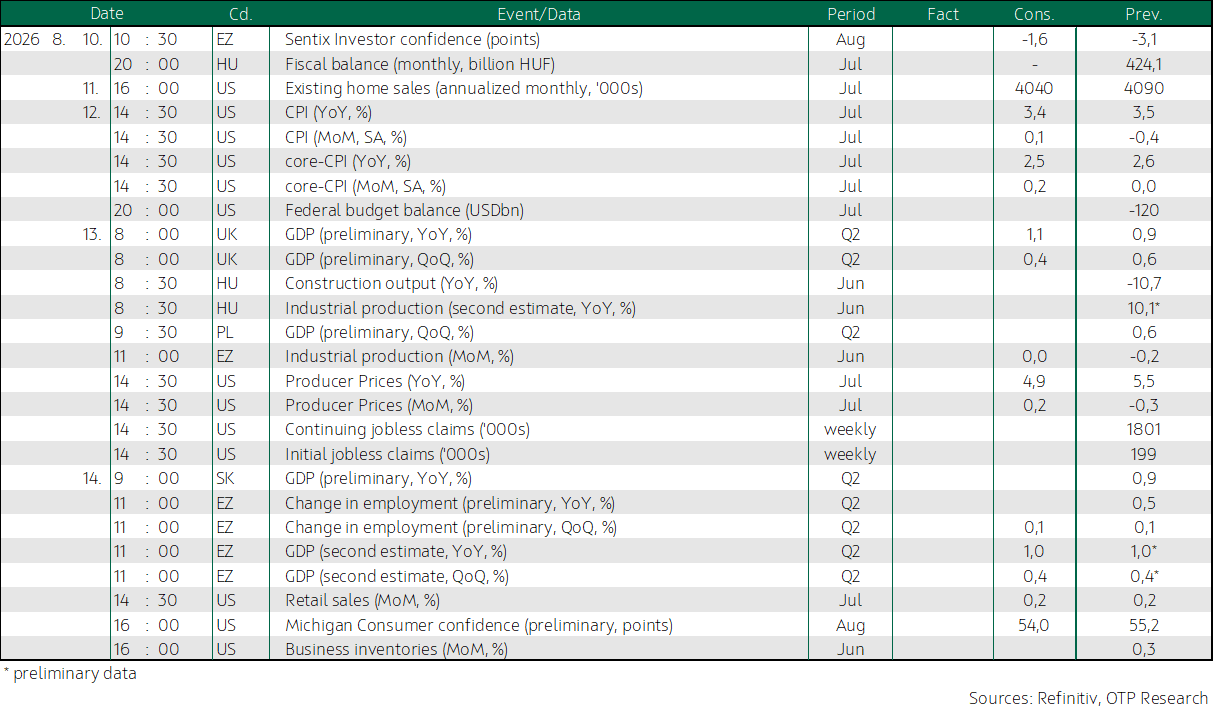
Today, investors will closely watch the August Sentix Economic Sentiment Index, which could provide an important signal about the region’s economic performance in Q3. The indicator has improved every month since April, with July’s reading of -3.1 significantly exceeding market expectations. If this positive trend continues in August, it would further support the view that the euro area economy may be shifting onto a more favorable growth path in the second half of the year. Later this week, the second estimate of Q2 GDP will offer a more detailed picture of the composition of economic growth. June industrial production data will also be in focus, particularly after last week’s German and French releases delivered mixed signals about the strength of the region’s manufacturing sector.
In the US, another data-heavy week lies ahead, with July readings for the CPI, Producer Price Index (PPI), and retail sales set to provide fresh insights into inflation trends and the strength of consumer spending.
Get more out of your investments!
Global Markets Services
OTP Global Markets offers a broad range of services in the field of local and international money and capital markets.
Read morePrivate Banking Services
Personal care and expertise with OTP Private Banking, along with the knowledge, security, and innovations of a multinational banking group.
Read more