
OTP Morning Brief: Rising oil prices and US labor market data pushed developed market bond yields higher
Related content
OTP Morning Brief: Oil and gas prices hit multi-year highs as equity markets slide
By the end of last week, oil prices had climbed to their highest levels since spring, while European natural gas prices approached levels last seen in late 2022, driven by escalating tensions in the Middle East. Equity markets also turned lower by the end of the week: while the energy sector benefited from higher commodity prices and soared to record highs, all other sectors came under pressure. In the bond market, the US 10-year Treasury yield dipped back below 5%, while its German counterpart closed at a one-and-a-half-month low. French, Mediterranean, and CEE bond yields showed little movement on Friday, but over the course of the week they rose noticeably overall.
OTP Morning Brief: Earnings season continues to drive equities higher, while the French 10-year yield climbs above 5%
Stock markets moved higher yesterday in both Europe and the US, with technology stocks leading the gains on both sides of the Atlantic. Individual earnings reports released so far do not indicate that the AI investment boom is set to slow in the coming months. French financial indicators, however, are coming under increasing pressure from social and political uncertainty across both the corporate and public sectors: while French retail giant Carrefour issued a profit warning due to the unrest, French long-term bond yields soared to their highest level since 2002. The rise in yields also affected other countries, with the yield on 10-year Hungarian government bonds moving higher as well.
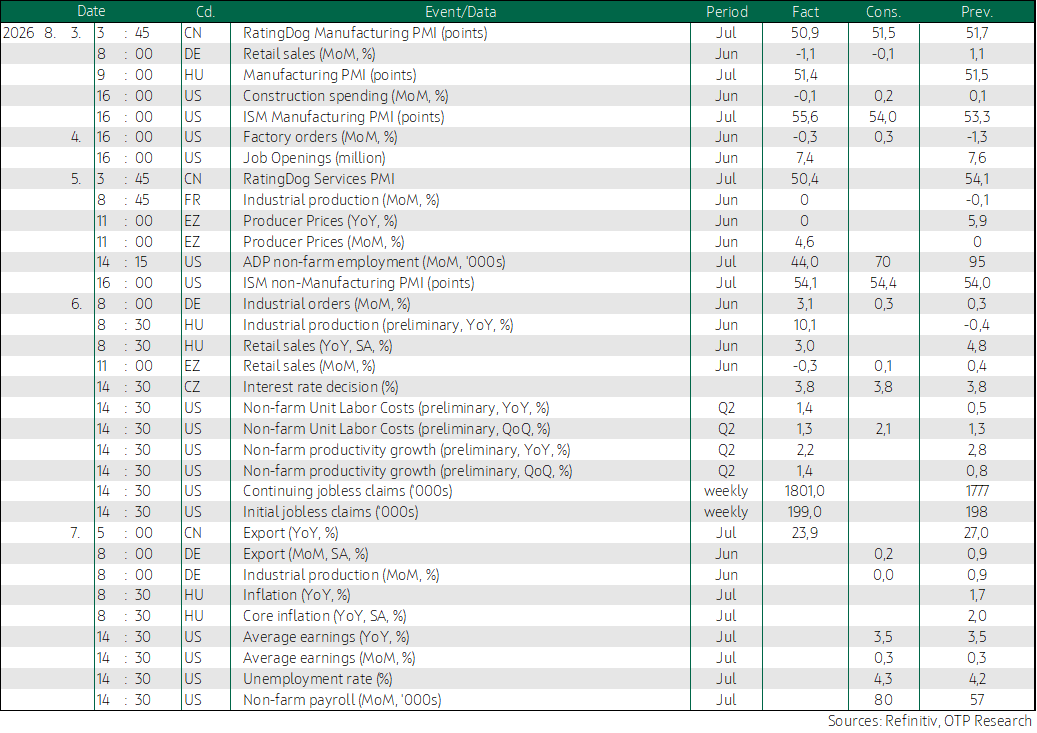
Supported by favorable corporate earnings reports, leading Western European stock indices mostly posted modest gains on Thursday. In contrast, US equity markets closed lower. Eurozone retail sales fell by 0.3% month-on-month in June, while the May figure was revised upward. German industrial orders increased by more than expected. The data released on Thursday continue to support the resilience of the US labor market. Developed market bond yields rose alongside higher oil prices. The forint weakened by 1% against the euro, underperforming its regional peers. Following stronger readings in May, Hungarian retail sales and industrial production declined month-on-month in June. Today, the primary focus will be on July CPI data released by the HCSO and US labor market figures.
Favorable corporate earnings reports supported European markets
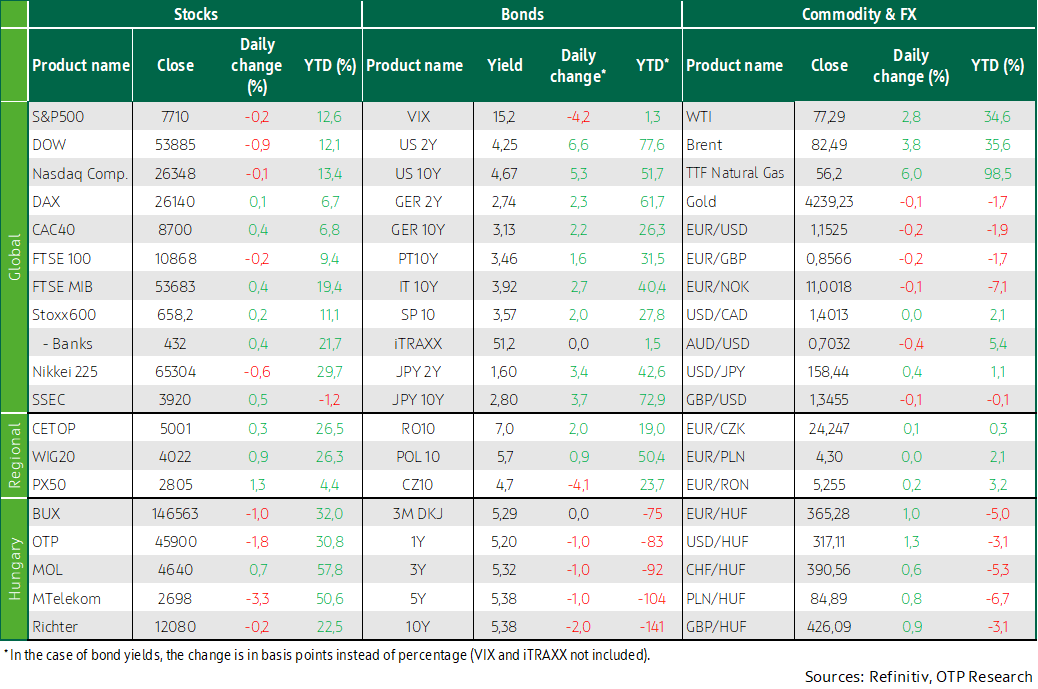
Leading Western European stock indices mostly posted modest gains amid limited market movements. The Stoxx Europe 600 rose 0.2%, the DAX gained 0.1%, and the CAC 40 advanced 0.4%, while the FTSE 100 slipped 0.2%. As a result, the pan-European benchmark closed at a record high for the third consecutive session. Much of the day's advance was driven by corporate earnings. Shares of Deutsche Telekom rose 6.3% after the German telecommunications company increased its 2026 share buyback program by EUR 3 billion. The broader telecommunications sector gained 2.9%. Shares of London-based advertising group WPP soared 28.6% after the company delivered stronger-than-expected organic growth. Defense manufacturer Renk rose 5.8% following a stronger-than-expected increase in its order backlog during Q2. In contrast, Rheinmetall fell 3.5% after lowering its 2026 sales guidance. Siemens shares declined 4.5% as results from its Digital Industries division missed expectations. Hikma Pharmaceuticals gained 8.2% after reporting a 9% increase in adjusted operating profit for the first half of the year.
As for macroeconomic data, although eurozone retail sales fell short of expectations with a 0.3% month-on-month decline in June, the broader picture is less concerning. The May figure was revised upward by 0.2 percentage points, resulting in a 0.2% expansion in Q2 compared to Q1 as a whole. This suggests that consumer spending remained resilient despite the energy price shock. German industrial orders rose by a stronger-than-expected 3.1% month-on-month in June. However, the increase was largely driven by large one-off orders and a downward revision to the previous month's data.
Hungarian industrial production in June was 1.4% lower than in May. Retail sales also declined by 0.4% month-on-month. Although both economic activity indicators came in negative, the picture is somewhat tempered by the fact that the previously released May data were relatively strong. The key question is whether the more favorable readings seen in recent months truly signal a turning point in the growth trend. The Czech central bank left its policy rate unchanged at 3.75%.
The Czech PX50 gained 1.3%, while Poland’s WIG20 advanced 0.9%, whereas the BUX underperformed on Thursday, falling 1.0%. Earlier today, MOL released its Q2 earnings report, which proved significantly stronger than expected. The most closely watched metric, clean EBITDA, exceeded expectations by 27%. The Hungarian energy company benefited from elevated energy prices, the resumption of Russian oil deliveries via the Druzhba pipeline, and widening refining margins.
Wall Street indices closed in negative territory on Thursday
US equity markets closed lower on Thursday as investors assessed corporate earnings reports and monitored signs pointing toward a potential peace agreement between the US and Iran. The S&P 500 fell 0.2%, the Dow Jones declined 0.9%, and the Nasdaq Composite ended the session 0.1% lower.
Shares of data storage solutions provider Western Digital plunged 13%, while memory chipmaker Sandisk fell 6.8% following the release of their quarterly results. AppLovin shares dropped 19.7% after the marketing platform reported quarterly revenue below Wall Street expectations. Datadog tumbled 19% after the cloud security company said it expects revenue growth to slow in the third quarter. SpaceX shares erased their early-session losses and ultimately rose 6.1% after the first lockup period restricting insider share sales expired on Thursday.
The weekly jobless claims data (199,000 new applications) and July layoff figures continue to support the resilience of the US labor market. Labor productivity increased faster than expected in Q2 (+1.4% qoq), helping to moderate the rise in labor costs (+1.3% qoq).
After declining earlier in the week, Brent crude rose 3.8% on Thursday to nearly USD 82.5 per barrel.
Developed market bond yields moved higher, while the forint weakened 1% against the euro
After three consecutive days of declines, the US 10-year Treasury yield moved higher again on Thursday, supported by rising oil prices and data pointing to the resilience of the US labor market. The benchmark yield closed at 4.67%, up 5 basis points, remaining near the upper end of its post-Covid trading range. The German 10-year Bund yield rose by just 2 basis points to 3.13%. Against the euro, the dollar strengthened 0.2% to 1.153. Meanwhile, the Hungarian yield curve shifted slightly lower, with the 10-year yield declining by 2 basis points to 5.38%. The forint significantly underperformed regional currencies, weakening 1.0% against the euro to 365.3.
At yesterday's auction of 3-year, 5-year, and 10-year government bonds, Hungary's Government Debt Management Agency (ÁKK) accepted bids worth HUF 30 billion, HUF 56.5 billion, and HUF 70 billion, respectively, amid strong investor demand and significant oversubscription.
Today's highlights
Leading Asian stock indices were mixed as trading neared its close. The Nikkei was down 0.6%, while the KOSPI declined 1.1%. In contrast, the SSEC gained 0.5% and the Hang Seng edged 0.1% higher. Data released this morning showed that Chinese exports continued to expand at a robust pace, rising by nearly 24% year-on-year in July.
Today, Germany will release its June export and industrial production data. In Hungary, the HCSO will publish the July CPI figures. We expect CPI to come in at 1.6% year-on-year. However, market participants will be primarily focused on labor market data from the US, particularly the change in non-farm payrolls.
Get more out of your investments!
Global Markets Services
OTP Global Markets offers a broad range of services in the field of local and international money and capital markets.
Read morePrivate Banking Services
Personal care and expertise with OTP Private Banking, along with the knowledge, security, and innovations of a multinational banking group.
Read more