
OTP Morning Brief: Trump's de-escalation comments drove equity markets higher
Related content
OTP Morning Brief: Earnings season continues to drive equities higher, while the French 10-year yield climbs above 5%
Stock markets moved higher yesterday in both Europe and the US, with technology stocks leading the gains on both sides of the Atlantic. Individual earnings reports released so far do not indicate that the AI investment boom is set to slow in the coming months. French financial indicators, however, are coming under increasing pressure from social and political uncertainty across both the corporate and public sectors: while French retail giant Carrefour issued a profit warning due to the unrest, French long-term bond yields soared to their highest level since 2002. The rise in yields also affected other countries, with the yield on 10-year Hungarian government bonds moving higher as well.
OTP Morning Brief: Better-than-expected earnings reports supported US equity indices
Major European indices closed slightly lower yesterday; Germany’s ZEW index declined more than expected; the UK unemployment rate developed favourably; and the MNB left its base rate unchanged, in line with expectations. Major indices closed mostly higher, supported by favourable earnings reports; several companies with significant AI exposure rebounded following the recent sell-off, while housing market data continued to point to weak activity in the US. Long-term US and European bond yields edged lower, while Hungarian long-term government bond yields rose more markedly following their decline in recent days. Today, UK CPI data will be in the spotlight.
Trump postponed a potential attack on Iran and signaled the prospect of diplomatic talks, helping to boost market optimism. European markets advanced, including the BUX, which closed at a record high. German retail sales disappointed. In contrast, US equities posted a strong rally, with the Dow also closing at a record high. At the same time, bond yields declined. The yen continued to strengthen following Friday's intervention.
The week started on an optimistic note as the BUX closed at a record high
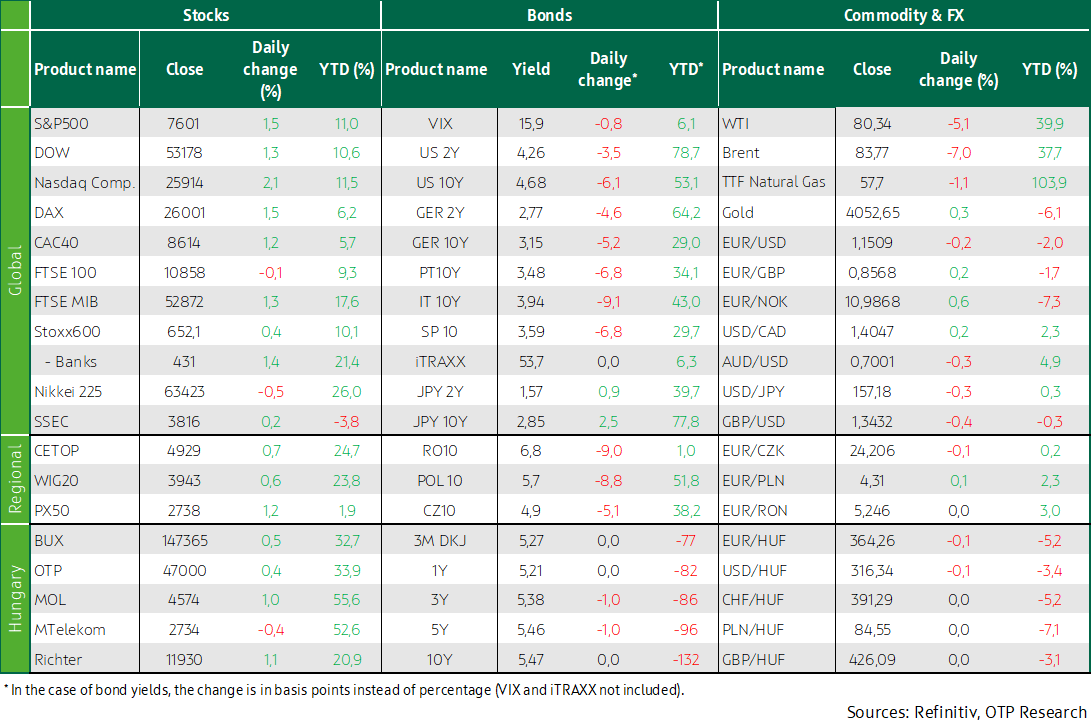
European equity markets started the week on a positive note and moved back close to their all-time highs after a sharp decline in global oil prices improved investor sentiment. Among the major continental indices, Germany's DAX rose 1.6%, France's CAC 40 gained 1.2%, and Italy's FTSE MIB advanced 1.3%, while London's FTSE 100 closed 0.1% lower, leaving the Stoxx 600 up 0.4% on the first trading day of the week. At the sector level, consumer goods and services as well as telecommunications led the gains, both rising 1.8%, while healthcare declined 1.7%. The sector's weakness was driven in part by AstraZeneca, whose shares plunged nearly 8% following media reports that the drugmaker had entered preliminary discussions with Bristol Myers Squibb regarding a potential merger. The deal would create the world's largest pharmaceutical company, with a market capitalization of nearly $400 billion. Shares of Italian cable manufacturer Prysmian fell 4% after reports emerged that it was in advanced talks to acquire US-based Atkore.
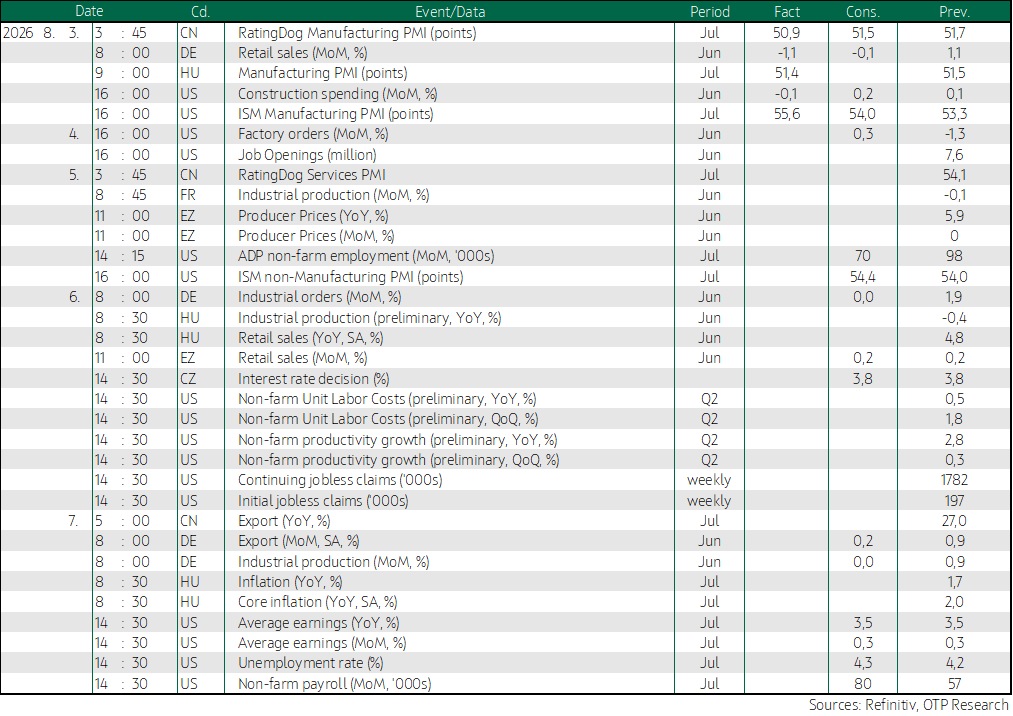
Germany's retail sales fell 1.1% month-on-month in June 2026, following an upwardly revised 1.2% increase in the previous month and missing market expectations. The decline marked the sharpest monthly drop since May 2025, suggesting that consumer spending is losing momentum amid persistent economic uncertainty.
Optimism also prevailed across the CEE region, with the PX50 and WIG20 both rising 0.6%, while the BUX gained 0.5%, allowing the latter two indices to close at record highs. The Hungarian benchmark was supported by gains in MOL and OTP shares, both of which also reached new record highs.
Signs of de-escalation drove US equities higher
August got off to a strong start on US equity markets, with the Dow Jones Industrial Average rising 1.3% to a record closing high, while the S&P 500 gained 1.5% and the Nasdaq advanced 2.1%, as signs of easing tensions between the US and Iran pushed oil prices lower. Brent crude fell roughly 5% to $83.5 per barrel after US President Donald Trump postponed potential strikes against Iran and announced that talks on reopening the Strait of Hormuz could begin on Monday, although Iran disputed the claim. The situation remains uncertain, as passage through the strait has yet to be fully restored, and a vessel attempting to transit the waterway was reportedly struck on Tuesday morning. Among S&P 500 sectors, communication services led the gains with a 4.3% rise, driven primarily by strong performances from Meta (+6.0%) and Alphabet (+4.9%). In contrast, the energy sector posted the weakest performance of the day, falling 1.2%. Amazon shares climbed 4.6% after the company's market capitalization surpassed $3 trillion for the first time following last week's earnings release. SpaceX, which is set to report its Q1 results on Tuesday, marking its first earnings announcement since going public, gained 5.6%.
In July, the ISM Purchasing Managers' Index surged to 55.6 from 53.3 in June, reaching its highest level in more than four years and significantly exceeding analysts' expectations of 54.0. The increase was supported by a strong order backlog, rising export demand, and expanding employment, pointing to a robust start to Q3.
Positive developments pushed yields lower, while the yen continued to strengthen
US Treasury yields moved lower on Monday as hopes for a de-escalation of the conflict involving Iran weighed on oil prices, although investors continued to assess the risk that a prolonged confrontation could eventually force the Federal Reserve to resume rate hikes. The yield on the policy-sensitive 2-year US Treasury note fell 3.5 basis points to 4.256%. The 10-year Treasury yield declined 6.1 basis points to 4.684%, after reaching 4.747% on Friday, its highest level since January 2025. Meanwhile, the yield on the 30-year Treasury bond eased to 5.227%, retreating from Friday's peak of 5.281%. European bond yields also moved lower, with Germany's 10-year government bond yield falling 5.4 basis points to 3.149%, while the 2-year yield declined to 2.76%, as easing CPI expectations prompted markets to scale back bets on further interest rate hikes by the European Central Bank.
The Japanese yen continued to strengthen on Monday after rebounding from a nearly 40-year low, following a coordinated foreign exchange market intervention by Japan and the US aimed at supporting the currency. Authorities also signaled their readiness to take further action if necessary. Friday's intervention, during which Japan is estimated to have spent as much as $36.6 billion to support the yen, underscored the two countries' determination to prevent further weakness in both the yen and Japanese government bonds from generating broader disruptions across global financial markets.
Hungarian government bond yields showed only a modest decline of around 1 basis point. However, unlike international markets, domestic yields had already started to move lower on Friday. Meanwhile, the Government Debt Management Agency's (ÁKK) bond switch auction attracted strong demand, with HUF 13 billion worth of T-bills sold compared to the originally announced HUF 10 billion. By the end of the day, the forint had strengthened beyond the 394 level against the euro.
Today's highlights
Yesterday's optimism was less evident across Asian markets, which delivered a mixed performance. Japan's Nikkei fell 0.5%, South Korea's Kospi slipped 0.4%, and Hong Kong's Hang Seng declined 0.8%, while China's Shanghai Composite edged 0.2% higher. Following the previously mentioned intervention, the dollar strengthened 0.3% against the yen on Tuesday. Reflecting the impact of the yen's earlier weakness, Toyota raised its full-year operating profit forecast by 13% on Tuesday, citing the depreciation of the Japanese currency. The upward revision came despite the company reporting a decline in earnings for the fifth consecutive quarter, primarily due to weaker sales in China. The world's largest automaker now expects operating profit of JPY 3.4 trillion ($21.6 billion) for the fiscal year ending in March, up from its previous forecast of JPY 3.0 trillion.
Today's macroeconomic calendar includes the release of US job openings data for June, alongside factory orders figures. In Hungary, the Government Debt Management Agency (ÁKK) will offer HUF 30 billion worth of T-bills at auction.
Get more out of your investments!
Global Markets Services
OTP Global Markets offers a broad range of services in the field of local and international money and capital markets.
Read morePrivate Banking Services
Personal care and expertise with OTP Private Banking, along with the knowledge, security, and innovations of a multinational banking group.
Read more