
OTP Morning Brief: Eurozone CPI rose in line with expectations
Related content
OTP Morning Brief: Earnings season continues to drive equities higher, while the French 10-year yield climbs above 5%
Stock markets moved higher yesterday in both Europe and the US, with technology stocks leading the gains on both sides of the Atlantic. Individual earnings reports released so far do not indicate that the AI investment boom is set to slow in the coming months. French financial indicators, however, are coming under increasing pressure from social and political uncertainty across both the corporate and public sectors: while French retail giant Carrefour issued a profit warning due to the unrest, French long-term bond yields soared to their highest level since 2002. The rise in yields also affected other countries, with the yield on 10-year Hungarian government bonds moving higher as well.
OTP Morning Brief: Better-than-expected earnings reports supported US equity indices
Major European indices closed slightly lower yesterday; Germany’s ZEW index declined more than expected; the UK unemployment rate developed favourably; and the MNB left its base rate unchanged, in line with expectations. Major indices closed mostly higher, supported by favourable earnings reports; several companies with significant AI exposure rebounded following the recent sell-off, while housing market data continued to point to weak activity in the US. Long-term US and European bond yields edged lower, while Hungarian long-term government bond yields rose more markedly following their decline in recent days. Today, UK CPI data will be in the spotlight.
European indices rose in July; eurozone CPI accelerated in line with expectations, while core inflation came in above forecasts. Favorable corporate earnings reports supported gains in US indices during the last two trading days of the week; oil prices rose in the second half of the week, although signs of easing tensions in the Middle East re-emerged from the US side over the weekend. Rising oil prices pushed bond yields higher, while the forint ended the week near 365 against the euro. Today's focus will be on German retail sales data, while later this week attention will primarily turn to changes in US nonfarm payrolls, as well as developments in US wages, productivity and job openings. The eurozone will release retail sales figures along with German industrial production and export data, while in Hungary, July CPI data will be published on Friday.
European indices rose in July; eurozone CPI accelerated in line with expectations, while core inflation came in above forecasts
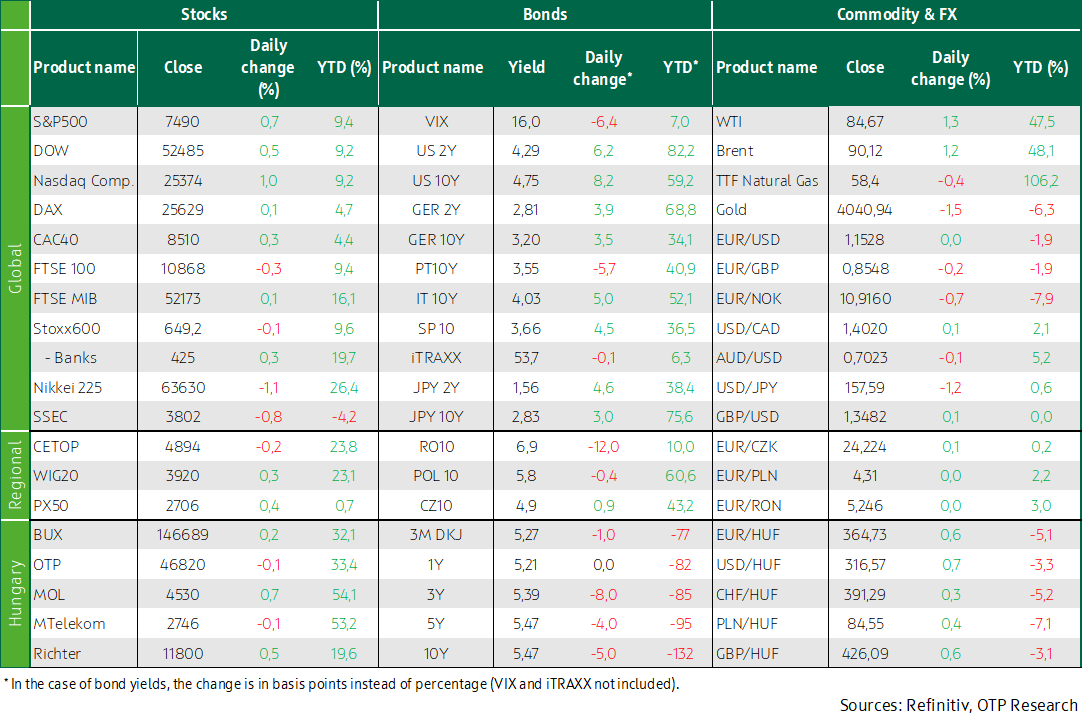
European equity markets closed mixed on Friday, although the pan-European STOXX 600 index posted a 1.2% gain in July and advanced 0.7% over the past week, as strong corporate earnings helped offset the negative impact of Middle East tensions and uncertainty surrounding artificial intelligence. One of the biggest losers on Friday was Dutch-based Universal Music Group, whose shares plunged 24.5% following the release of its first-half results, marking a record one-day decline. The sharp drop weighed on the broader media sector. Technology stocks, meanwhile, rebounded after losses earlier in the week. Investors remain closely focused on the returns generated by AI-related investments. Among corporate movers, Teleperformance surged 13.2% after reaffirming its 2026 targets. Credit Agricole rose 2.6% on the back of better-than-expected Q2 results. By contrast, Puma lost 2.5% as investors were disappointed that the company did not upgrade its guidance. IG Group shares fell 14.4% after the company announced the acquisition of US betting platform Underdog in a deal worth up to $1.3 billion.
On the macroeconomic front, the eurozone's annual CPI rate rose to 2.9% in July from 2.8% in June, in line with market expectations. Price pressures therefore remained significantly above the European Central Bank's 2% inflation target. The acceleration was driven primarily by higher energy prices, with energy CPI increasing to 10.0% from 8.5% in the previous month, supported in part by oil market tensions linked to the renewed escalation of the US-Iran conflict. Core inflation rose to 2.5% from 2.4% in June, exceeding expectations for an unchanged reading and indicating stronger underlying inflationary pressures. Services inflation edged up to 3.3% from 3.2%, while non-energy industrial goods inflation accelerated to 0.9% from 0.7%. In contrast, the pace of price increases for food, alcohol and tobacco products slowed to 1.2% from 1.5% a month earlier. The renewed acceleration in energy prices and the rise in core inflation strengthened expectations of further ECB tightening. Among the largest eurozone economies, CPI in Germany rose to 2.8% from 2.4% in June, while France saw an increase to 2.4% from 2.0%, and Spain to 3.8% from 3.6%. In Italy, however, inflation eased slightly, declining to 2.9% from 3.0%.
Major CEE indices moved higher on Friday. Among Hungary’s blue chips, OTP and Magyar Telekom, both of which had delivered strong performance over the previous week, underwent a modest correction on the final trading day, while the other two heavyweight stocks posted gains. On a weekly basis, the benchmark Hungarian index rose 2.2%, supported by a 3.2% increase in OTP and a 3.7% advance in Magyar Telekom shares.
Favorable corporate earnings supported gains in US indices during the final two trading days of the week; oil prices rose in the second half of the week, although signs of easing tensions in the Middle East re-emerged from the US side over the weekend
Major US indices closed higher on Friday, the final trading day of July, as investors largely looked past rising Treasury yields and focused instead on favorable corporate earnings reports. However, both the S&P 500 and the Nasdaq ended July lower, as capital rotated out of technology stocks and into more traditional sectors, while the Dow Jones managed to post a modest gain.
Corporate earnings continued to play a key role in market movements. Amazon shares surged 15.3% on Friday after the company reported better-than-expected Q2 revenue, driven primarily by strong performance in its cloud computing business. The results reinforced investor confidence in the return potential of artificial intelligence-related investments. In contrast, Apple shares fell more than 7% despite reporting revenue above expectations, as weaker performance in its services segment disappointed the market. Throughout the week, the technology sector remained heavily influenced by earnings from AI-related companies. Following Microsoft's nearly 16% rally on Thursday, investors reacted positively to stronger-than-expected growth in its cloud business, helping sustain demand for technology stocks. Meanwhile, Meta shares came under pressure due to elevated capital expenditure and weaker free cash flow.
Oil prices moved higher on Friday amid renewed tensions in the Middle East. US WTI crude rose 1.3% to $84.67 per barrel, while Brent crude gained 1.2% to $90.12 per barrel. Despite the late-week increase, both benchmarks ended the week lower, supported by favorable developments ahead of the previous week's market opening. As a result, WTI closed the week down 5.2%, while Brent fell 6.9%. Following the price rise seen in the second half of the week, the weekend once again brought news pointing to a potential easing of tensions, as President Trump stated that the framework of an agreement was beginning to take shape, although this was not confirmed by the Iranian side. Meanwhile, OPEC+ decided on Sunday to increase its daily production quota by 188,000 barrels starting in September. On the negative side, US crude oil inventories fell to their lowest level since 2018.
Rising oil prices pushed yields higher, while the forint ended the week near 365 against the euro
US Treasury yields rose sharply on Friday as oil prices continued to climb amid growing geopolitical risks threatening global supply. Markets increasingly priced in the possibility that the Federal Reserve could be forced to implement further monetary tightening in the autumn if inflationary pressures persist. The yield on the 10-year US Treasury increased by more than 8 basis points to 4.75%, one of its highest levels since early 2025. Meanwhile, the 2-year Treasury yield rose by more than 6 basis points to 4.29%, bringing longer-dated yields closer to multi-year highs. The increase in yields reflected investors' reassessment of inflation and interest rate risks, particularly in light of higher energy prices, rising government debt levels and substantial AI-related investment spending. German bond yields also moved higher on Friday, with the 2-year yield rising by nearly 4 basis points and the 10-year yield increasing by 3.5 basis points.
Contrary to international trends, Hungarian government bond yields beyond the one-year maturity segment declined by 2-8 basis points on Friday. As a result, the 10-year yield ended the week at 5.47%, marking a 15-basis-point decrease over the course of the week. The forint weakened by 0.6% against the euro on Friday, approaching the 365 level. Meanwhile, the Japanese yen appreciated by 4.5% against the US dollar over the past week after Japan's Ministry of Finance, in coordination with US authorities, carried out an intervention aimed at strengthening the yen.
Today's highlights
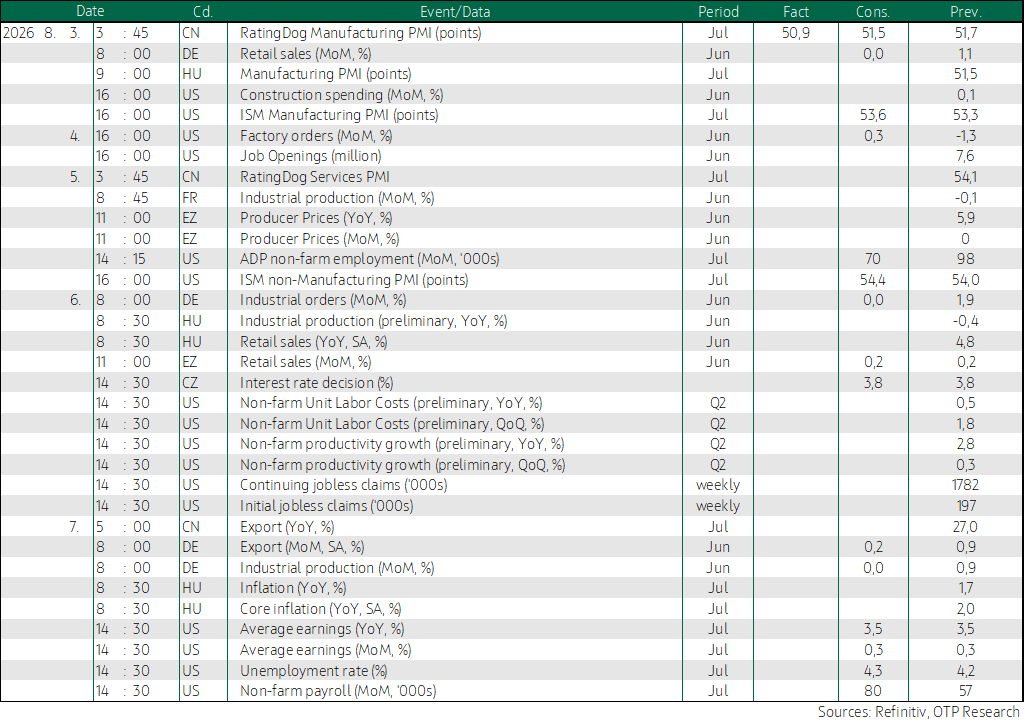
Major Asian indices traded mixed this morning. Japanese equities declined as the yen continued to strengthen, following Friday's confirmation by Japanese authorities that a coordinated intervention had taken place, while also signalling that further measures remain possible. China’s manufacturing PMI fell more than expected to 50.9, a four-month low, as both output and new orders grew at a slower pace than anticipated.
Today's focus will be on German retail sales data, while later this week investors are likely to pay closest attention to changes in US nonfarm payrolls, as well as developments in US wages, productivity and job openings. The eurozone will release retail sales figures along with German industrial production and export data, while in Hungary, July CPI data will be published on Friday. We expect annual price growth of 1.6%, down from 1.7% in the previous month.
Get more out of your investments!
Global Markets Services
OTP Global Markets offers a broad range of services in the field of local and international money and capital markets.
Read morePrivate Banking Services
Personal care and expertise with OTP Private Banking, along with the knowledge, security, and innovations of a multinational banking group.
Read more