
OTP Morning Brief: BUX hits a record high following better-than-expected GDP data, while yields rose across international bond markets
Related content
OTP Morning Brief: Further declines in the US technology sector on Friday
Selling pressure on the technology sector remained elevated across developed equity markets on Friday. However, favorable corporate earnings offset the weakness in the IT sector in Europe. European equity markets also posted weekly gains, marking their strongest weekly performance since June. In the US, the decline in equity indices continued, with concerns surrounding AI-related companies further amplified by the CoreWeave episode. The sell-off in equity markets prompted investors to shift toward safer assets, while long-term bond yields continued to decline. The US 10-year Treasury yield declined by 15 bps over the past week, closing Friday’s session at 5.1%, supported in part by easing expectations of further rate hikes. Based on futures pricing, the Fed is expected to leave interest rates unchanged at next week’s meeting. Eurozone bond yields also moved lower, tracking developments in overseas fixed-income markets. The euro strengthened to 1.124 against the dollar. Long-term yields also declined sharply in the Hungarian government bond market over the past week, with the 10-year yield falling by 29 bps to a three-month low of 5.31%. Oil prices continued to rise amid the unresolved situation in the Middle East. European natural gas futures soared to an early four-year high over the past week. This week, in the Hungarian market, attention will focus on the 2027 budget to be released today and the MNB’s interest rate decision meeting on Tuesday.
OTP Morning Brief: US producer price index came in above expectations, yet the US 10-year Treasury yield still declined
Western European equities continued to advance despite ongoing pressure on the technology sector. Wall Street indices also rebounded, recovering some ground after Wednesday’s sell-off. Healthcare was the standout performer on both sides of the Atlantic. Eurozone industrial production declined by 0.5% month-on-month in August. In the US, the producer price index accelerated to 6.3%, delivering another upside surprise in inflation developments. US retail sales increased by 0.8% compared to August. The US 10-year Treasury yield declined by more than 10 basis points. The long end of the Hungarian government bond yield curve also declined by 7-9 basis points. In Hungary, August wage data will be released today, while in the US, September industrial production figures are due.
A turnaround on Wall Street was driven by Microsoft's reassuring guidance, overshadowing concerns over Meta's aggressive spending plans and weaker-than-expected US GDP data. Meanwhile, in Europe, strong corporate earnings and stronger-than-expected economic expansion boosted market sentiment, which, together with favorable Hungarian data, propelled the BUX index to another record high. At the same time, escalating tensions in the Middle East continue to pose a persistent risk, keeping crude oil prices elevated and fueling fresh CPI concerns. Central bank caution, compounded by geopolitical risks, also pushed yields higher across global bond markets. Despite the tightening international environment, the Hungarian government bond market remained resilient, with the Government Debt Management Agency (ÁKK) successfully selling the offered bonds amid balanced demand despite international headwinds.
Interest rate decisions and a flood of earnings reports drove European markets
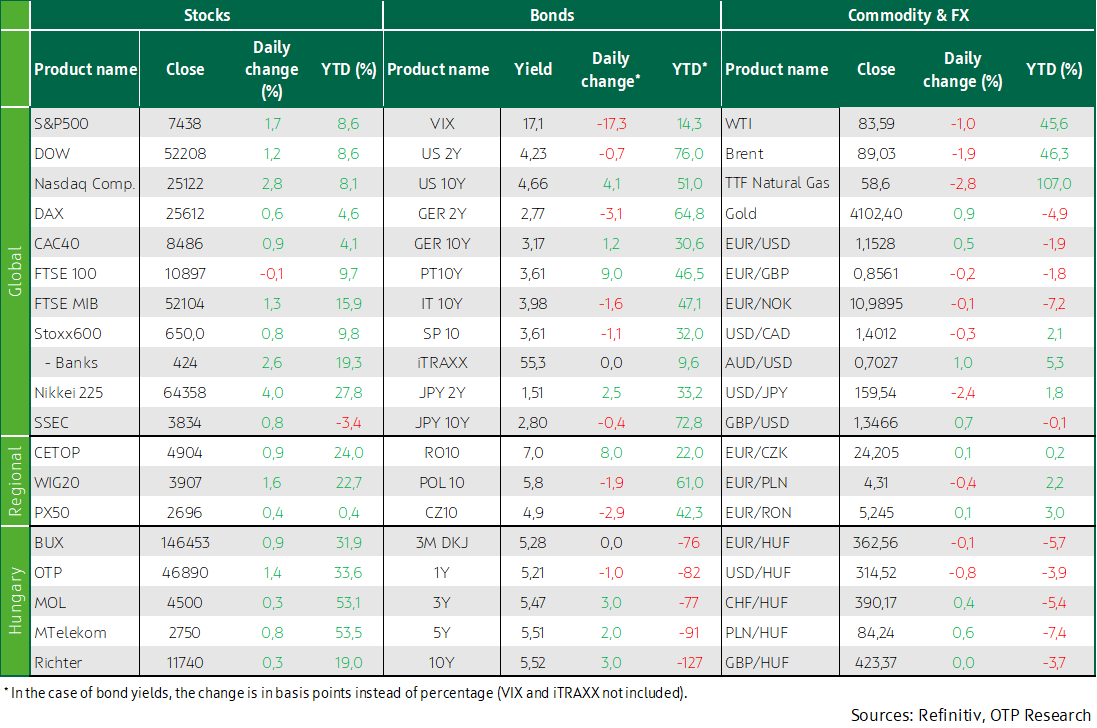
European stock indices closed higher on Thursday. The pan-European STOXX 600 index gained 0.8%. Investors focused on a barrage of macroeconomic data, escalating geopolitical tensions in the Middle East, and central bank decisions. Following the Fed's decision to leave interest rates unchanged on Wednesday, markets turned their attention to the Bank of England's policy announcement on Thursday, as well as earnings reports from Apple and Amazon due after the market close. The FTSE 100 edged down 0.1%, while the DAX advanced 0.6%.
Among sectors, construction stocks delivered the strongest performance, with the sector index rising 1.8% after French construction group Bouygues surged 7% on the back of quarterly results that significantly exceeded expectations. The banking sector advanced 0.9%, supported by a 5% gain in Spain's BBVA, driven by more than 11% growth in quarterly profit. Industrial stocks climbed 0.7%, with Schneider Electric soaring 10.8% after raising its full-year outlook, while packaging company Mondi posted an 11% jump, its strongest gain since 2009, following the release of its first-half results.
The energy sector index gained 0.3%, while Brent crude prices rose above the USD 90 per barrel mark during the trading session. The move in oil markets was driven by Wednesday's US strikes against Iran and the growing risk of a further escalation of the conflict.
On the corporate front, Adidas delivered one of Thursday's biggest negative surprises, with its shares tumbling around 11.5%, despite management raising its full-year sales outlook. Among the laggards was pest control group Rentokil, which plunged nearly 20.6% due to weakness in its North American operations. Airbus declined 2.8%, while Stellantis fell 4.3% following weaker quarterly results. In contrast, L'Oréal gained 2.74% thanks to better-than-expected sales figures.
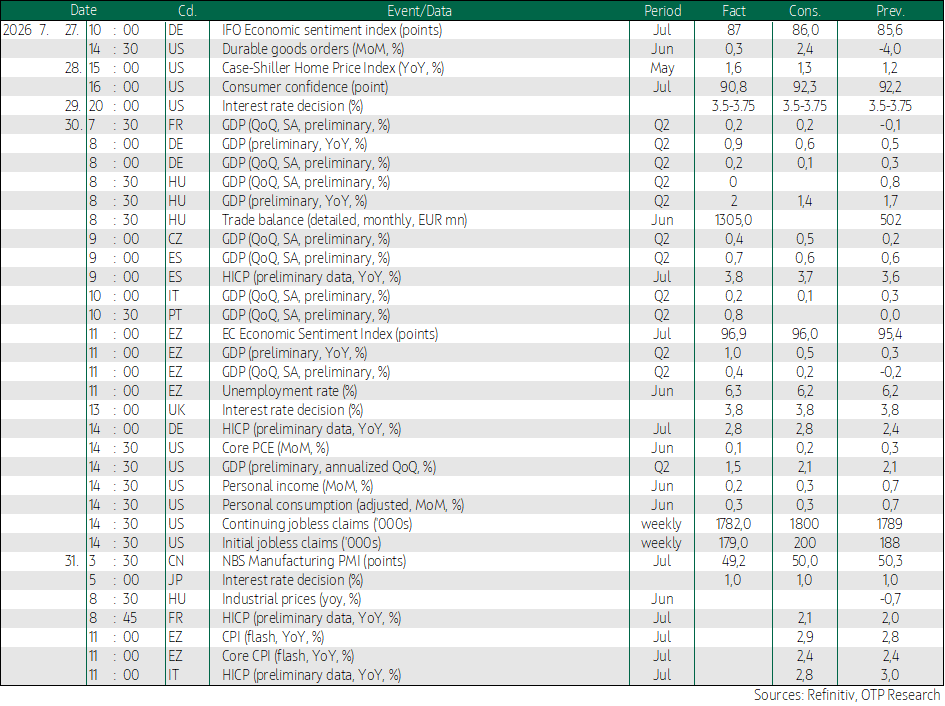
On the macro front, the eurozone economy delivered a meaningful positive surprise, expanding more strongly than expected in the second quarter. GDP grew by 0.4% quarter-on-quarter and 1.0% year-on-year. The upbeat reading was supported by stronger-than-expected growth across several major economies, including Germany (+0.2% QoQ), Spain (+0.7% QoQ), and Italy (+0.2% QoQ). Meanwhile, Hungary's 1.7% year-on-year GDP growth also exceeded expectations. However, according to the Hungarian Central Statistical Office (KSH), agriculture made a negative contribution to economic growth in the second quarter. Ahead of today's eurozone CPI release, Germany's inflation reading, published yesterday, came in line with expectations at 2.8%, while Spain's 3.8% figure exceeded the consensus forecast by one percentage point.
Trading across the Central and Eastern European region also remained upbeat on Thursday. Hungary's BUX index closed at a new record high, gaining 0.95%, led by OTP. Poland's WIG20 advanced 1.6%, while Prague's PX 50 added 0.4%. Among Hungarian blue chips, OTP delivered the strongest performance, ending the session near its previous peak after rising 1.41%.
Microsoft soared as the US economy sent mixed signals
US stock indices closed higher on Thursday, recovering from Wednesday's broad-based selloff. The Dow Jones gained 1.2%, the S&P 500 rose 1.7%, while the technology-heavy Nasdaq Composite surged nearly 2.8%. The rally was driven primarily by the technology sector, which soared 5.3%, more than offsetting declines across eight of the S&P 500's eleven sectors.
Investor sentiment was largely driven by Microsoft's soaring 15.5% rally after the company released better-than-expected sales and cloud growth guidance while keeping capital expenditures below estimates. This stood in sharp contrast to Meta's performance, with shares tumbling 8% after second-quarter free cash flow plunged 91% due to the substantial costs associated with its AI investments. The semiconductor sector also staged a strong rebound, as the Philadelphia Semiconductor Index (SOX) surged 8.2%, snapping a five-day losing streak. Ahead of earnings releases after the closing bell, Amazon gained 3.9%, Apple slipped 1.4%, while Qualcomm fell 2.6% following a weaker-than-expected profit outlook and declining revenue from Apple. Fair Isaac suffered a 17% plunge, whereas Starbucks advanced 1.6% after raising its full-year guidance.
On the macro front, data from the US painted a mixed picture. Annualized economic growth slowed to 1.5% in the second quarter, falling short of the 2.1% market consensus. At the same time, signs of easing CPI pressure emerged, as the Fed's closely watched Core PCE index rose by just 0.1% month-on-month in June, below expectations of 0.2%. Meanwhile, household income increased by 0.2%, while consumer spending expanded by 0.3%. Labor market indicators continued to point to relative resilience, with initial weekly jobless claims declining to 179,000, well below the consensus forecast of 200,000.
In the energy sector, developments continue to be driven by escalating geopolitical tensions in the Middle East. After surging more than 7% on Wednesday, Brent crude prices eased nearly 2% on Thursday, retreating to around USD 89 per barrel. The oil market rally has been fueled by concerns over US-Iran military incidents, Iraqi drone attacks targeting Saudi oil facilities, and threats posed by Houthi militants to shipping routes in the Red Sea.
Rising yields across international bond markets as the Bank of England holds rates steady
International bond markets saw yields move higher during Thursday's trading, as the sharp rise in US Treasury yields spilled over into European government bond markets. The move was triggered by the Federal Reserve's decision to keep interest rates unchanged on Wednesday and by Fed Chair Kevin Warsh's cautious remarks, which left uncertainty surrounding the future rate path. As a result, the yield on the 30-year US Treasury bond rose to 5.21%, its highest level in 19 years.
In the euro area, longer-dated bond yields posted the largest increases, reflecting investors' growing CPI concerns. Germany's 10-year Bund yield rose by 1 basis point to 3.17%, while the 30-year yield climbed by 3 basis points to 3.14%. The yield curve steepened as shorter-dated bonds saw modest declines in yields. Bond markets were also influenced by stronger-than-expected eurozone macroeconomic data, with the bloc's economy expanding by 0.4% quarter-on-quarter in the second quarter.
In the United Kingdom, the Bank of England left its benchmark interest rate unchanged at 3.75%, in line with market expectations, signaling that domestic economic conditions are gradually easing CPI pressures. Following the decision, both UK government bond yields and the pound weakened modestly.
The rise in international yields also made its presence felt in the Hungarian government bond market, with benchmark yields on longer-dated securities edging higher in the secondary market. Despite the increase in global yields, institutional demand remained stable at government debt auctions, with the Government Debt Management Agency (ÁKK) successfully selling more than the announced amount of both the one-year Treasury bills (DKJ) and the 25-year green bond.
Today's highlights
In Asia, major equity indices were mostly higher ahead of Friday's close. Japan's Nikkei was up more than 4%, while South Korea's KOSPI surged more than 16%.
Oil prices continued to decline this morning, with Brent crude approaching USD 88 per barrel and WTI crude nearing USD 82 per barrel.
Later today, Hungary will publish industrial producer data. Harmonised CPI figures are also due from France, Italy, and the euro area as a whole.
Get more out of your investments!
Global Markets Services
OTP Global Markets offers a broad range of services in the field of local and international money and capital markets.
Read morePrivate Banking Services
Personal care and expertise with OTP Private Banking, along with the knowledge, security, and innovations of a multinational banking group.
Read more