
OTP Morning Brief: The Fed left interest rates unchanged, while Warsh failed to provide guidance
Related content
OTP Morning Brief: Further declines in the US technology sector on Friday
Selling pressure on the technology sector remained elevated across developed equity markets on Friday. However, favorable corporate earnings offset the weakness in the IT sector in Europe. European equity markets also posted weekly gains, marking their strongest weekly performance since June. In the US, the decline in equity indices continued, with concerns surrounding AI-related companies further amplified by the CoreWeave episode. The sell-off in equity markets prompted investors to shift toward safer assets, while long-term bond yields continued to decline. The US 10-year Treasury yield declined by 15 bps over the past week, closing Friday’s session at 5.1%, supported in part by easing expectations of further rate hikes. Based on futures pricing, the Fed is expected to leave interest rates unchanged at next week’s meeting. Eurozone bond yields also moved lower, tracking developments in overseas fixed-income markets. The euro strengthened to 1.124 against the dollar. Long-term yields also declined sharply in the Hungarian government bond market over the past week, with the 10-year yield falling by 29 bps to a three-month low of 5.31%. Oil prices continued to rise amid the unresolved situation in the Middle East. European natural gas futures soared to an early four-year high over the past week. This week, in the Hungarian market, attention will focus on the 2027 budget to be released today and the MNB’s interest rate decision meeting on Tuesday.
OTP Morning Brief: US producer price index came in above expectations, yet the US 10-year Treasury yield still declined
Western European equities continued to advance despite ongoing pressure on the technology sector. Wall Street indices also rebounded, recovering some ground after Wednesday’s sell-off. Healthcare was the standout performer on both sides of the Atlantic. Eurozone industrial production declined by 0.5% month-on-month in August. In the US, the producer price index accelerated to 6.3%, delivering another upside surprise in inflation developments. US retail sales increased by 0.8% compared to August. The US 10-year Treasury yield declined by more than 10 basis points. The long end of the Hungarian government bond yield curve also declined by 7-9 basis points. In Hungary, August wage data will be released today, while in the US, September industrial production figures are due.
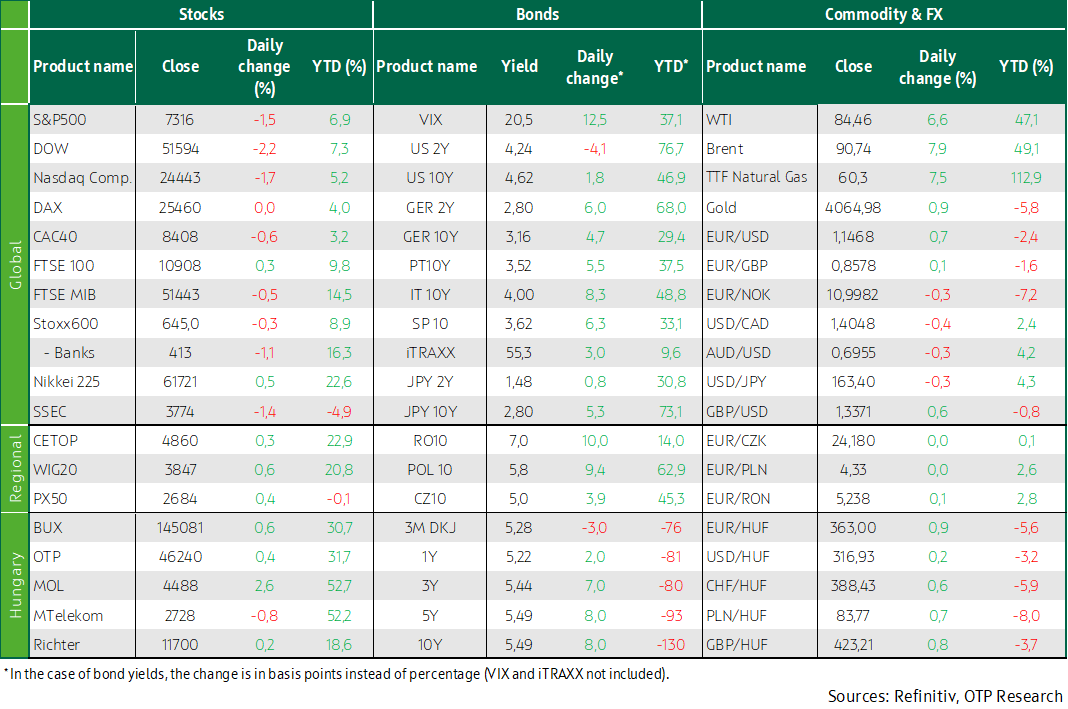
Wednesday's trading session on Wall Street ended with notable declines. Investors remained nervous ahead of the post-market earnings releases from major technology companies, while AI-related chipmakers sold off sharply. At the same time, the industrial segment of the S&P 500 also suffered significant losses. The Fed left interest rates unchanged as expected; however, a quarter of policymakers voted in favor of further tightening. At the press conference following the decision, Fed Chair Kevin Warsh refrained from providing clear guidance on the future path of interest rates. Long-term yields moved higher both in advanced economies and across our region, while the EUR/USD rose 0.7% to near 1.147. Meanwhile, the EUR/HUF climbed to around 363. Renewed tensions in the Middle East intensified geopolitical concerns, with crude oil prices surging 7-8% and European natural gas prices jumping 7.5%, amid growing fears that the conflict could spread to an increasing number of countries. Today, investors will focus on the preliminary Q2 GDP figures from Hungary, the euro area and the US, along with eurozone CPI data and the US core personal consumption expenditures (PCE) price index. Among today's earnings releases, Apple and Amazon are set to report their results. Samsung, meanwhile, announced a substantial increase in profit.
Weakness in the technology sector and rising crude oil prices kept the pan-European Stoxx 600 under pressure
European equities delivered a mixed performance on Wednesday, with the Stoxx 600 slipping 0.3% after a three-day winning streak, while the CAC 40 retreated 0.6%. The DAX was essentially unchanged, whereas the FTSE 100 edged 0.3% higher. Investors remained cautious ahead of the Fed's policy decision and earnings releases from major US technology companies later in the day. Although Kering soared 17%, marking its strongest rally since 2002, the luxury goods group warned about uncertainty surrounding sales prospects in China, its largest market. As a result, the luxury sector index ended the session as the worst performer, declining by more than 2%. The technology index also edged lower after a nearly 5% drop in ASM International weighed on sentiment despite the company's upbeat guidance. Meanwhile, French IT group Sopra Steria surged almost 14% after raising its full-year revenue target. Glencore shares jumped nearly 3% after the company reported a 15% increase in copper production during the first two quarters of the year, supported by higher-grade output at its key mining operations. Positive news also emerged from the financial sector, with Deutsche Bank gaining 1% after reporting a 10% increase in Q2 profit, exceeding market expectations. In contrast, Aberdeen fell 4.3% after the UK asset manager posted GBP 3 billion in net outflows during the first half of the year, compared with expectations for GBP 800 million in net inflows.
Among the Stoxx 600 sector indices, cyclical consumer goods manufacturers, banks, utilities, and the travel and leisure sector all declined by around 1%.
Trading in the CEE region remained upbeat on Wednesday. The BUX gained 0.6%, closing at a fresh record high led by OTP. Poland's WIG20 also advanced 0.6%, while the Czech PX added 0.4%. Among Hungarian blue chips, Mol delivered the strongest performance, rising 2.6% and ending the session close to its previous peak.
Major US indices declined as chipmakers sold off sharply again ahead of post-market earnings releases from big tech companies
Wall Street indices closed sharply lower on Wednesday after the Fed left interest rates unchanged as expected, while investors awaited earnings reports from major technology companies due after the closing bell. The S&P 500 fell 1.5% to a one-month low, the Nasdaq Composite lost 1.7% and now stands 9% below its record high reached in June, while the Dow declined 2.2%. The Nasdaq 100 also retreated by more than 2%, extending its recent losses as investors continued to sell AI-related stocks amid concerns over heavy capital spending. Market participants are increasingly worried that large US corporations are becoming ever more deeply committed to AI investments and will continue allocating billions of dollars to the emerging technology at the expense of free cash flow. Losses among AI-linked chipmakers deepened after South Korean chip producer SK Hynix reported quarterly profit that soared sixfold but still fell short of elevated investor expectations. The company's shares tumbled 10%.
Among the S&P sector indices, industrials recorded the steepest decline, with major companies in the aerospace and defense, specialized industrial machinery, and agricultural and heavy equipment segments ending the session notably lower. Information technology followed closely behind, while the financial sector also underperformed the broader market. The energy sector emerged as Wednesday's top performer, supported by rising oil prices amid renewed hostilities in the Middle East.
Meta shares fell 4% in after-hours trading after the company announced that it now expects 2026 capital expenditures to reach USD 130-145 billion, compared with its previous forecast of USD 125-145 billion. Microsoft, meanwhile, gained 0.6% after the closing bell after reporting quarterly cloud revenue growth that exceeded analyst expectations, suggesting that its massive investments in AI infrastructure are beginning to pay off. During regular trading hours, Meta declined 1.3% and Microsoft slipped 0.7%, while chipmakers themselves suffered losses ranging between 2% and 10%. Among them, Nvidia fell 3.6%, Broadcom lost 2.8%, Micron Technology tumbled nearly 10%, while AMD and Intel both dropped by more than 5%. AI infrastructure provider Vertiv plunged 17% after the company failed to meet quarterly revenue expectations.
Crude oil prices rose on Wednesday, with Brent surging more than 7% to above USD 90 per barrel, snapping a three-day losing streak as tensions in the Middle East continued to escalate and fears mounted that additional countries could become involved in the conflict. President Trump stated that the US would respond forcefully to Iran over an attempted surprise attack against American forces after the US military reported that it had successfully thwarted an unexpected Iranian strike targeting US troops stationed in the Middle East. Meanwhile, Iran-backed militias in Iraq launched drones for a second consecutive day against oil facilities in eastern Saudi Arabia. A tanker anchored at an Egyptian port also came under attack on Wednesday. In addition, reports suggested that Yemen's Houthi militants are considering imposing fees on vessels transiting the Red Sea, further intensifying concerns over shipping costs and energy flows. Iran also rejected an Omani proposal on Wednesday for joint oversight of the Strait of Hormuz.
The Federal Open Market Committee left rates unchanged as expected; long-term yields moved higher, while the dollar weakened significantly
As expected, the Fed left its key policy rate unchanged on Wednesday. Three FOMC members dissented, voting in favor of a 25bp rate hike. During the customary press conference, Chair Kevin Warsh offered limited forward guidance but stated that the Fed "will not hesitate to act if necessary" and that higher interest rates "could be part of the solution" to addressing excessively high CPI. Markets are currently no longer pricing in a rate hike this year. Over the longer term, investors assign a greater than 50% probability to one additional 25bp increase by the end of next year. Meanwhile, in the euro area, markets expect two 25bp rate hikes this year, while ECB officials have also continued to signal further policy tightening. Long-term yields moved higher across developed bond markets yesterday, with the US 10-year Treasury yield closing at 4.62% and the German 10-year benchmark yield rising to 3.16%, approaching last week's fifteen-year high. The EUR/USD climbed 0.7% to near 1.147.
In line with moves across developed bond markets, regional yields also edged higher on Wednesday, while Hungarian government bond yields followed the same upward trend. Along the curve beyond one year, benchmark yields increased by 7-9bp, with the 10-year yield rising to 5.49%. The forint weakened by nearly 1% against the euro, pushing the EUR/HUF exchange rate to the 363 level. At Wednesday's six-month Treasury bill auction, Hungary's Government Debt Management Agency (ÁKK) sold the planned HUF 30 billion of securities amid modest excess demand.
Today's highlights
Asian equity markets were mostly trading in negative territory ahead of the close. The Nikkei was a notable exception, gaining 0.9%, although it remains down 4% on a weekly basis. Market anxiety surrounding AI-related capital expenditure has made Asian markets highly volatile, with South Korean benchmark indices falling between 1.5% and 3% today, while suffering losses of 30-40% over the past month.
Samsung Electronics reported today that its operating profit soared nineteenfold in Q2 to a record high, as strong demand for AI chips more than offset weaker performance in its mobile business. The world's largest memory chipmaker posted operating profit of KRW 89.4 trillion (USD 61.9 billion), in line with its own guidance and representing a substantial increase from KRW 4.68 trillion a year earlier. Samsung expects the global chip shortage to intensify further and persist through 2028, while profit from its semiconductor division increased more than 250-fold, helping to ease some of the market's concerns. Meanwhile, a sharp sell-off in the South Korean equity market, with the KOSPI on track for a 15% weekly decline, prompted Finance Minister Koo Yun-cheol to apologize for the introduction of leveraged ETFs linked to individual stocks and led authorities to consider additional market stabilization measures.
Oil prices continued to rise this morning, with Brent approaching USD 93 per barrel and WTI nearing USD 86 per barrel.
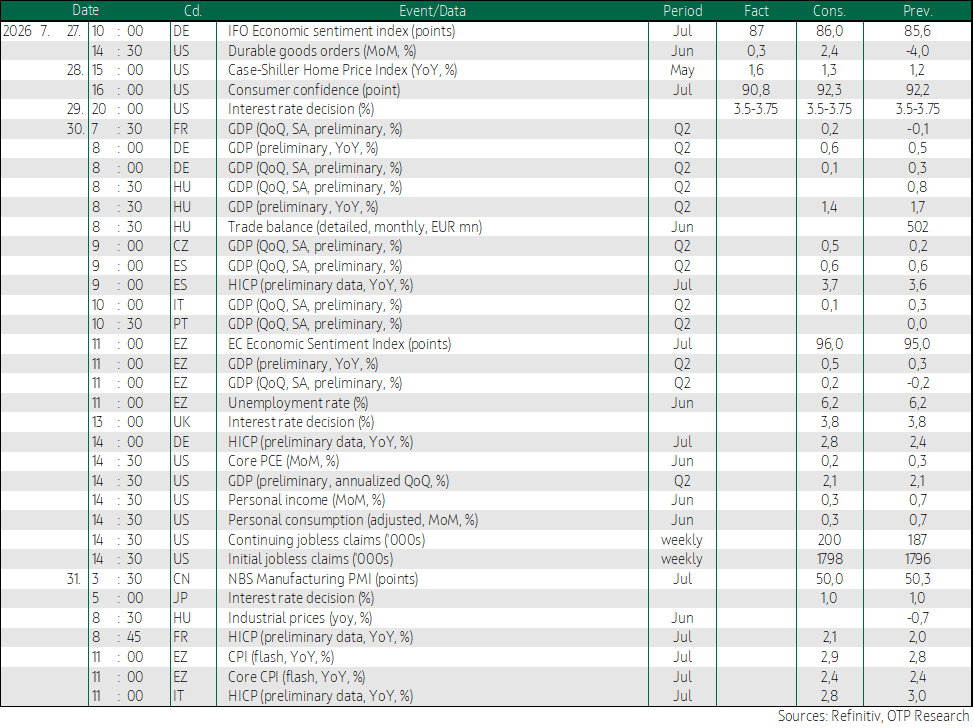
Preliminary Q2 GDP figures are due today in both Hungary and the euro area. The largest eurozone economies will publish not only their preliminary GDP estimates but also flash July CPI readings. The European Commission is scheduled to release confidence indicators, while eurozone unemployment data will also be in focus. The Bank of England will hold a policy meeting, where no change in interest rates is expected. In the US, attention will center on the preliminary Q2 GDP report, the core personal consumption expenditures (PCE) price index, household income and spending figures, as well as weekly jobless claims data.
Today's earnings calendar will be dominated by reports from Apple, Amazon, and Mastercard in the US. In Europe, investor attention will be focused on results from Shell, Schneider Electric, Anheuser-Busch, BAT, BBVA, ENEL, and Sanofi, among others.
Today, Hungary's Government Debt Management Agency (ÁKK) will auction 12-month Treasury bills and a green government bond maturing in 2051, with planned issuance volumes of HUF 30 billion and HUF 10 billion, respectively.
Get more out of your investments!
Global Markets Services
OTP Global Markets offers a broad range of services in the field of local and international money and capital markets.
Read morePrivate Banking Services
Personal care and expertise with OTP Private Banking, along with the knowledge, security, and innovations of a multinational banking group.
Read more