
OTP Morning Brief: Oil Prices Continued to Fall
Related content
OTP Morning Brief: Thursday trading brings equity market correction and rising oil prices
European equities closed slightly lower, primarily due to weakness in the technology and defence sectors. A more significant correction unfolded on US equities markets as a wave of selling hit technology stocks, while oil and natural gas prices rose markedly amid escalating geopolitical tensions. Amid growing investor caution, both US and German government bond yields declined, while the dollar edged higher against the euro after experiencing significant intraday volatility. Longer-dated yields also declined on the Hungarian bond market, while the forint weakened against both the euro and the dollar. The negative sentiment spilled over from US markets into Asia, with most major Asian equity indices trading in negative territory during the morning session. Today's focus will be on the October US labour market data, which could materially influence market expectations regarding the Federal Reserve's December rate decision. Additionally, retail sales data will be released from both the euro area and Hungary, while Germany will publish its September industrial production figures.
OTP Morning Brief: Investor sentiment improved following the Democrats’ congressional victory and the decline in oil prices
Lower bond yields and oil prices, driven by the Democrats’ expected congressional majority, improved market sentiment. Brent crude has fallen by roughly 20% since the beginning of the week, while the yield on the 10-year US Treasury note declined by 6 basis points to 4.89%. Amid the favourable risk environment, the US dollar weakened, with the EUR/USD exchange rate rising to near 1.123. In Europe, positive corporate news also supported market sentiment, with the STOXX 600 index rising by 1.8%, while shares of Novo Nordisk gained 5.6% after the company raised its full-year guidance. Today, investors will focus on German industrial orders, French industrial production and the euro area producer price index, alongside interest rate decisions by the Bank of England and the Czech central bank. In the US, weekly initial jobless claims, as well as Q3 productivity and labour cost data, will also be in the spotlight.
European indices closed mostly higher; Mercedes and Unilever reported better-than-expected results, while ASML shares declined. Major US indices closed mixed; capital rotated out of certain technology stocks and into traditional industries. Coca-Cola reported better-than-expected results, while Boeing's loss exceeded market forecasts. US yields declined, while oil prices fell amid easing tensions in the Middle East. Today's focus will be on the Fed's interest rate decision, alongside corporate earnings reports.
European indices closed mostly higher; Mercedes and Unilever reported better-than-expected results, while ASML shares declined
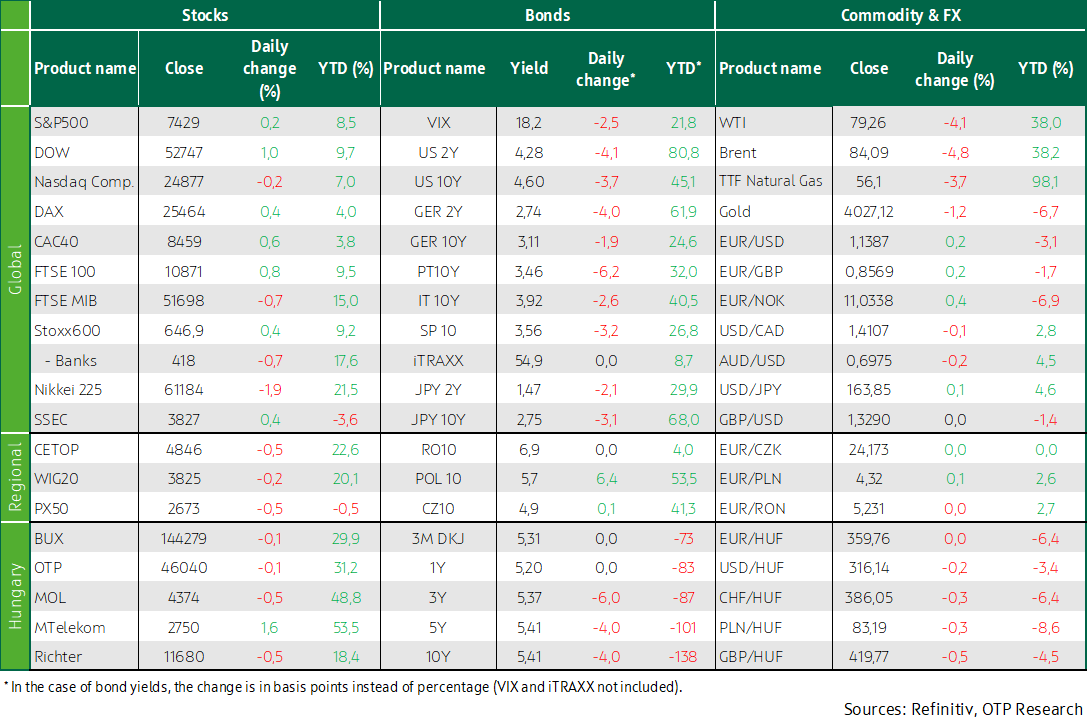
European equities advanced for a third consecutive session on Tuesday, with the STOXX 600 index gaining 0.4%. Market sentiment was primarily supported by the consumer sector after several major consumer-focused companies reported better-than-expected earnings, while banking and technology stocks lagged behind. Among the top gainers, Unilever surged 9.1% after reporting second-quarter revenue growth that exceeded market expectations. Mercedes-Benz shares rose 2.9% following a 22% increase in quarterly operating profit. Luxury goods group LVMH posted 3% quarterly revenue growth, lifting its stock by 0.8%. In the technology sector, investor sentiment weakened after reports that China had begun production of its own immersion DUV lithography machines, potentially intensifying competition for European semiconductor equipment suppliers. ASML shares fell 2.9%, while weakness among Asian chipmakers added further pressure to the sector. In banking, Barclays lost 4.2% despite reporting a 17% increase in first-half profit that exceeded analysts’ forecasts.
Investors' attention turned to the Federal Reserve's interest rate decision due on Wednesday. Markets expect rates to remain unchanged; however, a 25-basis-point rate cut by year-end has already been largely priced in, while the probability of a second cut is estimated at around 50%.
Sentiment was negative across the Central and Eastern European region, with the Budapest, Warsaw, and Prague indices all closing lower. Among Hungary’s blue chips, only Magyar Telekom posted gains, while the other three heavyweight stocks ended the session in negative territory.
Major US indices closed mixed; capital rotated out of certain technology stocks and into traditional industries. Coca-Cola delivered better-than-expected results, while Boeing's loss exceeded market expectations
Major US indices delivered mixed performance on Tuesday. The Dow Jones moved higher, supported by strong corporate earnings, a sharp decline in oil prices, and capital rotation from technology stocks into more traditional sectors. The S&P 500 also closed in positive territory, while the tech-heavy Nasdaq Composite slipped lower. Coca-Cola released its earnings report before the opening bell, beating expectations on both earnings and revenue. Management also raised its full-year guidance and noted that the FIFA World Cup had provided a valuable opportunity to strengthen its brands. The stock closed 5% higher. Boeing reported a larger-than-expected loss, although both revenue and aircraft deliveries increased from a year earlier. However, a $280 million loss related to the long-running Air Force One program weighed on results. Despite this, Boeing shares rose 4.8%. The technology sector remained under pressure, with Micron among the weakest performers, falling 8.9%, while AMD declined 8.1%.
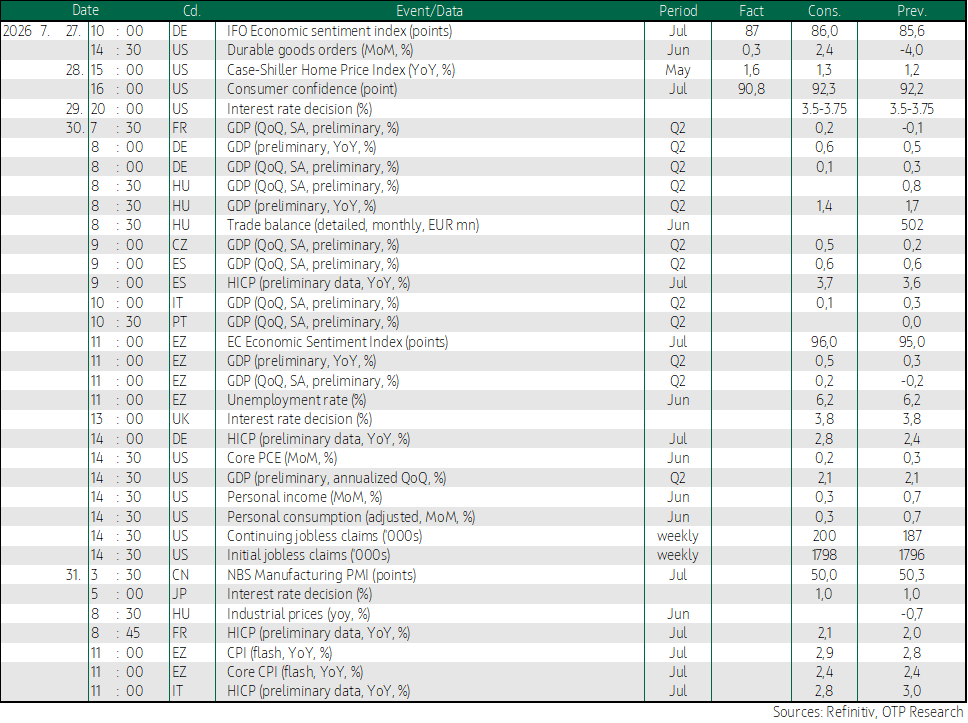
Among macroeconomic releases, the Case-Shiller 20-City Home Price Index rose 1.6% year-on-year in May, accelerating from the 1.2% increase recorded in April and surpassing market expectations of 1.3%. This marked the strongest annual pace of home price growth since August 2025. However, in real terms, home prices declined for the twelfth consecutive month, as CPI of 4.2% outpaced nominal price growth. Meanwhile, the Conference Board Consumer Confidence Index fell to 90.8 in July from 92.2 in June, missing the market consensus of 92.3. The weaker-than-expected reading suggests that households remain cautious in their assessment of economic conditions. The present situation index deteriorated for a third consecutive month, while the expectations index remained in territory typically associated with recession risks. According to the survey, consumers viewed current business conditions less favorably and also reported a somewhat weaker assessment of the labor market. Looking ahead, respondents did not anticipate a meaningful improvement in business conditions over the next six months, although expectations for the labor market improved slightly. Households’ income expectations also moderated, but overall they remained optimistic about their personal financial situation.
US yields declined, while oil prices fell amid easing tensions in the Middle East
US Treasury yields declined further on Tuesday as investors awaited the Fed's interest rate decision on Wednesday and welcomed signs of easing tensions between the US and Iran. The yield on the 10-year US Treasury note fell by nearly 4 basis points, while the policy-sensitive 2-year yield declined by 4.1 basis points. The drop in yields was partly supported by lower oil prices. Market sentiment improved following reports of constructive talks between the US and Iran highlighted by President Donald Trump. Investors also responded positively to news that Iran had held discussions with Saudi Arabia and Oman regarding developments in the Strait of Hormuz. Against this backdrop, WTI crude prices fell by 4%.
The EUR/USD pair was little changed during yesterday's trading session, with the euro posting only a marginal gain against the greenback. The Hungarian forint fluctuated around the 360 level against the euro and closed slightly below it. In the bond market, yields on maturities longer than one year declined by 4-6 basis points, with the yield on the 10-year Hungarian government bond falling to 5.41%.
Today's highlights
Trading in Asia was mixed. South Korea’s benchmark index extended its decline despite strong results from SK hynix, which nevertheless failed to meet elevated investor expectations. Japanese equities also moved lower, while Indian and Chinese indices traded in positive territory. Oil prices resumed their rise this morning following reports that Iran had launched several missiles, all of which were successfully intercepted and destroyed.
Today's focus will be on the Fed's interest rate decision, alongside corporate earnings reports, with results from Microsoft, Meta, HSBC, and Procter & Gamble among the key highlights.
Get more out of your investments!
Global Markets Services
OTP Global Markets offers a broad range of services in the field of local and international money and capital markets.
Read morePrivate Banking Services
Personal care and expertise with OTP Private Banking, along with the knowledge, security, and innovations of a multinational banking group.
Read more