
OTP Morning Brief: Crude oil prices plunged sharply as the Middle East conflict eased
Related content
OTP Morning Brief: US producer price index came in above expectations, yet the US 10-year Treasury yield still declined
Western European equities continued to advance despite ongoing pressure on the technology sector. Wall Street indices also rebounded, recovering some ground after Wednesday’s sell-off. Healthcare was the standout performer on both sides of the Atlantic. Eurozone industrial production declined by 0.5% month-on-month in August. In the US, the producer price index accelerated to 6.3%, delivering another upside surprise in inflation developments. US retail sales increased by 0.8% compared to August. The US 10-year Treasury yield declined by more than 10 basis points. The long end of the Hungarian government bond yield curve also declined by 7-9 basis points. In Hungary, August wage data will be released today, while in the US, September industrial production figures are due.
OTP Morning Brief: US CPI data came in above expectations
European equity markets advanced, supported by strong results from ASML and the outstanding performance of the healthcare sector. US equity markets came under pressure following higher-than-expected September CPI data. The annual CPI rate accelerated to 3.7%, driven primarily by a surge in gasoline prices, while core CPI rose by 0.3% month-on-month, supported by higher housing costs and rising transportation service prices. Oil prices rose amid escalating tensions in the Middle East and the impact of the IEA's oil market report. US Treasury yields retreated after an initial increase, driven by Fed commentary, while European bond yields generally moved higher. The US macro calendar will be busy today, with investors focusing on September retail sales and producer price index data, as well as the New York Fed Manufacturing Index, weekly jobless claims, and business inventories. August industrial production data from the euro area will be released today.
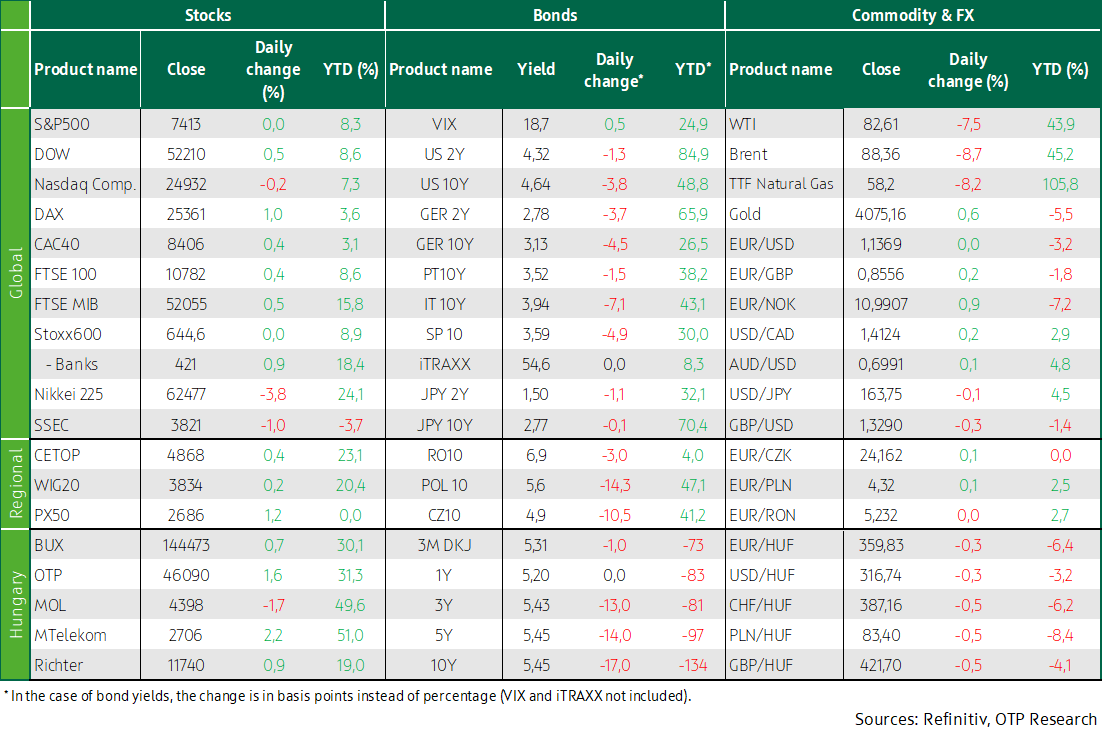
The first trading day of the week brought modest gains to the major European stock markets, as sectors benefiting from the easing of the Middle East conflict offset declines in the technology and energy sectors. Stock markets across the CEE region also moved higher, with the BUX gaining 0.7%. Wall Street indices closed mixed with minor moves, as investors turned their attention to the Fed's upcoming interest rate decision later this week and earnings reports from major technology companies. WTI crude futures fell by more than 7%, while Brent crude declined by over 8%. Developed-market bond yields declined as easing concerns over CPI, driven by lower oil prices, boosted demand for fixed-income assets. Domestic long-term bond yields also moved markedly lower. The EURHUF exchange rate is trading around the 360 level. Today marks the start of the Fed's two-day rate-setting meeting, while the earnings season continues with reports from several major companies.
Major European stock indices advanced, while the technology and energy sectors underperformed
Monday's trading session delivered modest gains across major European stock markets, while the pan-European Stoxx 600 was broadly unchanged, as weakness in the technology sector (-1.7%) overshadowed optimism fueled by easing Middle East tensions and a sharp drop in oil prices. The technology sector's poor performance was driven by an 8.5% plunge in ASML shares following reports that China had begun producing domestically developed semiconductor manufacturing equipment, a market long dominated by ASML. The news also weighed on the company's suppliers and competitors, with ASM International falling 7.1% and BE Semiconductor declining 9.7%. The oil and gas sector dropped 2% in line with the plunge in crude oil prices, which, however, provided support for retail as well as travel and leisure companies; Lufthansa, IAG, and Ryanair posted gains of between 1% and 2%.
Among corporate developments, AstraZeneca (+1.7%) also proved to be a market mover, with the pharmaceutical company beating second-quarter profit expectations and reaffirming its 2026 guidance. Vodafone climbed 4.8% after the telecommunications group improved its outlook.
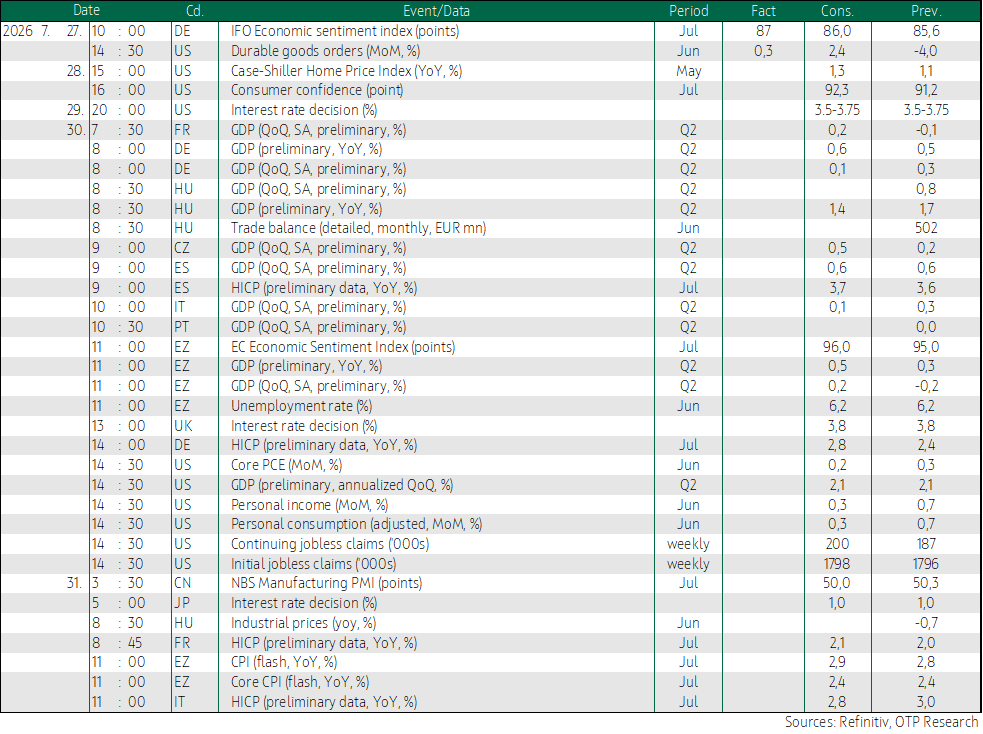
The German Ifo Business Climate Index released yesterday rose to 86.6 in July, marking the third consecutive monthly increase and coming in slightly above the market consensus forecast of 86. Based on the incoming data, the economy is gradually stabilizing, although the outlook remains fragile.
The European TTF natural gas price fell by more than 8%, dropping below EUR 60/MWh.
CEE stock markets also edged higher, with Prague delivering the strongest performance in the region. The BUX gained 0.7%; among the major Hungarian blue chips, only MOL ended in negative territory, tracking the decline in crude oil prices.
Major Wall Street indices closed mixed, while crude oil prices plunged sharply
Wall Street indices closed Monday's session mixed as investors awaited earnings reports from major technology companies due later this week, along with the Fed's rate-setting meeting. The Dow posted a modest gain, the S&P 500 was broadly unchanged, while the Nasdaq edged slightly lower. Market attention is focused on upcoming results from Microsoft, Amazon, Meta, and Apple, as a growing number of investors are questioning whether the AI-driven stock market rally can be sustained given exceptionally high capital expenditure requirements. At the sector level, consumer goods manufacturers and information technology companies delivered the strongest gains. Mirroring developments in Europe, the semiconductor sector remained under pressure: the PHLX Semiconductor Index fell 2.2% and is now 21% below its record high reached in June, while AMD and Nvidia both closed around 5% lower. Energy stocks declined alongside crude oil prices, with ExxonMobil slipping 1.4% and Chevron losing 2.5%.
Tensions in the Middle East eased, triggering a sharp decline in crude oil prices; WTI fell by more than 7% and Brent by over 8%, bringing them close to USD 82.5 and USD 88 per barrel, respectively. That said, given the twists and turns seen in recent months, the optimism may once again prove premature. Donald Trump has claimed that the US halted airstrikes against Iran at Tehran’s request. Meanwhile, Iran’s Foreign Ministry stated that no negotiations are currently underway and that Tehran “will never allow the US to dictate the timing of war and peace.”
Developed-market bond yields declined, while Hungarian long-term yields also moved notably lower
Developments related to the easing of the Middle East conflict were the key market driver across developed bond markets. As lower oil prices eased concerns over CPI and reduced expectations of further rate hikes, bond yields moved lower. The US 10-year Treasury yield declined by 4 basis points to 4.64%. In Europe, yield declines were even more pronounced, with the German 10-year Bund yield falling 5 basis points to 3.13%. Markets are currently pricing in a 25-basis-point rate hike from both the ECB and the Fed in September, while expectations regarding an additional move in December remain more divided. The EURUSD pair (1.137) was little changed during yesterday's trading session, with the euro posting a marginal gain against the greenback.
The forint traded around the 360 level against the euro yesterday and closed near that mark. In the bond market, yields beyond the one-year segment fell by 13–19 basis points, bringing the Hungarian 10-year yield down to 5.45%; nevertheless, it still rose by more than 40 basis points over the course of July. At yesterday’s discount Treasury bill (DKJ) switch auction, strong demand resulted in HUF 28 billion worth of Treasury bills changing hands.
Today's highlights
Tensions are running high across Asia-Pacific equity markets this morning as investors await earnings reports from major technology companies and the Fed's rate-setting meeting. Most leading stock indices are on track to close in negative territory. South Korea's KOSPI is currently posting the steepest decline, down around 10%, as it continues to be heavily weighed down by weak performance among semiconductor manufacturers. For similar reasons, Japan's Nikkei 225 is also trading roughly 4% lower. Meanwhile, crude oil prices extended their decline during this morning's session.
European equity futures point to a mixed open, while Wall Street is expected to start today's trading session in negative territory.
The Hungarian Government Debt Management Agency (ÁKK) will offer HUF 30 billion worth of three-month discount Treasury bills (DKJs) for sale today.
In terms of economic releases, today is expected to be the final relatively quiet day of the week. In the US, the May Case-Shiller Home Price Index and the Conference Board’s July Consumer Confidence Index are due to be published. The latter is likely to attract greater market attention. In June, the index rose by 0.6 points to 91.2 from a downwardly revised 90.6 in May, as lower fuel prices during the survey period helped ease concerns about CPI. The key question now is how consumers' assessment evolved in July amid rising crude oil prices. Today also marks the start of the Federal Open Market Committee's two-day rate-setting meeting.
However, the day will be busy on the corporate earnings front, with results due from companies including Visa, Coca-Cola, Boeing, UPS, Barclays, Mercedes-Benz, and Ford Motor. The first of the highly anticipated earnings reports from the technology giants will be released on Wednesday.
Get more out of your investments!
Global Markets Services
OTP Global Markets offers a broad range of services in the field of local and international money and capital markets.
Read morePrivate Banking Services
Personal care and expertise with OTP Private Banking, along with the knowledge, security, and innovations of a multinational banking group.
Read more