
OTP Morning Brief: Airstrikes eased in the Middle East
Related content
OTP Morning Brief: US producer price index came in above expectations, yet the US 10-year Treasury yield still declined
Western European equities continued to advance despite ongoing pressure on the technology sector. Wall Street indices also rebounded, recovering some ground after Wednesday’s sell-off. Healthcare was the standout performer on both sides of the Atlantic. Eurozone industrial production declined by 0.5% month-on-month in August. In the US, the producer price index accelerated to 6.3%, delivering another upside surprise in inflation developments. US retail sales increased by 0.8% compared to August. The US 10-year Treasury yield declined by more than 10 basis points. The long end of the Hungarian government bond yield curve also declined by 7-9 basis points. In Hungary, August wage data will be released today, while in the US, September industrial production figures are due.
OTP Morning Brief: US CPI data came in above expectations
European equity markets advanced, supported by strong results from ASML and the outstanding performance of the healthcare sector. US equity markets came under pressure following higher-than-expected September CPI data. The annual CPI rate accelerated to 3.7%, driven primarily by a surge in gasoline prices, while core CPI rose by 0.3% month-on-month, supported by higher housing costs and rising transportation service prices. Oil prices rose amid escalating tensions in the Middle East and the impact of the IEA's oil market report. US Treasury yields retreated after an initial increase, driven by Fed commentary, while European bond yields generally moved higher. The US macro calendar will be busy today, with investors focusing on September retail sales and producer price index data, as well as the New York Fed Manufacturing Index, weekly jobless claims, and business inventories. August industrial production data from the euro area will be released today.
European indices advanced on Friday, allowing them to end the week in positive territory once again. The July PMI data painted a positive picture of the eurozone outlook, although Trump imposed new tariffs, including measures affecting Europe. The BUX declined on Friday, but still ended the week in positive territory. According to the HCSO, employment declined while unemployment increased. Airstrikes between Iran and neighboring countries eased over the weekend. This pushed oil prices back below $100 per barrel. The S&P declined on Friday and posted a loss for the week as a whole. The composite PMI also increased in the US. Developed market government bond yields retreated from their local highs. Hungarian bond yields increased, while the forint strengthened slightly. Q2 GDP data will be released this week for Hungary, the eurozone, and the US. In addition, investors will be watching eurozone and US CPI data, as well as the Fed's interest rate decision.
Europe ended the week in positive territory again as economic activity improved in the eurozone
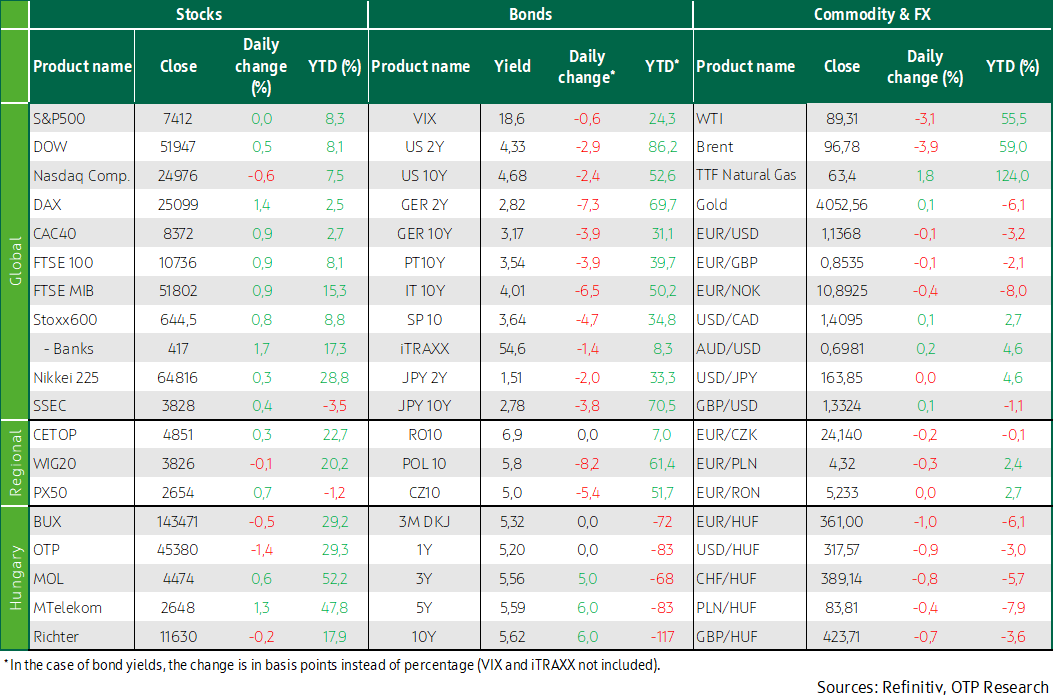
European stock markets closed higher on Friday after suffering their sharpest one-day decline in the past two weeks during the previous trading session. Investor sentiment was supported by corporate earnings reports, while markets also assessed the potential impact of higher oil prices on monetary policy. The pan-European Stoxx 600 gained 0.6%, with Germany’s DAX outperforming by rising 1.4%, driven primarily by an almost 10% surge in SAP shares. The software company reported stronger-than-expected growth in its cloud order backlog for the second quarter. The technology sector also rebounded, with its sectoral index advancing 1.7%, partially recovering losses from the previous day that had been triggered by disappointing quarterly results from STMicroelectronics and BE Semiconductor. Volkswagen shares fell 1% after CEO Oliver Blume stated that the company needs to further accelerate its cost-cutting program to remain competitive against increasingly strong Chinese automakers expanding their presence in both the European and German markets. While second-quarter results pointed to stabilizing operations, operating profit declined by nearly 10%. The company maintained its profit guidance but withdrew its revenue growth target and now expects sales to decline by as much as 3% by 2026. For the week as a whole, the Stoxx 600 posted its second consecutive weekly gain, rising 0.8%, while the UK's FTSE 100 delivered the strongest performance among the major indices with a 2.0% increase.
Adding to Europe's geopolitical challenges, the US administration imposed new tariffs of 10% and 12.5% on selected products from 60 trading partners, arguing that the affected countries had failed to adequately enforce bans related to forced labor. The move established a new legal basis for the tariffs after the previous measure had been struck down by the US Supreme Court. The new duties took effect just as the temporary 10% global tariff that had been in place previously expired.
On the data front, economic activity in the euro area returned to expansion in July after four months, with the S&P Global Composite PMI rising from 50.0 to 51.9, well above the consensus forecast of 50.2. Growth was supported by both the services sector, where the index increased to 51.6 from 49.4, and manufacturing, which improved to 52.0 from 51.4, with both readings exceeding market expectations. At the country level, Germany returned to growth territory, while the pace of contraction in France eased. Price pressures moderated and employment also recorded slight growth. However, analysts warned that the renewed conflict in the Middle East and higher energy prices could quickly weigh on the outlook. Although the third quarter has started on a strong footing, economists expect growth momentum to gradually weaken during the second half of the year. Beyond the eurozone, the UK also recorded a notable improvement, with the Composite PMI climbing from 49.3 to 52.1, signaling increased confidence in the early months of Prime Minister Andy Burnham’s administration. Supporting this trend, retail sales volumes rose by 1.0% month-on-month in June 2026, significantly outperforming market expectations, which had pointed to a 0.3% decline. Nevertheless, the pace of growth eased slightly compared with the 1.2% increase recorded in May.
The CEE region delivered mixed performance on Friday, as the BUX fell 0.5% and Poland’s WIG20 slipped 0.1%, partly offset by a 0.7% gain in the Czech PX 50. The Hungarian index was weighed down primarily by a 1.4% decline in OTP shares. On a weekly basis, however, the BUX still advanced 1.3%, while MOL climbed 5.9% over the week, supported by higher oil prices. According to data released by the HCSO on Friday, the number of employed persons stood at 4.6 million between April and June, down by 28,000 compared with the same period a year earlier, while the unemployment rate rose to 4.4% in June from 4.3% in the previous month.
Airstrikes eased in the Middle East, while major US indices ended the week in negative territory
US stock markets delivered mixed performance on Friday. Gains in the telecommunications, financial, and healthcare sectors supported sentiment, while technology, utilities, and energy stocks underperformed. Among the major indices, the Dow Jones advanced 0.5%, the S&P 500 was broadly unchanged, and the technology-heavy Nasdaq Composite closed 0.6% lower. Verizon was the leading contributor to the Dow’s gain, with its shares rising nearly 6%. Salesforce also posted a strong performance, climbing more than 4%, while IBM ended the session up around 3.7%. On the downside, American Express was the weakest performer, with its shares losing more than 4% of their value. Within the S&P 500, International Paper stood out with a share price increase of more than 11%. Similar gains of over 11% were recorded by oilfield services company SLB and digital infrastructure and data center specialist Digital Realty Trust. The strong performance of these three companies helped keep the S&P 500 in positive territory despite weakness in the technology sector. Overall, Friday’s session highlighted investors’ continued selectivity, with companies operating under more traditional and stable business models, along with parts of the cyclical sectors, posting gains, while technology stocks remained under profit-taking pressure. For the week as a whole, the Dow Jones rose 0.2%, while the S&P 500 declined 0.4% and the Nasdaq fell 2.1%.
After 13 consecutive days of exchanges of airstrikes between the US and Iran, which had pushed oil prices back toward the $100 mark, missile attacks came to an abrupt halt on Friday evening and did not resume over the weekend. According to US Ambassador to the UN Mike Waltz, President Trump aims to create room for diplomacy, while Iran stated that it would refrain from further attacks as long as the US side also stands down, although it remains skeptical about diplomatic negotiations. Pakistan has called for the resumption of talks, a move that has also received support from China. The temporary easing of the conflict led to a 4% decline in oil prices, pushing them back below $100 per barrel.
The S&P Global US Composite PMI rose to 53.6 in July 2026 from 51.9 in June, reaching its highest level since November last year. The improvement was driven primarily by the services sector, where business activity accelerated to an eight-month high. In contrast, manufacturing output continued to expand but at a much more moderate pace, with factories reporting the weakest increase in production since March.
Falling oil prices pulled yields lower, while the forint ended the week at 361 against the euro
In Friday’s trading, the benchmark 10-year US Treasury yield retreated to 4.679% from its highest level in the past 18 months as oil prices began to decline. Investors nevertheless remained cautious ahead of next week’s Federal Reserve policy meeting, with many concerned that the central bank could strike a more hawkish tone than expected. The yield on the two-year US Treasury note, which is particularly sensitive to monetary policy expectations, fell by 2.94 basis points to 4.331%. Despite this decline, it still posted a substantial weekly increase, recording its largest weekly rise since mid-May at around 16 basis points. Interest rate expectations also shifted meaningfully, with futures markets pricing a 38% probability that the Federal Reserve will raise rates at the conclusion of its two-day meeting on Wednesday, up sharply from 15% a week earlier. In Europe, government bond yields also moved lower on Friday after reaching multi-year highs a day earlier. The yield on the German 10-year Bund, the eurozone benchmark, fell 2.7 basis points to 3.184%, having climbed to a 15-year high during the previous trading session.
Contrary to international trends, Hungarian bond yields beyond one year rose by 5–6 basis points. As a result, the three-year yield ended the week at 5.56%, the five-year at 5.59%, and the 10-year at 5.62%. On a weekly basis, the three-year yield increased by 21 basis points, while the five- and 10-year yields climbed by 24–25 basis points. On Tuesday, the MNB cut its policy rate by 25 basis points to 5.75%, in line with expectations. At the press conference following the decision, Mihály Varga reiterated, similarly to June, that further rate cuts could be possible during the summer if favorable conditions persist. The forint strengthened by 1% against the euro on Friday, ending the week at 361, nearly two forints weaker than a week earlier.
Today's highlights
Most major Asian equity markets closed higher, reflecting improved global risk appetite as oil prices continued to decline. Japan’s TOPIX gained 1.0%, while the Nikkei 225 advanced 0.4%. Hong Kong’s Hang Seng rose 0.7%, and the Shanghai Composite added 0.4%, with Chinese markets supported primarily by strong gains in technology and battery manufacturing stocks. Shares of Contemporary Amperex Technology Co. Ltd. (CATL) surged after the company reported stronger-than-expected first-half results and announced the launch of a new share buyback program.
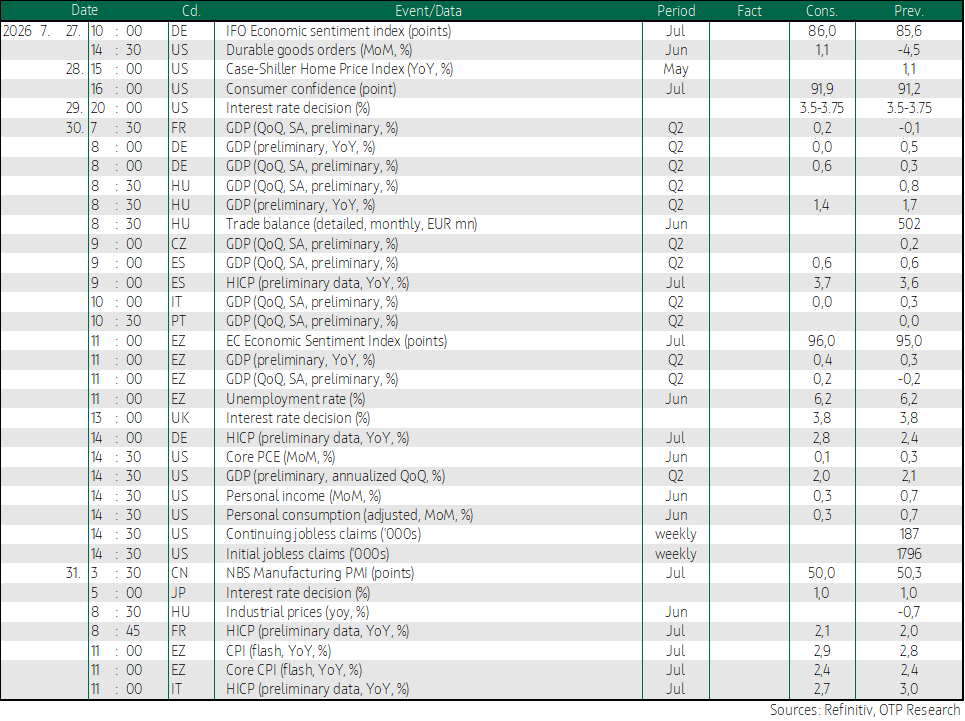
Today, the July reading of Germany’s Ifo Business Climate Index and US durable goods orders data will be released. Later in the week, Hungary’s Q2 GDP figures will also be published. We expect the Hungarian economy to have expanded by 1.8% year-on-year, representing a slight acceleration from the 1.7% growth recorded in Q1. Most Hungarian business activity indicators have pointed to improving economic momentum. Even the industrial sector, which has struggled for an extended period, is showing increasingly convincing signs of a turnaround, which should hopefully be reflected in export performance in the coming months. Household consumption, which has already remained strong, is receiving additional support from stronger-than-expected disinflation and, consequently, more robust real wage growth. If Q2 growth comes in line with our expectations, full-year economic growth is likely to land in the upper end of the 1.5–2.0% range.
In addition, eurozone Q2 GDP figures and the preliminary July CPI data will be in focus for investors next week. We expect GDP growth of 0.7% year-on-year and 0.2% quarter-on-quarter in Q2, supported by stronger industrial production performance compared with Q1. The July CPI figures are likely to present a mixed picture. Headline CPI is expected to edge up to 2.9% from 2.8% in June, while core CPI is projected to remain unchanged at 2.4%. The US will also face a busy week in terms of economic releases and key events, with the Fed’s interest rate decision, the first estimate of Q2 GDP growth, and the June core PCE reading all expected to be significant market movers.
Get more out of your investments!
Global Markets Services
OTP Global Markets offers a broad range of services in the field of local and international money and capital markets.
Read morePrivate Banking Services
Personal care and expertise with OTP Private Banking, along with the knowledge, security, and innovations of a multinational banking group.
Read more