
OTP Morning Brief: Oil prices climbed back above $100, while tech sector earnings reports drove market movements
Related content
OTP Morning Brief: US producer price index came in above expectations, yet the US 10-year Treasury yield still declined
Western European equities continued to advance despite ongoing pressure on the technology sector. Wall Street indices also rebounded, recovering some ground after Wednesday’s sell-off. Healthcare was the standout performer on both sides of the Atlantic. Eurozone industrial production declined by 0.5% month-on-month in August. In the US, the producer price index accelerated to 6.3%, delivering another upside surprise in inflation developments. US retail sales increased by 0.8% compared to August. The US 10-year Treasury yield declined by more than 10 basis points. The long end of the Hungarian government bond yield curve also declined by 7-9 basis points. In Hungary, August wage data will be released today, while in the US, September industrial production figures are due.
OTP Morning Brief: US CPI data came in above expectations
European equity markets advanced, supported by strong results from ASML and the outstanding performance of the healthcare sector. US equity markets came under pressure following higher-than-expected September CPI data. The annual CPI rate accelerated to 3.7%, driven primarily by a surge in gasoline prices, while core CPI rose by 0.3% month-on-month, supported by higher housing costs and rising transportation service prices. Oil prices rose amid escalating tensions in the Middle East and the impact of the IEA's oil market report. US Treasury yields retreated after an initial increase, driven by Fed commentary, while European bond yields generally moved higher. The US macro calendar will be busy today, with investors focusing on September retail sales and producer price index data, as well as the New York Fed Manufacturing Index, weekly jobless claims, and business inventories. August industrial production data from the euro area will be released today.
Global equity indices moved lower after earnings reports from leading technology companies revealed a significant rise in artificial intelligence-related investment costs. At the same time, developments in the Middle East pushed Brent crude prices above $100 per barrel, once again bringing CPI trends into investors' focus. Driven by macroeconomic data and the rise in oil prices, US and European government bond yields increased, while the ECB left its key interest rates unchanged, in line with expectations. The Trump administration will replace the expiring 10% global tariff with a new set of tariffs.
European markets declined on Thursday
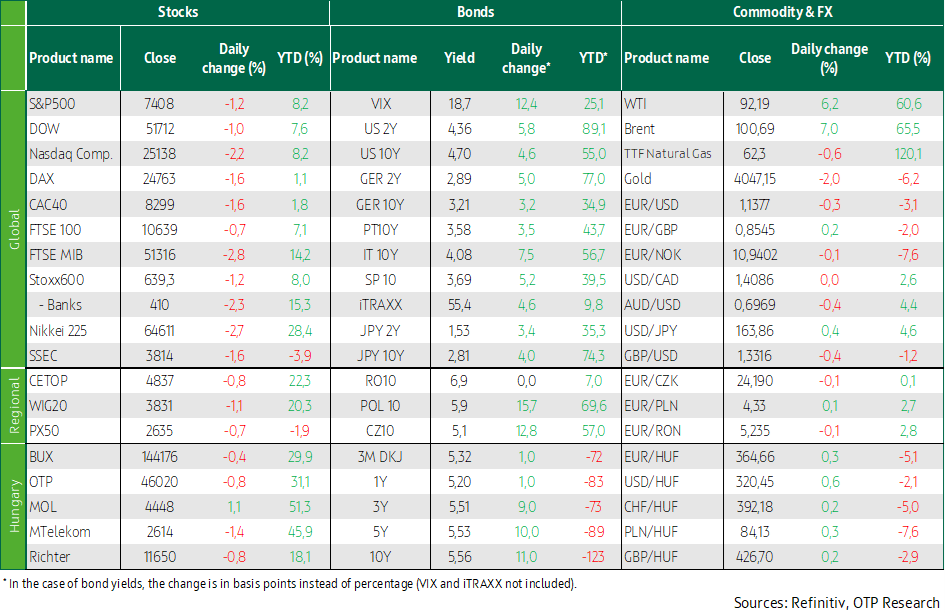
European equity markets declined on Thursday, with technology stocks coming under heavy pressure. STMicroelectronics plunged 18.7% after its Q3 revenue guidance fell significantly short of market expectations. In contrast, French semiconductor company Soitec closed the day 21.6% higher, supported by a remarkably strong quarterly earnings report. At the sector level, technology stocks ended the session down 0.8%. Investor sentiment toward AI-related spending continues to tighten as market participants reassess companies’ ability to generate returns on these investments. Switzerland-based Nestlé dropped nearly 8% following a weak quarterly earnings report, marking the stock’s largest intraday loss since 2002. Meanwhile, EasyJet managed to gain 2.7% during the session despite reporting a 70% decline in Q3 profit. Within the STOXX 600, the food and beverage sector was the worst performer, weighed down in part by Nestlé’s weak share price performance. The energy sector index advanced 1.6%, primarily driven by the strong rise in oil prices. Among the major European benchmarks, the STOXX 600 ended the day 1.2% lower, the DAX fell 1.6%, and the FTSE 100 declined 0.7%.
The ECB’s rate-setting meeting was the key macroeconomic event of the day. As widely expected, policymakers left interest rates unchanged. The ECB acknowledged that eurozone CPI has eased in recent months, supporting a wait-and-see approach for the time being. At the same time, rising energy prices driven by the renewed conflict in the Middle East pose a fresh inflationary risk. Christine Lagarde emphasized that the ECB is closely monitoring both the direct and indirect effects of the energy price shock, while refraining from committing to any specific interest rate path.
In the CEE region, Hungary’s BUX fell 0.4%, the Czech PX Index declined 0.7%, while Poland’s WIG20 dropped 1.1% during the trading session.
European benchmark TTF natural gas prices edged lower on Thursday, declining 0.5% to EUR 62.2/MWh.
Tech earnings reports and renewed inflation concerns cast a shadow over Thursday’s trading session
Trading on US equity markets was notably downbeat as disappointing earnings reports from major technology giants, combined with a surge in oil prices, placed markets under dual pressure. The tech-heavy Nasdaq Composite led the decline, plunging 2.2% to its lowest level in more than two months and moving over 7% below its record high reached in early June. The S&P 500 fell 1.2%, while the Dow Jones lost 1.0%, with both indices closing at roughly one-month lows. Investor nervousness was also reflected in the VIX, often referred to as Wall Street’s fear gauge, which jumped to 18.7 points, its highest level in nearly a month.
The spotlight was on the first two members of the Magnificent Seven to report earnings, Alphabet and Tesla. Results from both companies triggered a significant sell-off, reinforcing concerns that massive artificial intelligence (AI) investments are not yet generating returns sufficient to justify elevated valuations. Alphabet shares declined 7.1% after the company reported negative free cash flow for the first time in its history, while also raising its already substantial capital expenditure plans. The sell-off dragged down the entire communication services sector, which tumbled 5.2%, making it the worst-performing segment within the S&P 500.
Tesla reported negative free cash flow for the second quarter for the first time in more than two years, a development investors punished severely, sending the stock down 14.5%.
Meanwhile, clouds were gathering on both the macroeconomic and geopolitical fronts. Investors’ attention shifted from the Strait of Hormuz to the Red Sea and the Bab el-Mandeb Strait, where the Iran-backed Houthi movement in Yemen opened a new front, including attacks on two Saudi oil tankers. US President Donald Trump threatened a “serious military response” against Iran and the Houthis. As the conflict intensified, Brent crude prices surged above the psychologically important $100 per barrel mark for the first time since late May.
The spike in oil prices almost immediately reignited inflation concerns. According to the CME FedWatch Tool, markets are now pricing in a 36% probability of a 25-basis-point rate hike at the Fed’s policy meeting next week, up sharply from just 12% a week ago.
Chipmakers also struggled, with Texas Instruments falling 3.1%. Despite issuing quarterly revenue guidance that exceeded market expectations, the company was unable to escape the sector-wide sell-off. There were, however, a few bright spots during the session. Defense giant Lockheed Martin skyrocketed 10.5% after raising its 2026 revenue and profit forecasts.
The Trump administration will impose new tariffs of 10% and 12.5% on 60 trading partners on Friday, including the European Union and China, citing what it describes as inadequate efforts by these countries to combat forced labor. The measures are set to take effect just as the temporary, uniform 10% global tariff expires.
Oil prices surged back above $100 following May, driving bond yields higher
The renewed escalation of the Middle East conflict has once again brought CPI concerns to the forefront. The yield on the US 10-year Treasury rose to 4.7%, its highest level since January 2025. This move was reinforced by the latest US labor market data, with initial jobless claims falling to 187,000, their lowest level since 1969. Germany’s 10-year government bond yield increased by 3 basis points to 3.21%, reaching a 15-year high, while its French counterpart climbed to 4.0%. Hungarian yields also moved higher, with the benchmark 10-year yield standing at 5.56% on Thursday. The forint weakened against the euro, touching 365.13 during the day and currently trading within the 363.98–364.70 range, partly reflecting concerns over rising Hungarian energy import costs.
Yesterday, Hungary’s Government Debt Management Agency (ÁKK) held auctions for 3-year and 10-year HUF-denominated government bonds. Despite modest oversubscription, it accepted bids worth only HUF 9 billion at each maturity, compared with the originally announced amounts of HUF 15 billion and HUF 20 billion, respectively. At the 5-year auction, where demand was weak, no bids were accepted.
Today's highlights
As Asian markets approached the close, major equity indices were mostly lower, following the negative trend set by US markets in the previous session. Japan’s Nikkei declined 3.0%, South Korea’s KOSPI dropped 5.6%, Hong Kong’s Hang Seng fell 1.3%, while China’s Shanghai Composite (SSEC) was down 1.2%.
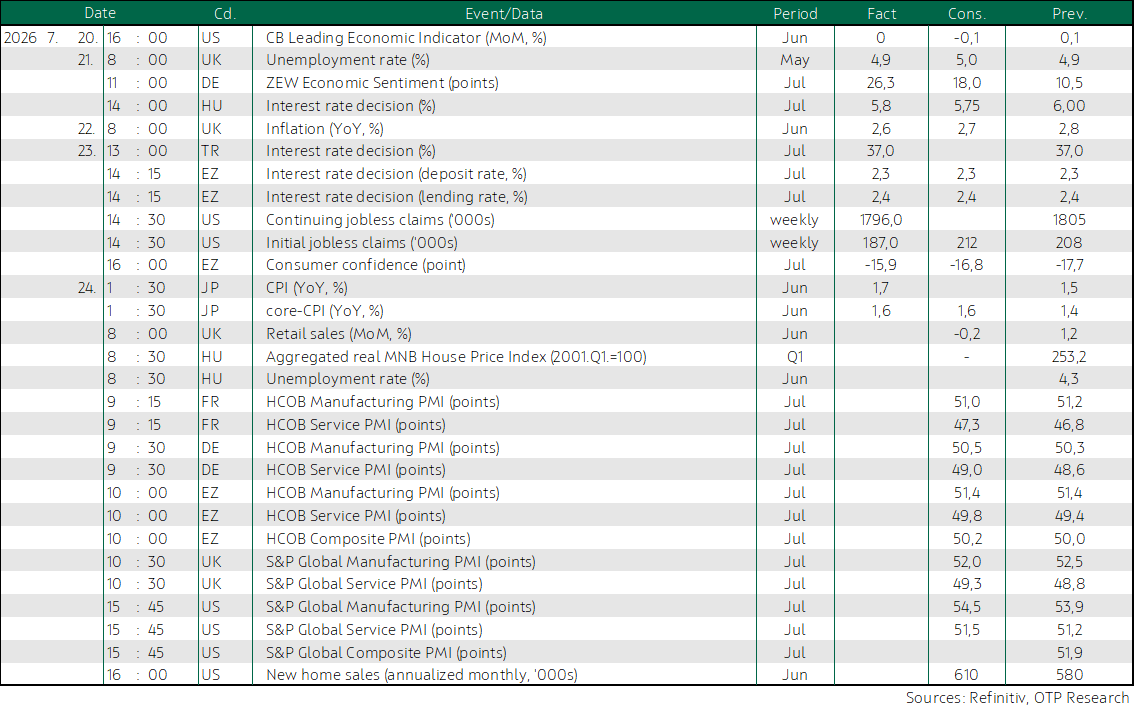
From a macroeconomic perspective, today is set to bring a flood of data releases, with a significant portion of this week’s key indicators scheduled for publication. In Hungary, investors will focus on the MNB’s Q1 House Price Index and the June unemployment rate. In addition, HCOB will release its manufacturing and services PMI data for France, Germany, and the eurozone. S&P Global will also publish the corresponding indicators for the United Kingdom and the US. The day’s packed economic calendar will conclude with June new home sales data from the US.
Get more out of your investments!
Global Markets Services
OTP Global Markets offers a broad range of services in the field of local and international money and capital markets.
Read morePrivate Banking Services
Personal care and expertise with OTP Private Banking, along with the knowledge, security, and innovations of a multinational banking group.
Read more