
OTP Morning Brief: Middle East Escalation and Earnings Reports Drove Markets on Wednesday
Related content
OTP Morning Brief: US producer price index came in above expectations, yet the US 10-year Treasury yield still declined
Western European equities continued to advance despite ongoing pressure on the technology sector. Wall Street indices also rebounded, recovering some ground after Wednesday’s sell-off. Healthcare was the standout performer on both sides of the Atlantic. Eurozone industrial production declined by 0.5% month-on-month in August. In the US, the producer price index accelerated to 6.3%, delivering another upside surprise in inflation developments. US retail sales increased by 0.8% compared to August. The US 10-year Treasury yield declined by more than 10 basis points. The long end of the Hungarian government bond yield curve also declined by 7-9 basis points. In Hungary, August wage data will be released today, while in the US, September industrial production figures are due.
OTP Morning Brief: US CPI data came in above expectations
European equity markets advanced, supported by strong results from ASML and the outstanding performance of the healthcare sector. US equity markets came under pressure following higher-than-expected September CPI data. The annual CPI rate accelerated to 3.7%, driven primarily by a surge in gasoline prices, while core CPI rose by 0.3% month-on-month, supported by higher housing costs and rising transportation service prices. Oil prices rose amid escalating tensions in the Middle East and the impact of the IEA's oil market report. US Treasury yields retreated after an initial increase, driven by Fed commentary, while European bond yields generally moved higher. The US macro calendar will be busy today, with investors focusing on September retail sales and producer price index data, as well as the New York Fed Manufacturing Index, weekly jobless claims, and business inventories. August industrial production data from the euro area will be released today.
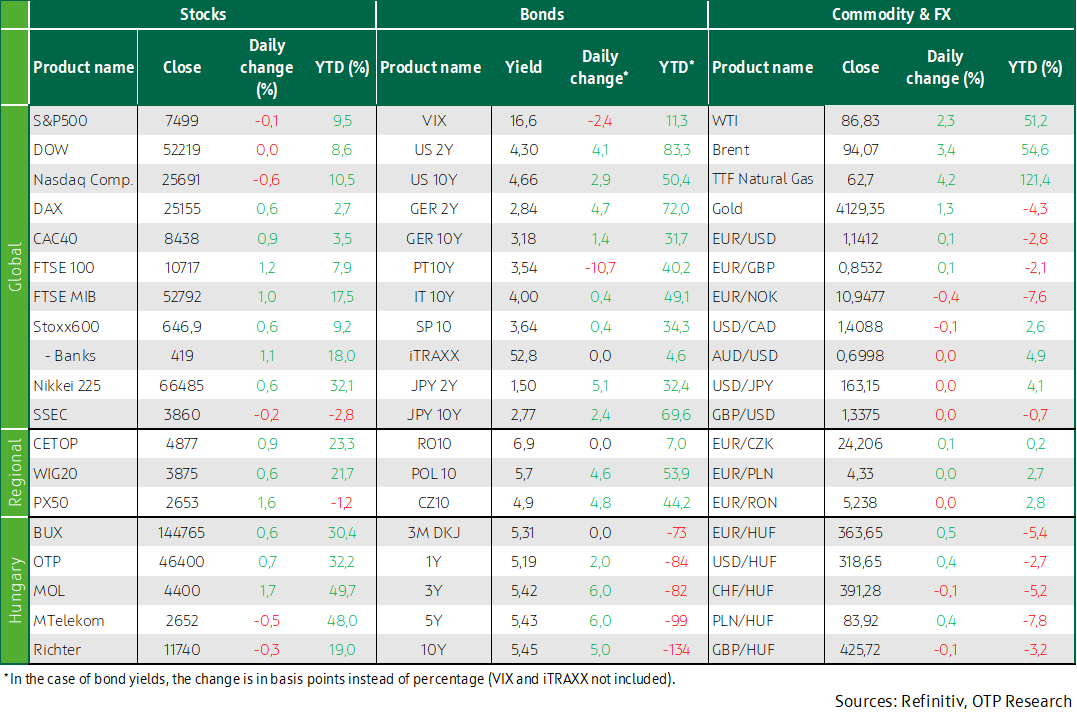
The escalation of the Middle East conflict continued to push energy prices higher. TTF natural gas rose by more than 4%, while Brent crude climbed 3.4%, moving above USD 94 per barrel. The rise in oil prices fueled CPI concerns, leading to higher Hungarian and international government bond yields. Despite these developments, the major Western European equity indices managed to post gains on Wednesday. CPI Came in Lower Than Expected in the United Kingdom. US equity markets moved lower. After the close, Alphabet and Tesla reported earnings, with the initial market reaction proving unfavorable. The substantial investment plans announced by US technology companies, including Alphabet and Tesla, provided support to the share prices of Asian chipmakers. The ECB is expected to keep its key deposit rate unchanged at 2.25% today.
European Markets Extended Their Gains on Wednesday
Major Western European equity markets continued to move higher on Wednesday. The Stoxx 600 and the DAX gained 0.6%, while the CAC 40 advanced 0.9% and the FTSE 100 rose 1.2%. The rally was led by the defense sector (+2.5%) and the energy sector (+0.8%), while the technology sector index closed slightly lower. Among individual stocks, the Dutch staffing company Randstad delivered a standout performance after reporting quarterly revenue that exceeded expectations, with its share price soaring nearly 14%. Airbus shares surged 7% after the aircraft manufacturer announced a EUR 5 billion share buyback program and unveiled new medium-term targets, aiming to nearly double its profit by 2029. Nestlé gained 2.2% after the Financial Times reported that private equity firm Platinum Equity was close to reaching an agreement to acquire an approximately 50% stake in the Swiss company's European water business.
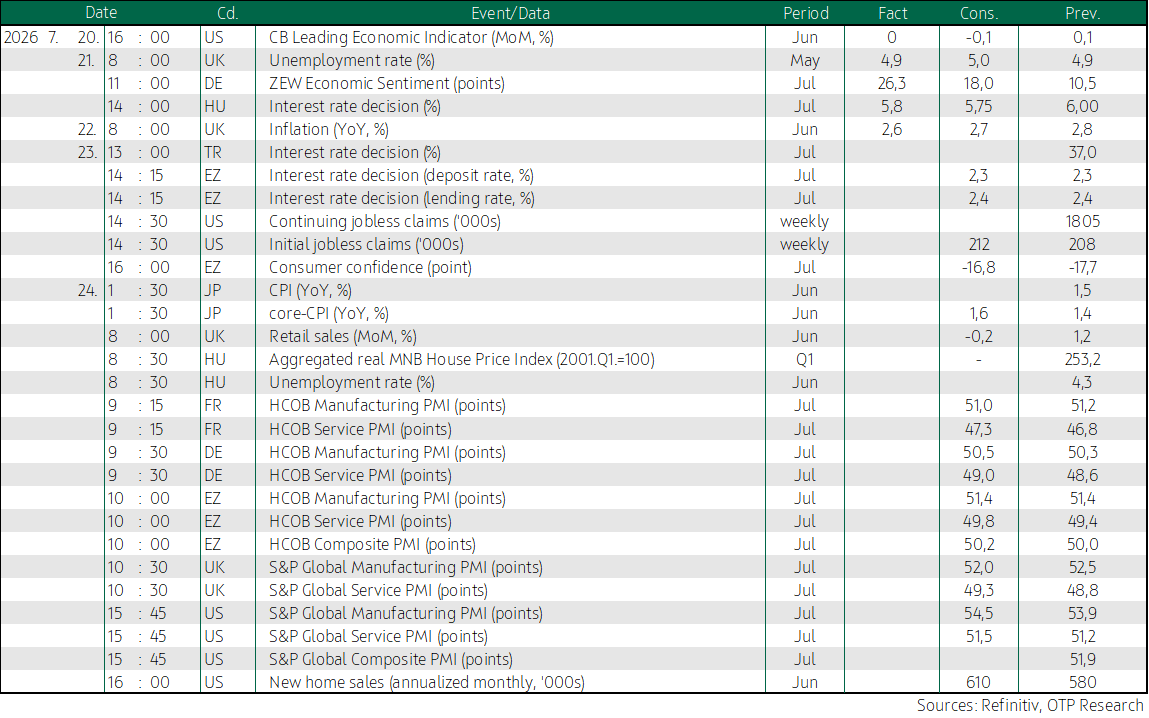
UK CPI eased more than expected to 2.6% in June. Core CPI, however, remained unchanged at 2.6%, contrary to expectations for a 0.1 percentage point decline.
In the CEE region, the BUX and the WIG20 gained 0.6%, while the Czech PX index advanced 1.6%.
Alongside Wednesday's rise in energy prices, European benchmark TTF natural gas climbed 4.2%, moving above EUR 62/MWh.
Alphabet and Tesla Reported Earnings After the Closing Bell
Wall Street indices moved lower. While the S&P 500 slipped 0.1% and the Dow Jones closed marginally in negative territory, the Nasdaq Composite declined 0.6%. The technology sector delivered mixed performance. The Philadelphia SE Semiconductor Index closed 0.4% higher, recovering its earlier losses during the session and marking its third consecutive day of gains. Shares of Super Micro Computer skyrocketed 19.8% after the server manufacturer reported securing more than USD 60 billion in new orders during the fourth quarter.
After the close, Alphabet (-1.2%) and Tesla (-1.3%) released their Q2 earnings reports. Alphabet raised its 2026 capital expenditure forecast by USD 15 billion after its cloud business delivered the strongest growth in its history. Adjusted earnings per share (EPS) came in at USD 2.85, slightly below the USD 2.89 expected by Wall Street. The company's shares reversed course and fell around 3% in after-hours trading. Tesla reported weaker-than-expected Q2 results and posted negative free cash flow for the first time in more than two years, as the Elon Musk-led electric vehicle manufacturer significantly accelerated its investments in artificial intelligence and robotics infrastructure. The earnings miss and cash burn came despite the company delivering a record number of vehicles during the quarter. Tesla shares fell around 4% in after-hours trading.
The Middle East conflict once again proved to be a key market driver. On Tuesday, Yemen’s Houthi rebels threatened to block Saudi Arabia’s Red Sea oil exports. As a result, several oil tankers were forced to alter their routes to avoid the Bab el-Mandeb Strait, the southern gateway to the Red Sea. The significance of the development lies in the fact that the East-West crude oil pipeline, which supplies the Red Sea port of Yanbu, serves as the most important alternative route to the Strait of Hormuz. Meanwhile, US President Donald Trump stated on Wednesday that the US would destroy an Iranian bridge or power plant every time Iran opened fire on a vessel in the Strait of Hormuz. Ongoing escalation continued to fuel market concerns, helping Brent crude rise for a fourth consecutive session on Wednesday. The benchmark closed above USD 94 per barrel, up 3.4% on the day.
Oil Price Gains Fueled CPI Concerns, Driving Bond Yields Higher
Renewed tensions surrounding the war with Iran once again brought CPI concerns to the forefront. The US 10-year Treasury yield rose 3 basis points to 4.66%. Markets are now pricing in nearly an 80% probability that the Fed will raise interest rates by September. Germany’s 10-year government bond yield increased by 1.5 basis points to 3.18%, while its French counterpart is approaching the 4% level. Investors consider it almost certain that the ECB will leave its key policy rate unchanged today, although the probability of a rate hike in September has climbed above 80%. The US dollar weakened again against the euro, with EUR/USD moving above 1.14.
In Hungary, the long end of the yield curve rose by 5 basis points, pushing the 10-year government bond yield up to 5.45%. The forint weakened by 0.5% against the euro to 363.65, once again underperforming its regional peers.
Today, Hungary’s Government Debt Management Agency (ÁKK) will offer HUF 15 billion each of 3-year and 5-year government bonds, along with HUF 20 billion of 10-year government bonds.
Today's highlights
As Asian markets approached the close, major equity indices were mostly trading higher, supported by the substantial investment plans announced by US technology companies (see Alphabet’s and Tesla’s quarterly earnings reports), which provided a boost to the region’s chipmakers. The Nikkei rose 0.6%, the KOSPI surged 3.6%, and the Hang Seng gained 1.3%, while the Shanghai Composite (SSEC) slipped 0.2%.
In early trading, Brent crude continued to rise, approaching the USD 96 per barrel level.
The Japanese yen remains close to its four-decade low against the US dollar. With the exchange rate having traded above 163 in recent days, Japan’s Ministry of Finance has warned that it may intervene in the foreign exchange market. Although the Bank of Japan will hold a policy meeting next Friday, markets are currently pricing in the next rate hike only for October.
After a relatively quiet Wednesday on the macroeconomic front, the European Central Bank will hold its policy meeting today. The ECB is widely expected to leave its key deposit rate unchanged at 2.25%. In addition to the ECB, the Turkish central bank will also announce its interest rate decision. Elsewhere, the euro area will release its July consumer confidence index, while in the US, the usual weekly jobless claims data are due. Early Friday morning, Japan will publish its June CPI figures.
Get more out of your investments!
Global Markets Services
OTP Global Markets offers a broad range of services in the field of local and international money and capital markets.
Read morePrivate Banking Services
Personal care and expertise with OTP Private Banking, along with the knowledge, security, and innovations of a multinational banking group.
Read more