
OTP Morning Brief: The escalating conflict in the Middle East intensified concerns over CPI and interest rate hikes over the past week
Related content
OTP Morning Brief: US producer price index came in above expectations, yet the US 10-year Treasury yield still declined
Western European equities continued to advance despite ongoing pressure on the technology sector. Wall Street indices also rebounded, recovering some ground after Wednesday’s sell-off. Healthcare was the standout performer on both sides of the Atlantic. Eurozone industrial production declined by 0.5% month-on-month in August. In the US, the producer price index accelerated to 6.3%, delivering another upside surprise in inflation developments. US retail sales increased by 0.8% compared to August. The US 10-year Treasury yield declined by more than 10 basis points. The long end of the Hungarian government bond yield curve also declined by 7-9 basis points. In Hungary, August wage data will be released today, while in the US, September industrial production figures are due.
OTP Morning Brief: US CPI data came in above expectations
European equity markets advanced, supported by strong results from ASML and the outstanding performance of the healthcare sector. US equity markets came under pressure following higher-than-expected September CPI data. The annual CPI rate accelerated to 3.7%, driven primarily by a surge in gasoline prices, while core CPI rose by 0.3% month-on-month, supported by higher housing costs and rising transportation service prices. Oil prices rose amid escalating tensions in the Middle East and the impact of the IEA's oil market report. US Treasury yields retreated after an initial increase, driven by Fed commentary, while European bond yields generally moved higher. The US macro calendar will be busy today, with investors focusing on September retail sales and producer price index data, as well as the New York Fed Manufacturing Index, weekly jobless claims, and business inventories. August industrial production data from the euro area will be released today.
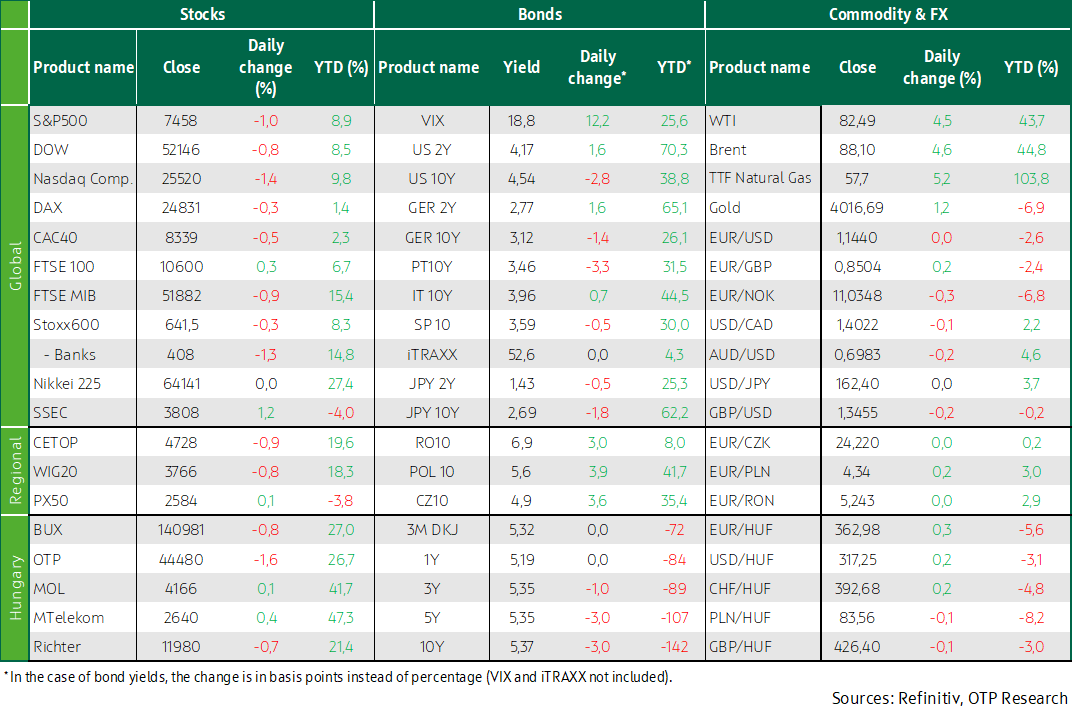
Sentiment in developed equity markets was shaped last week by the escalation of the Middle East conflict and concerns surrounding the future of artificial intelligence. Crude oil prices surged 15% over the course of a week, reinforcing concerns over CPI and further interest rate hikes. Developed equity markets generally declined on Friday, with most major indices ending the week in negative territory. The CEE region’s stock markets were not spared from the downturn last week either. US long-term yields were little changed on a weekly basis, while their European counterparts moved higher. The euro strengthened modestly against the dollar. The long end of the Hungarian yield curve shifted higher, while the forint weakened toward the 363 level against the euro. This week, our focus will be on the interest rate decisions of the MNB and the ECB, as well as developments from the earnings season.
Major European equity indices mostly ended Friday's trading session in negative territory, while their performance for the week as a whole was mixed; stock markets across the CEE region moved lower over the past week
With the exception of the UK’s FTSE 100 – which managed to edge higher despite the broadly negative equity market sentiment thanks to the strong performance of energy companies – major European stock indices closed Friday’s session with modest losses, largely driven by weakness in the technology sector. The technology sector ended four trading days in negative territory last week, with Friday’s 2.4% decline marking the steepest drop, while the sector fell 3.3% on a weekly basis. Utilities delivered the strongest performance on Friday. Among individual stocks, Saab soared nearly 10% after reporting stronger-than-expected quarterly results, while EQT advanced 11% following news related to a takeover offer. In contrast, Burberry lost more than 6% after stating that the Middle East conflict had dampened tourist spending across Europe. Volvo’s share price declined despite the Swedish manufacturer reporting 35% growth in second-quarter profit.
Looking at the week as a whole, the major indices delivered mixed performance, with concerns over the returns on AI investments and the escalation of the Middle East conflict serving as the primary market drivers. The DAX declined 1.0%, while the FTSE 100 gained the same amount, whereas the CAC 40 was virtually unchanged, as was the Stoxx 600. At the sector level, technology as well as travel and leisure were the weakest performers, while the oil and gas sector – supported by rising crude oil prices – along with luxury goods emerged as the week's top performers.
Among the macroeconomic data released last week, particular attention should be paid to eurozone industrial production for May, which suggests that the region’s industrial sector remains surprisingly resilient to the rise in energy prices and supply chain disruptions caused by the Middle East conflict. Excluding the highly volatile Irish figures, industrial output increased for a third consecutive month in May. Including the Irish data, however, production declined by 0.2% on a monthly basis.
The front-month TTF natural gas contract in Europe surged 18% during the week, climbing to nearly EUR 58/MWh due to the escalation of the Middle East conflict, just shy of this year's peak of EUR 60/MWh.
Stock markets across the CEE region, with the exception of the PX50, closed Friday in negative territory, while all major indices in the region moved lower over the week as a whole. Hungarian blue chips delivered mixed performance on Friday; however, on a weekly basis, all of them declined except for MOL, which advanced alongside rising oil prices.
Leading Wall Street indices declined both on Friday and over the week as a whole, while Brent and WTI crude oil prices surged by more than 15% over the past week
The leading Wall Street indices closed Friday's session in negative territory as the correction in artificial intelligence and semiconductor stocks – one of the key drivers of this year's equity market rally – evolved into a broader risk-off sentiment. The semiconductor sector came under particularly heavy pressure, with the Philadelphia Semiconductor Index posting its steepest weekly decline in more than a year. The index has lost more than 18% so far in July, although it still remains up nearly 65% year to date. Among the "Magnificent Seven" technology giants, all stocks except Apple moved lower, with Meta and Alphabet among the weakest performers. By the closing bell, the Dow had fallen 0.8%, the S&P 500 declined 1.0%, and the NASDAQ dropped 1.4%. Netflix shares plunged 7.4% after the company issued a weaker-than-expected earnings outlook.
On a weekly basis, the major US equity indices also moved lower, primarily due to weakness in the technology sector. In addition to concerns over the returns on AI investments, investors were unsettled by the competitive threat posed by the artificial intelligence system unveiled by China's Moonshot. The Q2 earnings season has started on a particularly strong note, with 90% of S&P 500 companies that have reported so far beating analysts' expectations. At the sector level, communication services joined technology among the weakest performers, while energy stocks were supported by rising oil prices.
Among the data releases published last week, CPI figures proved to be the most significant market movers in the US. In June, both the consumer price index and producer price index came in more favorably than expected, easing expectations of further interest rate hikes and reducing the probability of a September rate increase in market pricing. Headline CPI moderated from 4.2% to 3.5%, while core CPI slowed from 2.9% to 2.6%. Based on the June retail sales and industrial production data, second-quarter economic growth is likely to have remained only slightly below the 2.1% annualized quarter-on-quarter expansion recorded in Q1, despite the Middle East conflict. During his first congressional hearings as Fed Chair, Kevin Warsh reaffirmed his commitment to bringing CPI under control during his first congressional hearings. Meanwhile, the University of Michigan’s consumer sentiment index climbed to a five-month high in July.
The US military launched multiple waves of strikes against Iran over the past week, while Iran continued attacks on US allies across the region. On Monday, Donald Trump proposed imposing a 20% tariff on all goods passing through the Strait of Hormuz, but abandoned the idea as early as Tuesday. The escalating conflict in the Middle East pushed crude oil prices higher; Brent and WTI surged 4.5% on Friday and gained more than 15% over the week as a whole, with Brent rising above USD 88 per barrel and WTI climbing past USD 82 per barrel.
European long-term bond yields moved higher last week, while the long end of the Hungarian yield curve also shifted upward; meanwhile, the forint weakened toward the 363 level against the euro
On Friday, investors assessed incoming US macroeconomic data, which indicated that the economy remains resilient despite rising CPI risks stemming from the conflict with Iran, while concerns over the unresolved Middle East conflict continued to intensify. Earlier in the week, expectations of further interest rate hikes eased following lower-than-expected CPI readings; however, this was insufficient to offset inflation concerns fueled by rising fuel prices. The US 10-year Treasury yield declined by 3 basis points both on Friday and over the week as a whole, to 4.54%, remaining in the upper third of its post-pandemic trading range. Following the June CPI data release, market pricing for a September rate hike diminished significantly. By Friday, however, investors once again expected the Fed’s next increase to come in September. In Europe, bond market sentiment was primarily driven by developments related to the escalation of the Middle East conflict, with strengthening inflation expectations pushing long-term yields higher. Despite a 2-basis-point decline on Friday, the German 10-year yield rose by 9 basis points over the week, reaching 3.12%. Markets are currently pricing in 25 basis points of tightening from the ECB in September and a cumulative 50 basis points by year-end.
The EUR/USD exchange rate remained relatively stable on Friday, but the week as a whole saw the euro strengthen against the dollar.
On Friday, yields at the long end of the Hungarian yield curve declined by a few basis points; nevertheless, on a weekly basis, yields on maturities longer than one year still rose substantially, by 19–26 basis points. According to the Government Debt Management Agency’s (ÁKK) early afternoon benchmark quotations, the Hungarian 10-year yield stood at 5.37% on Friday.
News of the collapse of the Middle East ceasefire also weighed on the forint, which weakened toward the 363 level against the euro.
Today's highlights
The US launched strikes against Iran for the ninth consecutive night on Sunday, aiming to destroy Tehran’s capabilities to attack commercial vessels passing through the Strait of Hormuz. Amid the weekend’s geopolitical developments, Asia-Pacific equity markets are showing mixed performance this morning: Chinese and Australian markets are moving higher, South Korean stocks are declining, while Japanese markets remain closed for a public holiday. In China, policymakers left benchmark lending rates unchanged at record lows for a 14th consecutive month in July, keeping the one-year rate at 3.0% and the five-year rate at 3.5%. Crude oil futures are advancing this morning, with Brent already trading above USD 90 per barrel.
European equity markets are indicated to open on a mixed note, while US futures point to a higher start for today’s trading session.
The Government Debt Management Agency (ÁKK) is holding a Discount Treasury Bill (DKJ) exchange auction today.
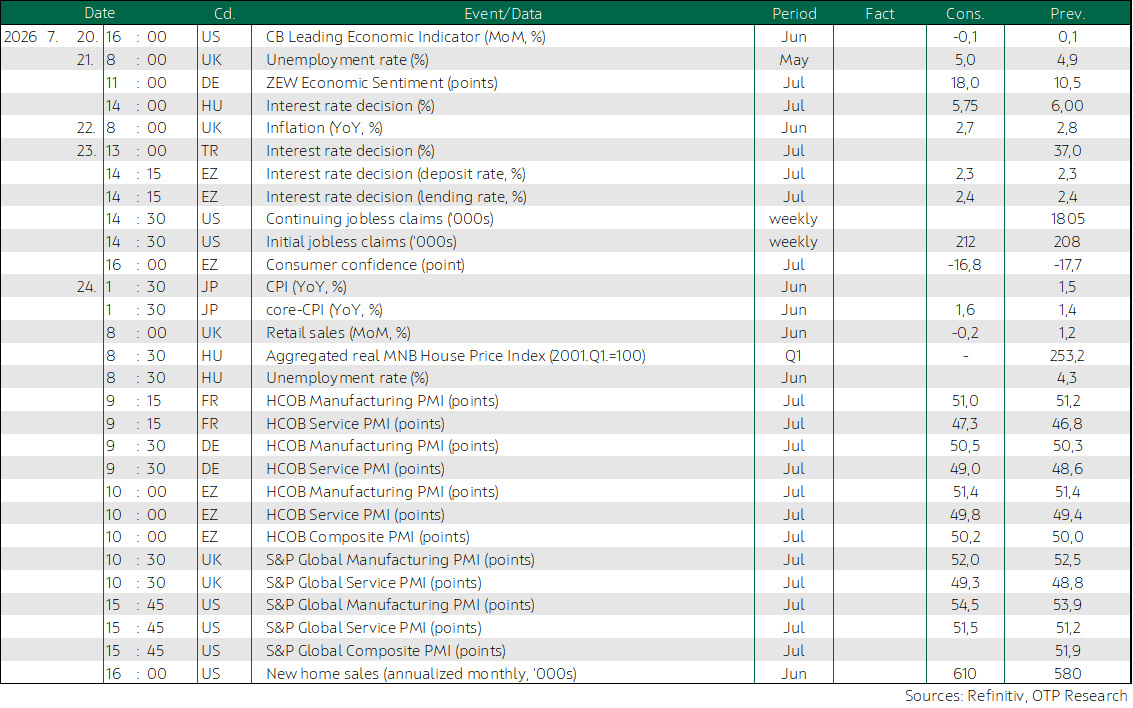
On the domestic front, attention this week will focus on the MNB’s rate-setting meeting, where the central bank is expected to cut the base rate by 25 basis points to 5.75%, in line with its June communication.
The ECB is also holding a policy meeting this week, with markets expecting interest rates to remain unchanged following the rate hike delivered in June.
The earnings season will continue this week with reports from several high-profile companies, including Alphabet, General Motors, Tesla, Intel, Exxon Mobil, and Volkswagen.
Get more out of your investments!
Global Markets Services
OTP Global Markets offers a broad range of services in the field of local and international money and capital markets.
Read morePrivate Banking Services
Personal care and expertise with OTP Private Banking, along with the knowledge, security, and innovations of a multinational banking group.
Read more