
OTP Morning Brief: Better-than-expected US CPI data eased expectations of further interest rate hikes
Related content
OTP Morning Brief: US producer price index came in above expectations, yet the US 10-year Treasury yield still declined
Western European equities continued to advance despite ongoing pressure on the technology sector. Wall Street indices also rebounded, recovering some ground after Wednesday’s sell-off. Healthcare was the standout performer on both sides of the Atlantic. Eurozone industrial production declined by 0.5% month-on-month in August. In the US, the producer price index accelerated to 6.3%, delivering another upside surprise in inflation developments. US retail sales increased by 0.8% compared to August. The US 10-year Treasury yield declined by more than 10 basis points. The long end of the Hungarian government bond yield curve also declined by 7-9 basis points. In Hungary, August wage data will be released today, while in the US, September industrial production figures are due.
OTP Morning Brief: US CPI data came in above expectations
European equity markets advanced, supported by strong results from ASML and the outstanding performance of the healthcare sector. US equity markets came under pressure following higher-than-expected September CPI data. The annual CPI rate accelerated to 3.7%, driven primarily by a surge in gasoline prices, while core CPI rose by 0.3% month-on-month, supported by higher housing costs and rising transportation service prices. Oil prices rose amid escalating tensions in the Middle East and the impact of the IEA's oil market report. US Treasury yields retreated after an initial increase, driven by Fed commentary, while European bond yields generally moved higher. The US macro calendar will be busy today, with investors focusing on September retail sales and producer price index data, as well as the New York Fed Manufacturing Index, weekly jobless claims, and business inventories. August industrial production data from the euro area will be released today.
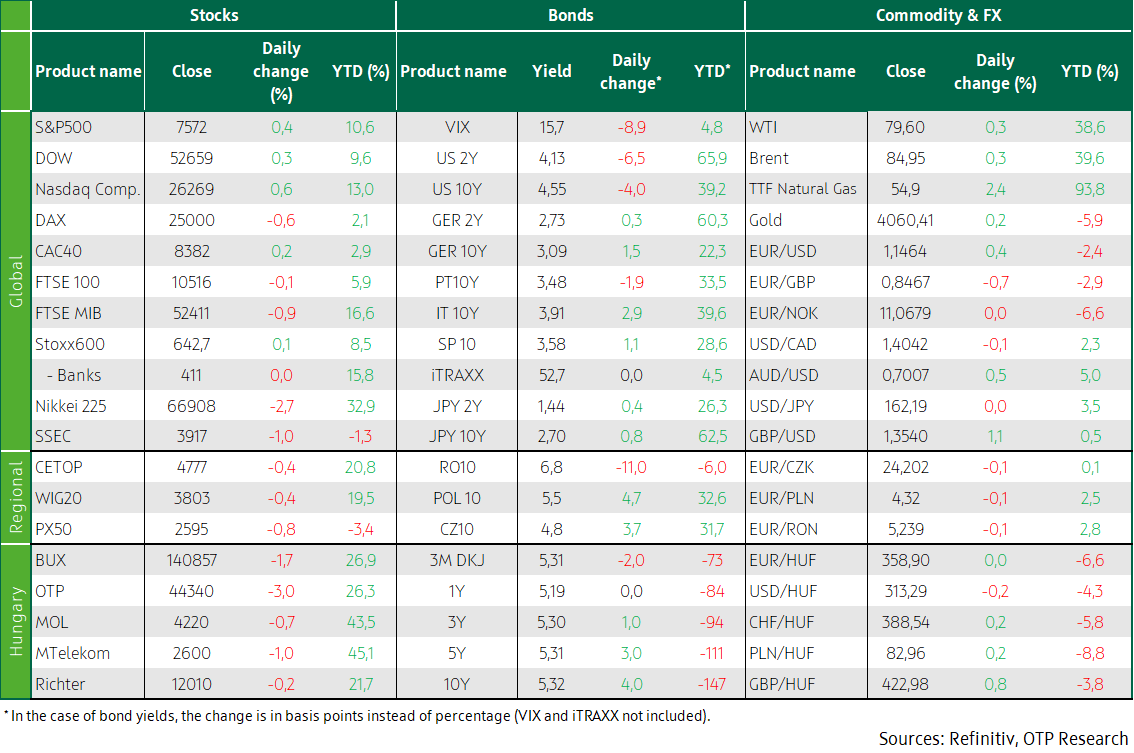
Major European stock indices closed mixed, while key benchmarks in the US posted gains. The earnings season delivered better-than-expected results yesterday. CEE stock markets closed in negative territory on Wednesday. The better-than-expected US Producer Price Index, together with the similarly favorable CPI data released a day earlier, helped ease expectations of further interest rate hikes. Tensions in the Middle East remain elevated, while the Strait of Hormuz stays closed. Long-term yields declined in the US, while rising in Europe, and the dollar weakened against major currencies. Hungarian yields continued to rise at maturities beyond one year; following a modest weakening of the forint, the EUR/HUF exchange rate remained below 360. June retail sales data from the US are due to be released today. The earnings season continues, with results from UnitedHealth and Netflix among the highlights.
Major Western European indices closed mixed, while the BUX and Hungarian blue-chip stocks declined
Major European stock indices closed mixed on Wednesday, as positive corporate news failed to fully offset concerns over the lack of progress toward resolving the conflict in the Middle East. The pan-European Stoxx 600 edged 0.1% higher, with sector performance mixed. The basic resources sector posted the steepest decline, while the technology sector, a key market focus this year, slipped 0.5%. In contrast, the luxury goods sector advanced by more than 3%, driven primarily by Richemont’s nearly 7.0% rally following better-than-expected quarterly results. ASML reported stronger-than-expected earnings and revenue and raised its 2026 sales outlook; nevertheless, after trading higher during the session, the stock closed 0.4% lower. The DAX fell 0.6%, with much of the decline attributable to semiconductor manufacturer Infineon, whose shares dropped more than 6%.
Several ECB policymakers commented yesterday, the last day before the pre-meeting blackout period ahead of next week’s interest rate decision. Executive Board member Piero Cipollone and Austrian central bank governor Martin Kocher both said there are currently no signs of second-round effects stemming from higher energy prices, while emphasizing the importance of remaining vigilant. Bundesbank President Joachim Nagel noted that the escalation of the Middle East conflict and another wave of rising oil prices highlight the fragility of the situation and the exceptionally high level of uncertainty, underscoring the need for a cautious yet determined policy approach.
On the data front, May industrial production figures from the euro area were noteworthy, showing that the region’s manufacturing sector continues to display surprising resilience despite higher energy prices and supply chain disruptions linked to the conflict in the Middle East. Excluding the highly volatile Irish data, output increased for a third consecutive month in May, while production in energy-intensive industries was also higher than in February. At the same time, the structural challenges facing euro area manufacturing remain intact: output in high-tech and defense-related industries continues to expand at a robust pace, whereas production across most traditional sectors is still declining. Including the Irish data, industrial production fell 0.2% month-on-month.
Amid uncertainty surrounding the situation in the Middle East, the European TTF gas price climbed to nearly EUR 55/MWh, its highest level since March and approaching this year’s peak of EUR 60/MWh.
Against the backdrop of unfavorable global sentiment, CEE stock markets also moved into negative territory, with all Hungarian blue-chip stocks closing lower.
Major US indices advanced; the earnings season delivered solid results; June Producer Price Index data came in better than expected
On Wall Street, strong corporate earnings and favorable inflation data outweighed concerns related to the conflict in the Middle East. Following the CPI release, the Producer Price Index also came in below expectations in June, declining 0.3% month-on-month. The encouraging figures were largely driven by lower energy prices and declines in the cost of certain industrial commodities, while prices for products linked to AI investment continued to rise. Based on the CPI and PPI data, the Fed’s preferred core PCE measure is likely to show less than a 0.2% month-on-month increase in June, consistent with the central bank’s 2% annual target on a trend basis, although the year-on-year reading is still expected to remain above 3%. Market pricing reflected easing expectations for a rate hike in September following the release of the data. The earnings season also featured results from major companies including Morgan Stanley, BlackRock, and Johnson & Johnson, all of which reported better-than-expected figures.
Kevin Warsh also appeared before the relevant Senate committee following his hearing in the House of Representatives, where he pledged to take a firm stance against inflation.
Despite ongoing hostilities in the Middle East, crude oil prices rose only marginally yesterday, partly because EIA data showed that inventories declined less than expected over the past week.
Long-term yields declined in the US, while rising in Europe, as the dollar weakened against major currencies
The favorable US CPI data eased expectations of further interest rate hikes, leading to a decline in long-term Treasury yields. The 10-year yield fell 4 basis points to 4.55%, while the 30-year yield dropped 11 basis points to 5.083%. Easing rate hike expectations were also reflected in the currency market, with the dollar weakening against major currencies and the EUR/USD exchange rate rising to 1.146. In Europe, bond markets continued to be driven by developments related to the conflict in the Middle East; Germany’s 10-year yield increased by 2 basis points to 3.09%. While recent comments from ECB policymakers do not point to an imminent rate hike and interest rates are widely expected to remain unchanged in July, a September increase is still being priced in by the market.
Against the backdrop of unfavorable global sentiment, Hungarian long-term yields continued to rise, with benchmark yields on maturities beyond one year increasing by 1–4 basis points based on the Government Debt Management Agency’s (ÁKK) early-afternoon reference quotes. The 10-year yield climbed to 5.32%, its highest level since the first half of June. Although the forint weakened slightly, it remained below the 360 level against the euro.
Demand was subdued at the ÁKK’s Treasury bill auction yesterday. Bids totaling HUF 26.5 billion were submitted for the HUF 30 billion of six-month discount Treasury bills on offer, of which the debt management agency accepted HUF 19.5 billion at an average yield of 5.33%.
Today's highlights
Asia-Pacific equity markets are poised for a mixed open this morning, with investors focusing on earnings season results and developments in the Middle East conflict. Shares of Chinese technology giants Alibaba and Baidu advanced following their partnership with Apple to roll out AI-powered tools. South Korean shipbuilders also moved higher after Donald Trump reportedly said his administration would “likely” ask South Korean companies to participate in US naval development projects.
The ÁKK will offer a total of HUF 30 billion worth of government bonds maturing in 2036 and 2037 today, alongside HUF 30 billion of 12-month discount Treasury bills.
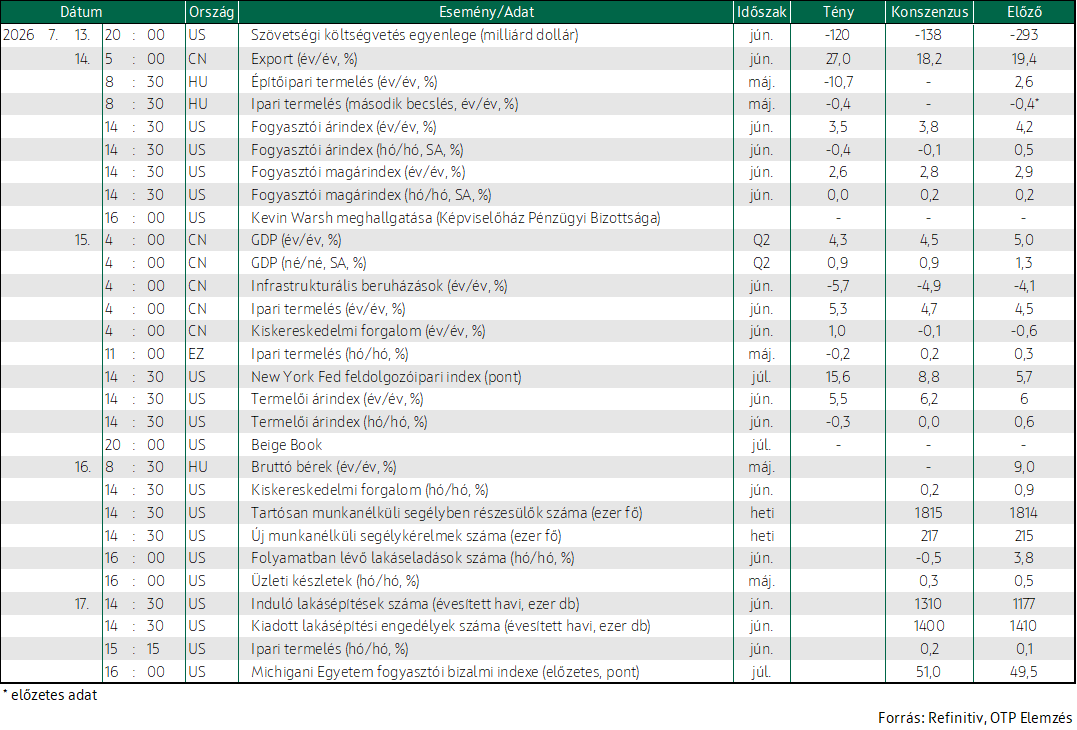
The Hungarian Central Statistical Office (KSH) will release May wage data today.
Data releases from the US today include June retail sales figures, May business inventories data, and the weekly jobless claims report. Market expectations point to a notably more moderate month-on-month increase in retail sales compared with May. However, considering that the upcoming release is not adjusted for inflation and that fuel prices were significantly higher in May, the apparent slowdown may be less pronounced than it initially appears. Business inventories are also expected to have expanded at a slower pace in May compared with the exceptionally strong April reading. Meanwhile, weekly jobless claims are likely to remain broadly in line with the average seen in recent weeks.
The earnings season continues, with results from major names including UnitedHealth, GE Aerospace, and Netflix.
Get more out of your investments!
Global Markets Services
OTP Global Markets offers a broad range of services in the field of local and international money and capital markets.
Read morePrivate Banking Services
Personal care and expertise with OTP Private Banking, along with the knowledge, security, and innovations of a multinational banking group.
Read more