
OTP Morning Brief: Renewed hostilities in the Middle East have pushed crude oil prices higher
Related content
OTP Morning Brief: US producer price index came in above expectations, yet the US 10-year Treasury yield still declined
Western European equities continued to advance despite ongoing pressure on the technology sector. Wall Street indices also rebounded, recovering some ground after Wednesday’s sell-off. Healthcare was the standout performer on both sides of the Atlantic. Eurozone industrial production declined by 0.5% month-on-month in August. In the US, the producer price index accelerated to 6.3%, delivering another upside surprise in inflation developments. US retail sales increased by 0.8% compared to August. The US 10-year Treasury yield declined by more than 10 basis points. The long end of the Hungarian government bond yield curve also declined by 7-9 basis points. In Hungary, August wage data will be released today, while in the US, September industrial production figures are due.
OTP Morning Brief: US CPI data came in above expectations
European equity markets advanced, supported by strong results from ASML and the outstanding performance of the healthcare sector. US equity markets came under pressure following higher-than-expected September CPI data. The annual CPI rate accelerated to 3.7%, driven primarily by a surge in gasoline prices, while core CPI rose by 0.3% month-on-month, supported by higher housing costs and rising transportation service prices. Oil prices rose amid escalating tensions in the Middle East and the impact of the IEA's oil market report. US Treasury yields retreated after an initial increase, driven by Fed commentary, while European bond yields generally moved higher. The US macro calendar will be busy today, with investors focusing on September retail sales and producer price index data, as well as the New York Fed Manufacturing Index, weekly jobless claims, and business inventories. August industrial production data from the euro area will be released today.
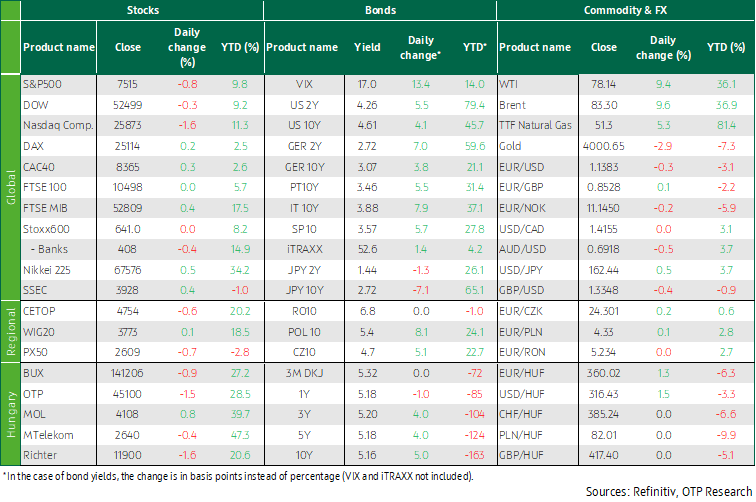
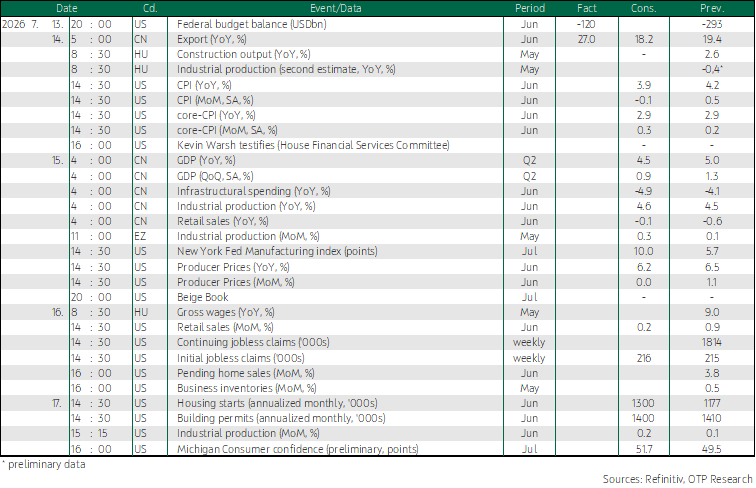
The USA bombed Iranian targets for the third night in a row, while Iran attacked tankers in the Strait of Hormuz, after closing it again. President Trump ordered the blockade of Iranian ports to be reinstated. Crude oil prices jumped nearly 10% on Monday, and futures rose another 2–3% this morning. Inflation concerns flared up, expectations for interest rate hikes have strengthened. Money market is now pricing in a nearly 60% probability of a second rate hike by the Fed this year. Long-term yields continued to rise in the developed bond markets, as well as in Hungary. The dollar strengthened slightly against the euro, the EUR/HUF climbed above 360 and the USD/HUF traded above 316 — levels not seen since the Hungarian elections this Spring. Amid the deteriorating geopolitical situation, Western European stock markets held steady on Monday, while major US indices declined as pressure on technology stocks mounted. Today, we are focusing on US June inflation figures, while in Hungary, May construction and industrial production data will be released. The Q2 earnings season in the US kicks off today, with reports from the major banks.
Stock markets in Western Europe held steady despite escalating tensions in the Middle East
Renewed hostilities between the USA and Iran over the weekend filled investors with concern after the parties carried out intense missile and drone attacks against each other. Iran has once again closed the Strait of Hormuz, crude oil prices have surged, and inflation fears have returned to the forefront, fueling expectations of interest rate hikes. European stock indices held steady overall following last week’s decline; the Stoxx 600 and the FTSE 100 remained flat, while the DAX rose 0.2% and the CAC 40 gained 0.3%. Among the Stoxx600 sector indices, the energy sector rose the most (+2.2%), while defense sector stocks lost just over 1%. Shares of Norwegian defense company Kongsberg Gruppen plummeted nearly 7% after its second-quarter orders fell short of expectations. The travel and leisure sector also joined the list of losers; among airlines, Lufthansa fell by just over 4%, Ryanair dropped more than 2%, and tour operator TUI slipped 1%. The technology sector also came under pressure after SK Hynix plunged 15% on the South Korean stock exchange following the stock’s successful Nasdaq debut on Friday. Fintech broker Plus500 fell 15%. Vodafone jumped 5.5% on news that billionaire Xavier Niel is buying a 6USDbn stake in the company from its former owner in the United Arab Emirates.
In the CEE region, only the Polish WIG20 held steady on Monday, while the BUX fell 0.9% and the PX dropped 0.7%. Among Hungarian blue chips, Richter slipped 1.6%, OTP fell 1.5%, and Mol rose 0.8%.
European gas prices climbed just over 2% in Monday’s session, along with rising crude oil prices; the 1-month TTF futures closed above 52 EUR/MWh.
Technology sector is under pressure, Wall Street indices started the week in the red
Key US equity indices started the week on a negative note, S&P 500 dropped 0.8%, the Dow fell 0.3%, and the Nasdaq Composite declined 1.6%. IT and telecommunications sectors were the main drags on the S&P, though gains in the energy sector cushioned the overall negative sentiment. Amid the ongoing AI frenzy of recent months, chip stocks have tended to take the lead through rally and selloff. The Philadelphia SE Semiconductor Index was the clear underperformer, with constituents SanDisk, Marvell Technology and Intel dropping between 6.1% and 12.6%.This came one day after South Korean SK Hynix, recently debuted on the Nasdaq, rallied 12% on Friday and then plummeted 9% on Monday.
The United States and Iran exchanged fierce airstrikes over the weekend, marking a sudden escalation in the scale and scope of the attacks. Iran’s closure of the Strait of Hormuz prompted Trump to reinstate the U.S. blockade of Iranian ports, raising concerns about the future of peace talks. Crude oil prices rose sharply by 9–10% on Monday, further intensifying concerns that tight supply and upward pressure on energy prices could lead to long-term, systemic inflation.
Long yields in developed bond markets and in Hungary as well crept even higher, the forint depreciated to levels not seen for months
Long-term yields rose even higher in developed bond markets, with the US 10-year yield climbing above 4.6%, reaching a nearly two-month high. In the eurozone, the German 10-year yield crept toward 3.1%, a level not seen since mid-May, excluding last week’s spike. Amid the renewed hostilities between the US and Iran, that sent energy prices soaring, brought back inflation concerns into the forefront. Expectations for Fed rate hikes have strengthened; the CME FedWatch Tool now projects two 25-basis-point rate hikes by the end of this year, with a nearly 80% probability of a hike in September. For the last quarter of the year, the market prices in a nearly 60% probability of a December rate hike. The dollar strengthened slightly on Monday, with the EUR/USD falling to 1.138, approaching its annual low of 1.1357 set in June.
In the Hungarian Treasury market, the rise in yields observed last week continued at the middle and long ends of the yield curve. The 10-year yield crept up to 5.16%. The forint weakened more than 1% against both the euro and the dollar: the EUR/HUF rose above 360, a level not seen in nearly two months, while the USD/HUF returned yesterday to pre-election levels.
Today's highlights
As trading draws to a close, main indices in Asian stock exchanges are mostly in the green, based on available data. In China, exports grew by 27% year-over-year in June, exceeding expectations. However, the situation in the Middle East remains fragile, Iran bombed tankers in the Strait of Hormuz, the US military carried out airstrikes against Iranian targets for the third consecutive night on Monday, while President Donald Trump reimposed a blockade on Iranian shipping and proposed imposing a 20% fee for patrolling the Strait of Hormuz. Crude oil prices rose another 2–3% this morning.
Stock index futures are mostly pointing to a negative opening on the stock markets of developed economies.
June inflation figures from the US will be today's highlights, and Fed Chair Ken Warsh's first hearing before the House Financial Services Committee will also be in the spotlight. In Hungary, May’s construction and industrial production data will be released.
Meanwhile, the Q2 earnings season in the US kicks off with the latest reports from major US banks. Today, we should keep an eye on the earnings reports from JPMorgan, Bank of America, Goldman Sachs, Wells Fargo, and Citigroup.
Get more out of your investments!
Global Markets Services
OTP Global Markets offers a broad range of services in the field of local and international money and capital markets.
Read morePrivate Banking Services
Personal care and expertise with OTP Private Banking, along with the knowledge, security, and innovations of a multinational banking group.
Read more