
OTP Morning Brief: Military tensions between the United States and Iran escalated again over the weekend
Related content
OTP Morning Brief: US producer price index came in above expectations, yet the US 10-year Treasury yield still declined
Western European equities continued to advance despite ongoing pressure on the technology sector. Wall Street indices also rebounded, recovering some ground after Wednesday’s sell-off. Healthcare was the standout performer on both sides of the Atlantic. Eurozone industrial production declined by 0.5% month-on-month in August. In the US, the producer price index accelerated to 6.3%, delivering another upside surprise in inflation developments. US retail sales increased by 0.8% compared to August. The US 10-year Treasury yield declined by more than 10 basis points. The long end of the Hungarian government bond yield curve also declined by 7-9 basis points. In Hungary, August wage data will be released today, while in the US, September industrial production figures are due.
OTP Morning Brief: US CPI data came in above expectations
European equity markets advanced, supported by strong results from ASML and the outstanding performance of the healthcare sector. US equity markets came under pressure following higher-than-expected September CPI data. The annual CPI rate accelerated to 3.7%, driven primarily by a surge in gasoline prices, while core CPI rose by 0.3% month-on-month, supported by higher housing costs and rising transportation service prices. Oil prices rose amid escalating tensions in the Middle East and the impact of the IEA's oil market report. US Treasury yields retreated after an initial increase, driven by Fed commentary, while European bond yields generally moved higher. The US macro calendar will be busy today, with investors focusing on September retail sales and producer price index data, as well as the New York Fed Manufacturing Index, weekly jobless claims, and business inventories. August industrial production data from the euro area will be released today.
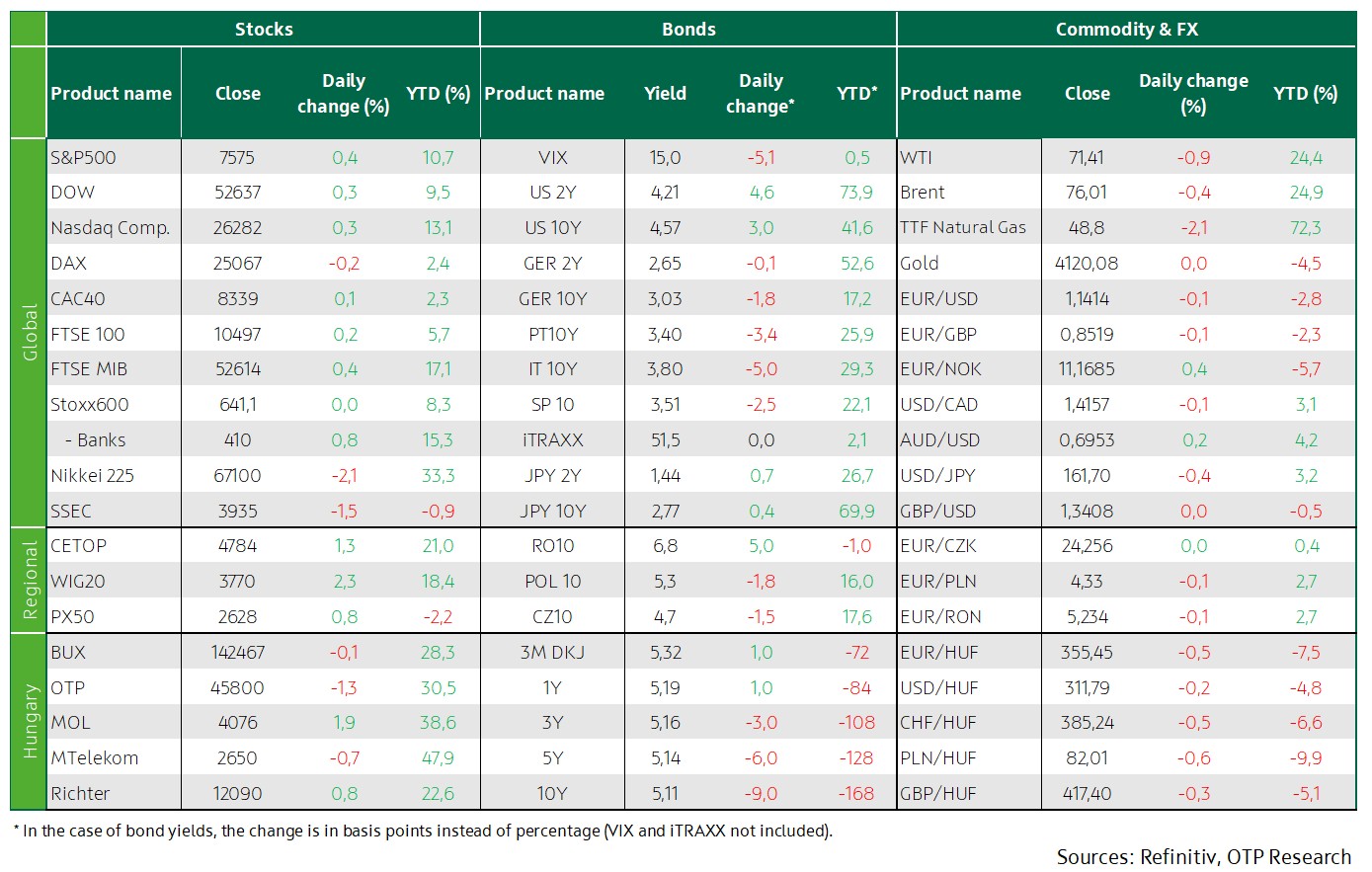
The STOXX Europe 600 declined by 1.8% over the course of last week. The renewed escalation of the Middle East conflict, coupled with investor concerns surrounding the technology sector, kept European markets under pressure. U.S. equity indices posted modest gains on Friday. SK Hynix's Nasdaq debut was particularly successful, standing out as one of the market highlights. Over the weekend, U.S. and Iranian forces carried out intensive missile and drone attacks against each other. Bond yields generally moved higher across both developed markets and the domestic market during the week. The forint recovered most of its earlier losses over the final two trading days of the week and closed at 355.45 against the euro on Friday. This week, markets will focus on U.S. June inflation, retail sales, and industrial production data. In China, a set of key macroeconomic indicators, including second-quarter GDP figures, will be released early Wednesday morning. In the United States, the second-quarter earnings season is set to begin this week, led by the major banks. Asian equity markets are posting steep losses on Monday morning.
The STOXX Europe 600's four-week winning streak came to an end
The STOXX Europe 600 was little changed on Friday, leaving the pan-European benchmark down 1.8% for the week and bringing its four-week winning streak to an end. European markets remained under pressure last week as the renewed escalation of the Middle East conflict, a more than 5% increase in Brent crude prices, and persistent investor concerns surrounding the technology sector weighed on sentiment. Over the week as a whole, the DAX, CAC 40 and FTSE 100 fell by 1.7–2.8%. The technology sector declined by 0.8% on Friday and by 2.1% over the week. Shares of Soitec and ASML fell by 5.9% and 2.1%, respectively, during Friday's session. In contrast, the telecommunications sector gained 1.3%, supported primarily by a more than 10% jump in Vodafone shares. EasyJet surged 14.3% after the airline reached an agreement regarding Apollo Global's L5.7 billion ($7.65 billion) takeover proposal. Meanwhile, J.P. Morgan turned more positive on the European steel sector and upgraded ArcelorMittal from underweight to neutral, helping lift the stock by 6.4%. Although Volkswagen increased sales in Europe, the group delivered 6.3% fewer vehicles globally in the first half of the year compared with the same period a year earlier. The decline was largely attributable to a 26% drop in sales in China. In response to these challenges, Volkswagen has reportedly considered restructuring measures that could include up to 100,000 job cuts, although these plans have faced opposition from employee representatives. The stock lost more than 5% over the course of the week.
Following recent developments, markets are now pricing in roughly an 85% probability that the ECB will raise interest rates before year-end. Among last week's macroeconomic releases, euro area retail sales were notable for rising by 0.2% month-on-month in May, slightly below expectations. In addition, German industrial production surprised to the upside, increasing by 0.9% month-on-month in May.
Within the region, the Hungarian BUX underperformed on Friday, falling 0.1%. By comparison, Poland's WIG20 gained 2.3% and the Czech PX Index advanced 0.8%. Looking at the week as a whole, the BUX was the only major regional benchmark to finish in negative territory.
SK Hynix stood out with a remarkably strong Nasdaq debut on Friday
Wall Street indices posted moderate gains on Friday. The S&P 500 advanced 0.4%, while both the Dow Jones Industrial Average and the Nasdaq Composite rose 0.3%. For the week as a whole, the Dow finished down 0.5%, whereas the S&P 500 and the Nasdaq gained 1.2% and 1.7%, respectively. Investor sentiment toward memory-chip manufacturers received a boost from South Korean chipmaker SK Hynix's highly successful Nasdaq debut on Friday. The world's leading producer of High Bandwidth Memory (HBM) chips, which supplies memory solutions for Nvidia's AI processors among others, raised $26.5 billion through the issuance of American Depositary Receipts (ADRs). The ADRs climbed nearly 13% on their first day of trading. Among individual stocks, Meta surged 6.0%, while Moderna fell 10.8% after JPMorgan reaffirmed its underweight rating on the stock. The vaccine maker had rallied roughly 48% in June, prompting a wave of profit-taking.
On Friday, U.S. President Donald Trump stated that the United States and Iran had agreed to continue negotiations despite the recent military escalation. At the same time, he made it clear that the ceasefire reached between the two sides last month was no longer in effect. While there were no reports of fresh attacks on Friday, U.S. and Iranian forces carried out intensive missile and drone strikes against each other over the weekend. Iran announced on Sunday that it had once again closed the Strait of Hormuz. However, according to the USA, the waterway remains open to maritime traffic.
Regarding last week's macroeconomic releases, growth in the U.S. services sector eased slightly in June according to the ISM Services PMI, which declined from 54.5 to 54.0. Meanwhile, the minutes of the Federal Reserve's June policy meeting pointed to a somewhat more hawkish tone overall, with a majority of policymakers indicating that further interest-rate increases may still be warranted.
Bond yields rose across most developed markets as well as in Hungary over the past week
The yield on the 10-year U.S. Treasury rose by 9 basis points over the past week, reaching 4.57%. The renewed escalation of the conflict in the Middle East heightened inflation risks. By Friday, markets were assigning an 85% probability to the Federal Reserve delivering at least one rate hike by year-end. Germany’s 10-year government bond yield increased by 10 basis points on a weekly basis, closing at 3.03%. Meanwhile, Japan’s 10-year government bond yield gave back the 11-basis-point increase accumulated during the first four days of the week and ended Friday at 2.77%, after Japan’s Ministry of Finance announced plans to encourage pension funds to increase their purchases of domestic assets. There was little movement in the EUR/USD exchange rate over the course of last week. The U.S. dollar strengthened by 0.2%, ending the week at 1.141 against the euro.
Although the Hungarian 10-year government bond yield declined by 9 basis points on Friday, it still closed the week 11 basis points higher overall. The forint recovered most of its earlier losses during the final two trading days of the week and ultimately finished 0.6% weaker against the euro, closing at 355.45. Across the week as a whole, the Czech koruna depreciated by 0.3% and the Polish zloty by 0.8% against the euro. In addition to developments in the Middle East, sentiment toward the forint may also have been influenced by a statement from the Ministry of Finance indicating that, without further fiscal measures, this year's budget deficit would reach an estimated 7.5% of GDP. A revised deficit target, together with the corresponding amendments to the 2026 budget, is expected by the end of August.
Today's highlights
As trading draws to a close, sentiment remains negative across Asian equity markets. The KOSPI is down nearly 8%, weighed down by a decline of more than 10% in SK Hynix. The Nikkei is falling 2.2%, the SSEC 1.5%, and the Hang Seng 0.1%.
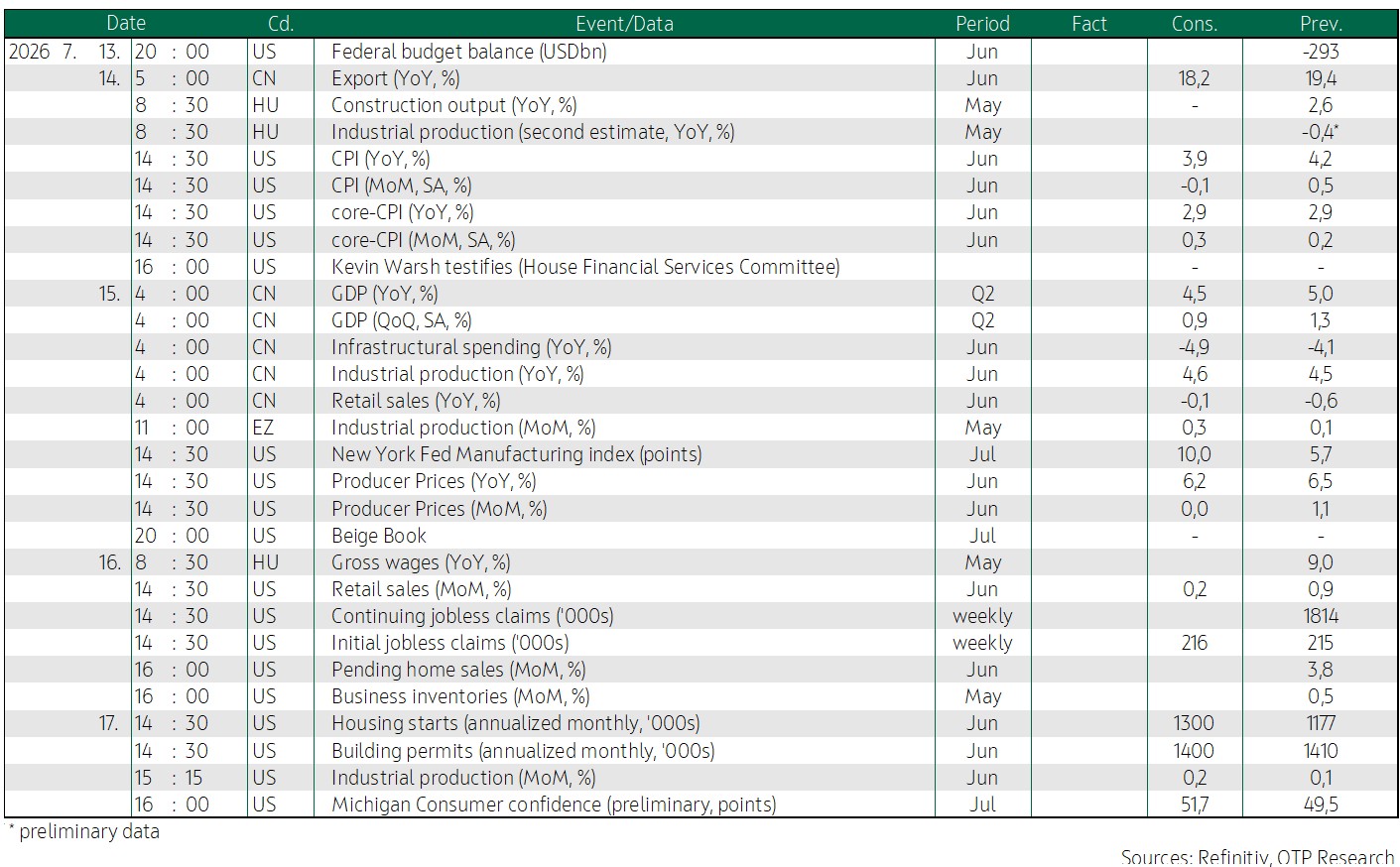
Today, investors will be watching the U.S. federal budget balance for June. Later in the week, attention will shift to key U.S. macroeconomic releases, including June inflation data as well as June retail sales and industrial production figures. In China, a set of closely watched economic indicators will be released early Wednesday, most notably second-quarter GDP growth. Meanwhile, the second-quarter earnings season in the United States will get underway this week with results from the major banks. According to LSEG data, analysts expect aggregate earnings for S&P 500 companies to increase by approximately 24% year-on-year, with much of the growth being driven by the technology sector.
Get more out of your investments!
Global Markets Services
OTP Global Markets offers a broad range of services in the field of local and international money and capital markets.
Read morePrivate Banking Services
Personal care and expertise with OTP Private Banking, along with the knowledge, security, and innovations of a multinational banking group.
Read more