
OTP Morning Brief: Stock markets corrected higher, while bond yields moved lower on Thursday
Related content
OTP Morning Brief: US producer price index came in above expectations, yet the US 10-year Treasury yield still declined
Western European equities continued to advance despite ongoing pressure on the technology sector. Wall Street indices also rebounded, recovering some ground after Wednesday’s sell-off. Healthcare was the standout performer on both sides of the Atlantic. Eurozone industrial production declined by 0.5% month-on-month in August. In the US, the producer price index accelerated to 6.3%, delivering another upside surprise in inflation developments. US retail sales increased by 0.8% compared to August. The US 10-year Treasury yield declined by more than 10 basis points. The long end of the Hungarian government bond yield curve also declined by 7-9 basis points. In Hungary, August wage data will be released today, while in the US, September industrial production figures are due.
OTP Morning Brief: US CPI data came in above expectations
European equity markets advanced, supported by strong results from ASML and the outstanding performance of the healthcare sector. US equity markets came under pressure following higher-than-expected September CPI data. The annual CPI rate accelerated to 3.7%, driven primarily by a surge in gasoline prices, while core CPI rose by 0.3% month-on-month, supported by higher housing costs and rising transportation service prices. Oil prices rose amid escalating tensions in the Middle East and the impact of the IEA's oil market report. US Treasury yields retreated after an initial increase, driven by Fed commentary, while European bond yields generally moved higher. The US macro calendar will be busy today, with investors focusing on September retail sales and producer price index data, as well as the New York Fed Manufacturing Index, weekly jobless claims, and business inventories. August industrial production data from the euro area will be released today.
After three consecutive days of declines, major European indices rebounded, driven primarily by strong performance in the technology and basic materials sectors. CPI may remain elevated for longer than previously expected, according to the minutes of the ECB’s latest rate-setting meeting. CEE stock markets advanced. Tehran said it had targeted US military assets following Wednesday's US strikes against Iran. Despite tensions in the Middle East, major US equity indices moved higher, led by gains in semiconductor stocks. The IT sector was supported by Micron Technology. Following Wednesday’s sharp rise, crude oil futures declined on Thursday as investors grew optimistic about the continuation of US-Iran peace talks. Developed market bond yields eased on Thursday. Japan’s 10-year yield fell by more than 11 basis points after the finance minister suggested encouraging pension funds to increase their asset purchases. Hungary’s 10-year government bond yield rose to 5.2%, while the forint strengthened by 0.7% against the euro. Asian equity indices were mostly higher this morning.
Major European indices advanced amid optimistic investor sentiment
After three consecutive days of declines, major European indices mostly advanced on Thursday, with the pan-European Stoxx 600 rising 0.8%. Among its sector indices, technology (+2.8%) and basic materials (+3.3%) contributed the most to the gains, having been among the weakest performers earlier in the week. Investor risk appetite generally improved despite escalating tensions in the Middle East, supported by lower oil prices and expectations related to the upcoming earnings season. The technology sector’s strong performance was driven by a rally in semiconductor stocks: Siltronic soared 13.4%, Soitec rose 5.9%, and ASML gained 4.8% following reports that China may grant limited access to Nvidia’s H200 chips for domestic artificial intelligence developers, reinforcing expectations that demand for AI infrastructure could accelerate. At the sector level, healthcare was the worst performer, falling 0.9%, primarily due to AstraZeneca’s 6.2% decline after one of the company’s developments failed to meet its primary endpoint in clinical trials. AstraZeneca’s sharp drop may also have been behind the UK’s FTSE 100 slipping slightly into negative territory despite the otherwise optimistic market sentiment. Meanwhile, the Spanish stock market advanced 1.1%, helped by favorable comments regarding US-Spain trade relations after Donald Trump had earlier in the week spoken about severing trade ties between the two countries.
According to the minutes of the ECB’s latest rate-setting meeting published yesterday, CPI may remain above target for longer than previously expected, reinforcing expectations of further rate hikes.
Yesterday, CEE stock markets also moved higher, with Hungary’s BUX outperforming its regional peers by closing 1.3% higher. Hungary’s blue-chip stocks delivered mixed performances; OTP was the strongest performer, while Richter was the only major stock to finish slightly in negative territory.
US equity indices advanced yesterday, led by gains in semiconductor stocks
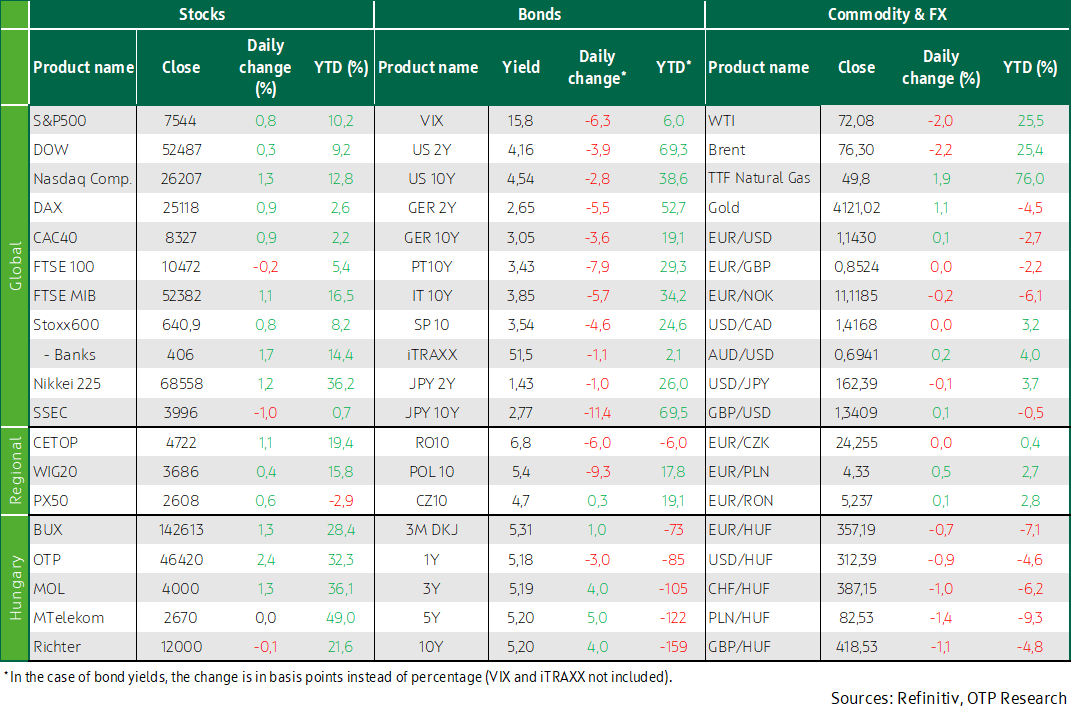
US equities finished Thursday’s session with strong gains, as the S&P 500 rose 0.8%, the Nasdaq advanced 1.3%, and the Dow added 0.3%. Weekly jobless claims declined, indicating that labor market conditions remain stable, while investors largely shrugged off the renewed escalation in the Middle East. The positive sentiment was primarily driven by Micron’s US investment plans, under which the company intends to invest more than $250 billion in the country by 2035, boosting semiconductor-related stocks. The Philadelphia Semiconductor Index jumped more than 3%, while Micron and Marvell Technology rallied 5%, AMD rose 6%, Sandisk soared nearly 8%, and Broadcom closed 3% higher. Nvidia, the sector’s largest player, lost 0.7% of its value. Seven of the S&P 500’s 11 sector indices ended in positive territory, with IT posting the strongest gain, while consumer discretionary and financial services stocks also recorded notable advances. The largest declines were seen in the consumer staples and energy sectors. PepsiCo fell 3.3% despite the snack and soft-drink giant beating second-quarter revenue expectations. Shares of Costco Wholesale plunged 4.2% to a six-month low after the retail chain reported a slowdown in comparable sales for June.
Crude oil prices declined yesterday following Wednesday’s sharp rise, with Brent falling 2% to near $76 per barrel, while WTI also retreated by a similar magnitude. Despite renewed airstrikes in the Gulf region, some reports indicated that the US and Iran will continue peace negotiations. Nevertheless, Tehran stated that it had targeted US military assets in Kuwait, Qatar, and Bahrain following Wednesday’s US strikes against Iran.
Developed market bond yields eased, with Japan’s 10-year yield posting a sharp decline
After rising by nearly 9 basis points earlier in the week, the US 10-year Treasury yield corrected lower by almost 3 basis points to 4.54%. Germany’s 10-year government bond yield eased by 3.6 basis points to 3.05%. Japan’s 10-year yield fell by more than 11 basis points to 2.77% after the finance minister stated that the government would encourage Japanese pension funds to increase their purchases of domestic financial assets. The euro strengthened modestly against the dollar to 1.143.
In contrast to developed market trends, the Hungarian government bond yield curve continued to move higher, except for the 12-month maturity. The 10-year yield rose by 4 basis points to 5.2%. Following Wednesday’s decline of more than 1%, the forint partially corrected yesterday, strengthening 0.7% against the euro to 357.19. Yesterday, the Government Debt Management Agency (ÁKK) accepted bids worth HUF 24 billion, HUF 5 billion and HUF 25 billion at its auctions of 3-, 5- and 10-year forint-denominated bonds, respectively, at an average yield of 5.14%.
Today's highlights
Asian equity indices were mostly higher this morning, as yesterday’s rally in US semiconductor stocks provided momentum for regional markets. Meanwhile, investors are already focusing on the US market debut of South Korea’s leading chipmaker, SK Hynix, later today, following a $26.5 billion share sale. The listing will serve as a key test of investor confidence in the durability of the AI boom, particularly after the recent pullback in semiconductor stocks. SK Hynix shares rose 2.2% to KRW 2.233 million ($1,479.98) in Seoul on Friday after the company sold American Depositary Receipts (ADRs) at $149 per share, representing a 2.7% premium to the stock’s average price over the previous three trading days. (Ten ADRs are equivalent to one ordinary share.)
In Japan, the IT sector was also driving the indices higher, while expectations related to the restructuring of the country’s massive pension fund provided support to both the bond market and the yen. Japan’s 10-year yield fell by 12 basis points, while the yen strengthened 0.4% against the dollar after Japan’s finance minister stated on Friday that the government aims to steer the country’s enormous public pension funds toward “significantly” increasing their investments in Japanese domestic assets.
European equity futures point to a higher open, while US equity futures are trading in negative territory.
Crude oil futures are trading in negative territory this morning.
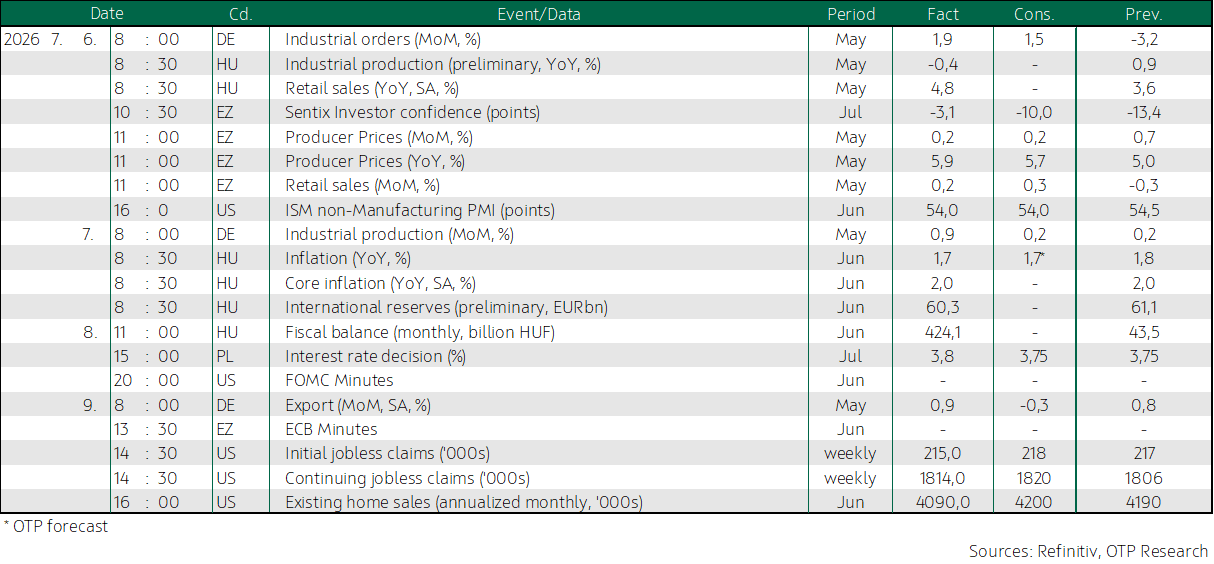
No major macroeconomic data releases are scheduled for today, with investors likely to focus on developments in the Middle East and the slowly unfolding earnings season.
Get more out of your investments!
Global Markets Services
OTP Global Markets offers a broad range of services in the field of local and international money and capital markets.
Read morePrivate Banking Services
Personal care and expertise with OTP Private Banking, along with the knowledge, security, and innovations of a multinational banking group.
Read more