
OTP Morning Brief: Middle East escalation drove market movements on Wednesday
Related content
OTP Morning Brief: US producer price index came in above expectations, yet the US 10-year Treasury yield still declined
Western European equities continued to advance despite ongoing pressure on the technology sector. Wall Street indices also rebounded, recovering some ground after Wednesday’s sell-off. Healthcare was the standout performer on both sides of the Atlantic. Eurozone industrial production declined by 0.5% month-on-month in August. In the US, the producer price index accelerated to 6.3%, delivering another upside surprise in inflation developments. US retail sales increased by 0.8% compared to August. The US 10-year Treasury yield declined by more than 10 basis points. The long end of the Hungarian government bond yield curve also declined by 7-9 basis points. In Hungary, August wage data will be released today, while in the US, September industrial production figures are due.
OTP Morning Brief: US CPI data came in above expectations
European equity markets advanced, supported by strong results from ASML and the outstanding performance of the healthcare sector. US equity markets came under pressure following higher-than-expected September CPI data. The annual CPI rate accelerated to 3.7%, driven primarily by a surge in gasoline prices, while core CPI rose by 0.3% month-on-month, supported by higher housing costs and rising transportation service prices. Oil prices rose amid escalating tensions in the Middle East and the impact of the IEA's oil market report. US Treasury yields retreated after an initial increase, driven by Fed commentary, while European bond yields generally moved higher. The US macro calendar will be busy today, with investors focusing on September retail sales and producer price index data, as well as the New York Fed Manufacturing Index, weekly jobless claims, and business inventories. August industrial production data from the euro area will be released today.
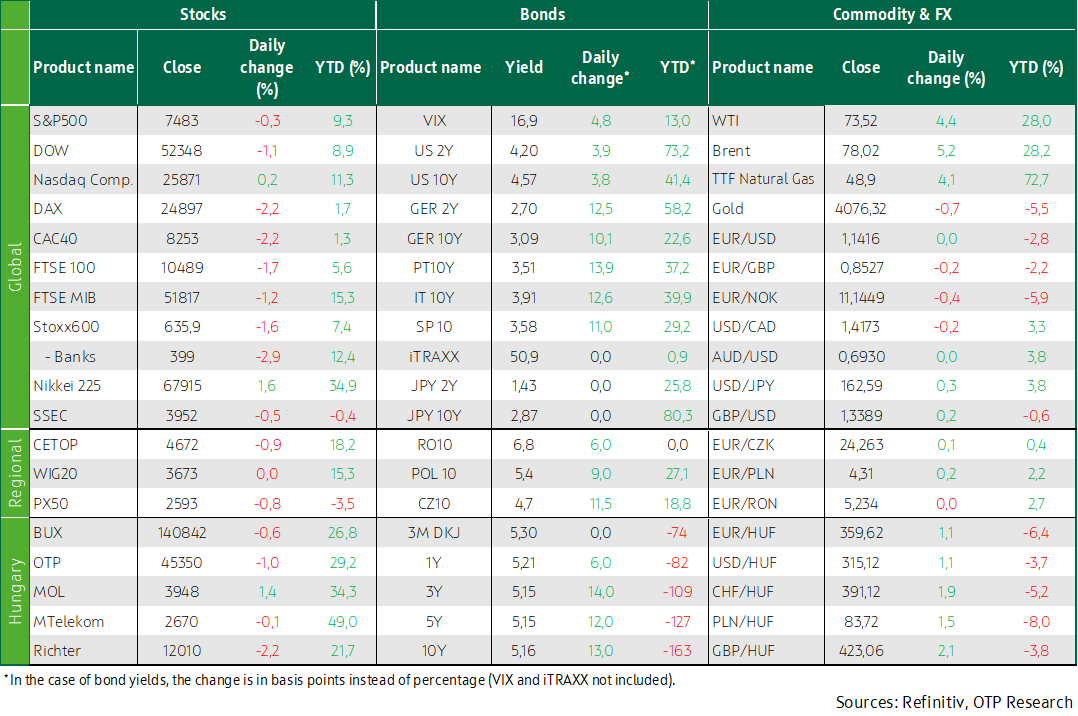
The US-Iran conflict escalated again. President Donald Trump stated that the previous 14-point agreement had effectively come to an end. Energy prices recorded a sharp rise. Brent crude oil surged by 5.2%, while the price of European benchmark TTF natural gas climbed 4.1% on Wednesday. European equity indices fell sharply, led by Spain's IBEX. Russia banned diesel exports until July 31. The Hungarian Ministry of Finance commented on the state of the budget. Major US indices closed mixed, with the Nasdaq posting a modest gain, supported by a 4.8% advance in Broadcom shares. With CPI risks intensifying, both US and German 10-year bond yields moved higher.
The US-Iran conflict escalated again
Since Tuesday — when several cargo vessels may have come under Iranian attack — tensions between the US and Iran have escalated once again. The US initially carried out retaliatory strikes overnight on Tuesday, followed by Iranian attacks on US targets on Wednesday. According to reports, several cargo ships turned back while transiting the Strait of Hormuz. President Donald Trump stated that the temporary agreement aimed at ending the conflict had effectively collapsed, adding that the US is expected to launch further strikes. Against this backdrop, energy prices surged on Wednesday, with Brent crude oil rising 5.2% and European benchmark TTF natural gas advancing 4.1%.
Leading European equity indices extended their losses on Wednesday
Driven primarily by unfavorable developments in the Middle East, Western European stock markets fell sharply on Wednesday. The STOXX 600 declined 1.6%, while the DAX and CAC 40 each dropped 2.2%, and the FTSE 100 closed 1.7% lower. Spain’s IBEX was hit particularly hard, plunging 2.7% after President Trump instructed Treasury Secretary Scott Bessent to suspend all trade with Spain and described Madrid as a terrible partner. Basic materials companies, along with construction and building materials stocks, weighed most heavily on the benchmark index, falling 4.5% and 3.7%, respectively. Automotive shares also retreated 3.7%, while the rise in crude oil prices lifted the energy sector by 1.9%. Higher oil prices also put pressure on airlines, with Air France shares dropping 6.6% and Wizz Air stock falling 5.0%. Among individual stocks, Sweden’s Bahnhof soared 17.1% after telecom operator Telenor agreed to acquire a majority stake in the Swedish broadband provider.
In its updated forecast released yesterday, the IMF lowered its 2026 euro area growth projection by 0.2 percentage points to 0.9%, while leaving its 2027 forecast unchanged at 1.2%.
After Ukrainian drone strikes on Russian oil refineries caused significant damage, Russia banned diesel exports until July 31 in an effort to stabilize the Hungarian fuel market. Following the announcement, the European diesel crack spread (the price difference between diesel and Brent crude oil) surged to a record high of $60.17 per barrel.
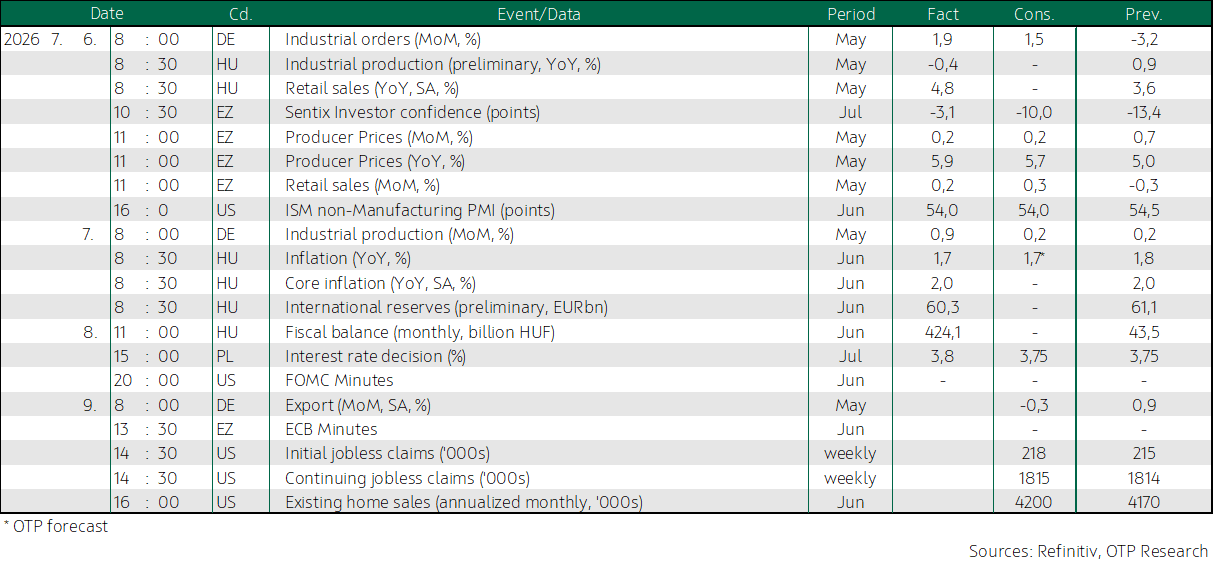
Hungary’s central government budget posted a HUF 424.1 billion surplus in June, an exceptionally strong result for the sixth month of the year, which typically records a deficit. According to a statement from the Ministry of Finance, the budget deficit would have reached 8.3% this year without the change in government, but measures implemented so far – including the agreement with the EU – have reduced it to 7.5%. The ministry also announced that the government will amend the 2026 budget and set a new deficit target for 2026 by the end of August, while the 2027 budget and the medium-term fiscal plan will be submitted by the end of October. Finance Minister András Kármán stated that the Hungarian government does not have a specific exchange rate target, although exchange rate predictability remains crucial. He also reaffirmed the government’s commitment to reducing the budget deficit below 3% of GDP by 2030.
Regional indices outperformed their Western European peers. The BUX declined 0.6%, while the PX50 fell 0.8%, and Poland’s WIG20 remained broadly unchanged. The National Bank of Poland left its benchmark interest rate unchanged at 3.75%.
Major US indices closed mixed, thereby outperforming Europe
On Wednesday, the S&P 500 fell 0.3% and the Dow Jones declined 1.1%, while the Nasdaq Composite managed to rise 0.2%. Microsoft and Alphabet each lost more than 1% of their value, while Meta Platforms weakened by 2%. The Nasdaq, however, remained in positive territory thanks to Broadcom, which advanced 4.8% after Apple announced plans to spend more than $30 billion as part of the chip supply agreement signed earlier this week. Nvidia rose 3.65% after reports suggested that China plans to allow its leading artificial intelligence companies to purchase limited quantities of Nvidia H200 chips.
According to the minutes of the Federal Reserve’s meeting last month, concerns about CPI strengthened among policymakers. One new issue raised during the discussion was the potential inflationary impact of extremely rapidly growing investment in artificial intelligence. Participants generally assessed that information received between meetings suggested that upside risks to price stability remained significant, while downside risks to achieving maximum employment had eased somewhat. Based on FedWatch data, market pricing currently indicates that one interest rate hike is the most likely outcome this year (36.9%), although the scenario of two rate hikes has also gained considerable ground (35.1%).
While the IMF lowered its 2026 global growth forecast by 0.1 percentage point to 3.0% and raised its 2027 projection to 3.4%, it continues to expect US GDP growth of 2.3% in 2026, while increasing its 2027 US forecast by 0.1 percentage point to 2.2%.
With CPI risks intensifying, both US and German 10-year bond yields moved higher
The renewed escalation of the Middle East conflict strengthened upside CPI risks globally, prompting a rise in developed market bond yields. The US 10-year Treasury yield increased by 3.8 basis points to 4.57%, while the German 10-year yield rose by 10.1 basis points to 3.09%. The yield on the 10-year Japanese government bond climbed 2.5 basis points to 2.865%, its highest level since September 1996. EURUSD remained near the 1.141 level.
The forint opened the day weaker amid the impact of the Middle East conflict and ultimately ended the session down 1.1% against the euro. Hungarian government bond yields rose by more than 10 basis points at maturities beyond one year, with the 10-year yield increasing by 13 basis points to 5.16%. Today, the Government Debt Management Agency (ÁKK) will offer HUF-denominated bonds worth HUF 20 billion, HUF 20 billion, and HUF 25 billion in 3-year, 5-year, and 10-year maturities, respectively.
Today's highlights
Asian indices were mixed as trading approached the close. The Nikkei rose 1.6%, while the KOSPI gained 0.1%. Meanwhile, the SSEC declined 0.5% and the Hang Seng fell 0.8%.
Today, we expect Germany’s May export data and the minutes of the ECB’s June rate-setting meeting from Europe. In the US, the usual weekly jobless claims data and June existing home sales figures will be released.
Get more out of your investments!
Global Markets Services
OTP Global Markets offers a broad range of services in the field of local and international money and capital markets.
Read morePrivate Banking Services
Personal care and expertise with OTP Private Banking, along with the knowledge, security, and innovations of a multinational banking group.
Read more