
OTP Morning Brief: The technology sector underperformed; tensions in the Middle East intensified
Related content
OTP Morning Brief: US producer price index came in above expectations, yet the US 10-year Treasury yield still declined
Western European equities continued to advance despite ongoing pressure on the technology sector. Wall Street indices also rebounded, recovering some ground after Wednesday’s sell-off. Healthcare was the standout performer on both sides of the Atlantic. Eurozone industrial production declined by 0.5% month-on-month in August. In the US, the producer price index accelerated to 6.3%, delivering another upside surprise in inflation developments. US retail sales increased by 0.8% compared to August. The US 10-year Treasury yield declined by more than 10 basis points. The long end of the Hungarian government bond yield curve also declined by 7-9 basis points. In Hungary, August wage data will be released today, while in the US, September industrial production figures are due.
OTP Morning Brief: US CPI data came in above expectations
European equity markets advanced, supported by strong results from ASML and the outstanding performance of the healthcare sector. US equity markets came under pressure following higher-than-expected September CPI data. The annual CPI rate accelerated to 3.7%, driven primarily by a surge in gasoline prices, while core CPI rose by 0.3% month-on-month, supported by higher housing costs and rising transportation service prices. Oil prices rose amid escalating tensions in the Middle East and the impact of the IEA's oil market report. US Treasury yields retreated after an initial increase, driven by Fed commentary, while European bond yields generally moved higher. The US macro calendar will be busy today, with investors focusing on September retail sales and producer price index data, as well as the New York Fed Manufacturing Index, weekly jobless claims, and business inventories. August industrial production data from the euro area will be released today.
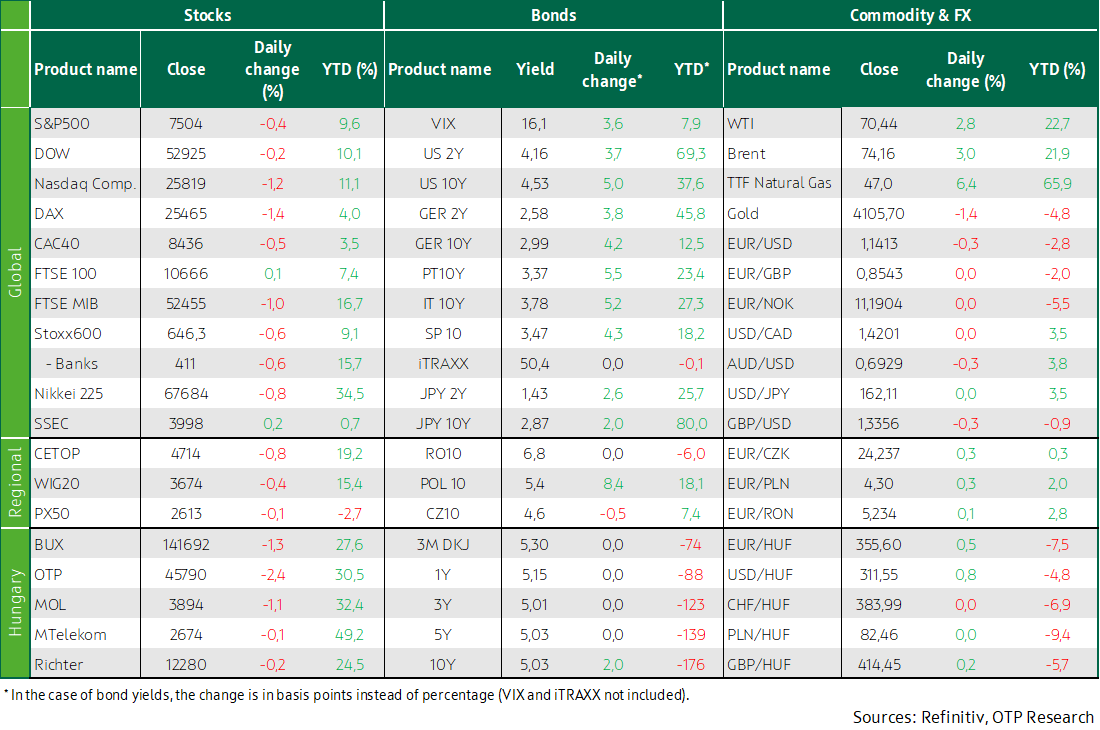
Major European and US equity markets closed predominantly in negative territory, while the technology sector remained under pressure. This year's NATO Summit has commenced. CEE stock markets also declined, with the BUX falling 1.3%. Hungarian CPI eased to 1.7% in June. Commercial vessels were attacked in the Strait of Hormuz, while the US carried out a series of strikes against Iranian targets; crude oil prices rose. Inflation concerns strengthened, pushing long-term yields higher across developed markets. The Hungarian forint weakened against the euro. Focus is on the Hungarian budget data and the minutes of the Fed's June meeting.
Major European indices mostly ended Tuesday's trading session lower; the BUX closed down 1.3%, while Hungarian CPI eased to 1.7% in June
With the exception of the UK’s FTSE 100, major European indices turned negative yesterday. The pan-European Stoxx 600 fell 0.7%, with technology (-3.6%) posting the steepest decline among its sector indices. Investors have recently rotated away from the sector, which had outperformed for much of the year, while the weak performance of Samsung shares also weighed on sentiment. Following the release of its Q2 earnings report, the South Korean company plunged nearly 7% despite reporting solid results, as markets across the sector have become increasingly concerned about elevated valuations and the returns on large-scale AI investments. Several key technology names, including ASML (-7.3%), Soitec (-17.1%), AT&S (-10.7%), and STMicroelectronics (-8.0%), ended the session with substantial losses. The decline in risk appetite also dragged cyclical sectors lower, with industrials and basic materials falling by around 2.5%.
Meanwhile, investors kept one eye on the NATO Summit, where arms procurement plans worth tens of billions of euros were announced, reinforcing expectations for further growth in European defence spending. Nevertheless, the European defence sector as a whole declined 2.5%, as investors took profits following the gains recorded in recent days. Shares of Swedish defence equipment manufacturer Saab rose 4.1% after Morgan Stanley upgraded the stock from underweight to overweight. In addition, NATO announced that it could purchase up to 10 GlobalEye surveillance aircraft from the company. Renault gained 0.7% after a report suggested that China's BYD had twice considered acquiring a stake in the French automaker. Shell advanced 3.4% after the energy giant raised its Q2 guidance.
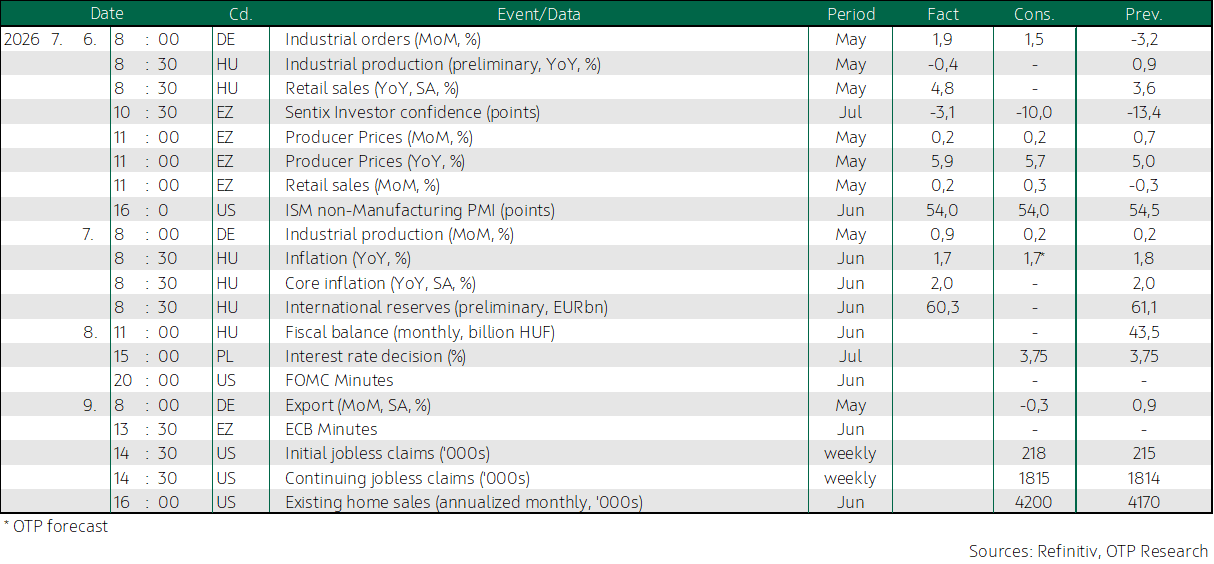
On the data front, Germany’s May industrial production figures delivered an upside surprise, rising 0.9% month-on-month after a 0.2% increase in April, marking the strongest expansion since September last year. Growth was driven primarily by the automotive industry and construction activity. This extended the streak of encouraging news surrounding German industry, following industrial orders data released earlier in the week that also exceeded expectations. Together with the favourable retail sales figures published last week, the latest releases suggest that the German economy may have continued to expand in Q2.
CEE stock markets also closed in negative territory, with the BUX emerging as the worst performer, falling 1.3%. All major Hungarian blue-chip stocks ended the session lower.
Hungarian CPI eased to 1.7% year-on-year in June from 1.8% in May, as price pressures moderated across a broad range of goods and services. Core CPI remained unchanged at 2.0%.
Wall Street indices closed in negative territory, while crude oil prices rose
Major Wall Street indices also ended the session in negative territory, with weak performance in the technology sector—particularly among semiconductor manufacturers—driving the risk-off sentiment, much like in Europe. Shares of Micron (-4.7%) and SanDisk (-7.3%) posted notable declines. Investors are increasingly concerned that the enthusiasm surrounding artificial intelligence has left semiconductor and AI-related stocks overvalued, prompting profit-taking and sector rotation. Chipmakers also came under additional pressure following a Reuters report that China's DeepSeek is developing its own AI chip, which could reduce its reliance on Nvidia's and Huawei's solutions over the longer term.
Oil prices moved higher yesterday following attacks on commercial vessels in the Strait of Hormuz. In response to the incidents, the Trump administration is reimposing sanctions on Iranian oil sales that had previously been lifted as part of the ceasefire agreement. The US carried out a series of strikes against more than 80 Iranian targets, prompting Tehran to pledge retaliation. WTI crude rose 2.8%, while Brent gained 3.0%, leaving both benchmarks trading above USD 70 per barrel.
Rate hike expectations strengthened across developed markets; the Hungarian forint weakened against the euro
Sentiment in developed bond markets was shaped by adverse developments in the Strait of Hormuz. Rising oil prices reinforced CPI concerns, leading investors to increase their expectations for rate hikes by both the Fed and the ECB in September. Market pricing continues to imply a total of 25 basis points of additional tightening by year-end for both central banks. Long-term yields climbed to their highest levels since the first half of June, with the US 10-year Treasury yield rising 5 basis points to 4.53%, while its German counterpart added 4 basis points to approach 3.0%. The US 30-year yield closed above the symbolic 5.0% threshold on Tuesday. The dollar strengthened modestly against the euro, with the EUR/USD exchange rate falling to 1.1413.
Based on the Government Debt Management Agency's (ÁKK) benchmark quotations published in the early afternoon, the Hungarian yield curve was largely unchanged during yesterday's trading session, with the 10-year yield edging up by 2 basis points to 5.03%. Regional currencies weakened against the euro, with the Hungarian forint underperforming its peers and losing more than 0.5%, pushing the EUR/HUF exchange rate back above the 355 level.
At yesterday's 3-month Treasury bill auction, Hungary's Government Debt Management Agency (ÁKK) received bids exceeding HUF 52 billion for the announced HUF 30 billion offering. However, the debt manager ultimately accepted bids only up to the originally offered amount, at an average yield of 5.36%.
Today's highlights
Major Asia-Pacific equity markets opened mostly lower this morning, with Hong Kong’s Hang Seng and China’s Shanghai Composite standing out as the only major indices managing to hold on to their early gains. Oil prices extended their advance following the US airstrikes, with Brent crude climbing above USD 76 per barrel, while WTI traded around USD 72.5 per barrel.
The flash estimate of Hungary’s June budget data is due to be released today.
In the US, investors are focused on the minutes of the Fed's June meeting, looking for guidance on the future path of interest rates.
The National Bank of Poland is holding a policy meeting today, with markets expecting the benchmark interest rate to remain unchanged.
Get more out of your investments!
Global Markets Services
OTP Global Markets offers a broad range of services in the field of local and international money and capital markets.
Read morePrivate Banking Services
Personal care and expertise with OTP Private Banking, along with the knowledge, security, and innovations of a multinational banking group.
Read more