
OTP Morning Brief: The US markets were driven higher by the technology sector on Monday
Related content
OTP Morning Brief: US producer price index came in above expectations, yet the US 10-year Treasury yield still declined
Western European equities continued to advance despite ongoing pressure on the technology sector. Wall Street indices also rebounded, recovering some ground after Wednesday’s sell-off. Healthcare was the standout performer on both sides of the Atlantic. Eurozone industrial production declined by 0.5% month-on-month in August. In the US, the producer price index accelerated to 6.3%, delivering another upside surprise in inflation developments. US retail sales increased by 0.8% compared to August. The US 10-year Treasury yield declined by more than 10 basis points. The long end of the Hungarian government bond yield curve also declined by 7-9 basis points. In Hungary, August wage data will be released today, while in the US, September industrial production figures are due.
OTP Morning Brief: US CPI data came in above expectations
European equity markets advanced, supported by strong results from ASML and the outstanding performance of the healthcare sector. US equity markets came under pressure following higher-than-expected September CPI data. The annual CPI rate accelerated to 3.7%, driven primarily by a surge in gasoline prices, while core CPI rose by 0.3% month-on-month, supported by higher housing costs and rising transportation service prices. Oil prices rose amid escalating tensions in the Middle East and the impact of the IEA's oil market report. US Treasury yields retreated after an initial increase, driven by Fed commentary, while European bond yields generally moved higher. The US macro calendar will be busy today, with investors focusing on September retail sales and producer price index data, as well as the New York Fed Manufacturing Index, weekly jobless claims, and business inventories. August industrial production data from the euro area will be released today.
Despite hitting a record high during the session, the major European markets ultimately closed in negative territory on the first trading day of the week. The defense sector performed well, supported by Russia's large-scale airstrike. Several encouraging economic indicators were released across Europe, with German industrial orders, eurozone retail sales, consumer confidence, and producer prices all posting gains. Meanwhile, both industrial output and retail trade performance improved in Hungary. Across the Atlantic, the technology sector led the markets higher, while the Dow reached a record high. The non-manufacturing PMI deteriorated slightly. Oil prices continued to decline. Bond market activity remained subdued. Asian markets fell sharply today amid growing skepticism surrounding AI.
European markets closed lower, despite a series of favorable economic data releases from both the eurozone and Hungary
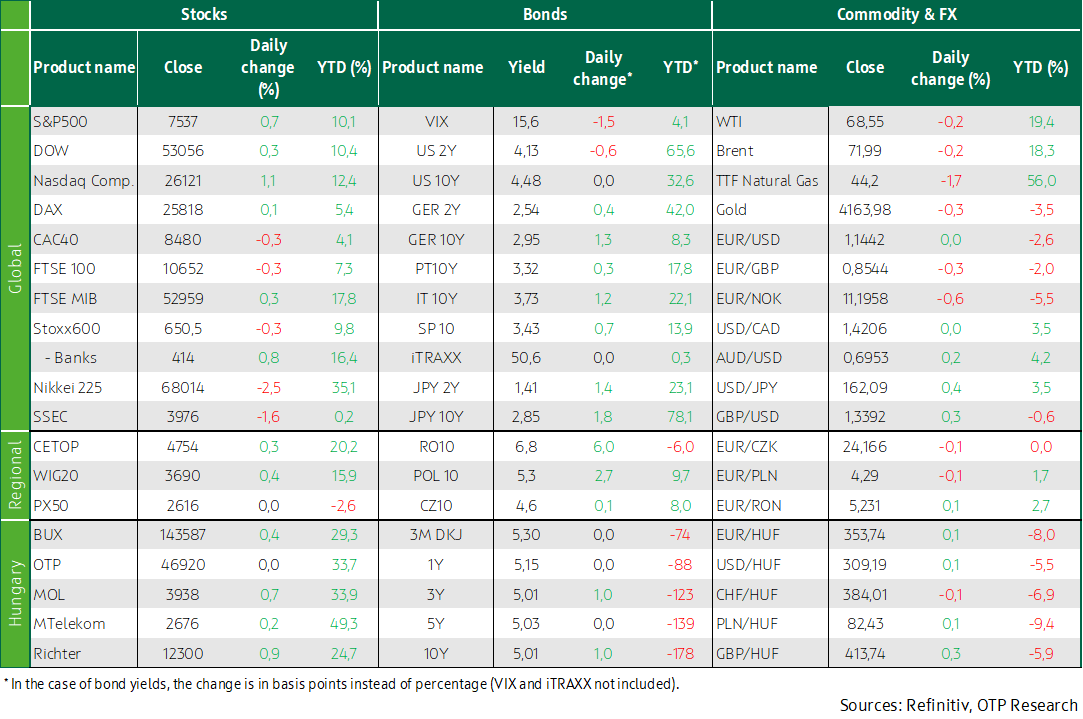
Although the major European markets opened higher, they finished the first trading day of the week in negative territory as investors took profits following the recent strong rise. By the close, the pan-European Stoxx 600 had slipped 0.3%, despite earlier reaching a new all-time high of 654.44 points after posting its strongest weekly performance since mid-May the previous week. Defying the broader regional weakness, Germany’s DAX gained 0.1% and closed at a fresh record high, marking its fifth consecutive day of gains. Utilities and healthcare stocks exerted the greatest downward pressure on the Stoxx index, with both sectors falling 1.8%, while food and beverage shares also underperformed, declining 1.7%. Defense stocks ranked among the best-performing sectors, advancing 1.3% after Russia’s most intensive airstrike of the year claimed 26 lives in the Ukrainian capital. Among the standout gainers, easyJet soared 9.3% after US investment firm Castlelake improved its takeover proposal for the British low-cost carrier. Airbus shares added 1.6% after industry sources reported that the aircraft manufacturer had set an internal target of delivering 900 aircraft this year.
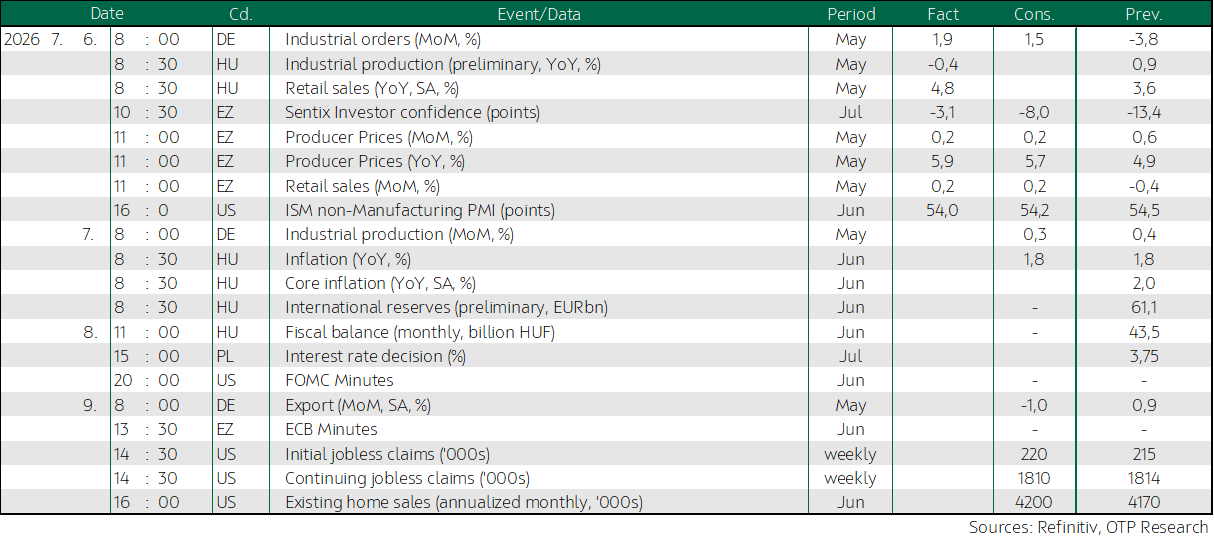
European macroeconomic data painted an overall favorable picture of economic activity. German industrial orders rose 1.9% month-on-month in May, exceeding the market expectation of 1.5% and marking a meaningful turnaround following the previous month’s 3.8% decline. The stronger-than-expected reading suggests that production prospects for German industry could improve in the coming months. Meanwhile, retail sales expanded by 4.8% year-on-year, up from 3.6% previously, while posting monthly growth of 0.2%, in line with expectations, indicating that household demand remains resilient. Sentiment indicators also improved, with the Sentix Investor Confidence Index climbing to -3.4 in July from -13.4 a month earlier, significantly outperforming the consensus forecast of -8.0. Although the index remained in negative territory, the sharp improvement suggests that investors are becoming increasingly optimistic about the eurozone’s economic outlook. On the inflation front, the producer price index increased by the expected 0.2% month-on-month, while annual growth accelerated to 5.9% from both the market expectation of 5.7% and the previous month’s 4.9%, signaling that pricing pressures remain persistent at the producer level.
Performance across the CEE region was mostly positive, with the Hungarian and Polish benchmark indices both rising 0.4%, while the Czech market was little changed. Among Hungary’s blue chips, Richter gained 0.9% and Mol advanced 0.7%. Hungarian economic data showed that industrial production declined by 0.4% year-on-year in May, while expanding 2.3% compared to the previous month, extending the positive trend seen so far this year. During the same period, retail sales exceeded the level recorded a year earlier by 4.8% and were 0.7% higher than in the previous month.
The technology sector led US markets higher on Monday
US markets closed sharply higher on Monday as investors continued to favor artificial intelligence-related stocks that are expected to support a strong second-quarter earnings season. In line with the tech rally, the Nasdaq led the major indices with a 1.1% rise, followed by the S&P 500 with a 0.7% gain and the Dow with a 0.3% advance, the latter closing at a record high. The S&P 500 Information Technology Index climbed 1.3%, while the Philadelphia Semiconductor Index rose 2.2%, recovering part of the losses recorded during the previous two consecutive trading sessions. Broadcom was a key contributor, with its shares advancing 3.7% after the chipmaker and Apple agreed to extend their partnership through 2031 for the design and supply of a range of custom chips. In contrast, Microsoft shares slipped nearly 1% after the technology giant announced plans to reduce its workforce by approximately 2.1%, equivalent to around 4,800 jobs. Ahead of its inclusion in the Nasdaq 100, SpaceX shares declined 1%. Dell Technologies gained more than 4% after Donald Trump encouraged Americans at an Oval Office event to “go out and buy a Dell computer.”
The US ISM Services PMI edged down to 54.0 in June from 54.5 in the previous month. Although the index softened slightly, it remained comfortably above the key 50-point threshold that signals expansion. Brent crude prices fell below USD 72 per barrel on Monday, hovering near their lowest levels since late February. The decline was driven by the gradual normalization of shipping traffic through the Strait of Hormuz, while OPEC+ signaled an increase in global oil supply.
There were only limited movements in the bond market on Monday as investors continued to assess their expectations for central bank policy
US Treasury yields were largely unchanged on Monday after a weaker-than-expected US employment report released ahead of the three-day holiday weekend tempered market expectations regarding further Federal Reserve rate hikes. The yield on the policy-sensitive 2-year US Treasury note stood at 4.129%, while the 10-year Treasury yield was 4.486%. Meanwhile, with limited scope for a meaningful shift in market expectations surrounding the European Central Bank, investors increasingly focused on whether longer-dated European bonds would continue to underperform their shorter-maturity counterparts and whether any individual market might diverge from broader regional trends. Germany’s 10-year government bond yield, the benchmark for the eurozone, rose to 2.94%, its highest level since June 23, although it was little changed overall during the session. The dollar stabilized after posting its weakest weekly performance since April. The US currency remained under pressure following the employment report, which showed that job creation slowed significantly in June.
Similarly to international markets, Hungarian government bond yields showed little meaningful movement, with both the three-year and ten-year yields rising by 1 basis point to 5.01%. At the same time, trading in regional currency markets remained subdued. The Czech koruna and the Polish zloty strengthened by 0.1%, while the Hungarian forint weakened by 0.1%, approaching the 354 level against the euro.
Today's highlights
Asian equity markets retreated on Tuesday despite Samsung Electronics issuing exceptionally strong earnings guidance. The company expects its Q2 operating profit to be nearly 19 times higher than a year earlier, potentially marking its third consecutive record quarter. Meanwhile, the Japanese yen remained near its weakest level in almost four decades amid speculation over possible central bank intervention. South Korean equities fell 4.1%, while Japan’s benchmark index declined 2.5% and Chinese stocks dropped 1.6%.
Today, investors will focus on German retail sales data, while Hungary’s June CPI reading is also due for release. According to market expectations, annual CPI remained unchanged at 1.8%, matching the previous month's figure. Based on our forecast, the CPI indicator may ease slightly to 1.6–1.7%.
Get more out of your investments!
Global Markets Services
OTP Global Markets offers a broad range of services in the field of local and international money and capital markets.
Read morePrivate Banking Services
Personal care and expertise with OTP Private Banking, along with the knowledge, security, and innovations of a multinational banking group.
Read more