
OTP Morning Brief: Stoxx 600 and DAX reach new record highs
Related content
OTP Morning Brief: US producer price index came in above expectations, yet the US 10-year Treasury yield still declined
Western European equities continued to advance despite ongoing pressure on the technology sector. Wall Street indices also rebounded, recovering some ground after Wednesday’s sell-off. Healthcare was the standout performer on both sides of the Atlantic. Eurozone industrial production declined by 0.5% month-on-month in August. In the US, the producer price index accelerated to 6.3%, delivering another upside surprise in inflation developments. US retail sales increased by 0.8% compared to August. The US 10-year Treasury yield declined by more than 10 basis points. The long end of the Hungarian government bond yield curve also declined by 7-9 basis points. In Hungary, August wage data will be released today, while in the US, September industrial production figures are due.
OTP Morning Brief: US CPI data came in above expectations
European equity markets advanced, supported by strong results from ASML and the outstanding performance of the healthcare sector. US equity markets came under pressure following higher-than-expected September CPI data. The annual CPI rate accelerated to 3.7%, driven primarily by a surge in gasoline prices, while core CPI rose by 0.3% month-on-month, supported by higher housing costs and rising transportation service prices. Oil prices rose amid escalating tensions in the Middle East and the impact of the IEA's oil market report. US Treasury yields retreated after an initial increase, driven by Fed commentary, while European bond yields generally moved higher. The US macro calendar will be busy today, with investors focusing on September retail sales and producer price index data, as well as the New York Fed Manufacturing Index, weekly jobless claims, and business inventories. August industrial production data from the euro area will be released today.
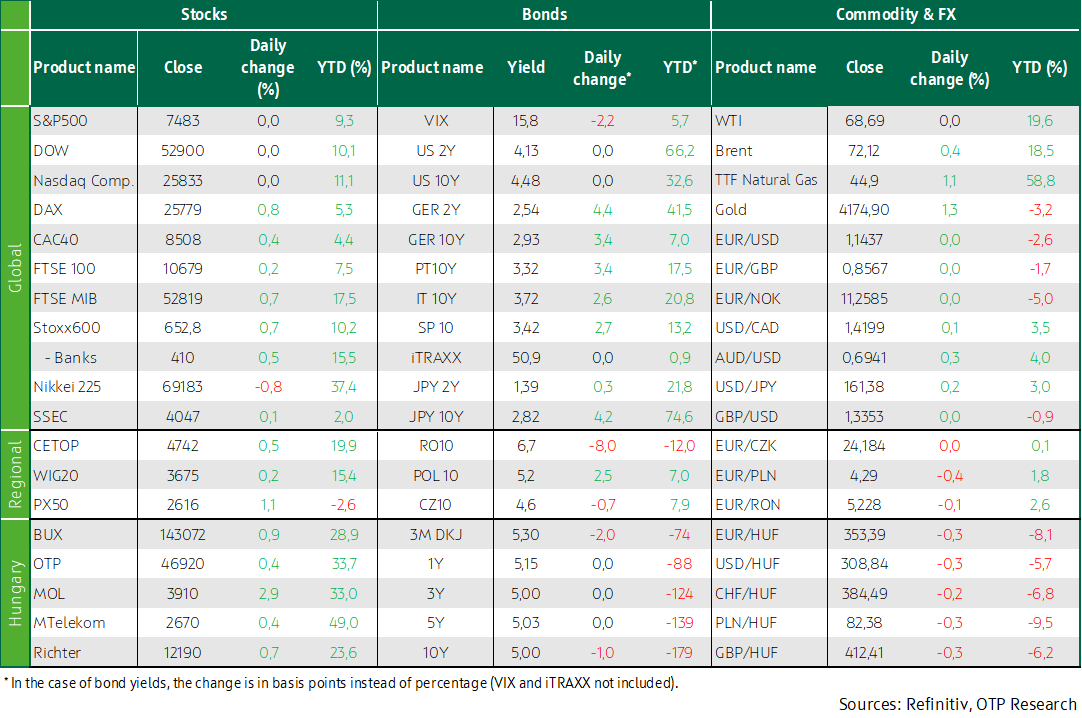
The Stoxx 600 Europe and the DAX closed at new record highs on Friday, supported by positive market sentiment driven by easing interest rate hike expectations. Looking at the week as a whole, Western European equity indices posted considerable gains, while US benchmarks recorded only modest advances. US markets were closed on Friday due to the holiday weekend. Eurozone bond yields continued to move higher, with the German 10-year yield ending the week at 2.93% after rising 8 bps. The Hungarian 10-year yield fell to 5.0%, marking its lowest level in more than four years. EUR/USD remained below 1.144 on Friday, while the dollar weakened by 0.5% vs the euro over the course of the week. The Hungarian forint extended its gains, approaching 353.4 against the euro, its strongest level in more than two weeks. Today, we are watching German industrial orders data, Hungarian industrial production and retail sales figures, as well as the eurozone Sentix investor confidence index, producer price indices, and retail sales data.
Stoxx 600 and DAX close at record highs; defence sector in focus; European gas prices continue to rise
The Stoxx 600 reached another record high on Friday, with the pan-European equity index closing 0.7% higher amid upbeat market sentiment. The DAX climbed 0.8% to a fresh all-time high, while the CAC 40 gained 0.5% and the FTSE 100 advanced 0.3%. Among the Stoxx 600 sector indices, industrials, basic materials and utilities led the gains, whereas the travel and leisure sector underperformed. Siemens surged 2.6% after brokerage firm Kepler Cheuvreux upgraded its recommendation on the stock from reduce to hold. Chipmaker Aixtron rallied 6%, while peers Soitec and BE Semiconductor jumped 5% and more than 4%, respectively. Defence stocks also performed strongly, with the sector index rising 0.7% as Russia launched its deadliest attack of the year so far on Ukraine. Investors expect defence spending and production to increase during periods of heightened geopolitical tensions.
On a weekly basis, the Stoxx 600 gained 2.7%, marking its strongest weekly performance since mid-May, while the DAX soared 4.5%. Easing interest rate hike expectations continued to support developed equity markets throughout the week. Following a softer-than-expected eurozone CPI release and a weaker-than-forecast US labour market report for June, market pricing assigned lower odds to more than one additional 25 bps rate hike this year. Defence stocks delivered the strongest gains during the week, alongside cyclical sectors such as industrials, banks and financial services, as the rally that had previously been concentrated in technology shares broadened across the market. The easing of Middle East tensions also contributed to the broader market advance.
Trading volumes were lighter than usual due to the US holiday.
CEE markets also moved higher, with the BUX gaining 0.9%. All major Hungarian blue chips closed in positive territory, led by MOL, which surged nearly 3%. Looking at the week as a whole, the WIG20 advanced almost 3%, the PX gained more than 2%, while the BUX rose 2.3%, with MOL providing the main boost to the Hungarian market after skyrocketing 6.6%.
In commodity markets, Brent crude oil futures continued to edge higher, moving above USD 72 per barrel (no Friday settlement was available for WTI due to the US holiday). European TTF natural gas prices rose alongside crude, albeit at a faster pace, with the benchmark contract climbing nearly 2% on Friday and approaching EUR 45/MWh. On a weekly basis, WTI posted a modest gain and Brent recorded a slight increase, while the Strait of Hormuz has remained open for shipping. Amid the ongoing European heatwaves, European gas prices rose by 9–11% over the course of the week. Gold prices advanced 2% last week, ending a streak of four consecutive weekly declines.
Easing interest rate hike expectations in developed markets, while long-term eurozone bond yields continued to move higher on Friday; the Hungarian forint strengthened against the euro, and the Hungarian 10-year government bond yield hit a four-year low
The US bond market was closed on Friday due to the holiday weekend, but long-term eurozone bond yields resumed their upward move. The German 10-year yield rose to 2.93%, an increase of nearly 9 bps, marking the first weekly rise in the benchmark since early June. Market participants adjusted their positions after the initial decline in yields following the US-Iran agreement, while rising long-term yields in Japan, driven by concerns over higher fiscal spending, also put upward pressure on German yields. Reuters reported on Friday that Germany’s draft 2027 budget envisages more than EUR 203bn in borrowing, exceeding the EUR 196.5bn total borrowing target outlined in the government's key fiscal plans approved in April. European bond yields remain well below the multi-year highs reached in May, as lower crude oil prices, softer-than-expected CPI data, and dovish comments from ECB President Christine Lagarde prompted markets to scale back expectations for a third ECB rate hike this year. Money markets continue to view a second rate increase as the more likely outcome. June CPI data came in below expectations, with headline CPI easing to 2.8% and core CPI declining to 2.4%. At the ECB's Sintra forum, Lagarde noted that risks to eurozone inflation and growth had become more balanced. Meanwhile, a weaker-than-expected US employment report further reduced expectations for a near-term rate hike by the Federal Reserve. The US 10-year Treasury yield rose 11 bps to 4.48% over the week. EUR/USD moved close to 1.144 on Friday, while over the course of the week the euro strengthened by 0.5% against the dollar.
There was little movement in the Hungarian government bond market during Friday's trading session. Based on the Debt Management Agency's (ÁKK) early afternoon benchmark fixing, the 10-year yield edged down by 1 bp to 5.00%. Among regional currencies, the zloty and the Hungarian forint saw the most notable moves on Friday, with EUR/HUF strengthening by a further 0.3%, slipping back below the 353.5 level. Over the week as a whole, the forint appreciated by only 0.1% against the euro, although it gained 0.7% versus the dollar.
Today's highlights
Asian-Pacific equity markets are painting a mixed picture this morning. While most Japanese indices are trading in positive territory, the Nikkei is showing a modest decline of 0.3%. In China, the Shanghai Composite is trading 1 point below Friday's close, while the CSI 300 is marginally higher and remains in positive territory. South Korean indices, meanwhile, are uniformly pointing to notable losses ahead of the morning close.
European equity index futures are mostly pointing to a higher open, while US equity futures are uniformly trading in positive territory.
Oil prices are edging lower on Monday after OPEC+ agreed to further increase production quotas from August, while exports through the Strait of Hormuz by major producers are gradually returning to normal, potentially boosting global supply.
The week-long funeral ceremonies for former Iranian Ayatollah Ali Khamenei began on Sunday. He was killed during the joint US-Israeli airstrikes launched at the end of February. According to media reports, three of his sons attended the prayers, although the son designated as his successor was not present. During the week-long mourning period, a breakthrough in US-Iran negotiations appears unlikely.
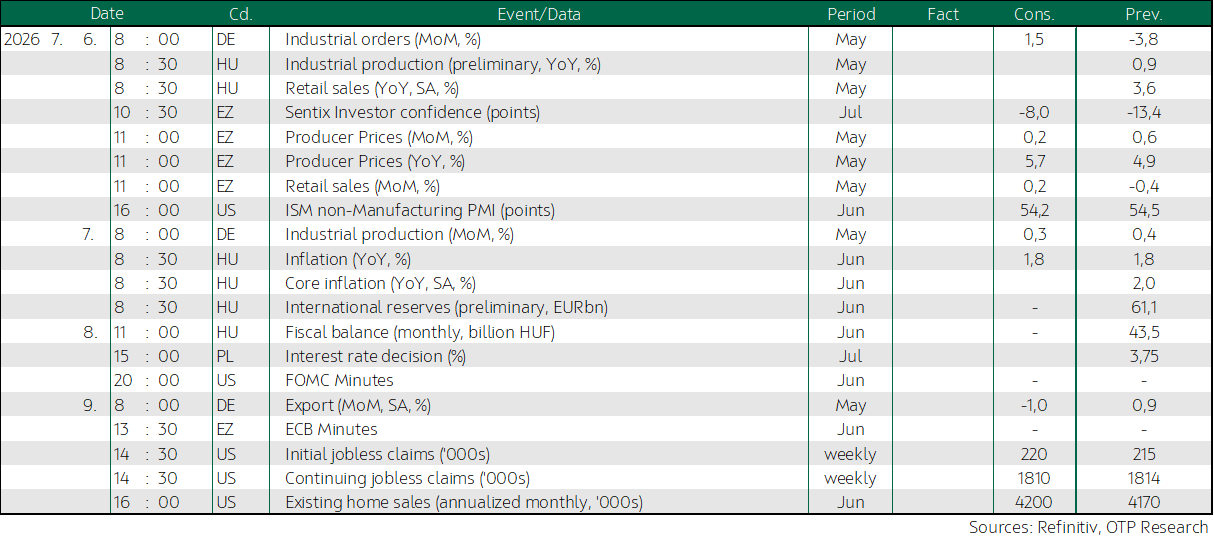
Today, we are watching German industrial orders data, Hungarian industrial production and retail sales figures, as well as the eurozone Sentix investor confidence index, producer price indices, and retail sales data.
In the week ahead, investors will primarily focus on the release of Hungarian June CPI data on Tuesday, while several May activity indicators will also be published. In the US, the ISM Services PMI and the weekly jobless claims figures could influence market sentiment, while the minutes of the latest FOMC meeting will also be closely watched. Eurostat is scheduled to release the eurozone’s May retail sales data.
The Hungarian Debt Management Agency (ÁKK) is holding bond switch auctions today.
Get more out of your investments!
Global Markets Services
OTP Global Markets offers a broad range of services in the field of local and international money and capital markets.
Read morePrivate Banking Services
Personal care and expertise with OTP Private Banking, along with the knowledge, security, and innovations of a multinational banking group.
Read more