
OTP Morning Brief: Euro Area CPI Slowed to 2.8%
Related content
OTP Morning Brief: US producer price index came in above expectations, yet the US 10-year Treasury yield still declined
Western European equities continued to advance despite ongoing pressure on the technology sector. Wall Street indices also rebounded, recovering some ground after Wednesday’s sell-off. Healthcare was the standout performer on both sides of the Atlantic. Eurozone industrial production declined by 0.5% month-on-month in August. In the US, the producer price index accelerated to 6.3%, delivering another upside surprise in inflation developments. US retail sales increased by 0.8% compared to August. The US 10-year Treasury yield declined by more than 10 basis points. The long end of the Hungarian government bond yield curve also declined by 7-9 basis points. In Hungary, August wage data will be released today, while in the US, September industrial production figures are due.
OTP Morning Brief: US CPI data came in above expectations
European equity markets advanced, supported by strong results from ASML and the outstanding performance of the healthcare sector. US equity markets came under pressure following higher-than-expected September CPI data. The annual CPI rate accelerated to 3.7%, driven primarily by a surge in gasoline prices, while core CPI rose by 0.3% month-on-month, supported by higher housing costs and rising transportation service prices. Oil prices rose amid escalating tensions in the Middle East and the impact of the IEA's oil market report. US Treasury yields retreated after an initial increase, driven by Fed commentary, while European bond yields generally moved higher. The US macro calendar will be busy today, with investors focusing on September retail sales and producer price index data, as well as the New York Fed Manufacturing Index, weekly jobless claims, and business inventories. August industrial production data from the euro area will be released today.
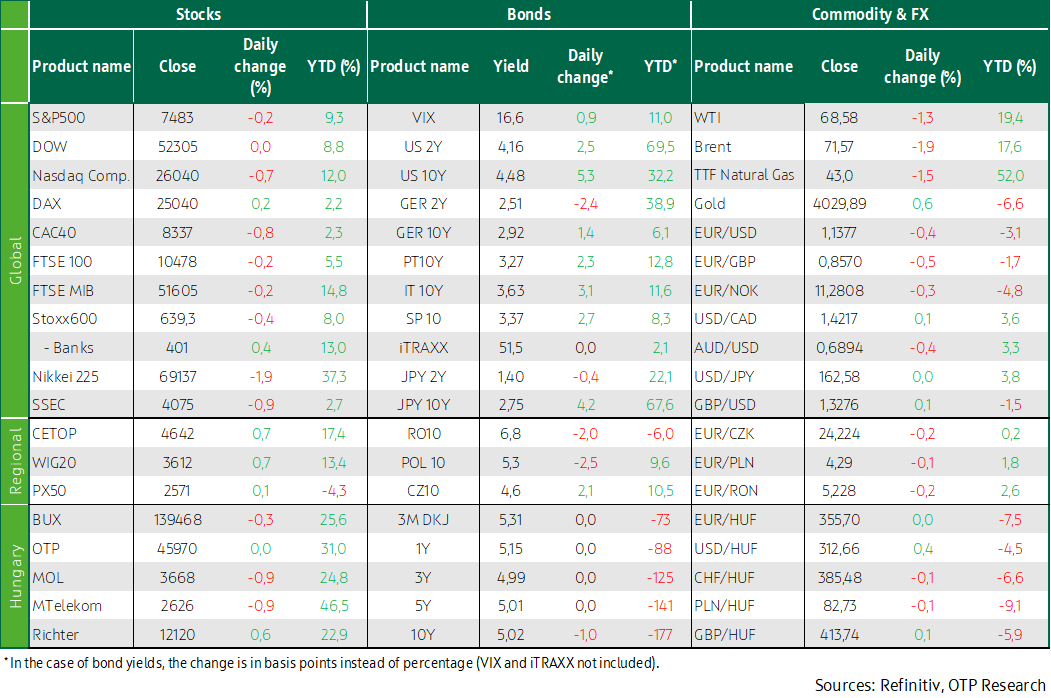
The pan-European STOXX 600 started July with a 0.4% decline. Euro Area CPI Fell to 2.8% in June, Significantly Below Expectations. Core inflation slowed to 2.4%, giving the ECB greater flexibility to remain on hold before considering any further rate hikes. According to data released by the Hungarian Central Statistical Office (KSH), Hungary’s government sector deficit amounted to 9% of GDP in Q1. US equity indices moved lower on Wednesday. Meta delivered an outstanding performance, soaring 8.8%. Fed Chair Kevin Warsh has consistently refrained from providing forward guidance. According to ADP data, US private-sector employment increased by less than expected in June. Official US labor market data will be released today. The upcoming figures, together with Warsh’s remarks, trimmed Wednesday’s increase in the US 10-year yield to 5 basis points.
The pan-European STOXX 600 started July with a 0.4% decline
After a particularly strong second quarter (+10% gain in Q2), the pan-European STOXX 600 started July with a 0.4% decline. While the DAX advanced 0.2%, the CAC 40 fell 0.8% and the FTSE 100 slipped 0.2%. The technology sector index dropped 1.2%, weighed down in part by a 4.6% decline in ASML. Schneider Electric, a manufacturer of equipment linked to artificial intelligence infrastructure, lost 3.1% after agreeing to acquire Cognite Holding. Among individual stocks, Associated British Foods, the owner of Primark, fell 3.2% after warning that annual profit is expected to come in below last year's level. Meanwhile, Swedish defense company Saab rose 3.3% after signing a contract worth approximately $2.54 billion to supply 16 Gripen fighter jets to Ukraine.
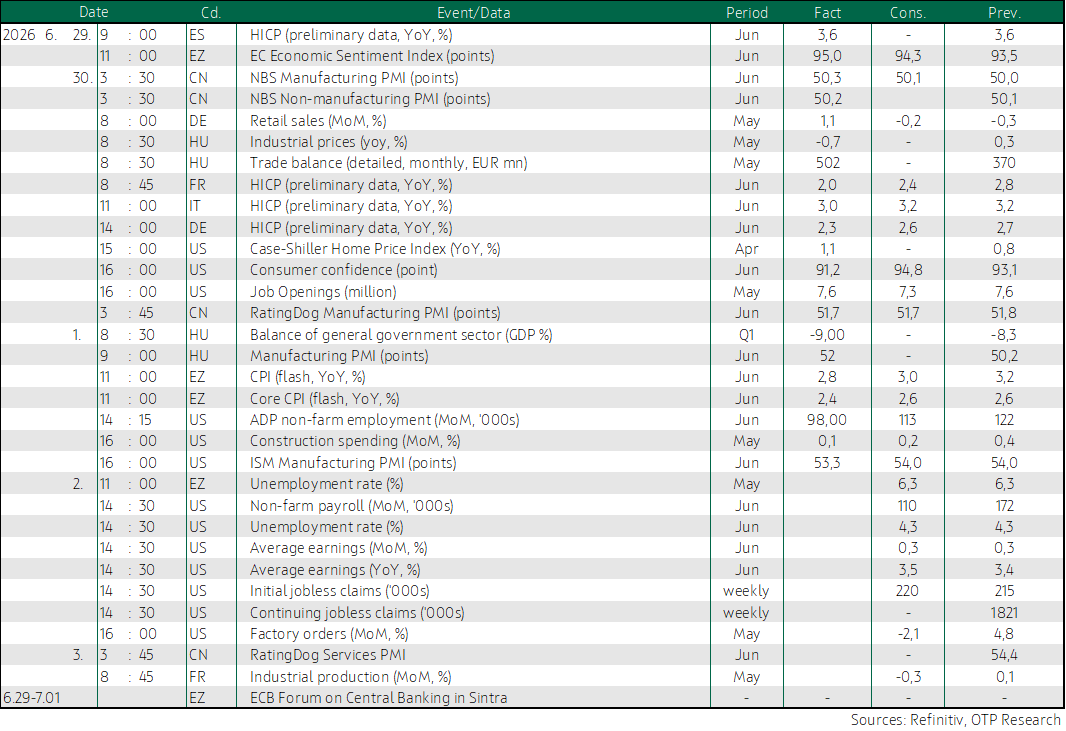
Euro Area CPI slowed significantly more than expected in June. Following the 3.2% reading in May, headline CPI came in at just 2.8% in June, 0.2 percentage points below the consensus forecast. Core inflation eased to 2.4%, while services inflation declined from 3.5% to 3.2%. Against this backdrop – also taking into account expectations surrounding a potential US-Iran agreement and Brent crude prices retreating toward pre-conflict levels – the ECB has gained greater flexibility to remain on hold before considering any further rate hikes. Market pricing continues to imply a September rate increase.
Preliminary data showed that Hungary’s government sector deficit reached 9% of GDP in Q1, exceeding the level recorded in the same period of the previous year by 3.1 percentage points. Meanwhile, the Hungarian manufacturing PMI rose to 51.5 in June, marking its highest reading since December.
Among regional indices, the BUX declined 0.3%. Meanwhile, Poland’s WIG20 rose 0.7%, while the Czech PX50 advanced 0.1%.
US Equity Indices Moved Lower on Wednesday
All three major Wall Street indices ended Wednesday in negative territory. The S&P 500 slipped 0.2%, while the Nasdaq Composite fell 0.7%. The Dow Jones Industrial Average also closed slightly below its Tuesday level. Meta delivered a standout performance, soaring 8.8% after Bloomberg reported that the company is building a cloud-services business aimed at monetizing its excess artificial intelligence computing capacity.
Tesla was able to significantly increase its year-over-year new vehicle registrations in June across several key European markets, including Denmark, Sweden, Spain, and France. This may signal a positive turnaround following a challenging period during which the US automaker’s competitive position in Europe was pressured by a limited model lineup, intense competition from Chinese manufacturers, and Elon Musk’s political activities. In addition to company-specific factors, the broader momentum of the European electric vehicle market – partly supported by higher oil prices in recent months – is also providing a tailwind for Tesla’s sales.
Fed Chair Kevin Warsh, speaking at the ECB’s annual policy forum in Sintra, remained consistent in refraining from providing forward guidance on the future path of monetary policy. At the same time, he reaffirmed his commitment to the 2% inflation target and the principle of central bank independence.
Ahead of today’s official release, ADP’s June employment report showed that US private-sector employment increased by less than expected (+98,000 vs. +113,000 consensus). On the other hand, a significant decline in the number of layoffs suggests that the labor market remains resilient. Meanwhile, the ISM Manufacturing PMI indicated that activity in the US manufacturing sector slowed in June but continued to remain on stable footing.
On Tuesday and Wednesday, the US and Iran held indirect, technical-level talks in Doha based on the earlier 14-point ceasefire agreement. The agenda reportedly included the issue of the Strait of Hormuz, over which Iran remains determined to gain internationally recognized oversight rights and, in the future, collect transit fees from vessels passing through the waterway.
US and German 10-Year Yields Moved Higher
On Wednesday, the US 10-year Treasury yield briefly rose above 4.5%, but comments from Kevin Warsh in Sintra, along with weaker-than-expected ADP employment data and slowing manufacturing activity, helped curb the increase. As a result, the benchmark yield closed at 4.48%, up 5.3 basis points on the day. Meanwhile, the yield on the German 10-year government bond rose by 1.4 basis points to 2.92%. In contrast, the German 2-year government bond yield, which is particularly sensitive to ECB rate expectations, declined following the lower-than-expected Euro Area CPI reading. The US dollar strengthened 0.4% against the euro, with EUR/USD falling to 1.138.
Hungarian government bond yields showed only minimal movement on Wednesday, limited to maturities longer than five years. The 10-year yield stood at 5.02%. The forint weakened marginally against the euro to 355.7. At the auction of 6-month discount Treasury bills (DKJ), where the Government Debt Management Agency (ÁKK) offered HUF 30 billion, it accepted HUF 24 billion in bids at an average yield of 5.32%. Today, the ÁKK is scheduled to auction 15-year and 10-year forint-denominated government bonds, as well as one-year discount Treasury bills, in amounts of HUF 20 billion, HUF 25 billion, and HUF 30 billion, respectively.
Today's highlights
Approaching the close, both the Japanese and South Korean equity markets were trading sharply lower amid selling pressure on chipmakers. The Nikkei was down 1.9%, while the KOSPI declined 4.7%. Meanwhile, China’s SSEC was trading 0.9% lower, whereas Hong Kong’s Hang Seng advanced 1.2%.
Today, investors’ attention will be focused primarily on labor market data, particularly in the US, where the June employment report is regarded as the key event of the week. In the euro area, the unemployment rate is scheduled for release in the morning. In the afternoon, a series of US indicators will be published, including nonfarm payrolls (NFP), the unemployment rate, and average hourly earnings, all of which will be closely watched for assessing the future path of Fed policy, especially given the inflation implications of wage dynamics. In addition, weekly jobless claims will provide a timely snapshot of short-term labor market trends, while factory orders, due later in the day, may offer further insight into the direction of business demand and investment activity.
Get more out of your investments!
Global Markets Services
OTP Global Markets offers a broad range of services in the field of local and international money and capital markets.
Read morePrivate Banking Services
Personal care and expertise with OTP Private Banking, along with the knowledge, security, and innovations of a multinational banking group.
Read more