
OTP Morning Brief: Stronger-than-expected US labor market data, and softer eurozone CPI figures, were released on Tuesday
Related content
OTP Morning Brief: US producer price index came in above expectations, yet the US 10-year Treasury yield still declined
Western European equities continued to advance despite ongoing pressure on the technology sector. Wall Street indices also rebounded, recovering some ground after Wednesday’s sell-off. Healthcare was the standout performer on both sides of the Atlantic. Eurozone industrial production declined by 0.5% month-on-month in August. In the US, the producer price index accelerated to 6.3%, delivering another upside surprise in inflation developments. US retail sales increased by 0.8% compared to August. The US 10-year Treasury yield declined by more than 10 basis points. The long end of the Hungarian government bond yield curve also declined by 7-9 basis points. In Hungary, August wage data will be released today, while in the US, September industrial production figures are due.
OTP Morning Brief: US CPI data came in above expectations
European equity markets advanced, supported by strong results from ASML and the outstanding performance of the healthcare sector. US equity markets came under pressure following higher-than-expected September CPI data. The annual CPI rate accelerated to 3.7%, driven primarily by a surge in gasoline prices, while core CPI rose by 0.3% month-on-month, supported by higher housing costs and rising transportation service prices. Oil prices rose amid escalating tensions in the Middle East and the impact of the IEA's oil market report. US Treasury yields retreated after an initial increase, driven by Fed commentary, while European bond yields generally moved higher. The US macro calendar will be busy today, with investors focusing on September retail sales and producer price index data, as well as the New York Fed Manufacturing Index, weekly jobless claims, and business inventories. August industrial production data from the euro area will be released today.
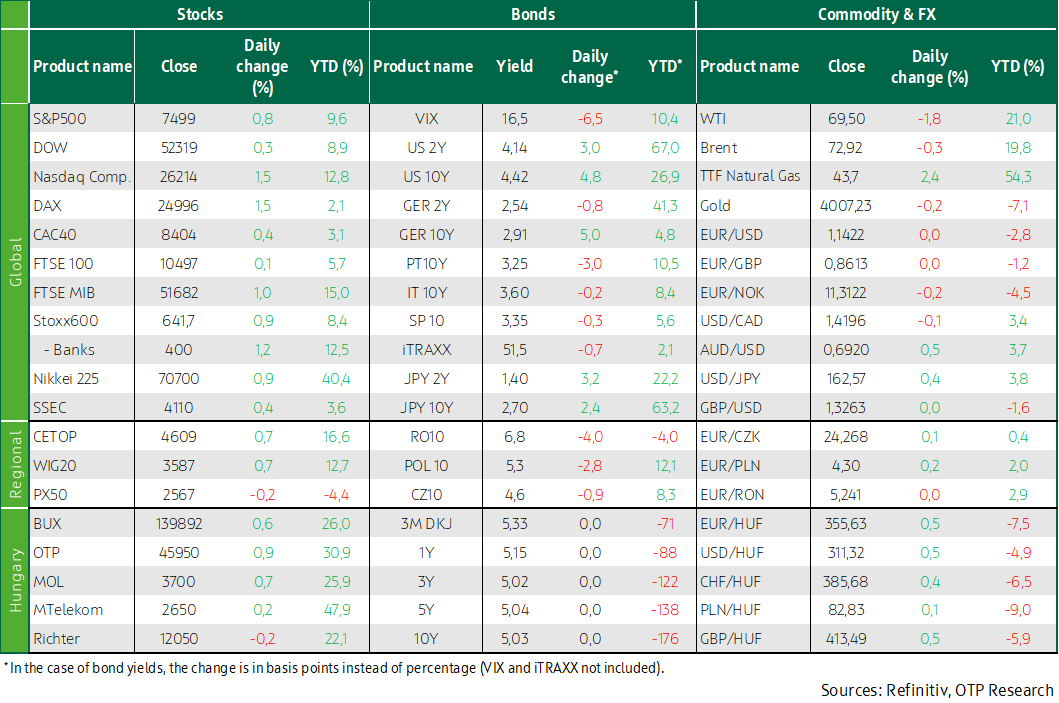
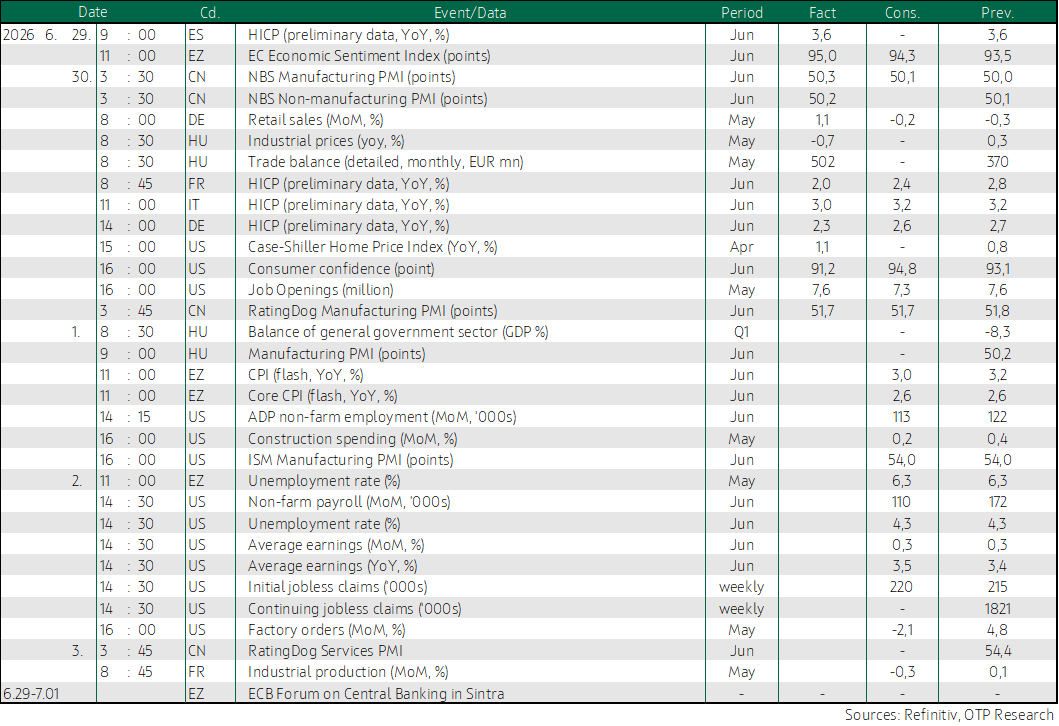
Sentiment was optimistic across developed equity markets on Tuesday, although no progress was made in US–Iran peace negotiations. Developed stock markets closed the second quarter with substantial gains despite the Middle East conflict and its repercussions, primarily driven by the technology sector’s soaring performance. Strong job openings data were released in the USA, while in the eurozone, favorable large country HICP figures supported sentiment ahead of today’s aggregate inflation reading. Both the US and German 10-year yields rose, while EUR/USD remained stable at 1.14. The Hungarian 10-year benchmark yield remained at 5.01%, while EUR/HUF edged up to 355.6. Today, we are also watching Hungarian Q1 fiscal data, the US ADP employment report, and the ISM manufacturing index.
European markets posted modest gains on Tuesday, capping a strong second quarter despite the Middle East conflict
European equity markets opened Tuesday’s trading session higher, with the STOXX 600 rising 0.9% and reaching a new all-time high during the day. The index has now posted gains for a third consecutive month, delivering a 10% quarterly increase—its strongest performance since October 2020. The advance was primarily driven by optimism around AI, as well as easing tensions in the Middle East. The FTSE 100 edged up 0.1% on Tuesday, while the DAX closed 1.5% higher. On a monthly basis, the London benchmark gained 0.8%, whereas the German index slipped 0.4%; however, the second quarter brought gains of 3% and nearly 8%, respectively.
At the sector level, technology stocks clearly dominated Tuesday’s trading, with the sector rising 2.5% on the day and delivering a standout quarterly performance, potentially marking its strongest quarter since 2001. The market narrative continues to be driven by demand for AI infrastructure, particularly relevant in the semiconductor segment. Europe’s leading semiconductor company, the Netherlands-based ASML, surged 6.8%. In addition, Siemens Energy jumped nearly 5.6% after confirming it continues to see robust demand for AI-related energy infrastructure, highlighting an important trend: the AI boom is benefiting not only chipmakers but also energy companies.
Easing Middle East tensions supported a positive shift in market direction. Oil prices returned to pre-conflict levels, providing a boost particularly to cyclical sectors such as tourism. The sector staged a meaningful rebound and is now showing nearly a 20% increase on a quarterly basis, after coming under significant pressure in recent weeks due to energy market uncertainty.
Among regional indices, the BUX rose 0.6%, the WIG 20 gained 0.7%, while the PX50 declined by 0.2%. Among Hungarian blue chips, OTP posted the strongest performance, closing the trading day up 0.9%.
Yesterday, the latest June CPI data were released in the eurozone: the German figure came in weaker than expected, with price growth declining by 0.2% month-on-month, while Italian and French readings also indicated deceleration. From a macroeconomic and monetary policy perspective, attention is focused on the European Central Bank’s annual conference, where investors are closely watching the tone of central bank communication. The market currently prices in one additional 25-basis-point tightening by year-end, while policymakers continue to emphasize a cautious, data-driven approach. As such, the event may provide short-term guidance for yield dynamics and the direction of European asset prices.
The Dow closed at a new high, as investors remained optimistic about peace negotiations, while favorable labor market data were released
US equity indices continued to rise on Tuesday, with the Dow up 0.3%, the S&P gaining 0.8%, and the Nasdaq Composite climbing 1.5%. This marked the second consecutive day of record highs for the Dow, while the S&P and Nasdaq delivered their strongest quarterly performance since 2020 in the second quarter that ended yesterday. The Dow jumped 13%, the S&P advanced 14%, and the Nasdaq Composite appreciated by more than 20%. As for June, recent weakness in the technology sector weighed on monthly performance, leaving the S&P and Nasdaq down 1% and 3%, respectively.
Confidence in US–Iran peace negotiations remains intact in equity markets, although recent news has been dominated more by renewed attacks. Looking ahead, investors are already preparing for the upcoming second-quarter earnings season.
However, Tuesday’s trading session was relatively uneventful, with turnover coming in 15% below the average recorded over the past 20 trading days. On the corporate front, Nike’s quarterly earnings report drew attention: for its fiscal fourth quarter ending May 31, the sportswear company delivered stronger-than-expected revenue and profit, yet the stock declined by 1%. Technology once again led the gains during the session, with mega-cap names outperforming: Nvidia and Apple rose by nearly 3%, while Alphabet and Amazon advanced by more than 1%. Among semiconductor stocks, AMD surged nearly 8%, Marvell Technology climbed over 7%, and Intel rallied 6%, while Texas Instruments gained more than 4%. Competitor Broadcom and the smaller Analog Devices both increased by 1.4%, Micron edged up 0.78%, while Qualcomm declined by 2%. The Philadelphia Semiconductor Index jumped 3.9% yesterday. At the same time, several S&P sector indices closed with notable losses, led by real estate, utilities, and consumer staples. The JOLTS job openings data continue to reflect the strength of the US labor market: the number of vacancies rose by 9 thousand to 7.594 million in May 2026, the highest level since May 2024, and well above market expectations of 7.3 million, highlighting the resilience of the labor market despite rising energy costs linked to the Iran conflict.
Crude oil prices moved lower this time, with Brent slipping below USD 73 per barrel and WTI falling under USD 70 on Tuesday. Negotiating parties are gathered in Doha in an effort to advance a lasting peace in the Gulf, although the Iranian side has so far indicated it is not willing to come to the negotiating table. Meanwhile, traffic through the Strait of Hormuz continues to recover after both sides halted the latest exchange of fire in the area. On a quarterly basis, WTI plunged 31% and Brent dropped 38%, while the decline in June reached 20–21%.
Long-term yields increased in both the US and the eurozone, supported by strong labor market data in the US and favorable member-state CPI releases in the eurozone
Yields rose across developed bond markets by the end of Tuesday, as JOLTS data showed that job openings in the US reached their highest level in two years, significantly exceeding market expectations and aligning with the sharp increase in employment observed in recent periods. The data reinforced assessments of the resilience of the US labor market ahead of Thursday’s upcoming employment report. The US 10-year yield edged up by 5 basis points to 4.42%, while the German 10-year yield also rose by 5 basis points to above 2.9%. In the eurozone, key member-state CPI releases indicated a slowdown in year-on-year inflation in France, Italy, and Germany. The German 2-year yield declined slightly, while EUR/USD remained stable near its yearly low at 1.14.
On the Hungarian government bond market, yields changed only marginally on Tuesday based on early afternoon pricing: in the middle segment of the curve, yields declined by 3 basis points at the 3- and 5-year maturities, while the 10-year yield remained stable at 5.01%. At yesterday’s 3-month T-bill auction, demand came in slightly below the announced HUF 30 billion target, resulting in a final issuance of HUF 20 billion. The forint weakened modestly, with EUR/HUF moving above 355.6 by the close.
Today's highlights
Asian equity markets showed a mixed tone, with Japanese indices posting modest gains ahead of Wednesday’s close, while sentiment in China remained positive, with the Shanghai Composite up more than 1% and the CSI 300 rising more moderately. In contrast, Hong Kong and South Korea traded lower, as the Hang Seng slipped by 0.6%, while leading Korean indices declined by 1–2%.
Futures equity indices are in the red this morning across major US and European benchmarks as well.
Today, eurozone CPI data will be released in Europe, which may have fallen below 3% in June based on the member-state figures published yesterday. On the Hungarian side, Q1 general government data may attract attention, while the Hungarian PMI will also be released. In the US, the ADP non-farm employment report, construction spending data, and the ISM manufacturing index will be in focus.
Today, the Government Debt Management Agency will hold a 6-month T-bill auction, along with a bond switch auction for securities maturing in 2026/27.
Get more out of your investments!
Global Markets Services
OTP Global Markets offers a broad range of services in the field of local and international money and capital markets.
Read morePrivate Banking Services
Personal care and expertise with OTP Private Banking, along with the knowledge, security, and innovations of a multinational banking group.
Read more