
OTP Morning Brief: US indices rose as the weekend fighting eased
Related content
OTP Morning Brief: US producer price index came in above expectations, yet the US 10-year Treasury yield still declined
Western European equities continued to advance despite ongoing pressure on the technology sector. Wall Street indices also rebounded, recovering some ground after Wednesday’s sell-off. Healthcare was the standout performer on both sides of the Atlantic. Eurozone industrial production declined by 0.5% month-on-month in August. In the US, the producer price index accelerated to 6.3%, delivering another upside surprise in inflation developments. US retail sales increased by 0.8% compared to August. The US 10-year Treasury yield declined by more than 10 basis points. The long end of the Hungarian government bond yield curve also declined by 7-9 basis points. In Hungary, August wage data will be released today, while in the US, September industrial production figures are due.
OTP Morning Brief: US CPI data came in above expectations
European equity markets advanced, supported by strong results from ASML and the outstanding performance of the healthcare sector. US equity markets came under pressure following higher-than-expected September CPI data. The annual CPI rate accelerated to 3.7%, driven primarily by a surge in gasoline prices, while core CPI rose by 0.3% month-on-month, supported by higher housing costs and rising transportation service prices. Oil prices rose amid escalating tensions in the Middle East and the impact of the IEA's oil market report. US Treasury yields retreated after an initial increase, driven by Fed commentary, while European bond yields generally moved higher. The US macro calendar will be busy today, with investors focusing on September retail sales and producer price index data, as well as the New York Fed Manufacturing Index, weekly jobless claims, and business inventories. August industrial production data from the euro area will be released today.
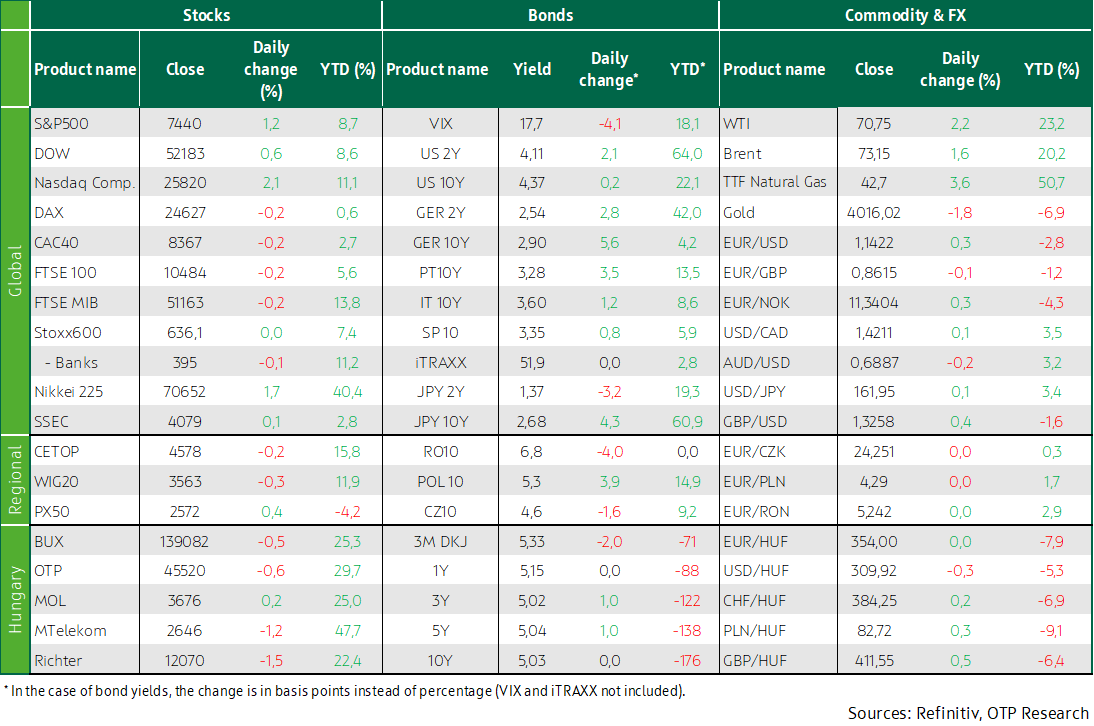
The outcome of this week’s US–Iran talks remains uncertain, with both delegations having travelled to the Qatari capital. European markets were flat, while the BUX fell by half a percent. Economic sentiment in the eurozone improved again in June. US investors reacted positively to the easing weekend clashes, leading markets to rise. Bond yields rose in both Europe and the US. Brent rose towards $73. China’s purchasing managers’ index improved, while the Japanese yen weakened.
European equity markets were flat on the first day of the week, while economic sentiment in the eurozone improved
European equity markets remained stable on Monday as investors weighed the durability of the temporary ceasefire in the Middle East, following an agreement between the US and Iran to halt the latest hostilities, with the pan-European STOXX 600 index little changed on the first trading day of the week, while major national benchmarks including the DAX, CAC 40 and FTSE 100 each slipped by 0.2%, and among sectors technology stocks led gains, climbing 1.4% after last week’s sell-off when they recorded their biggest weekly decline since mid-March, while within chipmakers Soitec advanced 7.2% and STMicroelectronics gained 3.6%, and Nagarro’s share price skyrocketed by 91% after India’s Persistent made an €81-per-share offer to acquire the AI-driven digital engineering firm, with Europe’s exposure to AI-related equities remaining significantly lower than in the US and Asia where the tech rally had already lifted regional indices to record highs weeks earlier, and among individual movers British American Tobacco also stood out, announcing plans to cut 5,500 jobs globally as part of its AI-led transformation programme, after which its shares edged down 1.0%.
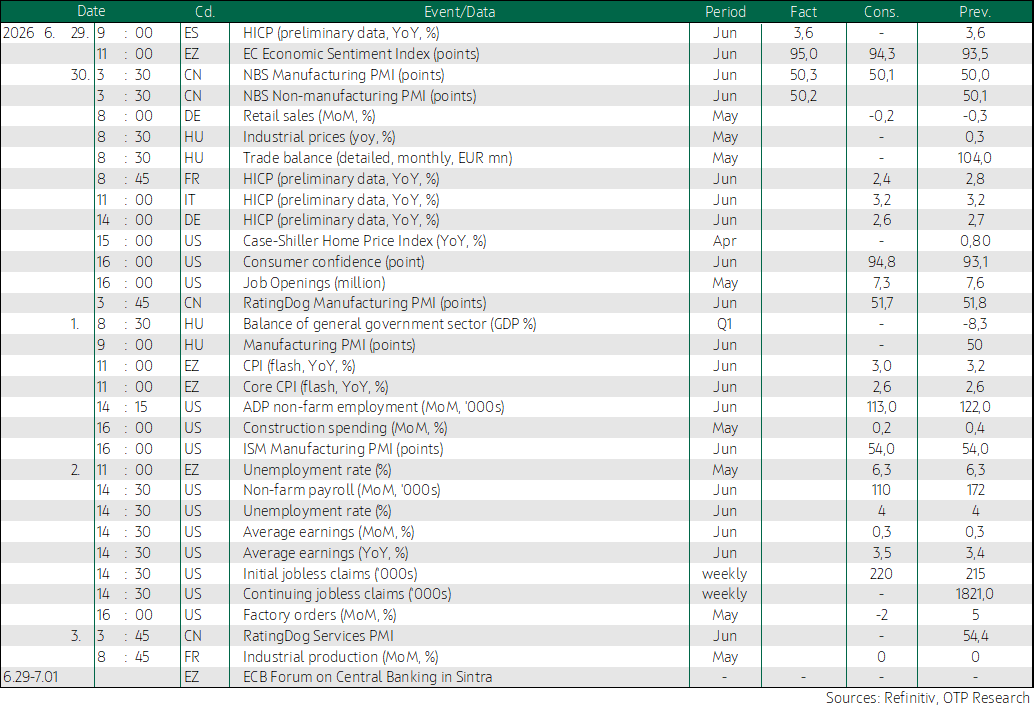
The eurozone’s Economic Sentiment Indicator (ESI) rose for a second consecutive month in June 2026, increasing to 95.0, moving further away from April’s five-year low and exceeding market expectations of 94.3, as companies and consumers continued to assess the economic impact of the Iran conflict amid ongoing peace talks between the US and Iran, while confidence showed a mixed picture across sectors, with slight improvement in retail, consumer sentiment and manufacturing, whereas construction confidence deteriorated and consumer inflation expectations declined, and among the eurozone’s major economies the ESI increased markedly in the Netherlands, Germany and Italy, while Spain recorded a more moderate rise.
The CEE region showed a mixed picture, with the PX50 rising by 0.4%, while the WIG 20 slipped by 0.3% and the BUX declined by 0.5%, as the Hungarian index was dragged lower by most blue chips, with the exception of MOL, which rose by 0.2%.
Although the outcome of this week’s US–Iran talks remains uncertain, US investors were optimistic
US equities closed with a sharp rise on Monday, with the Nasdaq jumping 2.1%, the S&P 500 gaining 1.2%, and the Dow adding 0.6% to reach a record closing high, as weekend US–Iran tensions eased and major technology stocks strengthened following the earlier sell-off, while Iranian and US negotiating delegations were expected to meet in Doha this week, although Iran stated that no meeting had been scheduled after missile strikes by both sides over the weekend tested the temporary ceasefire aimed at ending the four-month conflict, with the attacks also reducing traffic through the Strait of Hormuz, yet despite negative headlines negotiators from both sides travelled to the Qatari capital, and among S&P sectors communication services led gains, supported by Comcast, whose shares skyrocketed by 4.5% after the media and cable company announced plans to split into two separately listed entities, NBCUniversal and Sky, while Alphabet closed 4.8% higher as it began its first trading day as a Dow component, and the IT sector, which had been at the centre of growing investor scepticism in recent weeks, also advanced by 1.7%, while SpaceX shares rose 7.2% after Nasdaq announced that the newly listed company will be added to the Nasdaq 100 index on July 7.
Brent crude rose above $73 per barrel on Monday, modestly rebounding from a four-month low, as reduced shipping traffic through the Strait of Hormuz offset broader market optimism, and although commercial vessels continued to pass through the strategic waterway following the temporary pause in hostilities, the overall number of crossings declined after weekend attacks significantly undermined corporate confidence.
Mild yield increases and signs of central bank independence across global bond markets
US Treasury yields rose slightly on Monday as oil prices increased following the weekend US–Iran strikes, with the benchmark 10-year yield edging up by 0.6 basis points to 4.378% after declining for three consecutive weeks, while the two-year yield, which typically tracks Fed rate expectations, climbed 2.5 basis points to 4.113%, heading for its first daily rise after four straight declines, and in a 5–4 ruling the US Supreme Court blocked Donald Trump from removing Fed Governor Lisa Cook, reinforcing central bank independence, and although in a separate decision it expanded presidential powers to dismiss leaders of certain government institutions, it upheld the principle that Fed officials can only be removed for cause.
Eurozone bond yields also rose slightly on Monday, but remained close to their lowest levels since early March, with the German 10-year yield increasing by 1 basis point to 2.86%, after the bloc’s benchmark yield fell to 2.83% last Friday, marking its lowest level since March 10, while domestic yields were largely unchanged, alongside the forint, which also traded near flat on the day, similar to the Polish zloty and the Czech koruna.
Today's highlights
Asian markets followed the rise seen on Wall Street, with the Nikkei and Kospi each gaining 1.7%, while the SSEC edged up by 0.1%, and the yen weakened on Tuesday to levels not seen since 1986, raising concerns that Tokyo could be approaching direct market intervention, as the currency fell to 162.41 against the dollar for the first time in 40 years and was last trading at 162.23, while Japan’s Finance Minister Shunichi Katayama reiterated that authorities stand ready to take appropriate action at any time, though without adopting stronger rhetoric, and meanwhile the dollar pulled back from near 13-month highs ahead of employment data that could influence US rate expectations.
China’s manufacturing activity returned to expansion territory in June, driven by demand for chips, computers and other AI-related products, as robust export orders and front-loaded shipments to the US aimed at avoiding tariffs offset weakness in other parts of the economy, with the official manufacturing Purchasing Managers’ Index (PMI) rising to 50.3 from 50.0 in May, exceeding the Reuters median forecast of 50, while the non-manufacturing PMI improved to 50.2 from 50.1.
Today in Europe, attention will be on German retail sales data for May, as well as June CPI releases from major economies, while domestic data will include industrial producer prices and retail figures, and in the US, sentiment indices and job openings are expected.
Get more out of your investments!
Global Markets Services
OTP Global Markets offers a broad range of services in the field of local and international money and capital markets.
Read morePrivate Banking Services
Personal care and expertise with OTP Private Banking, along with the knowledge, security, and innovations of a multinational banking group.
Read more