
OTP Morning Brief: Oil prices continued to decline last week as well
Related content
OTP Morning Brief: US producer price index came in above expectations, yet the US 10-year Treasury yield still declined
Western European equities continued to advance despite ongoing pressure on the technology sector. Wall Street indices also rebounded, recovering some ground after Wednesday’s sell-off. Healthcare was the standout performer on both sides of the Atlantic. Eurozone industrial production declined by 0.5% month-on-month in August. In the US, the producer price index accelerated to 6.3%, delivering another upside surprise in inflation developments. US retail sales increased by 0.8% compared to August. The US 10-year Treasury yield declined by more than 10 basis points. The long end of the Hungarian government bond yield curve also declined by 7-9 basis points. In Hungary, August wage data will be released today, while in the US, September industrial production figures are due.
OTP Morning Brief: US CPI data came in above expectations
European equity markets advanced, supported by strong results from ASML and the outstanding performance of the healthcare sector. US equity markets came under pressure following higher-than-expected September CPI data. The annual CPI rate accelerated to 3.7%, driven primarily by a surge in gasoline prices, while core CPI rose by 0.3% month-on-month, supported by higher housing costs and rising transportation service prices. Oil prices rose amid escalating tensions in the Middle East and the impact of the IEA's oil market report. US Treasury yields retreated after an initial increase, driven by Fed commentary, while European bond yields generally moved higher. The US macro calendar will be busy today, with investors focusing on September retail sales and producer price index data, as well as the New York Fed Manufacturing Index, weekly jobless claims, and business inventories. August industrial production data from the euro area will be released today.
Oil prices continued to fall, supported by US–Iran peace talks, easing CPI concerns and expectations of rate hikes; the US core PCE came in line with expectations on Friday; over the weekend, tensions between the US and Iran escalated again. US equity markets delivered mixed performance during the week; on Friday, chipmakers came under pressure following media reports that OpenAI may delay its IPO. Following the weekend flare-up of the US–Iran conflict, traffic through the Strait of Hormuz had been restored by Sunday. Long-dated bond yields gradually declined over the week, with the 10-year Bund yield falling to a three-month low; the EUR/USD rate fell by 0.7% week-on-week to below 1.14. This week, attention will be on US labor market data and CPI releases from Western Europe.
Oil prices continued to decline last week, supported by US–Iran peace talks, which eased CPI concerns and expectations of rate hikes; the US core PCE came in line with expectations on Friday; over the weekend, the US–Iran conflict escalated again
Market sentiment was broadly optimistic last week, largely supported by progress in US–Iran negotiations, with shipments through the Strait of Hormuz accelerating and traffic rising markedly, allowing export volumes from the Persian Gulf to recover to around 75% of pre-war levels; as a result, a significant correction unfolded in oil markets, with crude prices falling by approximately 9–10% on a weekly basis, while the temporary peace agreement and a new 60-day US waiver permitting the global purchase of Iranian oil further eased price pressures, leading Brent to return to pre-conflict levels by Friday; in parallel, European gas prices also declined, with the one-month forward contract dropping below EUR 41/MWh by Friday, although it remained around 20% above pre-conflict levels, while precious metals and several industrial metals edged lower week-on-week due to the downward pressure from a stronger dollar; however, tensions between the US and Iran escalated again on Friday evening after the US carried out airstrikes on Iranian missile and drone storage facilities as well as coastal radar stations, a move justified by claims that Iran had violated the previously agreed 60-day ceasefire, including launching drone attacks on vessels passing through the Strait of Hormuz, prompting Iran to target US-linked assets in the region while Bahrain condemned an Iranian drone strike on Saturday, with Iran citing violations of the southern Lebanon ceasefire, and British reports indicating that a tanker was hit by an unidentified strike in the Strait of Hormuz on Saturday, with tensions intensifying despite an earlier memorandum of understanding aimed at preparing a comprehensive peace agreement, before the US and Iran reached an agreement by Sunday to suspend hostilities and allow commercial vessels to pass freely through the Strait of Hormuz.
The decline in energy prices also contributed to easing CPI concerns, leading to reduced expectations of rate hikes; in the euro area, market participants priced in a single 25 basis point ECB increase by year-end, while the likelihood of an additional move remained low, with ECB communication presenting a mixed picture as Christine Lagarde argued for a more cautious approach, whereas Isabel Schnabel considered further tightening justified due to still elevated energy prices.
In the US, the core PCE, the key macro release of the week, broadly met expectations, rising by 0.32% month-on-month in May (3.8% annualized) and reaching 3.4% year-on-year, while services CPI showed broad-based acceleration, suggesting that the disinflation process may be slower than previously anticipated; despite inflation remaining above the Fed’s 2% target, markets priced in a 25 basis point rate hike for September, while no further tightening was expected next year.
US equity markets delivered mixed performance during the week; on Friday, chipmakers came under pressure following media reports that OpenAI may delay its IPO
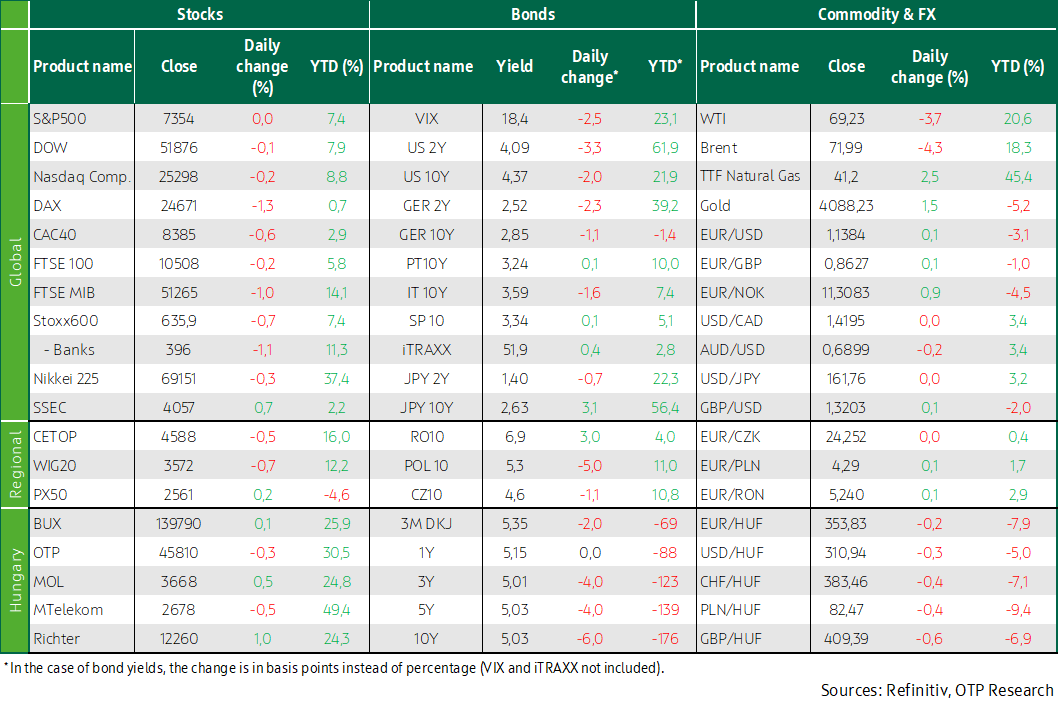
Rotation from technology stocks into defensive sectors continued on Friday in US equity markets, with the Nasdaq Composite declining for the fifth consecutive session while the S&P 500 remained broadly flat; on a weekly basis, the S&P 500 lost nearly 2% and the Nasdaq fell 4.6%, whereas the Dow outperformed with a 0.6% gain, as weakness in the technology sector was driven by multiple factors, with chipmakers facing particular pressure following media reports that OpenAI may delay its planned IPO until next year due in part to volatility in the AI sector and weaker market performance among related companies, amplifying concerns that the pace of investment in AI infrastructure may slow, leading semiconductor stocks lower, with Micron dropping more than 6%, AMD falling 2%, and Intel recording a decline of over 3%, while at the sector level the S&P 500 information technology index moved around 1% lower as investors shifted toward defensive segments, with the healthcare sector delivering strong performance as Eli Lilly shares rose 7.1%, Johnson and Johnson gained 4%, and AbbVie advanced by more than 4%, alongside gains in consumer staples, financials, and utilities.
In Europe, the Stoxx Europe 600 index was broadly flat, while among industrial companies Rheinmetall delivered notably weak performance, with its share price declining significantly following the cancellation of a major German naval project.
Regional markets closed mixed on Friday, with the Budapest and Prague indices posting modest gains, while the Polish market declined; among domestic blue chips, OTP and MTelekom shares fell, whereas Mol and Richter advanced, while Hungary’s current account recorded a surplus of EUR 0.25 billion in Q1 2026, below the market expectation of EUR 0.4 billion and significantly lower than the EUR 1.18 billion surplus a year earlier, marking the smallest surplus since Q1 2021, mainly due to a deterioration in the goods balance, which shifted to a deficit of EUR 0.47 billion from a surplus of EUR 0.82 billion the previous year, while the services balance improved slightly, with its surplus rising to EUR 2.17 billion from EUR 2.1 billion, as the primary income deficit narrowed to EUR 0.97 billion and the secondary income deficit decreased to EUR 0.47 billion compared to the previous year.
Long-dated bond yields gradually declined during the week, with the 10-year Bund yield falling to a three-month low; the EUR/USD rate declined by 0.7% week-on-week to below 1.14
A decline in yields was observed in US bond markets on Friday, particularly at the short end, after Minneapolis Fed President Neel Kashkari indicated that instead of a rate cut in March he now sees a rate hike this year likely in June, justified by persistent uncertainty related to the Iran situation and tariffs as well as an investment boom driven by the AI revolution; Kashkari’s comments came one week after the Fed left its policy rate unchanged, emphasizing that due to deteriorating CPI prospects a rate hike by year-end is now considered more appropriate than previously expected cuts, although decisions remain data dependent, while despite the statement bond prices were supported by declining energy prices which reduced expectations of future inflationary pressure, with the 2 year US Treasury yield falling by more than 3 basis points to around 4.09% while the 10 year benchmark yield declined by 2 basis points to 4.37%.
During the week, yields gradually declined, with the US 10 year yield falling by 8 basis points while the German Bund yield dropped even more sharply by 14 basis points to 2.85%, reaching a three month low; in the foreign exchange market, the dollar strengthened in the first half of the week on the back of rate hike expectations, pushing the EUR/USD rate temporarily below 1.134, however after the release of PCE data the momentum of the greenback faded and the pair closed below 1.14 by the end of the week.
Today's highlights
Asian equity markets were mostly slightly higher this morning following mixed developments related to Iran over the weekend.
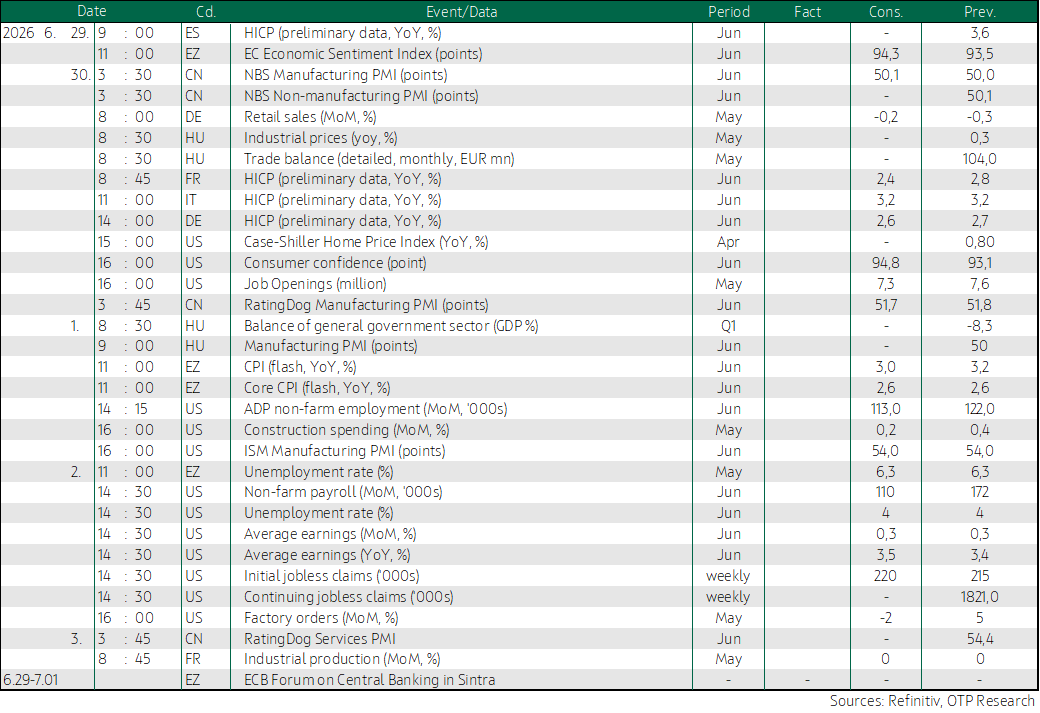
Next week, attention will focus on US labor market data, which will be released earlier than usual on Thursday due to the July 4 Independence Day holiday; the key question is whether the momentum of job growth will be sustained after employment gains remained strong in recent months and the unemployment rate stabilized at a low level of 4.3%, while although wage dynamics have moderated somewhat they remain relatively strong, pointing to persistent CPI risks, all of which is highly relevant for Fed monetary policy as the resilience of the labor market allows the central bank to focus on price stability, meaning that rate cuts are not justified in the near term, and based on market pricing the possibility of a 25 basis point rate hike in September may remain on the agenda.
In the euro area, CPI data will be in focus, as the latest forecasts suggest that inflation may have peaked in May at 3.2% and could have eased slightly to around 3.1% in June due to declining fuel prices, while core CPI is expected to have stabilized at 2.6%, indicating that the ECB may have effectively reached its short term objective with the June rate hike, and the economic environment, characterized by subdued growth prospects of around 1% and a moderate inflation gap, does not justify further significant monetary tightening, while markets still price in a year end rate hike its role may be more of a fine tuning measure, and ahead of the euro area CPI release on Wednesday, inflation data from Germany, France, Italy, and Spain earlier in the week may provide important guidance on the final reading.
Get more out of your investments!
Global Markets Services
OTP Global Markets offers a broad range of services in the field of local and international money and capital markets.
Read morePrivate Banking Services
Personal care and expertise with OTP Private Banking, along with the knowledge, security, and innovations of a multinational banking group.
Read more