
OTP Morning Brief: In Western Europe, the leading indices rose, while in the US they closed on a mixed note
Related content
OTP Morning Brief: US producer price index came in above expectations, yet the US 10-year Treasury yield still declined
Western European equities continued to advance despite ongoing pressure on the technology sector. Wall Street indices also rebounded, recovering some ground after Wednesday’s sell-off. Healthcare was the standout performer on both sides of the Atlantic. Eurozone industrial production declined by 0.5% month-on-month in August. In the US, the producer price index accelerated to 6.3%, delivering another upside surprise in inflation developments. US retail sales increased by 0.8% compared to August. The US 10-year Treasury yield declined by more than 10 basis points. The long end of the Hungarian government bond yield curve also declined by 7-9 basis points. In Hungary, August wage data will be released today, while in the US, September industrial production figures are due.
OTP Morning Brief: US CPI data came in above expectations
European equity markets advanced, supported by strong results from ASML and the outstanding performance of the healthcare sector. US equity markets came under pressure following higher-than-expected September CPI data. The annual CPI rate accelerated to 3.7%, driven primarily by a surge in gasoline prices, while core CPI rose by 0.3% month-on-month, supported by higher housing costs and rising transportation service prices. Oil prices rose amid escalating tensions in the Middle East and the impact of the IEA's oil market report. US Treasury yields retreated after an initial increase, driven by Fed commentary, while European bond yields generally moved higher. The US macro calendar will be busy today, with investors focusing on September retail sales and producer price index data, as well as the New York Fed Manufacturing Index, weekly jobless claims, and business inventories. August industrial production data from the euro area will be released today.
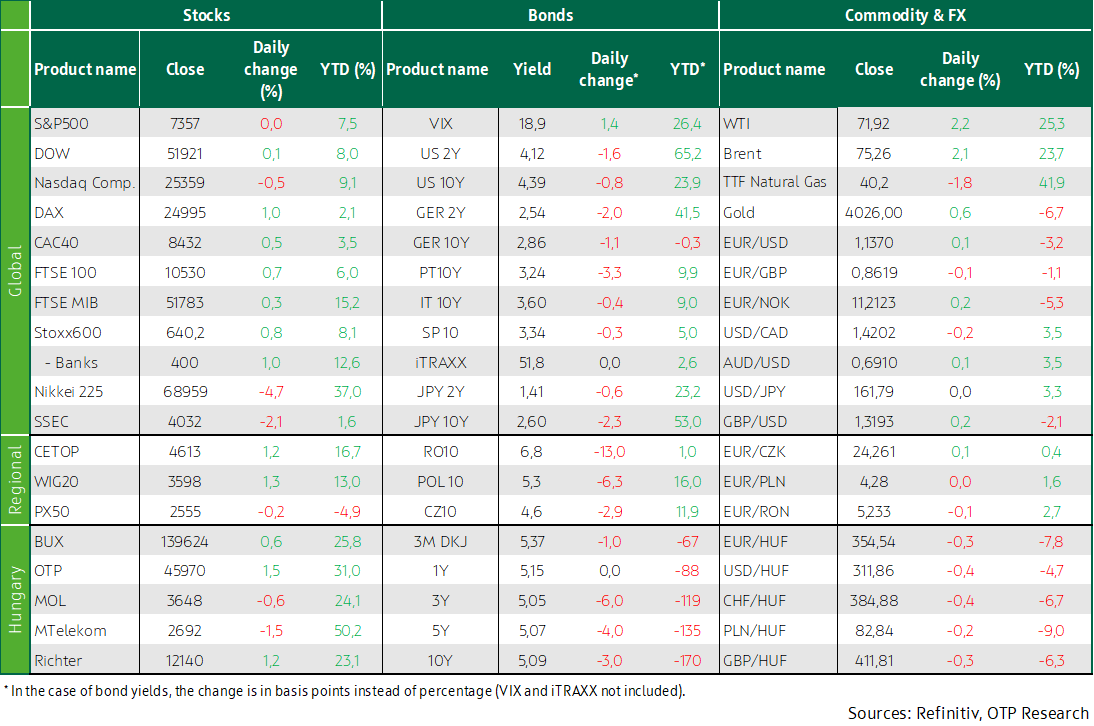
The STOXX 600 rose by 0.8%, closing at a record high. Bayer received a favorable court ruling in the Roundup herbicide case, and the German company’s shares soared. According to Isabel Schnabel, the ECB needs to raise interest rates further. Markets are still pricing in one more hike this year. According to data released by the KSH, the unemployment rate in Hungary declined to 4.3%. The US indices closed on a mixed note. Micron’s share price soared by 15.7%. US Q1 growth was revised up to 2.1%. Core PCE rose by 0.32% month-on-month in May. Both Hungarian and international bond yields declined on Thursday. The forint strengthened by 0.3% to 354.5 against the euro. Asian indices are in a sharp decline this morning.
Western European stock indices rose
Western European stock indices rose. The STOXX 600 rose by 0.8%, closing at a record high, while the DAX gained 1%, the CAC 40 added 0.5%, and the FTSE 100 advanced by 0.7%. Healthcare stocks contributed the most to the rise, with the sector index finishing 1.5% higher. Bayer’s share price soared by 18.7% after securing a legal victory, as the US Supreme Court limited lawsuits alleging that the German manufacturer failed to warn users about the potential cancer risks of its Roundup herbicide. The technology sector gave back part of its intraday gains but still closed 0.8% higher. Positive outlooks from Micron and Qualcomm eased investor concerns that AI-related stocks had become excessively overvalued. Among European chipmakers, Infineon and STMicroelectronics climbed by 3.1% and 5.1%, respectively, while semiconductor equipment supplier ASML moved 2.6% higher. Shares of Siemens Energy, which also produces AI-related equipment, increased by 2.3%. Among individual stocks, private equity firm 3i Group jumped 11.4%, while EasyJet rose by more than 5% after rejecting a fourth takeover bid from US investment firm Castlelake.
According to Isabel Schnabel, the ECB’s hawkish Executive Board member, the European Central Bank needs to raise interest rates further, as energy prices remain elevated and the Middle East ceasefire does not justify a pause. Market participants expect at least one more rate hike by year-end, assigning roughly a one-third probability to a move at the July 22–23 meeting, although a September step is seen as more likely.
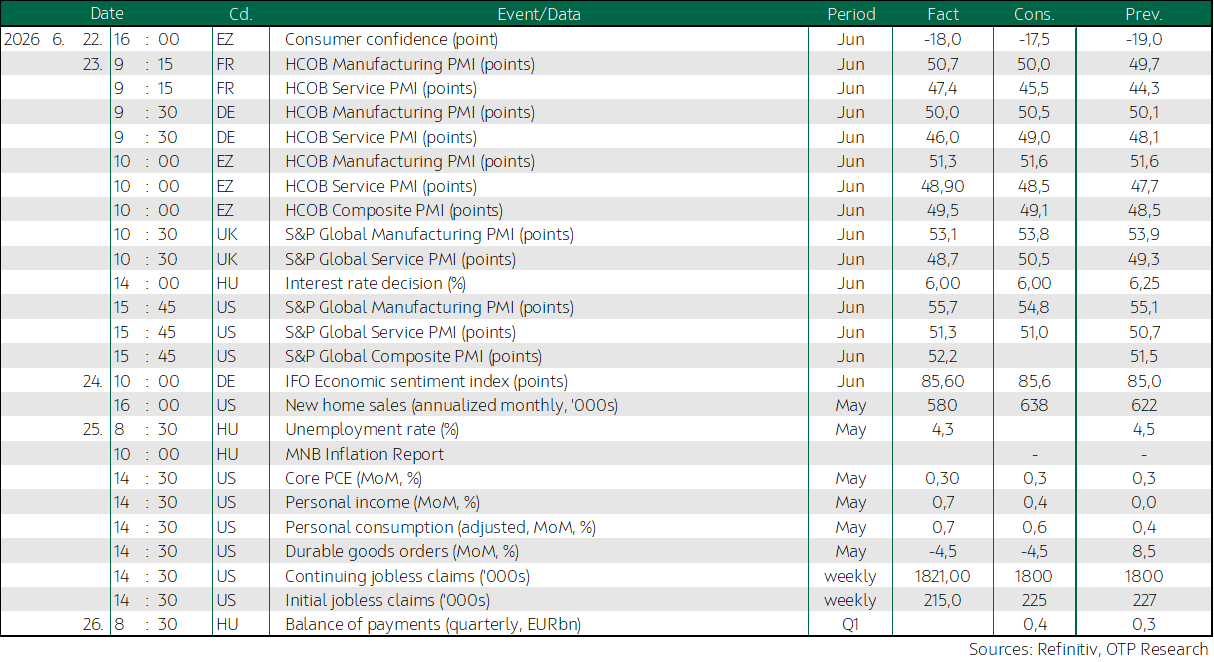
According to data released by the KSH, the unemployment rate in Hungary declined to 4.3%. At the same time, the downward trend in employment appears to be stabilizing based on the latest figures. Although a year-on-year decline of 33,000 is still visible, shorter-term data indicate a rise in employment.
In the region, the BUX rose by 0.6% and Poland’s WIG20 gained 1.3%, while the Czech PX50 declined by 0.2%.
The US indices closed on a mixed note
On Thursday, the S&P 500 was little changed. The Nasdaq Composite fell by 0.5%, while the Dow Jones edged 0.1% higher. Technology stocks reversed course after early gains, putting pressure on the Nasdaq. Apple shares dropped 6.1% after the company raised prices for iPads and MacBooks to offset higher costs for memory and storage chips. Shares of Nvidia, Microsoft, and Alphabet declined between 0.5% and 3.5%. Meanwhile, Micron’s share price soared by 15.7% after the company’s results and guidance exceeded Wall Street expectations, while memory chipmaker SanDisk jumped 22%.
US Q1 growth was revised up, with GDP expanding at an annualized rate of 2.1% instead of the previously estimated 1.6%. The 0.5 percentage point upward revision was primarily driven by a downward adjustment to imports. At the same time, the growth rate of consumer spending was cut from 1.4% to 0.5%, mainly due to a downward revision in services expenditure. Early Q2 data suggest that consumption has strengthened again, partly supported by substantial tax refunds.
Core PCE rose by 0.32% month-on-month in May, while the year-on-year figure increased by 0.1 percentage points to 3.4%. Services inflation was particularly broad-based, rising by 0.45% month-on-month, suggesting that rapid disinflation is less likely. The latest inflation data remain inconsistent with the Fed’s 2% target, and according to FedWatch data, markets are already pricing in a 25-basis-point rate hike for September.
Consumer spending rose by 0.7% month-on-month in May, exceeding expectations. The data reinforce the view that households have weathered the gasoline price shock relatively well. Nominal incomes increased by 0.7% on a monthly basis, matching the expansion in spending, leaving the savings rate broadly stable at around 3%.
Oil prices rose by more than 1% after a report indicated that Tehran plans to collect billions from reopening the Strait of Hormuz.
Both Hungarian and international bond yields declined on Thursday
US Treasury yields declined by a few basis points after May inflation data came in slightly more favorable than some investors had expected, although the headline PCE year-on-year price index rose to 4.1%, and the core PCE remains inconsistent with the Fed’s inflation target. The US 10-year yield thus edged just below 4.4%. Meanwhile, German yields also fell by a few basis points, with the 10-year at 2.86%. Following recent gains, the dollar weakened modestly against the euro to 1.138.
Hungarian government bond yields also declined, with the 10-year falling by 3 basis points to 5.09%. Demand was strong at the auctions of 3-, 5-, and 10-year bonds. Against announced amounts of HUF 20bn, HUF 20bn, and HUF 25bn, the Government Debt Management Agency accepted bids totaling HUF 76bn, HUF 40bn, and HUF 85bn, respectively, while total demand for the three instruments exceeded HUF 450bn. The forint strengthened by 0.3% to 354.5 against the euro.
Today's highlights
As technology stocks came under pressure, Asian indices turned to a significant decline. Approaching the close, the Nikkei was down 4.7%, the KOSPI dropped 7.8%, the SSEC fell 2.1%, while the Hang Seng declined by 1.9%. Oil prices have also turned lower again this morning.
Today, the KSH will publish Hungary’s Q1 current account data.
Get more out of your investments!
Global Markets Services
OTP Global Markets offers a broad range of services in the field of local and international money and capital markets.
Read morePrivate Banking Services
Personal care and expertise with OTP Private Banking, along with the knowledge, security, and innovations of a multinational banking group.
Read more