
OTP Morning Brief: President Trump threatened Iran with further attacks due to the prolonged negotiations
Related content
OTP Morning Brief: US producer price index came in above expectations, yet the US 10-year Treasury yield still declined
Western European equities continued to advance despite ongoing pressure on the technology sector. Wall Street indices also rebounded, recovering some ground after Wednesday’s sell-off. Healthcare was the standout performer on both sides of the Atlantic. Eurozone industrial production declined by 0.5% month-on-month in August. In the US, the producer price index accelerated to 6.3%, delivering another upside surprise in inflation developments. US retail sales increased by 0.8% compared to August. The US 10-year Treasury yield declined by more than 10 basis points. The long end of the Hungarian government bond yield curve also declined by 7-9 basis points. In Hungary, August wage data will be released today, while in the US, September industrial production figures are due.
OTP Morning Brief: US CPI data came in above expectations
European equity markets advanced, supported by strong results from ASML and the outstanding performance of the healthcare sector. US equity markets came under pressure following higher-than-expected September CPI data. The annual CPI rate accelerated to 3.7%, driven primarily by a surge in gasoline prices, while core CPI rose by 0.3% month-on-month, supported by higher housing costs and rising transportation service prices. Oil prices rose amid escalating tensions in the Middle East and the impact of the IEA's oil market report. US Treasury yields retreated after an initial increase, driven by Fed commentary, while European bond yields generally moved higher. The US macro calendar will be busy today, with investors focusing on September retail sales and producer price index data, as well as the New York Fed Manufacturing Index, weekly jobless claims, and business inventories. August industrial production data from the euro area will be released today.
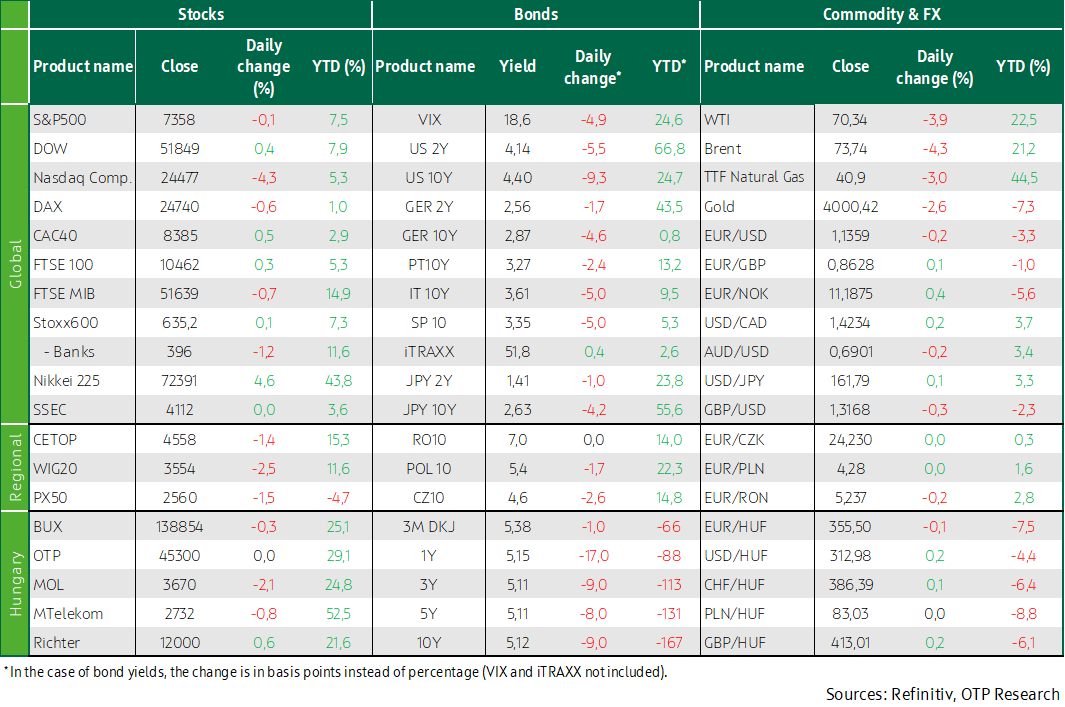
European indices closed mixed yesterday as investors monitored developments related to the war with Iran; Rheinmetall shares fell following a government decision; the IFO sentiment index rose in line with expectations. US indices closed mixed yesterday amid a correction in semiconductor stocks and a drop in oil prices; Alphabet rose; Micron released its earnings report; US new home sales for May came in below expectations. Long-term yields in developed markets declined, while the dollar continued to strengthen against the euro. The most important data release today will be the US core PCE rate; in addition, US household income and consumption figures, durable goods orders, and the usual weekly jobless claims will also be published, while Hungary’s unemployment rate will be released and the MNB will publish its CPI report.
European indices closed mixed yesterday as investors monitored developments related to the war with Iran; Rheinmetall shares fell following a government decision; the IFO sentiment index rose in line with expectations
European equity markets closed mixed on Wednesday as investors assessed developments in US–Iran negotiations, with the STOXX 600 index edging 0.1% higher while Germany’s DAX fell 0.6%; Rheinmetall shares plunged nearly 19% after Germany scrapped plans to build six F126 frigates due to project delays and cost overruns, a decision that hit the company particularly hard as it had been considered a strong contender for the contract, while in contrast Thyssenkrupp’s marine unit surged 16.1% after Berlin opted to procure smaller frigates instead; the technology sector also declined, partly extending the sharper correction seen the previous day, with most semiconductor and chip equipment makers weakening as investors awaited Micron’s earnings release, and according to market commentary the sector’s softness reflects short-term profit-taking similar to earlier corrections this year.
Oil prices fell to multi-month lows as a potential US–Iran peace agreement could ease concerns over supply disruptions, although uncertainty surrounding the details of the deal continued to keep investors cautious.
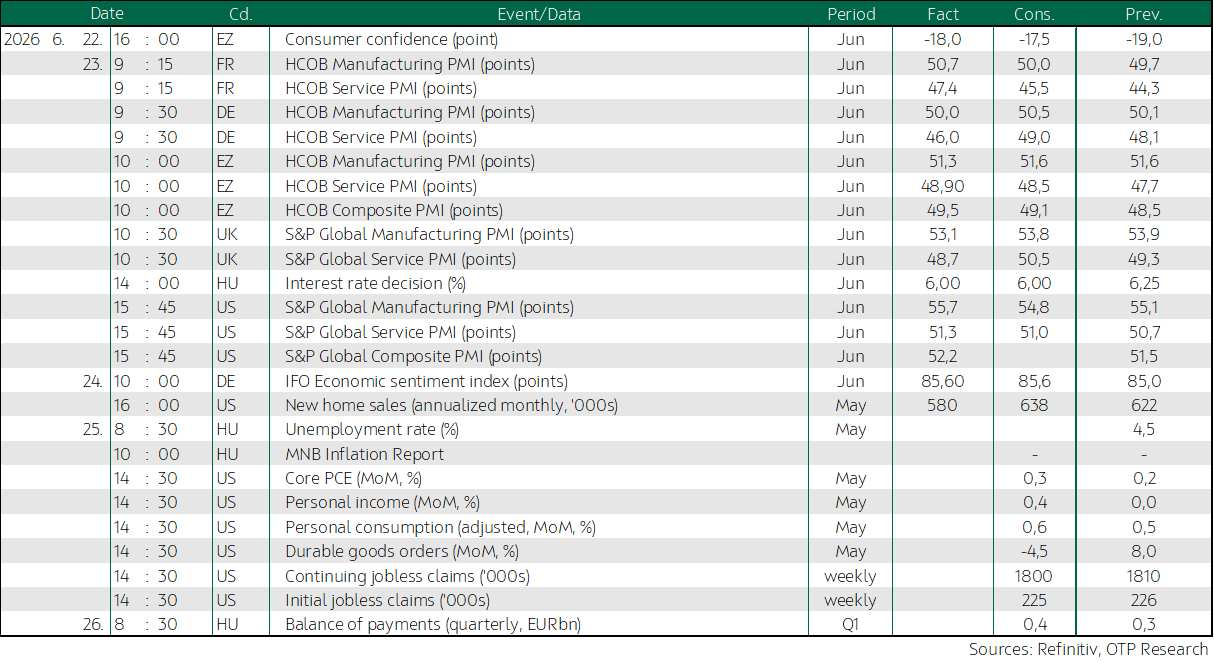
Germany’s IFO business climate index rose to 85.6 in June in line with analyst expectations, up from 85 in May, signaling a slight improvement in economic sentiment; the uptick was mainly driven by a more positive assessment of current business conditions, while easing geopolitical uncertainty helped stabilize expectations for the outlook, and market participants continue to focus on the central bank rate path, with pricing suggesting that the European Central Bank could still deliver one additional rate hike of around 25 basis points by year-end.
Regional markets declined yesterday: among Hungarian blue chips, Mol and Magyar Telekom shares fell, OTP was broadly unchanged, while only Richter managed to rise.
US indices closed mixed yesterday amid a correction in semiconductor stocks and a drop in oil prices; Alphabet rose; Micron released its earnings report; US new home sales for May came in below expectations
US equity markets closed mixed yesterday, with sentiment primarily shaped by weakness in the technology sector and uncertainty surrounding semiconductor industry prospects; the decline in chip stocks was led by Micron Technology, whose share price fell 5.3% ahead of its earnings release published after the close, while other players in the memory segment also underperformed and broader chipmakers came under pressure, and according to market assessments the pullback in the tech sector can be seen as a correction following a strong rally in the previous period that pushed expectations to elevated levels, increasing the risk of disappointment during the upcoming earnings season, however Micron’s post-close report ultimately exceeded expectations on both revenue and profit thanks to skyrocketing memory prices, sending its shares up more than 10% in after-hours trading.
Meanwhile, Alphabet shares rose after it was announced that the company will soon replace Verizon in the Dow Jones index, potentially generating additional investor demand for the stock; overall, yesterday’s trading was dominated by a correction in the technology sector and declining energy prices, while investors increasingly focused on reassessing corporate earnings outlooks as the reporting season approaches.
US new home sales fell to 580,000 in May from 626,000 in April, marking a notable decline and coming in below market consensus, which had expected a level of around 638,000; the negative surprise suggests that housing demand remains highly sensitive to the elevated interest rate environment, and from a macro perspective the housing market is particularly important as it is one of the fastest-reacting sectors through the interest rate transmission channel.
Long-term yields in developed markets declined, while the dollar continued to strengthen against the euro
US Treasury yields declined yesterday, mainly driven by falling oil prices: Brent dropped to multi-month lows as concerns over supply disruptions eased and an increasing number of tankers left the Strait of Hormuz; the decline in energy prices also weighed on CPI expectations, while the short end saw a more modest move, resulting in a slightly flatter 2–10 year segment of the yield curve, as market pricing currently implies more than a 65% probability of a September rate hike, putting upward pressure on short-term yields, while persistently above-target inflation continues to keep the central bank on a tightening path.
Meanwhile, German long-term yields also declined, the dollar extended its strengthening against the euro since last Wednesday’s Fed rate decision, while the forint remained largely unchanged following Tuesday’s more notable weakening driven by signals related to the MNB’s rate-cutting path.
Today's highlights
Asian indices were mixed this morning, while technology-heavy Japanese and Korean benchmarks surged following Micron’s earnings released yesterday; shares of Alibaba listed in Hong Kong fell by nearly 3% after Anthropic accused the Chinese tech company of attempting to acquire its artificial intelligence capabilities.
Today, on the domestic front, Hungary’s unemployment rate and the MNB’s CPI Report will be published, while tomorrow will see the release of several key US macroeconomic indicators, led by core PCE, the Fed’s preferred gauge and therefore a key driver of rate expectations; additionally, household income and consumption data will provide insight into the current state of domestic demand, durable goods orders will offer feedback on investment activity, and the usual Thursday jobless claims data will give an indication of labor market tightness.
Get more out of your investments!
Global Markets Services
OTP Global Markets offers a broad range of services in the field of local and international money and capital markets.
Read morePrivate Banking Services
Personal care and expertise with OTP Private Banking, along with the knowledge, security, and innovations of a multinational banking group.
Read more