
OTP Morning Brief: MNB cut interest rates and signaled further easing ahead
Related content
OTP Morning Brief: US producer price index came in above expectations, yet the US 10-year Treasury yield still declined
Western European equities continued to advance despite ongoing pressure on the technology sector. Wall Street indices also rebounded, recovering some ground after Wednesday’s sell-off. Healthcare was the standout performer on both sides of the Atlantic. Eurozone industrial production declined by 0.5% month-on-month in August. In the US, the producer price index accelerated to 6.3%, delivering another upside surprise in inflation developments. US retail sales increased by 0.8% compared to August. The US 10-year Treasury yield declined by more than 10 basis points. The long end of the Hungarian government bond yield curve also declined by 7-9 basis points. In Hungary, August wage data will be released today, while in the US, September industrial production figures are due.
OTP Morning Brief: US CPI data came in above expectations
European equity markets advanced, supported by strong results from ASML and the outstanding performance of the healthcare sector. US equity markets came under pressure following higher-than-expected September CPI data. The annual CPI rate accelerated to 3.7%, driven primarily by a surge in gasoline prices, while core CPI rose by 0.3% month-on-month, supported by higher housing costs and rising transportation service prices. Oil prices rose amid escalating tensions in the Middle East and the impact of the IEA's oil market report. US Treasury yields retreated after an initial increase, driven by Fed commentary, while European bond yields generally moved higher. The US macro calendar will be busy today, with investors focusing on September retail sales and producer price index data, as well as the New York Fed Manufacturing Index, weekly jobless claims, and business inventories. August industrial production data from the euro area will be released today.
On Tuesday, no news emerged regarding US-Iran peace talks that would have significantly influenced financial markets. However, the parties are communicating differently about the return of nuclear inspectors. The sell-off in the tech sector continued in equity markets, while mounting expectations of Fed rate hikes also weighed on sentiment; European and overseas stock indices closed in negative territory following a steep decline in technology sector indices. Investors sought safe-haven assets, while long-term bond yields declined in both the euro area and the US. The EUR/USD fell to 1.138, with the dollar strengthening to a 13-month high. Domestically, attention focused on the MNB’s Tuesday rate decision, where the central bank cut the benchmark rate by 25bp in line with expectations and signaled further easing, lowered its CPI forecast, and raised its growth outlook for this year. Today, we are watching the IFO German economic sentiment index and US new home sales data.
The tech sector’s sell-off kept European equity markets under pressure on Tuesday
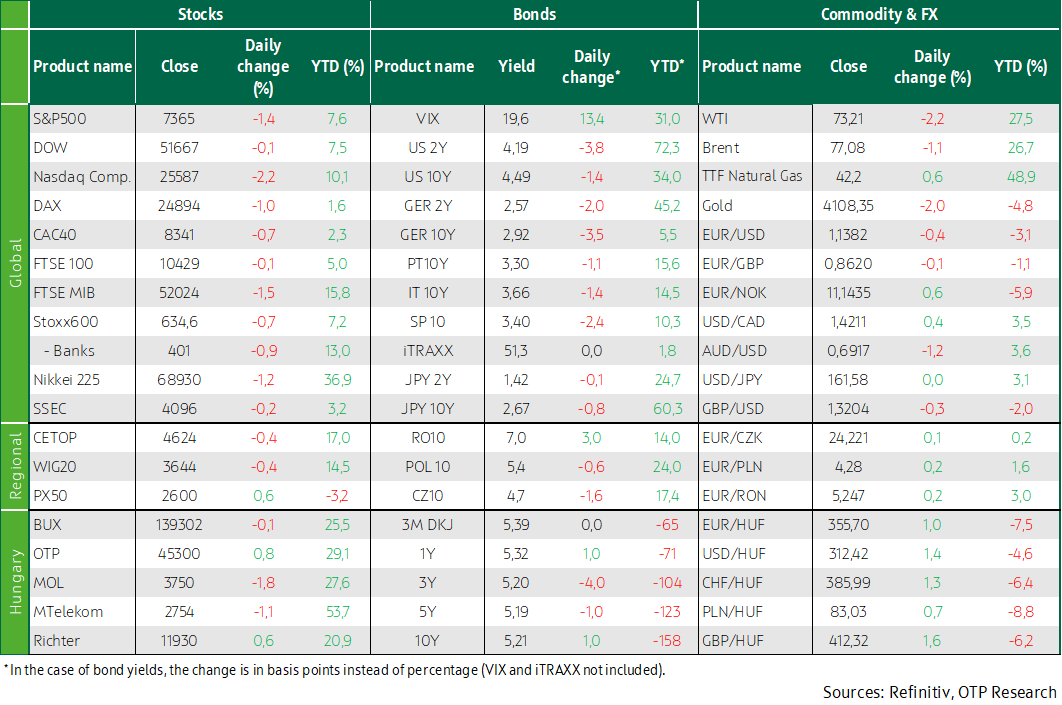
The Monday sell-off in the US tech sector spread to Asia on Tuesday and then reached Europe, with the Stoxx 600 slipping 0.7%, the DAX losing 1%, the CAC 40 falling 0.7%, while the FTSE 100 was broadly flat. Among Stoxx 600 sector indices, technology posted the sharpest decline, dropping 3.7%, marking its largest daily fall since February, as investors globally reassessed tech companies that had previously seen shares soar at the start of the quarter amid strong enthusiasm for artificial intelligence. Chipmaker Infineon plunged 6.5%, STMicroelectronics tumbled 8.5%, while semiconductor equipment manufacturers ASML fell nearly 6% and Aixtron dropped more than 8%. Rising financing costs have contributed to the tech sector’s current downturn, while the increase in yields since March has also kept valuations under pressure. Infineon and STMicroelectronics are among those that have recently tapped credit markets. Traditional defensive sectors performed well, with healthcare rising 1.9% and food producers gaining 1.7%, while among the laggards, the basic materials sector also closed lower, down 3.3% on Tuesday, as precious metal prices declined.
As for individual company performance, UK-based Bunzl surged nearly 6% after the provider of safety, hygiene, and packaging solutions raised its full-year revenue growth guidance following strong first-half results. Shares of Signify plunged 15% after the world’s largest lighting company revised its strategy and set a target of around a 10% adjusted EBITA margin by 2029.
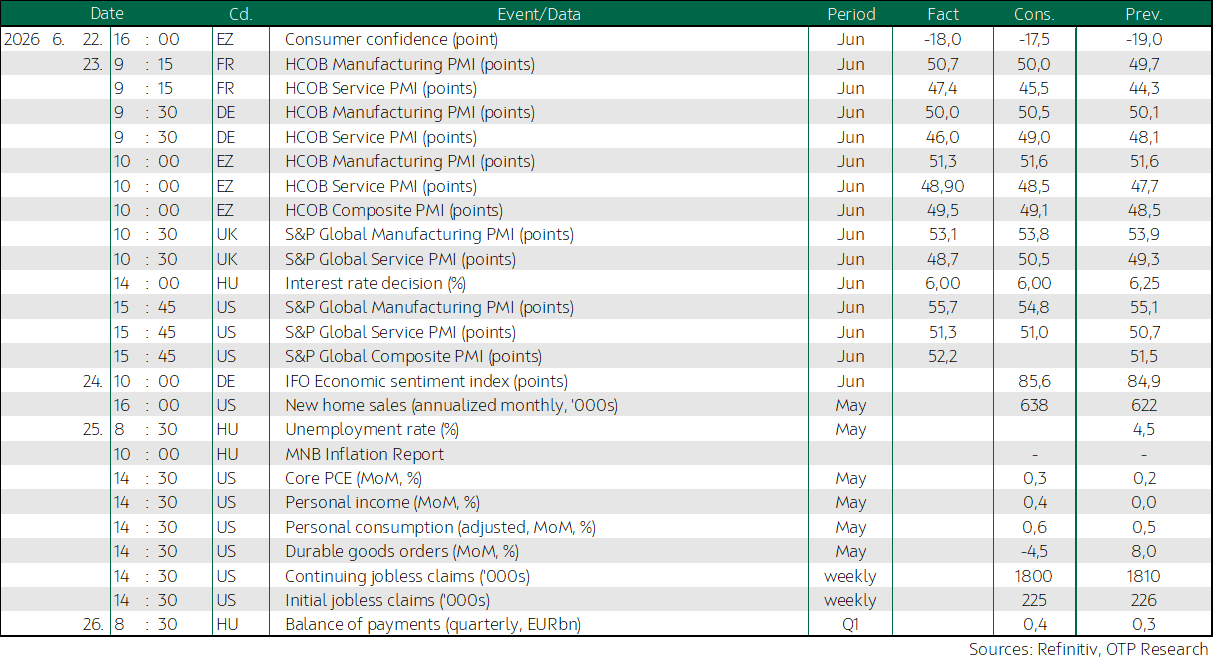
Eurozone PMI data also failed to influence sentiment: while both the composite and services indicators for the bloc came in stronger than expected, and French readings improved more than anticipated, Germany saw a deterioration instead of the projected improvement in both manufacturing and services.
The price of European TTF gas rose 0.5% to 42 EUR/MWh on Tuesday amid uncertainty surrounding transit through the Strait of Hormuz.
Regional equity markets showed mixed sentiment, with Poland’s WIG20 and the BUX edging lower, while the PX continued to rise. The BUX closed modestly down by 0.1%, as gains in OTP and Richter were unable to offset declines of over 1% in Magyar Telekom and nearly 2% in Mol. OTP’s level of HUF 45,300 marked a new peak.
The sell-off in the technology sector continued to weigh on overseas equity indices, driving further declines
Investment in AI-related developments by technology companies, along with the associated costs, continues to weigh on the tech sector overseas amid a rising interest rate environment. Mounting expectations of rate hikes have also put pressure on valuations. The S&P closed Tuesday down 1.4% and the Nasdaq fell 2.2%, while the Dow edged lower by just 0.1%. Semiconductor stocks, however, suffered a steep decline: the Philadelphia Semiconductor Index plunged nearly 8%, and the S&P technology sector index dropped close to 4%, leading losses among S&P sector indices. Industrials and materials also recorded notable declines.
Among chipmakers, Broadcom slipped 3%, Nvidia fell 4%, while AMD and Intel dropped by around 6%, with Texas Instruments and Qualcomm losing 8%. Memory chip producers Micron Technology and SanDisk, which had seen the strongest rally this year, plunged 13%. Megacap stocks closed mixed, with Alphabet and Apple declining by around 1%, Microsoft and Amazon ending in positive territory, while Tesla dropped nearly 6%.
PMI releases in the US point to a stronger-than-expected improvement in both manufacturing and services.
Oil prices fell by a further 1% on Tuesday, with Brent dropping to USD 77 per barrel and WTI slipping below USD 73, marking the lowest level in nearly three months, as traders focused on progress toward resolving the Iran conflict. Following a temporary peace agreement that had already driven prices down by 40% from their peak, a new 60-day US waiver now allows global buyers—including US refiners—to purchase Iranian crude and fuels. Although both sides reported progress during talks in Switzerland and agreed to establish four working groups to address nuclear issues and sanctions, differences persist. Tehran disputed US claims regarding the immediate return of nuclear inspectors.
The MNB delivered a 25bp rate cut and signaled further easing, while the forint weakened by 1%. Mounting expectations of rate hikes in the US pushed the EUR/USD to 1.138, with the dollar strengthening to a 13-month high
In Hungary, the MNB’s interest rate decision on Tuesday was in the focus: the central bank cut the benchmark interest rate by 25 bps as expected and signalled further cuts during the summer, revised down its inflation forecasts, and raised its growth forecast for this year. As a result, the benchmark rate fell to a four-year low. At the same time, central bank communication signaled further easing ahead. The MNB also released its latest inflation forecast, with the projected CPI path revised significantly downward compared to the March outlook. According to the baseline scenario, inflation is expected at 1.8% in 2026 and 2.3% in 2027 (previously 3.8% and 3.7%), before returning to the 3% target by 2028. The central bank now sees GDP growth at 2% in 2026 and 3% in 2027 (previously 1.7% and 3%). Governor Mihály Varga noted that easing geopolitical tensions have improved the global risk environment, while lower risk premiums on domestic assets have also persisted, significantly increasing the room for maneuver in monetary policy. He also signaled two additional 25bp rate cuts over the summer.
Varga Mihály also announced the phase-out of the central bank facility related to energy imports as of June 30, noting that, according to the MNB’s assessment, easing market tensions have significantly reduced FX hedging needs among energy importers. He also indicated that the current environment could be the right time to remove the retail margin cap, as the favorable CPI outlook suggests it would not threaten price stability.
The forint gradually weakened over the course of Tuesday, resulting in a 1% depreciation by the close, with EUR/HUF rising to 355.7.
The sell-off in the technology sector drove investors toward safe-haven assets, while expectations of rate hikes strengthened in the US. As a result, yields at the long end rose across developed bond markets, with the US 10-year yield falling below 4.5% and the German 10-year closing at 2.92%. At the same time, shorter maturities in the US saw a slight rise in yields, reflecting mounting expectations of monetary tightening. According to the CME FedWatch Tool, futures are pricing in a September 25bp rate hike with a probability above 70%, while the likelihood of an additional hike by year-end is approaching 50%. Strengthening Fed rate hike expectations supported the dollar yesterday, pushing it to a 13-month high, with EUR/USD falling to 1.138.
Benchmark yields in the domestic government bond market showed mixed movements, with yields edging lower in the 3- and 5-year segments, while the 10-year yield inched up by 1bp to 5.21% based on reference yields fixed in early afternoon. At Tuesday’s 3-month T-bill auction, submitted bids exceeded the planned HUF 30bn issuance by roughly 10%, although the Debt Management Agency ultimately accepted only HUF 20bn worth of offers.
Today's highlights
Following the earlier sharp sell-off, a degree of correction is visible across Asian markets this morning: the Shanghai Composite inched higher, the Hang Seng rose by 0.8%, while Korean benchmarks are up 3–4%. Japanese indices, however, are trading in negative territory, as concerns over large tech firms’ AI-related spending weighed on sentiment, while the prospect of further rate hikes also kept markets under pressure after minutes from the BoJ’s June meeting showed policymakers generally supported continuing rate increases, citing core inflation moving closer to the 2% target alongside still accommodative financial conditions.
US equity index futures point to a positive open, with the exception of the Dow, while European futures are trading in negative territory.
Micron Technology, one of Tuesday’s biggest losers, is set to release its earnings today, which may provide insight into the outlook for the memory and artificial intelligence chip sectors following the sharp rise seen earlier this year.
Today, the German IFO economic sentiment index may be in focus, while new home sales data will also be released in the US.
Get more out of your investments!
Global Markets Services
OTP Global Markets offers a broad range of services in the field of local and international money and capital markets.
Read morePrivate Banking Services
Personal care and expertise with OTP Private Banking, along with the knowledge, security, and innovations of a multinational banking group.
Read more