
OTP Morning Brief: The progress of the US–Iran deal, along with the big tech sector’s weakness, moved markets yesterday
Related content
OTP Morning Brief: US producer price index came in above expectations, yet the US 10-year Treasury yield still declined
Western European equities continued to advance despite ongoing pressure on the technology sector. Wall Street indices also rebounded, recovering some ground after Wednesday’s sell-off. Healthcare was the standout performer on both sides of the Atlantic. Eurozone industrial production declined by 0.5% month-on-month in August. In the US, the producer price index accelerated to 6.3%, delivering another upside surprise in inflation developments. US retail sales increased by 0.8% compared to August. The US 10-year Treasury yield declined by more than 10 basis points. The long end of the Hungarian government bond yield curve also declined by 7-9 basis points. In Hungary, August wage data will be released today, while in the US, September industrial production figures are due.
OTP Morning Brief: US CPI data came in above expectations
European equity markets advanced, supported by strong results from ASML and the outstanding performance of the healthcare sector. US equity markets came under pressure following higher-than-expected September CPI data. The annual CPI rate accelerated to 3.7%, driven primarily by a surge in gasoline prices, while core CPI rose by 0.3% month-on-month, supported by higher housing costs and rising transportation service prices. Oil prices rose amid escalating tensions in the Middle East and the impact of the IEA's oil market report. US Treasury yields retreated after an initial increase, driven by Fed commentary, while European bond yields generally moved higher. The US macro calendar will be busy today, with investors focusing on September retail sales and producer price index data, as well as the New York Fed Manufacturing Index, weekly jobless claims, and business inventories. August industrial production data from the euro area will be released today.
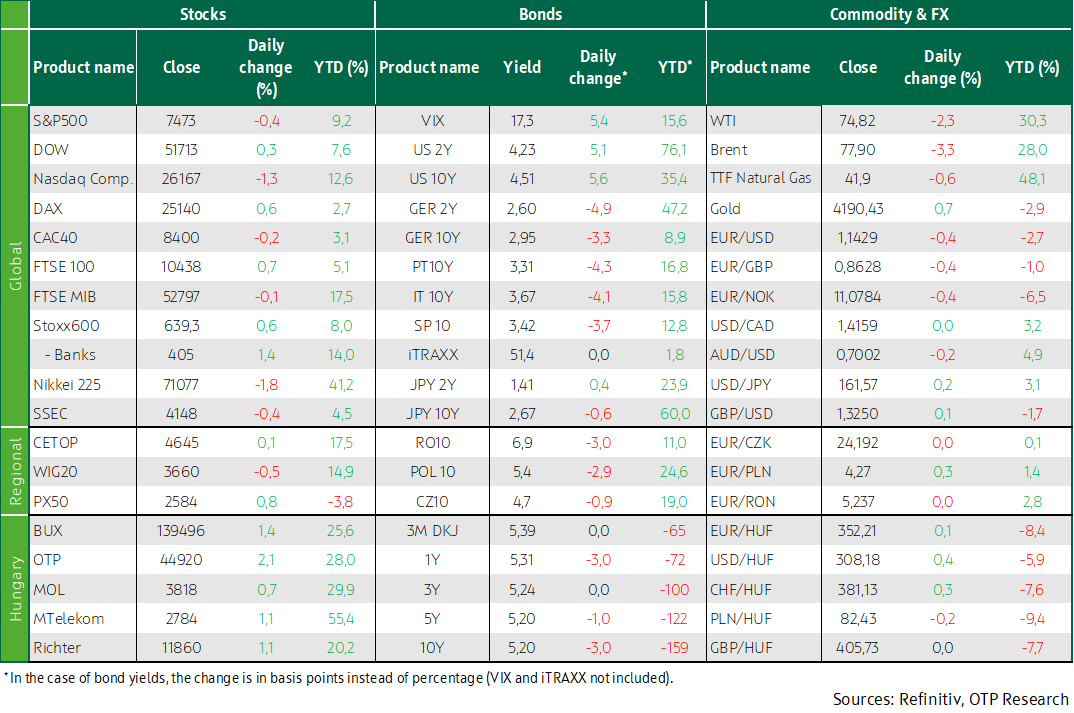
European equity markets closed with a slight rise, supported by progress in US–Iran talks and Keir Starmer’s resignation. UK bank shares rose, while the STOXX 600 index increased by 0.6%. In the US, markets closed mixed, with technology stocks underperforming—particularly due to SpaceX’s sharp drop—while hyperscaler big tech names also lost value. US yields rose on strengthening rate hike expectations, while in Europe they edged lower as Christine Lagarde eased concerns over second-round CPI effects. Today, locally the focus is on the MNB’s rate decision.
News of the US–Iran talks and Keir Starmer’s resignation drove European markets
European equity markets closed with a slight rise on Monday, supported by progress in the latest round of US–Iran negotiations, while markets also reacted positively to the news of UK Prime Minister Keir Starmer’s resignation, as his departure could pave the way for an orderly transfer of power to the Labour Party’s likely leadership contender, Andy Burnham, who could become the UK’s tenth prime minister in seven years as early as next month; against this backdrop, UK bank stocks rose, with Barclays, NatWest, and Standard Chartered gaining 3.9%, 4%, and 1.3%, respectively, while the broader banking index increased by 1.4%, and on the FTSE 100 front, UK defense company Babcock fell 5.9% after reporting a significant decline in annual profit, partly due to a 140 million pound charge linked to higher-than-expected remedial work on the Royal Navy’s Type 31 frigate program.
The pan-European STOXX 600 index rose by 0.6% after declining over the previous two trading sessions, while technology stocks gained 0.5%, with chipmaker Infineon closing 4.8% higher in line with the rise seen across Asian markets; discount airline easyJet advanced 2.8% after US investment firm Castlelake announced a public takeover bid valued at around 4.74 billion pound ($6.26 billion), and among the day’s top performers was Carl Zeiss Meditec, whose share price soared nearly 10%.
The German and French governments have agreed on the terms for listing the KNDS armored vehicle manufacturer, with the company’s IPO likely to take place as early as July; the German state will acquire a 40% stake to strengthen strategic industries and defense capabilities, while France will also hold 40%, ensuring a balanced governance structure between the two countries and securing their long-term influence over a key European defense company, which is valued at €15–18 billion, with shares worth several billion euros expected to be offered to investors in the IPO.
Among regional exchanges, Hungary’s BUX and the Czech PX rose, while Poland’s WIG declined; on the domestic market, all four blue chips moved higher, with OTP leading the gains as its share price rose by 2% during the session.
US markets closed mixed, with technology stocks underperforming
On Monday, the S&P 500 and the Nasdaq closed lower, dragged down mainly by declines in mega-cap technology stocks, including Alphabet, as investors assessed developments in US–Iran talks, while the Dow edged higher, supported primarily by the performance of the healthcare and industrial sectors.
SpaceX shares plunged 16.4%—marking their largest single-day drop—exerting a significant negative impact on the Nasdaq Composite, although the stock continues to trade above its $135 IPO price; the Elon Musk-led company completed its first bond issuance on Monday and reported holding approximately $100.8 billion in cash and cash equivalents as of June 19.
Alphabet fell 5%, while Meta, Amazon, and Microsoft declined between 2.5% and 5% as more investors question hyperscalers’ heavy spending on expanding infrastructure.
One of the day’s biggest gainers was Apogee Therapeutics, whose share price soared 47% after AbbVie announced it would acquire the biotechnology firm for $10.9 billion in cash, while AbbVie’s stock rose by 6.2%.
Oil prices declined after Washington and Tehran agreed on a roadmap leading to a final deal within 60 days; US and Iranian officials achieved “significant progress” in the first round of talks held in Switzerland, which concluded early on Monday, according to mediators, although tensions remain over Lebanon and the Strait of Hormuz, while Brent crude fell nearly 3% per barrel.
US yields rose, while in Europe they declined
In the US, rate hike expectations strengthened following last week’s Fed meeting, pushing long-term yields higher, with the 10-year yield rising by 6 basis points, and as a result, investor focus this week is on the core PCE CPI data due on Thursday; in contrast, eurozone bond yields declined, with the German Bund yield falling by 4 basis points, partly as ECB President Christine Lagarde eased concerns over second-round effects of the current rise in energy prices, which could result in fewer rate hikes than currently priced in for the eurozone, while Hungarian yields moved lower in line with Europe, supported by strengthening expectations of an MNB rate cut tomorrow, and in FX markets there was no meaningful movement in either EURUSD or EURHUF.
Today's highlights
Asian markets are in the red this morning, driven primarily by declines in chipmakers, as investors continue to worry about weakening chip demand fueled by AI investment.
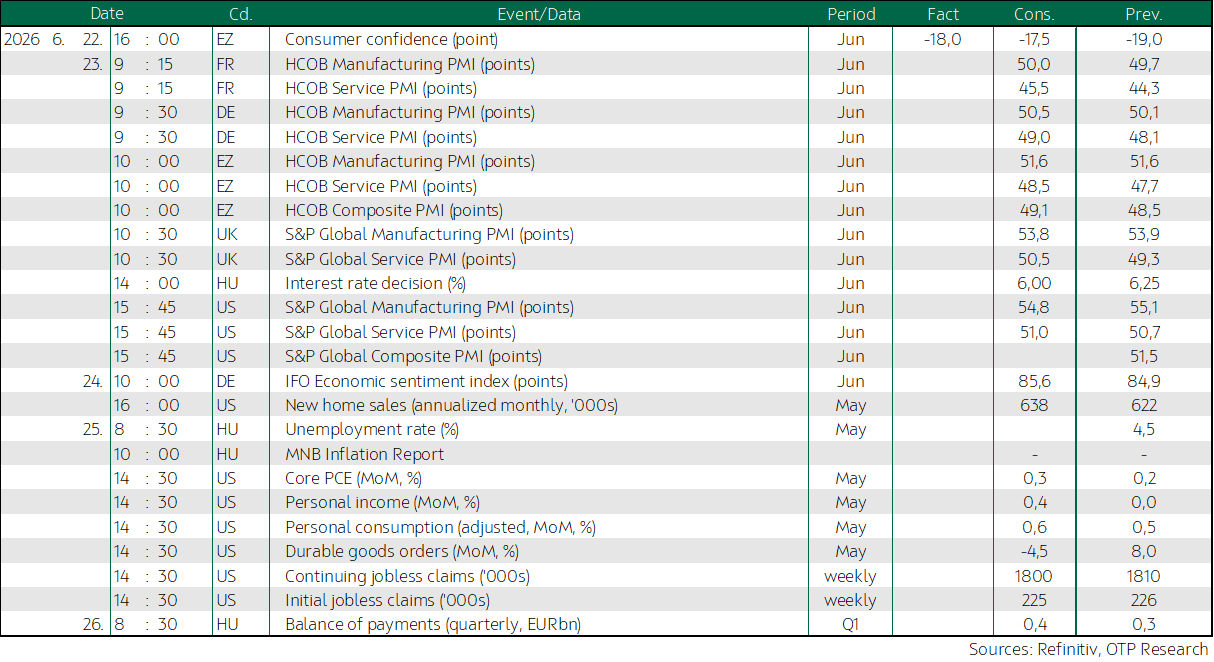
In Hungary, the central bank’s next rate-setting meeting is due today, where a base rate cut is widely expected, although a 50 basis point reduction cannot be ruled out entirely; focus will be on the post-decision press conference and the updated CPI forecast.
In addition, corporate PMI data will be released from both Europe and the US.
Get more out of your investments!
Global Markets Services
OTP Global Markets offers a broad range of services in the field of local and international money and capital markets.
Read morePrivate Banking Services
Personal care and expertise with OTP Private Banking, along with the knowledge, security, and innovations of a multinational banking group.
Read more