
OTP Morning Brief: The volatile situation surrounding the Middle Eastern peace agreement dominated equity markets last week
Related content
OTP Morning Brief: US producer price index came in above expectations, yet the US 10-year Treasury yield still declined
Western European equities continued to advance despite ongoing pressure on the technology sector. Wall Street indices also rebounded, recovering some ground after Wednesday’s sell-off. Healthcare was the standout performer on both sides of the Atlantic. Eurozone industrial production declined by 0.5% month-on-month in August. In the US, the producer price index accelerated to 6.3%, delivering another upside surprise in inflation developments. US retail sales increased by 0.8% compared to August. The US 10-year Treasury yield declined by more than 10 basis points. The long end of the Hungarian government bond yield curve also declined by 7-9 basis points. In Hungary, August wage data will be released today, while in the US, September industrial production figures are due.
OTP Morning Brief: US CPI data came in above expectations
European equity markets advanced, supported by strong results from ASML and the outstanding performance of the healthcare sector. US equity markets came under pressure following higher-than-expected September CPI data. The annual CPI rate accelerated to 3.7%, driven primarily by a surge in gasoline prices, while core CPI rose by 0.3% month-on-month, supported by higher housing costs and rising transportation service prices. Oil prices rose amid escalating tensions in the Middle East and the impact of the IEA's oil market report. US Treasury yields retreated after an initial increase, driven by Fed commentary, while European bond yields generally moved higher. The US macro calendar will be busy today, with investors focusing on September retail sales and producer price index data, as well as the New York Fed Manufacturing Index, weekly jobless claims, and business inventories. August industrial production data from the euro area will be released today.
Although last week began with highly optimistic news regarding the Middle Eastern conflict, by Friday several issues had emerged, leaving the outcome of the peace agreement entirely uncertain to this day. As a result, markets posted gains for most of the week, while European indices declined on the final trading day; on Friday, the US market remained closed. Following significant fluctuations, oil prices ultimately closed the week at around $80, marking a sharp decline. European yields rose on Friday, while the dollar hit a 13-month high following the Fed’s hawkish communication accompanying Thursday’s rate decision. Asian markets rose on Monday, driven by positive news released earlier in the day. This week, attention will focus on the Hungarian rate decision and the release of US PCE data.
A 14-point agreement came close to ending the conflict, but ongoing fighting called its sustainability into question
News related to the Middle Eastern conflict once again dominated the entire week, with market sentiment improving markedly at the beginning, as a final 14-point agreement appeared capable of delivering a lasting ceasefire and reopening the Strait of Hormuz. Crude oil prices declined significantly, yields eased slightly, equity indices rose, and the Dow closed at a new high on Tuesday. Later in the week, however, several statements cast doubt on the prospects for peace, culminating in the cancellation of Friday’s meeting between the US and Iran following Israel’s ongoing attacks in Lebanon. By Friday afternoon, a ceasefire between Hezbollah and Israel was announced, but this was soon called into question on Saturday after Israeli airstrikes killed 16 people in Lebanon just hours after it came into effect. Israel stated the strikes were in response to Hezbollah attacks. Iran subsequently closed the strait again, while Trump renewed threats of military action against the Middle Eastern country. The first round of negotiations concluded in Switzerland on Monday, led on the US side by Vice President JD Vance, with further talks expected later in the week. The Iranian side commented positively on the process, noting that several concessions had already been secured, including the lifting of restrictions on oil and petrochemical exports.
European equities edged lower due to Friday’s uncertainty, while US stock markets remained closed
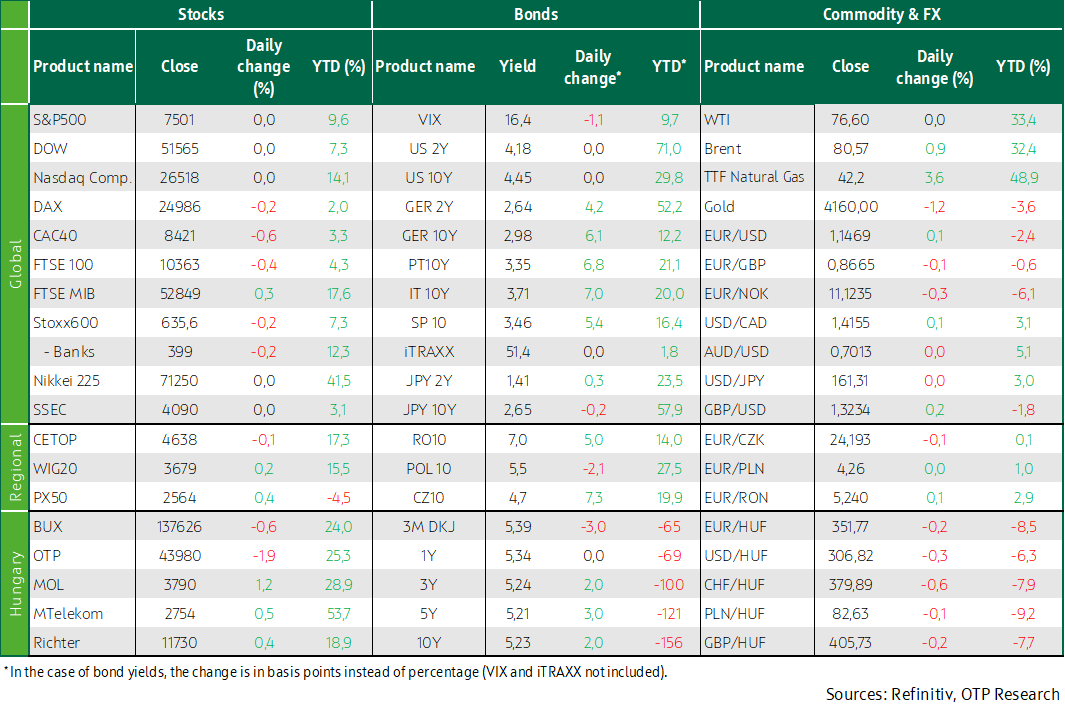
European equities edged lower on Friday as investors remained cautious after talks between the US and Iran aimed at resolving the Middle Eastern conflict stalled. The pan-European Stoxx 600 closed 0.2% lower, though it still posted a 0.4% weekly gain after reaching record highs earlier in the week. Among major national indices, the DAX rose 0.2%, the FTSE 100 gained 0.4%, and the CAC 40 advanced 0.6%, leaving the German index up 1.4% and the French benchmark 0.8% higher for the week overall, while the UK market declined by 1%. Higher oil prices on Friday weighed on the travel and leisure sector, which fell 0.9% on the day, while the energy sector rose 1.3%. Mining stocks led the declines, dropping 2.1% in line with weaker commodity prices. ASML, a manufacturer of semiconductor equipment, stated that it had never delivered an extreme ultraviolet lithography machine to China, following reports that US officials feared one of its most advanced tools may have reached the country; its shares ultimately closed 1.1% lower.
The CEE region showed a mixed performance, with the WIG 20 rising 0.2% and the PX 50 gaining 0.4% on Friday, while the BUX fell 0.6%. This was largely driven by a 1.9% decline in OTP, even as the other three blue chips closed in positive territory. Despite the pullback, the BUX still ended the week up 1.4%, with OTP remaining the top performer, posting a 3.5% weekly gain despite its Friday drop.
On Friday, June 19, US money and capital markets were closed due to the Juneteenth federal holiday, leaving the major indices to finish the week in positive territory overall, with the Dow rising 0.7%, the S&P 0.9%, and the Nasdaq advancing 2.4%.
Crude oil prices showed even greater-than-usual volatility throughout the week due to the uncertain outcome of peace negotiations; on Friday, Brent rose 0.9%, once again moving above $80, yet it still declined by 7.7% over the full week. On news of the Swiss talks, Brent fell again to $78 by Monday.
Yields rose in Europe on Friday, while the Hungarian forint finished the week below the 352 level
Eurozone government bond yields rose on Friday after peace talks between the US and Iran in Switzerland were unexpectedly halted, while European Central Bank policymakers adopted a more hawkish tone regarding CPI. The German 10-year government bond yield increased by 6 basis points to 2.987% after falling to a more than two-month low of 2.915% on Wednesday. Overall, Bund yields changed little over the week, declining by just 1 basis point. Among key ECB policymakers, Pierre Wunsch linked the likelihood of further rate hikes to the risk of CPI broadening beyond the energy sector, while Philip Lane noted that the euro area economy may already be able to withstand somewhat higher interest rates without losing momentum. These comments added further upward pressure, pushing the German 2-year government bond yield up by 4 basis points to 2.64%. The dollar index hovered near a 13-month high, supported by the firm commitment of the Fed’s new chair, Kevin Warsh, to curb inflation and ensure price stability. This prompted traders to price in at least one rate hike this year, compared to a negligible probability just a few weeks earlier. The shift in the Fed’s tone placed significant pressure on the US government bond market, with 2-year yields rising by nearly 10 basis points compared to a week earlier, while the benchmark 10-year yield fell by 3 basis points to 4.451%.
Regional currencies strengthened slightly on Friday, with the HUF appreciating by 0.3% and the CZK gaining 0.2% against the euro, while the Polish zloty remained broadly unchanged. Over the full week, the Polish and Czech currencies recorded modest depreciation, while the forint finished close to its level at the beginning of the week. Reference yields of the Government Debt Management Agency rose by a few basis points on Friday, leaving the 10-year yield above 5.2%, which is 6 basis points below its level at the start of the week.
Today's highlights
Asian equity markets rose on Monday after Iranian negotiators stated that progress had been made in peace talks with the US, easing concerns that the process might be collapsing. Japan’s Nikkei advanced 1.9% after reaching a record high last week, supported by a nearly 8% gain. The South Korean market added a further 2.6%, following a more than 11% surge the previous week driven by strong demand for semiconductor stocks. China’s SSEC also moved 0.2% higher.
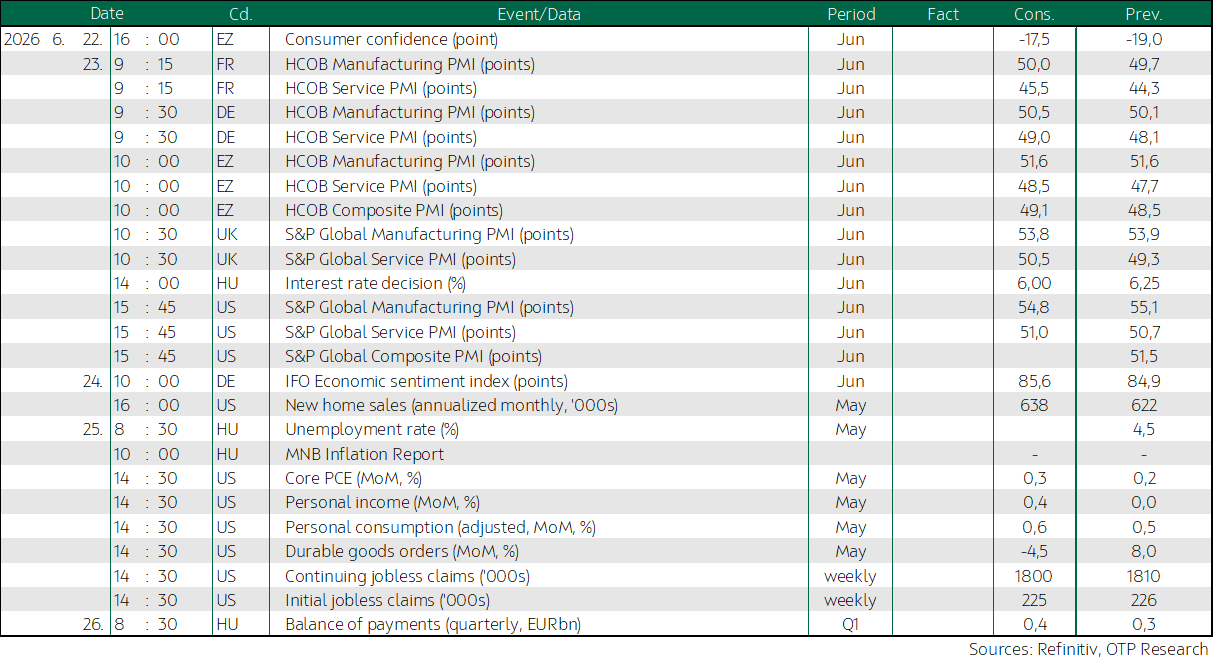
Today, euro area consumer confidence data is expected, while several key developments are due later in the week. The Hungarian central bank (MNB) will hold its next rate-setting meeting next Tuesday, where it is highly likely to cut the base rate. The recent drop in global oil prices has effectively removed the last obstacle to easing, shifting the focus to the magnitude of the move. Market pricing already reflects a non-negligible probability of a 50 basis point cut, implying a total of four rate reductions by year-end, including next Tuesday’s decision.
Core PCE data for May will also be released in the US next week, having exceeded the 2% target every month for the past five years; in April, the annual index rose to 3.3%, its highest level since late 2023. Already available May CPI and producer price data provided negative signals for core PCE, as underlying components suggest a monthly increase of 0.3–0.4%, which would imply an annual rate of around 3.5%. Considering the inflation and growth outlook, alongside labor market conditions, we continue to believe that maintaining a tight monetary policy stance is justified, and the 50 basis point hike priced in by the market for this year does not appear unrealistic. In addition, consumer confidence indices will be released for both the euro area and the US, offering a more up-to-date view of the short-term economic impact of the Iranian conflict.
Get more out of your investments!
Global Markets Services
OTP Global Markets offers a broad range of services in the field of local and international money and capital markets.
Read morePrivate Banking Services
Personal care and expertise with OTP Private Banking, along with the knowledge, security, and innovations of a multinational banking group.
Read more