
OTP Morning Brief: Fed held its interest rates unchanged, while markets declined on the back of a more hawkish-than-expected tone
Related content
OTP Morning Brief: US producer price index came in above expectations, yet the US 10-year Treasury yield still declined
Western European equities continued to advance despite ongoing pressure on the technology sector. Wall Street indices also rebounded, recovering some ground after Wednesday’s sell-off. Healthcare was the standout performer on both sides of the Atlantic. Eurozone industrial production declined by 0.5% month-on-month in August. In the US, the producer price index accelerated to 6.3%, delivering another upside surprise in inflation developments. US retail sales increased by 0.8% compared to August. The US 10-year Treasury yield declined by more than 10 basis points. The long end of the Hungarian government bond yield curve also declined by 7-9 basis points. In Hungary, August wage data will be released today, while in the US, September industrial production figures are due.
OTP Morning Brief: US CPI data came in above expectations
European equity markets advanced, supported by strong results from ASML and the outstanding performance of the healthcare sector. US equity markets came under pressure following higher-than-expected September CPI data. The annual CPI rate accelerated to 3.7%, driven primarily by a surge in gasoline prices, while core CPI rose by 0.3% month-on-month, supported by higher housing costs and rising transportation service prices. Oil prices rose amid escalating tensions in the Middle East and the impact of the IEA's oil market report. US Treasury yields retreated after an initial increase, driven by Fed commentary, while European bond yields generally moved higher. The US macro calendar will be busy today, with investors focusing on September retail sales and producer price index data, as well as the New York Fed Manufacturing Index, weekly jobless claims, and business inventories. August industrial production data from the euro area will be released today.
European markets still managed to rise on Wednesday, as investors waited ahead of the Fed’s rate decision. Although the Fed ultimately left rates unchanged, policymakers signaled a possible rate cut by year-end, which triggered a broad and significant decline across US markets. Bond yields rose, the dollar strengthened, and regional currencies weakened, with the forint also moving back above the 350 level against the euro. Asian markets rose, with Japan ready to step in to support the weakening yen. Today, attention will focus on the interest rate decisions in the UK and the Czech Republic.
European markets rose on Wednesday, while wages in Hungary increased by 11.2%
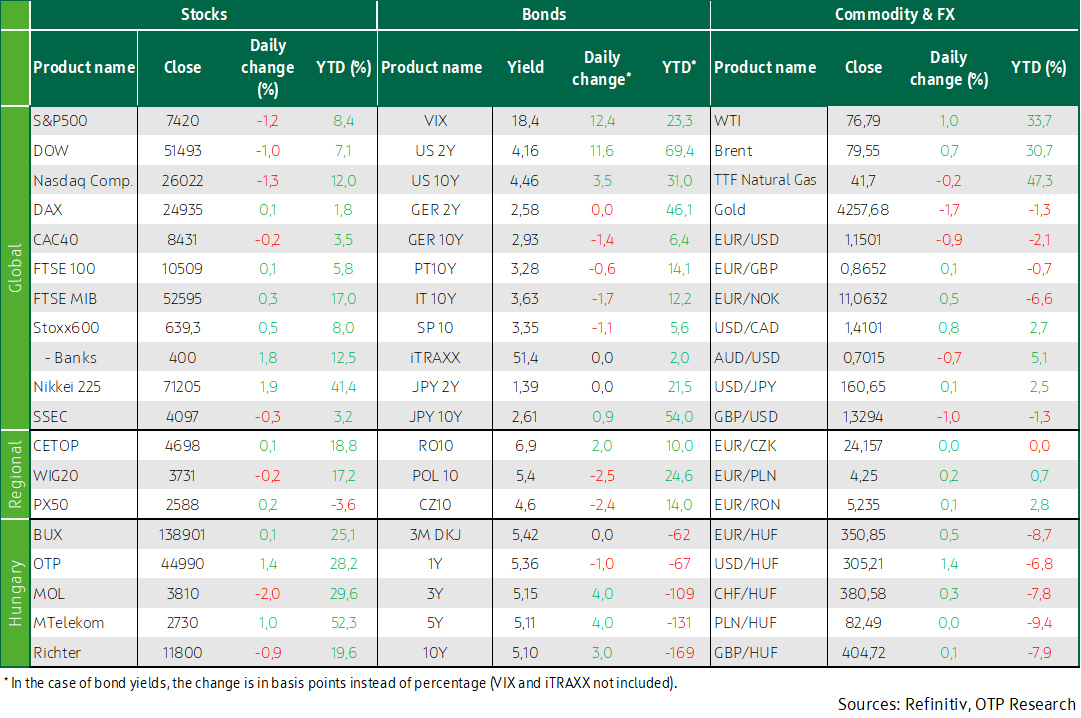
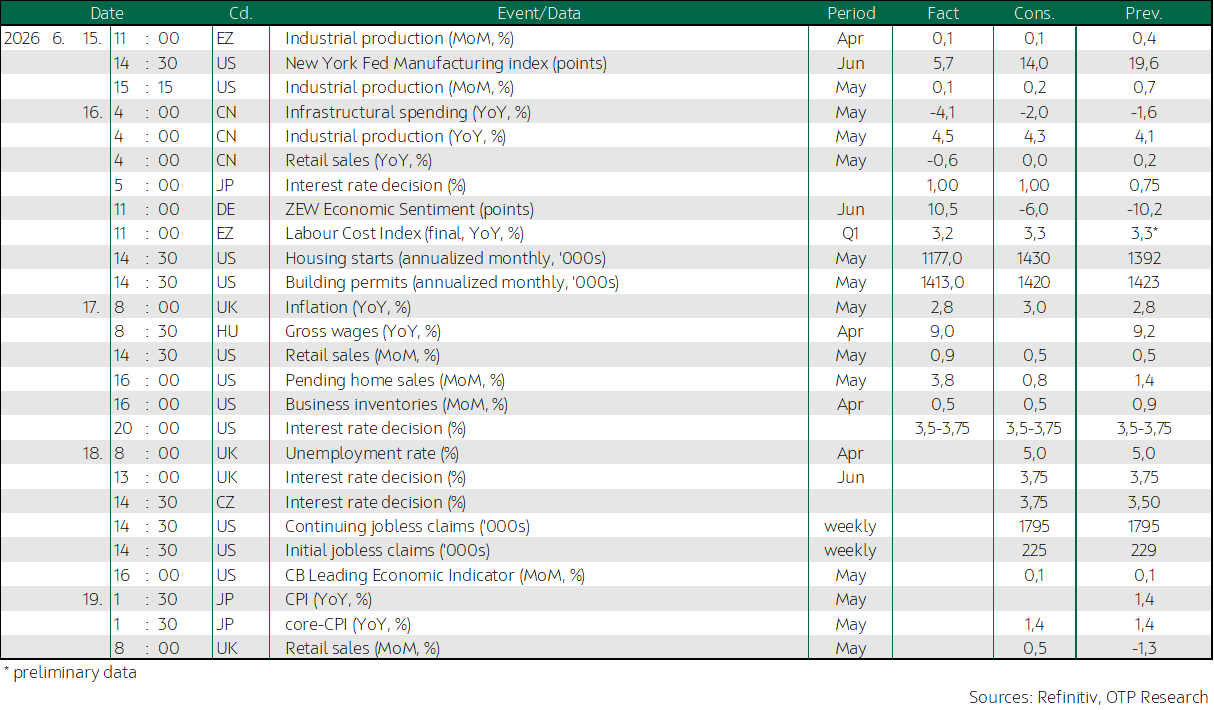
European equities edged higher on Wednesday, as investors awaited details of a peace agreement between the US and Iran, as well as the Federal Reserve’s monetary policy outlook, with the pan-European STOXX 600 index closing 0.5% higher and marking its fifth consecutive day of gains, while the DAX and FTSE 100 posted more modest increases and the CAC 40 underperformed with a 0.1% decline, as auto stocks led the losses with a 3.3% drop, their steepest one-day fall in nearly a month, with BMW sliding 8.3% after lowering its annual profit outlook due to weakness in the Chinese market and the impact of the US–Iran conflict, whereas bank stocks provided support with a 1.9% rise driven by Commerzbank (+5.2%), Deutsche Bank (+2.5%) and Barclays (+3.4%), while technology shares advanced 1.5% as Aixtron jumped 6.7% and both BE Semiconductor and ASML gained around 4%, and defense sector stocks added 0.5%, meanwhile on the macro front UK CPI remained unchanged at 2.8% in May, holding at April’s 13-month low and coming in below both economists’ expectations and the Bank of England’s forecast according to official data released on Wednesday, one day ahead of the central bank’s next rate decision.
Most markets in the region also rose, with the BUX adding 0.1% and the PX gaining 0.2%, while the WIG 20 declined by 0.2%, with OTP standing out among Hungarian blue chips with a 1.4% increase, whereas Mol fell by 2.0%, meanwhile in April 2026 gross average earnings in Hungary reached HUF 772,200, representing a 9.0% rise year-on-year, while net wages grew by 11.2% supported by expanded family tax benefits and additional allowances for mothers, and amid declining oil prices and a strengthening forint, Péter Magyar announced an initiative in Parliament to phase out regulated fuel pricing.
The Fed held its interest rates unchanged, while markets declined on the back of a more hawkish-than-expected tone
The Federal Reserve left interest rates unchanged on Wednesday in line with expectations, but policymakers signaled a potential rate hike later this year amid rising concerns that CPI could remain above the central bank’s 2% target, with the new quarterly projections showing that nine Fed officials now expect a rate increase by the end of 2026, while the updated monetary policy statement removed the previous reference suggesting a likelihood of further easing this year, which according to the new Fed Chair Warsh had been justified by earlier economic conditions, meanwhile the Fed now sees GDP growth in 2026 at 2.2%, down from the 2.4% projected in March, while the 2027 forecast remains unchanged at 2.3%, and CPI projections were revised higher to 3.6% for this year from 2.7% and to 3.3% for 2027 from 2.7%, with policymakers noting that both economic growth and the labor market remain stable, and following the meeting CME FedWatch data showed that 67.1% of investors now expect a rate hike by September, up sharply from 29.1% on Tuesday.
The Fed’s hawkish tone weighed on markets, with the Dow falling 1.0%, the S&P 500 declining 1.2%, and the Nasdaq dropping 1.3%, while all 11 major S&P 500 sector indices ended lower, led by communication services with a roughly 3% decline, whereas the industrial sector proved the most resilient, closing just 0.1% lower, and regional banks underperformed their larger peers as the KBW Regional Banking Index fell 1.8% compared with a 0.2% drop in the S&P 500 bank index, with one analyst cited by Refinitiv noting that higher interest rates tend to weigh more heavily on regional lenders and also highlighting the 2.3% decline in the State Street SPDR S&P 500 Homebuilders ETF, as a higher rate environment typically puts pressure on the housing market, while among individual stocks SpaceX stood out, snapping its post-listing skyrocketing trend and correcting by 4.9%.
Brent rose by more than 1% on Wednesday to nearly $80 per barrel after US President Donald Trump warned that bombing of Iran could resume if Tehran does not “behave appropriately,” raising fresh uncertainty around a potential ceasefire agreement, adding that a memorandum of understanding with Iran has not yet been finalized and that the possibility of military action remains on the table, despite the fact that the US and Iran had already released the text of a temporary agreement signed by both presidents aimed at ending the conflict.
Yields also reacted to the Fed’s decision, while the forint moved back above the 350 level
Following the Fed’s decision, expectations for rate hikes and the dollar strengthened, while bond yields rose, with the 10-year US Treasury yield barely moving ahead of the announcement but climbing by 6 basis points to 4.5% afterward, as the dollar soared, appreciating by 1% against the euro to the 1.15 level.
The Fed triggered a correction across regional and domestic markets, with regional currencies generally weakening yesterday, particularly in the afternoon, as the zloty slipped by 0.2% and the forint weakened by half a percentage point, moving back above the 350 level, while reference yields published by the Government Debt Management Agency rose by around 5 basis points, with the 10-year yield reaching 5.1%, and demand at the six-month T-bill auction was subdued with only two-thirds of the announced HUF 30 billion issued, whereas at the switch auctions, where investors could exchange bonds maturing this and next year for seven- and fifteen-year securities, HUF 40 billion worth of bonds changed hands.
Today's highlights
Most Asian markets rose, with sentiment dominated by developments surrounding the end of the Iran war, as the Nikkei advanced 1.9%, while a government spokesperson stated that Japan stands ready to respond appropriately to exchange rate movements at any time, with the yen briefly weakening to 160.795 per dollar on Wednesday—near a two-year low—erasing gains following Tokyo’s April 30 intervention, before standing at 160.76 on Thursday, and although a weaker yen boosts corporate profits, it also increases the burden on companies and households through higher import costs, while the Bank of Japan’s rate hike on Tuesday—which lifted the policy rate to a 31-year high—did little to stabilize the pressured currency given that the benchmark rate still stands at just 1%, well below the Federal Reserve’s 3.50–3.75% range, meanwhile the Kospi also rose by 1.9%, while the SSEC edged slightly lower.
Today, attention in Europe will focus on interest rate decisions in the UK and the Czech Republic, while in the US the usual weekly labor market data releases are also due.
At today’s auction, the Government Debt Management Agency will offer one-year T-bills alongside 10-year floating-rate and 10-year fixed-rate bonds, with announced volumes of HUF 15 billion, HUF 20 billion, and HUF 30 billion, respectively.
Get more out of your investments!
Global Markets Services
OTP Global Markets offers a broad range of services in the field of local and international money and capital markets.
Read morePrivate Banking Services
Personal care and expertise with OTP Private Banking, along with the knowledge, security, and innovations of a multinational banking group.
Read more