
OTP Morning Brief: Oil prices continued to fall
Related content
OTP Morning Brief: US producer price index came in above expectations, yet the US 10-year Treasury yield still declined
Western European equities continued to advance despite ongoing pressure on the technology sector. Wall Street indices also rebounded, recovering some ground after Wednesday’s sell-off. Healthcare was the standout performer on both sides of the Atlantic. Eurozone industrial production declined by 0.5% month-on-month in August. In the US, the producer price index accelerated to 6.3%, delivering another upside surprise in inflation developments. US retail sales increased by 0.8% compared to August. The US 10-year Treasury yield declined by more than 10 basis points. The long end of the Hungarian government bond yield curve also declined by 7-9 basis points. In Hungary, August wage data will be released today, while in the US, September industrial production figures are due.
OTP Morning Brief: US CPI data came in above expectations
European equity markets advanced, supported by strong results from ASML and the outstanding performance of the healthcare sector. US equity markets came under pressure following higher-than-expected September CPI data. The annual CPI rate accelerated to 3.7%, driven primarily by a surge in gasoline prices, while core CPI rose by 0.3% month-on-month, supported by higher housing costs and rising transportation service prices. Oil prices rose amid escalating tensions in the Middle East and the impact of the IEA's oil market report. US Treasury yields retreated after an initial increase, driven by Fed commentary, while European bond yields generally moved higher. The US macro calendar will be busy today, with investors focusing on September retail sales and producer price index data, as well as the New York Fed Manufacturing Index, weekly jobless claims, and business inventories. August industrial production data from the euro area will be released today.
European indices closed higher yesterday; the ZEW sentiment index returned to positive territory; in Q1, labor cost growth in the eurozone slowed. Overseas indices closed mixed yesterday, while profit-taking was seen in semiconductors; both US housing starts and building permits declined. Long-term yields in developed markets edged lower, the dollar weakened against the euro, while regional currencies strengthened. Today, the US Federal Reserve holds a rate-setting meeting; UK CPI figures will be released; from the US, retail sales, housing and business inventory data are due, while wage data arrive from Hungary.
European indices closed higher yesterday; the ZEW sentiment index returned to positive territory; in Q1, labor cost growth in the eurozone slowed
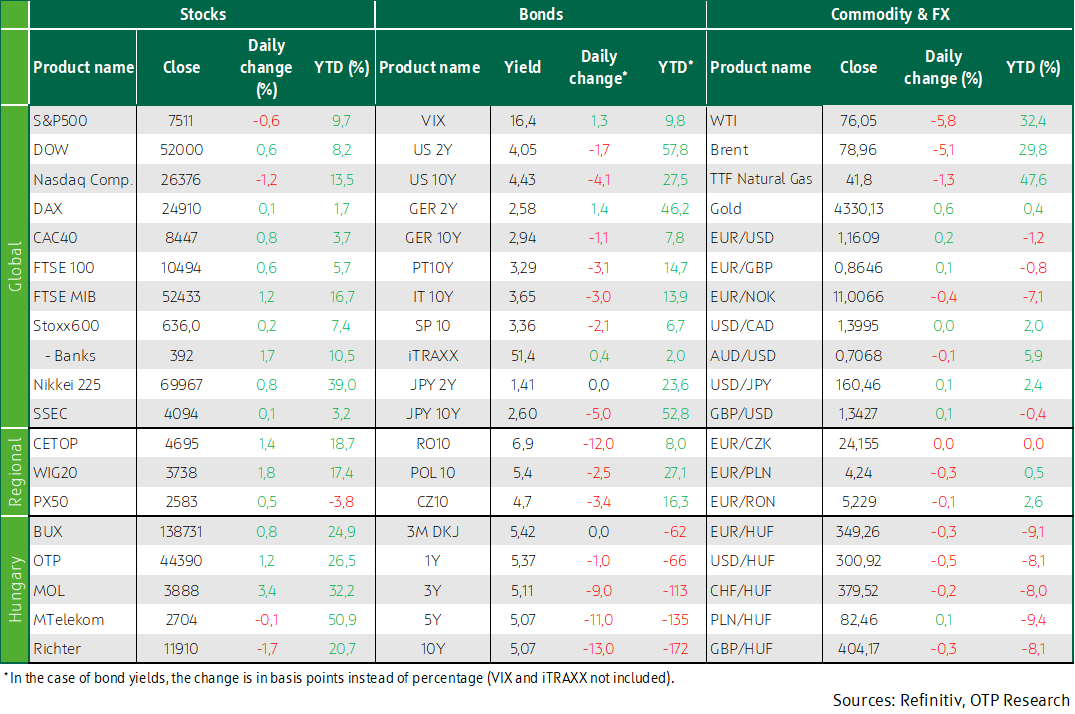
European equity markets closed moderately higher yesterday, extending the previous day’s rally triggered by news of a preliminary agreement between the US and Iran. Oil prices declined, with Brent falling below $80 per barrel, benefiting import-dependent European economies and easing CPI concerns, thereby reducing expectations of further monetary tightening. On the corporate front, UniCredit stood out, with its share price rising by 4.2% after Germany rejected the Italian bank’s bid for Commerzbank shares, citing low valuation and the importance of maintaining Commerzbank’s independence. In the technology sector, investor focus shifted to the financing of artificial intelligence, particularly amid increasing bond issuance. Dutch-based STMicroelectronics fell by 4% after announcing a $1.5 billion convertible bond issue, while Nvidia also unveiled significant debt issuance, reinforcing concerns that companies in the sector are increasingly relying on debt-based financing.
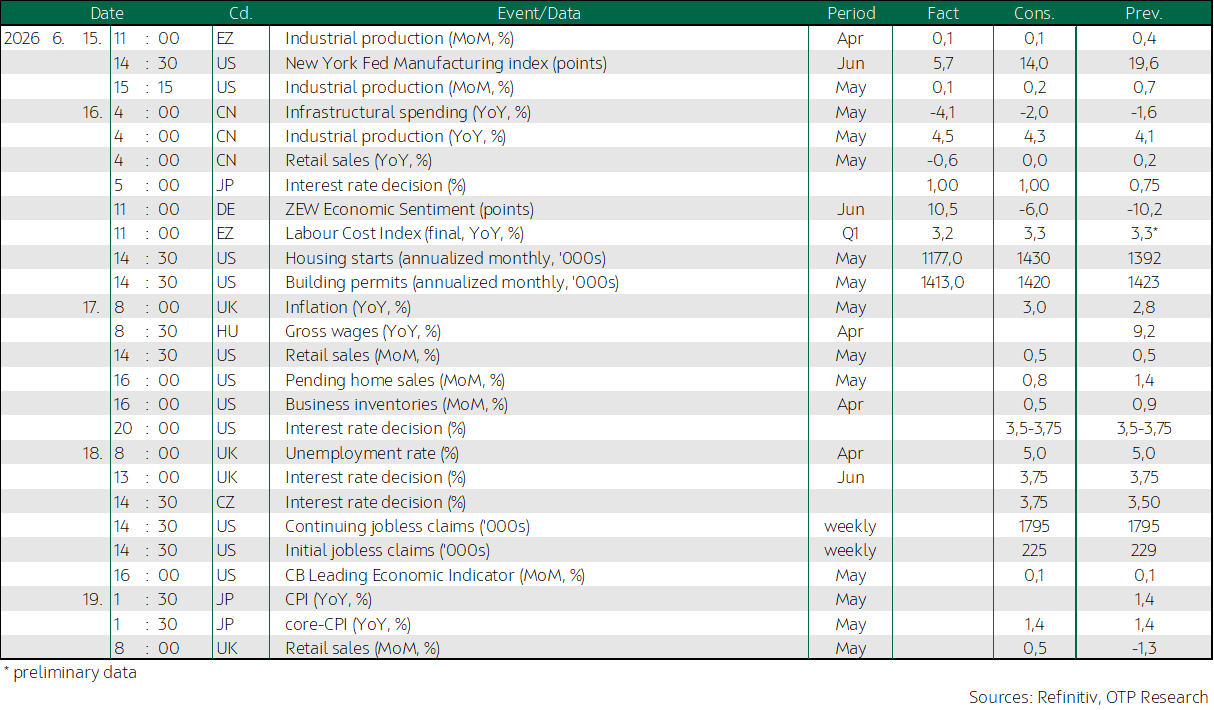
The ZEW economic sentiment index rose from -10.2 in the previous month to 10.5 in June, returning to positive territory for the first time since March and significantly exceeding market expectations of -6.0. The improvement is supported by confidence in a swift resolution to the Iran conflict, as well as expectations of easing energy prices and CPI. Although several sectors (automotive, chemicals/pharmaceuticals, machinery, and consumer outlook) showed meaningful improvement, they remained in negative territory. In contrast, construction sector prospects deteriorated (-12 points, a decline of 15.2 points), partly due to the ECB’s June rate hike. The assessment of the current situation weakened slightly (-81) and fell short of expectations (-78). The eurozone labor cost index increased by 3.2% year-on-year in Q1, marking a slight slowdown from 3.3% in 2025 Q4 and coming in marginally below the 3.3% preliminary estimate. Wage growth accelerated (3.4% after 3%), while the pace of non-wage costs eased significantly (2.9% after 4.3%).
Amid declining oil prices, regional markets rose yesterday: among Hungarian blue chips, OTP and Mol gained, while the other two stocks fell.
Overseas indices closed mixed yesterday, while profit-taking was seen in semiconductors; both US housing starts and building permits declined
US equity markets delivered mixed performance yesterday: the Dow Jones rose to a new all-time high, while the S&P 500 and the Nasdaq declined. The moves were primarily driven by sector rotation, as investors shifted from technology—particularly semiconductor stocks—toward cyclical names, in parallel with a notable drop in oil prices. The Nasdaq’s weakness was accompanied by declines across several chipmakers, with AMD, Broadcom, and Micron falling between 4% and 7%, while Nvidia closed down more than 2%. By contrast, lower energy prices supported industrials and financials: Caterpillar gained more than 1%, while JPMorgan rose by 3.7%. Meanwhile, SpaceX continued to outperform, with its share price rising by nearly 4.8%, extending the rally seen since its IPO last week, although the stock had traded at significantly higher levels intraday.
US housing starts fell by 15.4% month-on-month to an annualized 1.177 million, the lowest level since May 2020. This came in well below market expectations (1.43 million), while the April figure was revised down to 1.392 million. The weak reading primarily reflects subdued demand due to elevated mortgage rates and a more cautious stance by developers. To attract buyers, builders have often reduced prices, offered mortgage incentives, and slowed construction of unsold units. Building permits edged lower by 0.7% month-on-month to 1.413 million, slightly missing market expectations (1.42 million).
Long-term yields in developed markets edged lower, the dollar weakened against the euro, while regional currencies strengthened
The US–Iran peace framework agreement aimed at ending the Middle East conflict boosted optimism in bond and currency markets as well. After oil prices fell by a further 5%, dropping below $80, rate hike concerns eased and bond yields declined. In Europe, the move was more modest, with the 10-year German yield falling by 2 basis points to 2.93%. Meanwhile, the 10-year US yield dropped by 5 basis points, slipping below 4.45%.
The dollar weakened again against the euro, with EURUSD trading above 1.16.
Among regional currencies, both the zloty and the forint strengthened by 0.3% against the euro, with the forint rising below 350, marking its strongest level since mid-2021. Bond yields also declined across the region, with Hungarian government reference yields falling to 5.1%. At yesterday’s 3-month T-bill auction, the Government Debt Management Agency (ÁKK) sold HUF 50 billion worth of securities amid solid demand.
Today's highlights
Asian indices were mixed this morning as investors assessed the possibility of an agreement between the US and Iran, while also awaiting today’s US rate decision, where expectations point to no change in the policy rate.
Today, the US Federal Reserve holds a rate-setting meeting; UK CPI figures will be released; from the US, retail sales, housing and business inventory data are due, while wage data are set to be published from Hungary.
Get more out of your investments!
Global Markets Services
OTP Global Markets offers a broad range of services in the field of local and international money and capital markets.
Read morePrivate Banking Services
Personal care and expertise with OTP Private Banking, along with the knowledge, security, and innovations of a multinational banking group.
Read more