
OTP Morning Brief: Main points of the preliminary agreement ahead of a US–Iran peace deal may be signed on Friday, with a 60-day ceasefire set to begin on Monday night
Related content
OTP Morning Brief: US producer price index came in above expectations, yet the US 10-year Treasury yield still declined
Western European equities continued to advance despite ongoing pressure on the technology sector. Wall Street indices also rebounded, recovering some ground after Wednesday’s sell-off. Healthcare was the standout performer on both sides of the Atlantic. Eurozone industrial production declined by 0.5% month-on-month in August. In the US, the producer price index accelerated to 6.3%, delivering another upside surprise in inflation developments. US retail sales increased by 0.8% compared to August. The US 10-year Treasury yield declined by more than 10 basis points. The long end of the Hungarian government bond yield curve also declined by 7-9 basis points. In Hungary, August wage data will be released today, while in the US, September industrial production figures are due.
OTP Morning Brief: US CPI data came in above expectations
European equity markets advanced, supported by strong results from ASML and the outstanding performance of the healthcare sector. US equity markets came under pressure following higher-than-expected September CPI data. The annual CPI rate accelerated to 3.7%, driven primarily by a surge in gasoline prices, while core CPI rose by 0.3% month-on-month, supported by higher housing costs and rising transportation service prices. Oil prices rose amid escalating tensions in the Middle East and the impact of the IEA's oil market report. US Treasury yields retreated after an initial increase, driven by Fed commentary, while European bond yields generally moved higher. The US macro calendar will be busy today, with investors focusing on September retail sales and producer price index data, as well as the New York Fed Manufacturing Index, weekly jobless claims, and business inventories. August industrial production data from the euro area will be released today.
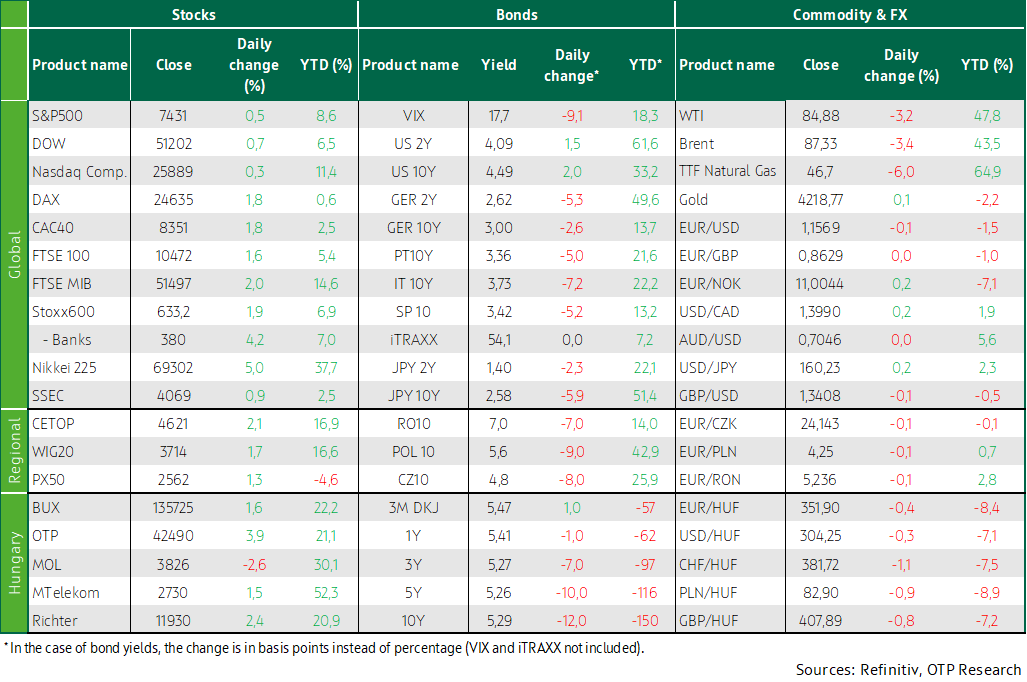
Western European equities surged on Friday, with major indices rising by more than 1%, as renewed hopes for a diplomatic breakthrough with Iran pushed oil prices lower and boosted market sentiment. The positive sentiment also spilled over into the region and the BUX, with OTP rising by 3.9%. Overseas, alongside the Iran-related news, the debut of SpaceX also drove the indices higher, with the company’s stock soaring 19.2% on its first trading day. Yields both domestically and globally declined over the week, while the forint closed below 352 against the euro. According to early morning reports today, the US and Iran have agreed on the main terms of a preliminary deal ahead of a peace agreement, which could be signed on Friday. A 60-day ceasefire is set to begin tonight. This week, attention will be on interest rate decisions by the Fed and the Bank of Japan, along with industrial production and labor cost data from Western Europe.
Western European markets rose, while oilprices declined on fresh news of a potential US–Iran peace agreement
Western European equities surged on Friday, with major indices rising by more than 1% as renewed hopes surrounding an imminent US–Iran peace agreement pushed oil prices lower and lifted market sentiment. Brent crude futures fell 3.7%, extending the previous day’s losses, after US President Donald Trump called off a planned strike against Iran and suggested that a deal could be reached as early as this weekend. The pan-European STOXX 600 index rose 1.9%, ending the week with a total gain of 1.7%. Spain’s IBEX 35 outperformed its regional peers, soaring more than 2.6% to reach a record high, while the Italian stock market also closed at a new peak with a 2% rise.
The week’s positive close followed a turbulent period in European equity markets, marked by sharp swings in AI-related tech stocks, pressure on London-listed banks due to tightening regulation in China, and a quarter-point rate hike by the European Central Bank. Energy stocks were the only laggards on Friday, weakening by 1% in line with falling oil prices. Travel and leisure shares emerged as the day’s winners, surging 4.1% to reach a five-month high. Lufthansa and Air France gained 5.2% and 8.4%, respectively, while integrated tourism group TUI AG soared 8.7%. The STOXX 600 banking index led sectoral gains with a 4.3% rise, as Deutsche Bank and Société Générale both advanced by more than 6%. Acciona Energía skyrocketed 13% following media reports that global infrastructure funds are preparing a joint bid for stakes in the Spanish renewable energy firm, while its parent company, construction and energy conglomerate Acciona, also rose 10.4%. Novo Nordisk added 1.7% after the UK medicines regulator approved its weight-loss pill on Thursday, making the country the first European market where patients can access the treatment.
Domestically and across the region, sentiment was also highly favorable, with indices rising between 1–2%, while the BUX gained 1.6%. OTP soared 3.9%, while Richter (+2.4%) and Magyar Telekom (+1.5%) also posted solid performances; only MOL declined (-2.6%), tracking its Western European peers amid weaker oil prices. Hungary’s construction output delivered strong growth in April, expanding 6.9% month-on-month, driven by gains in civil engineering. Meanwhile, the second estimate of industrial production confirmed a 1.1% monthly decline. Among the major sectors, output increased in automotive manufacturing as well as in computer, electronic, and optical products, while food production and electrical equipment manufacturing contracted.
Following positive developments in the Middle East, the SpaceX IPO helped drive US markets higher
US equities extended their gains on Friday following Thursday’s rally, as investors balanced optimism over a potential peace agreement between Iran and the United States with the soaring performance of SpaceX shares after the company’s market debut, which became the largest IPO in Wall Street history. The United States and Iran signaled that a deal to end the conflict may be within reach, with a senior US official indicating that a mutually acceptable draft is already in place. US President Donald Trump has repeatedly stated since mid-March that such an agreement is close.
Market participants closely monitored Elon Musk’s SpaceX shares, which began trading on Nasdaq on Friday. The stock soared 19.2% to close at $160.95, well above its $135 per share offering price. The company’s market capitalization was last valued at $2.1 trillion. Shares of other space industry companies, which had surged ahead of the listing, moved lower on Friday, with Rocket Lab falling 10.8%, Intuitive Machines down 13.1%, and Planet Labs declining 8.8%.
The Dow Jones Industrial Average rose 0.7%, the S&P 500 advanced 0.5%, while the Nasdaq Composite edged 0.3% higher. The small-cap Russell 2000 index closed at a record high. On a weekly basis, equities also posted gains, with all three major indices rising by roughly 0.7% over the period. At the same time, US equity funds saw weekly outflows for the first time in three weeks, while the technology index signaled a correction earlier in the week. According to analysts, the recent weakness may partly reflect investors trimming exposure ahead of the SpaceX debut. SpaceX has now become one of the largest publicly listed companies in the US. Looking ahead, significant market anticipation also surrounds the potential IPOs of AI-focused firms OpenAI and Anthropic later this year.
Domestic and global yields declined over the week, while the forint closed below 352 against the euro
Thanks to mutually confirmed reports from both sides, the US and Iran, rate-hike expectations eased, long-term yields declined, and the dollar weakened slightly. Regarding macroeconomic developments, the ECB raised interest rates by 25 basis points in line with expectations, increased its inflation (CPI) forecast for the euro area, and lowered its growth outlook. In the US, inflation (CPI) rose as expected, while producer price indices (PPI) also indicated that inflationary pressures are intensifying.
In the US, markets currently assign a probability of over 60% to at least one Fed rate hike by the end of this year, and close to 50% to two hikes by mid-next year—down by 20 and 10 percentage points, respectively, compared to the previous Friday. For the ECB, markets are still fully pricing in one additional hike this year, while the timing of the previously expected third tightening step has become uncertain, with growing expectations that it may only take place in 2027. Bond yields rose in the first half of the week, but then started to decline following positive Middle East developments; by the end of the week, both US and German 10-year yields had fallen by around 5 basis points, to below 4.5% and 3%, respectively. The dollar initially strengthened to around 1.15 against the euro early in the week, but later weakened, with the exchange rate moving closer to the 1.16 level by the end of the period.
Global sentiment generally supported regional currencies: while the zloty remained broadly unchanged against the euro, the koruna strengthened by 0.4% over the week, and the forint appreciated by 0.4% on Friday and 1.3% over the week, moving below the 352 level against the euro and approaching 350, a level not seen since mid-2021. Regional government bond markets are also pricing in lower rate paths, with expectations that the Polish central bank may raise rates only twice instead of three times from the current 3.75%, while the Czech base rate, currently at 3.5%, is likely to peak at 4.25% instead of 4.5%. Markets have long anticipated rapid rate cuts from the MNB; based on pricing at the end of last week, the current 6.25% base rate could fall to 5.25% by year-end and to 4.75% by the end of 2027, the former 25 basis points lower and the latter unchanged compared to a week earlier. This shift has been supported by May data, where CPI declined to 1.8% instead of rising, while core inflation eased to 2%. As a result, bond yields declined across regional markets last week, by around 15–20 basis points at the 10-year maturity, with Hungary’s 10-year yield dropping below 5.3%, its lowest level since early 2022.
Today's highlights
Asian equity markets surged this morning, while the dollar weakened and oil prices plunged after the announcement of a preliminary peace agreement between the US and Iran. Pakistani Prime Minister Shehbaz Sharif said in a social media post early Monday that a deal had been reached, while President Donald Trump stated that the agreement includes the reopening of the strategically important Strait of Hormuz. The memorandum of understanding (MOU) is expected to be formally signed in Switzerland on Friday, although the exact terms have not yet been disclosed. In a post on X, Sharif said the agreement provides for “the immediate and permanent cessation of military operations” on all fronts, including Lebanon. Lebanon had been a key sticking point in the negotiations, as Israel and Hezbollah had ignored repeated calls from Trump and others in recent weeks to halt hostilities. Iran’s Supreme National Security Council said in a statement that the war and all military operations will permanently end on all fronts, including Lebanon, starting Monday evening. Iran’s Deputy Foreign Minister Kazem Gharibabadi said that a more comprehensive agreement will be negotiated during a 60-day ceasefire period, including possible relief from sanctions imposed on Iran. The future of Iran’s nuclear program—another sensitive issue—will also be addressed in these later talks, as previously indicated by sources to Reuters. Iran also said that traffic through the strait will be jointly regulated by Iran and Oman, a move that could challenge free trade rules and suggests that some form of transit fee may be introduced.
Markets had already begun to price in the agreement earlier, but following the announcement Brent crude fell 4.7% to $83.2 per barrel. US crude dropped 5.5% to $80.2 per barrel, though it remained above the pre-war level of $67. In Europe, EUROSTOXX 50 futures and DAX futures both rose 1.7%, while FTSE futures gained 0.7%. S&P 500 futures rose 1.1%, while Nasdaq futures surged 1.8%, and the Dow added 0.9%.
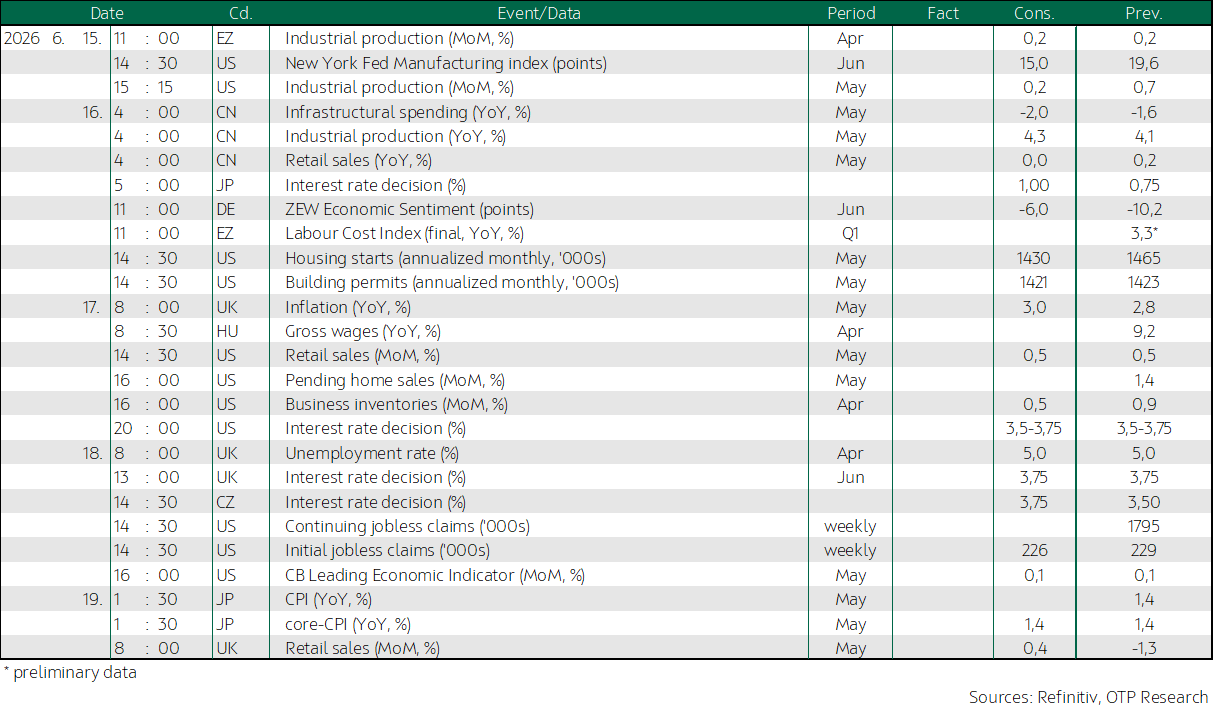
This week, the euro area will release April industrial production data as well as the second estimate of Q1 labor costs. Leading indicators for industrial activity present a mixed picture: among the major economies, Germany and Italy recorded monthly growth of around 0.5%, France’s performance was broadly flat, while Spain—following strong momentum in the previous month—posted a 0.4% decline. Based on these figures, the aggregate euro area data may point to modest growth of around 0.2% month-on-month in April. While this is positive, it still does not signal a meaningful strengthening overall, with industrial output likely to remain close to stagnation on an annual basis. At the same time, there are some grounds for optimism, as manufacturing outlooks in the largest industrial economies—primarily Germany and Italy—appear to be improving, provided that signals from purchasing managers’ indices prove reliable. Regarding labor costs, the preliminary Q1 data is already available: annual growth stood at 3.3%, in line with the previous quarter, while the 0.8% quarterly increase, when annualized, points to a similar pace. Although this 3–3.5% expansion marks a notable slowdown compared to the inflation shock-driven period of 2022–2024, the overall picture remains somewhat concerning. Taking into account productivity growth of only around 0.5%, wage dynamics are still not fully consistent with the 2% CPI target. For this reason, the European Central Bank will closely monitor the detailed data releases.
On Wednesday, the Federal Open Market Committee will conclude its first meeting chaired by Kevin Warsh. The regime shift outlined by the Fed veteran is unlikely to be established at this meeting, but he may already attempt to introduce certain ideas to the agenda in some form. Of the changes he considers necessary—such as market deregulation, balance sheet reduction, revamping communication, replacing the target inflation indicator, and lowering interest rates—the latter is currently receiving the most attention from markets. Warsh’s arrival may also bring a shift in how inflation data is assessed, as instead of the currently preferred core PCE, which stood at 3.3% year-on-year in April, he favors the Dallas Fed’s trimmed PCE measure, which was only 2.3%. Markets do not expect a rate hike at this meeting, but are already pricing in at least a 25 basis point increase by year-end. In addition, May activity indicators will also be released this week, providing insight into whether the US economy’s momentum seen at the start of Q2 is being sustained.
The Bank of Japan’s rate-setting meeting may also attract attention this week, where the base rate is expected to rise by 25 basis points to 1%, potentially reaching a level not seen in 31 years.
Get more out of your investments!
Global Markets Services
OTP Global Markets offers a broad range of services in the field of local and international money and capital markets.
Read morePrivate Banking Services
Personal care and expertise with OTP Private Banking, along with the knowledge, security, and innovations of a multinational banking group.
Read more