
OTP Morning Brief: President Trump threatened Iran with further attacks as the talks drag on
Related content
OTP Morning Brief: US producer price index came in above expectations, yet the US 10-year Treasury yield still declined
Western European equities continued to advance despite ongoing pressure on the technology sector. Wall Street indices also rebounded, recovering some ground after Wednesday’s sell-off. Healthcare was the standout performer on both sides of the Atlantic. Eurozone industrial production declined by 0.5% month-on-month in August. In the US, the producer price index accelerated to 6.3%, delivering another upside surprise in inflation developments. US retail sales increased by 0.8% compared to August. The US 10-year Treasury yield declined by more than 10 basis points. The long end of the Hungarian government bond yield curve also declined by 7-9 basis points. In Hungary, August wage data will be released today, while in the US, September industrial production figures are due.
OTP Morning Brief: US CPI data came in above expectations
European equity markets advanced, supported by strong results from ASML and the outstanding performance of the healthcare sector. US equity markets came under pressure following higher-than-expected September CPI data. The annual CPI rate accelerated to 3.7%, driven primarily by a surge in gasoline prices, while core CPI rose by 0.3% month-on-month, supported by higher housing costs and rising transportation service prices. Oil prices rose amid escalating tensions in the Middle East and the impact of the IEA's oil market report. US Treasury yields retreated after an initial increase, driven by Fed commentary, while European bond yields generally moved higher. The US macro calendar will be busy today, with investors focusing on September retail sales and producer price index data, as well as the New York Fed Manufacturing Index, weekly jobless claims, and business inventories. August industrial production data from the euro area will be released today.
European indices closed mixed yesterday as uncertainty surrounding the Iran war persisted, while investors awaited today’s ECB rate decision. US indices declined yesterday following President Trump’s hawkish remarks; the correction in semiconductor stocks continued. May’s monthly core CPI came in slightly below expectations, while on an annual basis it remained above the Fed’s target, as headline CPI rose above 4%. Long-term yields in developed markets edged higher, while regional currencies weakened slightly. Today, the Turkish and European central banks hold rate-setting meetings, while in the US the focus will be on producer price index data and the usual weekly jobless claims.
European indices closed mixed yesterday as uncertainty surrounding the Iran war persisted, while investors awaited today’s ECB rate decision
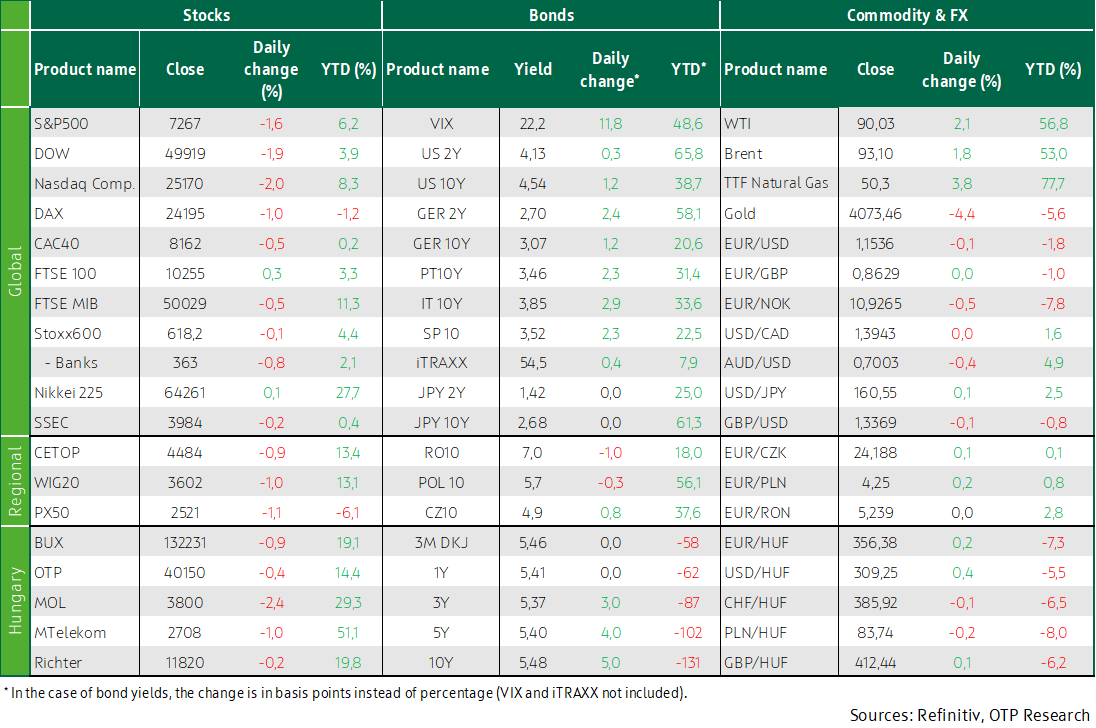
Following volatile trading, European equity markets closed mixed on Wednesday, as investors priced in renewed tensions between the US and Iran, along with the upcoming ECB rate decision. The pan-European Stoxx 600 index ultimately edged lower by 0.08%, marking its fourth consecutive daily decline. The situation in the Middle East returned to the forefront of investor attention, with Brent crude stabilizing near $93 after one of the most significant incidents since the US-Iran ceasefire agreed in April. US President Donald Trump signaled that Iran had “dragged out the negotiations for too long,” while Tehran hinted at reconsidering diplomatic ties. At the same time, market assessments suggest that, for now, these developments point to isolated incidents rather than a broader escalation of the conflict.
Investors’ focus has increasingly shifted to the ECB’s two-day rate-setting meeting, where a 25 basis point hike is expected to counter the inflationary impact of rising energy prices. Market participants are primarily watching for signals regarding the future rate path.
Among sectors, mining and industrial stocks underperformed the most, both falling by more than 1%, while the technology sector declined by 0.7%, extending its recent correction. Volatility in global AI-related equities was more subdued in Europe due to lower tech exposure. On the corporate side, shares of Norway-based defense and technology company Kongsberg experienced significant fluctuations before ultimately closing down around 5%, after management’s profit margin outlook disappointed investors.
Amid the negative global sentiment, regional markets posted declines of around 1% yesterday, with all domestic blue chips ending lower, led by the steep drop in MO shares.
US indices declined yesterday following President Trump’s hawkish remarks; the correction in semiconductor stocks continued; May’s monthly core CPI came in slightly below expectations, while on an annual basis it remained above the Fed’s target, as headline CPI rose above 4%
US equity markets closed sharply lower on Wednesday after President Donald Trump delivered hawkish remarks, signaling that negotiations with Iran were dragging on for too long and raising the prospect of further military action. Market sentiment was further weighed down by reports that the US military carried out strikes on Iranian targets on Tuesday, following accusations that Tehran was responsible for downing a US military helicopter. Investor uncertainty increased amid the growing risk of escalation, making the outlook for energy prices particularly sensitive.
Within the technology sector, semiconductor stocks came under pressure again, with shares of Micron, AMD, and Broadcom all declining, as the segment continued the correction that began in previous days. The weakness was partly driven by profit-taking and partly by portfolio rebalancing ahead of the upcoming large-scale IPOs of SpaceX and other technology companies. Despite this, the semiconductor sector’s performance this year has remained outstanding.
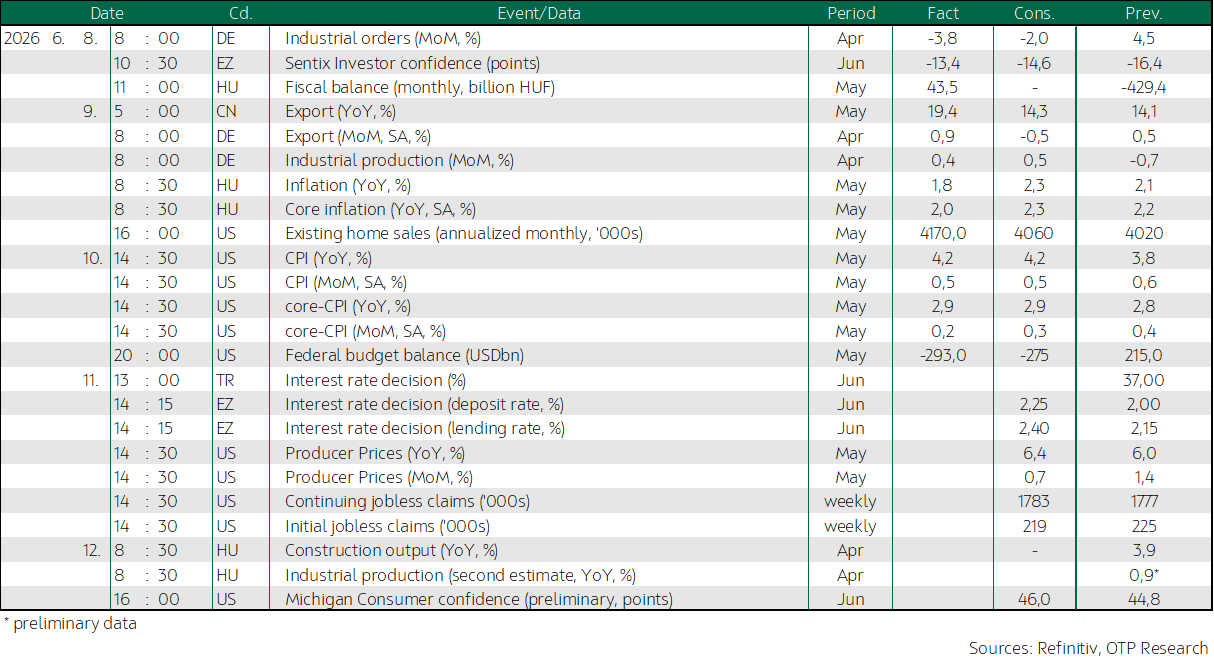
On the macro front, US CPI in May rose by 0.5% month-on-month, in line with expectations, following a 0.6% increase in April, while annual CPI accelerated to 4.2% from 3.8%, also meeting forecasts, largely driven by the surge in energy prices caused by the shock related to the Iran conflict. In contrast, underlying trends remained more moderate: core CPI slowed to 0.2% on a monthly basis from 0.4% previously, falling short of the 0.3% forecast, while the annual measure rose to 2.9% from 2.8%, in line with expectations, marking the highest level since September 2025.
Long-term yields in developed markets edged higher, while regional currencies weakened slightly
CPI in May rose to 4.2% in the US, in line with expectations, while core CPI increased to 2.9%. Meanwhile, Middle East tensions intensified as Iran launched strikes on several countries in the region, pushing oil prices up by 2%. Bond yields edged higher by a few basis points, with the US 10-year around 4.55% and the German equivalent near 3.07%. The EURUSD exchange rate showed little movement, hovering around 1.155.
Regional currencies weakened slightly by 0.1–0.2%, with the forint depreciating to 356.5 against the euro. Bond yields rose by 5–6 basis points, with the 10-year yield reaching 5.5%.
Today, the Hungarian Government Debt Management Agency (ÁKK) will offer three-, five-, and ten-year bonds, with a planned issuance of HUF 20bn each.
Today's highlights
Asian indices mostly declined this morning as Middle East tensions continued to intensify.
Today, the Turkish and European central banks will hold rate-setting meetings, while in the US the focus will be on producer price index data and the usual weekly jobless claims.
Get more out of your investments!
Global Markets Services
OTP Global Markets offers a broad range of services in the field of local and international money and capital markets.
Read morePrivate Banking Services
Personal care and expertise with OTP Private Banking, along with the knowledge, security, and innovations of a multinational banking group.
Read more