
OTP Morning Brief: The Middle East ceasefire and the tech sector remain under pressure
Related content
OTP Morning Brief: US producer price index came in above expectations, yet the US 10-year Treasury yield still declined
Western European equities continued to advance despite ongoing pressure on the technology sector. Wall Street indices also rebounded, recovering some ground after Wednesday’s sell-off. Healthcare was the standout performer on both sides of the Atlantic. Eurozone industrial production declined by 0.5% month-on-month in August. In the US, the producer price index accelerated to 6.3%, delivering another upside surprise in inflation developments. US retail sales increased by 0.8% compared to August. The US 10-year Treasury yield declined by more than 10 basis points. The long end of the Hungarian government bond yield curve also declined by 7-9 basis points. In Hungary, August wage data will be released today, while in the US, September industrial production figures are due.
OTP Morning Brief: US CPI data came in above expectations
European equity markets advanced, supported by strong results from ASML and the outstanding performance of the healthcare sector. US equity markets came under pressure following higher-than-expected September CPI data. The annual CPI rate accelerated to 3.7%, driven primarily by a surge in gasoline prices, while core CPI rose by 0.3% month-on-month, supported by higher housing costs and rising transportation service prices. Oil prices rose amid escalating tensions in the Middle East and the impact of the IEA's oil market report. US Treasury yields retreated after an initial increase, driven by Fed commentary, while European bond yields generally moved higher. The US macro calendar will be busy today, with investors focusing on September retail sales and producer price index data, as well as the New York Fed Manufacturing Index, weekly jobless claims, and business inventories. August industrial production data from the euro area will be released today.
Although tensions in the Middle East eased on Monday, a downed Apache helicopter and an attack on a southern Lebanese port city triggered a renewed rise in instability. By morning, escalation had already materialized, with both the US and Iran launching strikes against each other. Meanwhile, the decline in the technology sector continued, weighing on markets in both Europe and overseas. The Bux fell by 0.3% on Tuesday. German economic data showed some improvement in the country’s economic performance. Domestic inflation stood at 1.8% in May, which could provide room for a rate cut. Yields declined. Oil prices moved in an uncertain direction. The forint remained below the 356 level against the euro. Following Wednesday’s surge, Asian stock markets fell sharply. Today, attention will be on the release of US CPI data.
European equities declined again on Tuesday, German exports saw a notable rise, and domestic CPIcame in at 1.8% in May
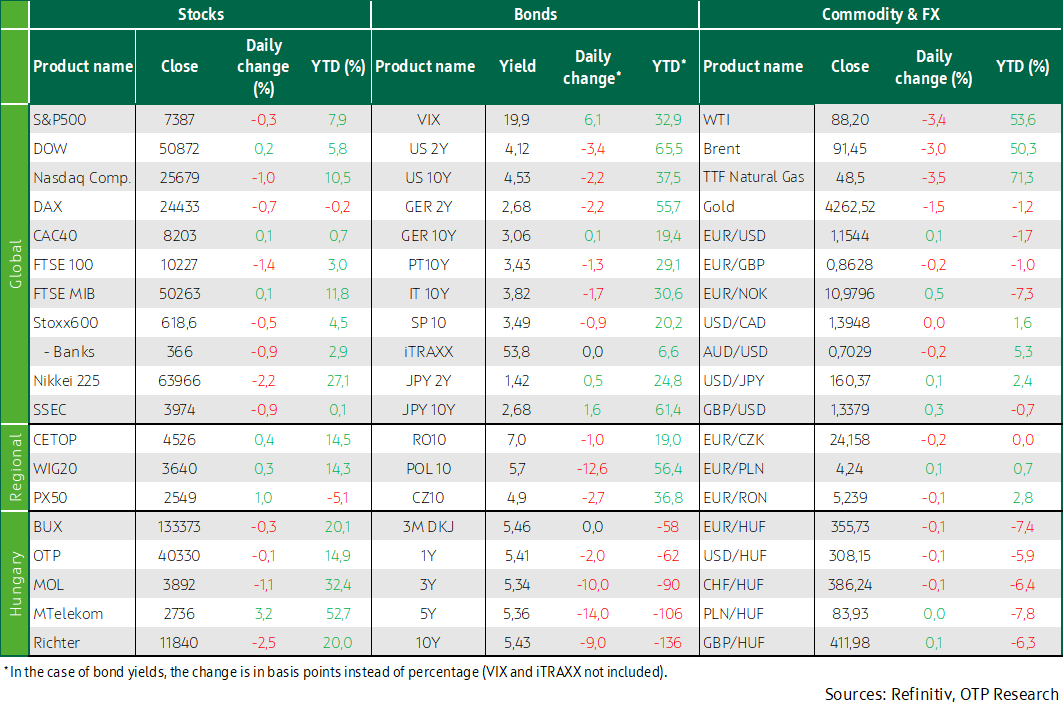
European equities reversed course in the second half of Tuesday’s session, giving up earlier gains and extending their losing streak to a third consecutive day, driven primarily by weakness in commodity-related stocks as investors weighed the fragile ceasefire between Iran and Israel. The pan-European STOXX 600 index declined by 0.5%, with the FTSE 100 dropping 1.4%, the DAX falling 0.7%, and the CAC 40 posting a slight increase. Within the STOXX, mining and energy shares led losses, declining by 2.5% and 2.4% respectively, while European technology stocks also moved lower, ending 1.3% down after showing notable volatility recently. In other sectors, telecom stocks fell by 2%, partly due to declines in Ericsson and Nokia following news that Nvidia may develop technology for mobile networks, while European defense stocks slipped 0.7% after Morgan Stanley downgraded the sector.
Based on data released yesterday for April, German industrial production recorded a 0.4% monthly rise, falling short of analysts’ expectations, but showing a marked improvement compared to previous months. Meanwhile, German exports exceeded forecasts, posting a 0.9% monthly increase instead of the anticipated 0.5% decline.
Sentiment in the CEE region was mixed, with the WIG 20 gaining 0.3% and the PX rising 1%, while the BUX declined by 0.3%. Among Hungarian blue chips, all but Magyar Telekom moved lower, with Richter posting the steepest drop at 2.5%. Domestic CPI stood at 1.8% year-on-year in May, coming in below our expectation of 2.0%, the market consensus of 2.3%, and the central bank’s forecast, suggesting that the low reading could provide room for the MNB to consider a rate cut. Core inflation came in at 2.0% over the same period.
Downed helicopter threatens the ceasefire, while the tech sector continued to decline
Investors continued to monitor developments in the Middle East conflict. Although tensions between Israel and Iran appeared to ease on Monday following Trump’s intervention, the US president announced Tuesday evening that Iran had shot down a US Apache helicopter in the Strait of Hormuz and vowed retaliation, further deepening doubts about the prospects for peace between the two countries. Meanwhile, an Israeli strike in southern Lebanon left eight people dead, adding further complexity to the situation. According to reports this morning, the promised countermeasures have materialized, with the US military stating on X that it had targeted Iranian air defense units, ground control stations, and surveillance radar systems near the strait. In response, Iran’s Revolutionary Guard announced that it carried out attacks on a US base in Jordan as well as 21 additional targets across the Gulf region on Wednesday.
The S&P 500 and Nasdaq indices declined on Tuesday, with the former slipping 0.3% and the latter falling 1%, driven partly by developments in the Middle East and partly by the fading rebound in technology stocks. The Cboe Volatility Index (VIX) climbed to its highest level since April 7 during the session. By the close, the technology index dropped 1.8%, while the semiconductor index ended 1.9% lower. Shares of Broadcom fell 1.1% on Tuesday, while Nvidia edged down just 0.2%. Beyond the chip sector’s decline, the broader AI space also came into focus after OpenAI, the developer of ChatGPT, announced it had filed for an IPO, just over a week after its rival Anthropic, behind Claude, made a similar move. Apple shares closed 3.6% lower as investors and analysts reacted cautiously to the company’s latest product unveilings and announcements at its annual Worldwide Developers Conference.
Yields declined, while the forint remained below 356
Commodity traders were still pricing in de-escalation on Tuesday, pushing oil prices down by 2.5% to around $90, though they began to rise again by morning. The US 10-year Treasury yield fell to around 4.5%, while European yields declined more modestly, with the German 10-year yield holding near 3.05%. The dollar weakened slightly, with EURUSD recovering to 1.115.
The forint’s exchange rate against the euro remained largely unchanged, holding below the 356 level, while neither the zloty nor the koruna showed any meaningful movement. Weaker-than-expected CPI data and a decline in external yields led to a drop in benchmark yields on the domestic bond market by around 10 basis points, with the 10-year yield easing to 5.4%. At the Government Debt Management Agency’s (ÁKK) three-month T-bill auction, demand was subdued, yet HUF 38 billion worth of securities were sold versus the announced HUF 30 billion, at an average yield of 5.54%.
Today's highlights
Asian equity markets declined on Wednesday as risk aversion increased following a renewed flare-up in military tensions between the US and Iran, while the earlier rebound in technology stocks also lost momentum. South Korea’s KOSPI was the region’s worst performer, dropping 6.5%, dragged lower by further losses in leading chipmakers after Monday’s sharp decline. Chinese (SSEC -0.9%) and Japanese (Nikkei -2.2%) equities also moved lower, as local inflation data amplified concerns about the inflationary impact of a potential conflict involving Iran.
Today, alongside developments in the Middle East, the focus will be on the release of US May CPI data, which is expected to further reinforce inflation concerns: the market anticipates core inflation of 0.3% month-on-month and headline inflation of 0.5%.
Get more out of your investments!
Global Markets Services
OTP Global Markets offers a broad range of services in the field of local and international money and capital markets.
Read morePrivate Banking Services
Personal care and expertise with OTP Private Banking, along with the knowledge, security, and innovations of a multinational banking group.
Read more